BRECK: Stone’s Rest — Chapter Ten The Story That Made Us Careful

Daily writing prompt What’s a piece of media (book, movie, song) that changed how you see the world? View all responses

BRECK: Stone’s Rest — Chapter Ten

The Story That Made Us Careful

This is Chapter 10 of BRECK: Stone’s Rest, Book Three of the BRECK series — a serialized noble dark fantasy story by Chadwick Rye. New chapters post daily.

The Story So Far

Three days in Garrow’s records found the actual problem — not the trench, but page forty-seven of the original charter, where “affected parties” was defined using a template that never knew the mountains existed. The trench is fixable. The definition is a different problem. Breck needs Mira to start building Frostpeak’s testimony into something a Lumenvale proceeding can receive. He needs the Council to hold long enough to let him try.

← Chapter Nine: The Ending No One Wrote | Chapter Eleven →

Chapter Ten: The Story That Made Us Careful

This chapter asks what changed how a person sees the world — and answers with a story that isn’t a book, but carries more weight than most books ever will.

Mira agreed to the translation work without much discussion, which told Breck she’d already been thinking about it before he asked, possibly since the chamber session, possibly longer. She laid out, with the same flat diagnostic clarity she brought to everything, what it would require and what it might cost.

“Frostpeak’s account can be rendered in a form that’s legible outside Nomados,” she said. “What I carry out of communion with her is specific enough — dates as she experiences them, locations, the progression of what she’s felt in the deep stone over the six years of the concession. I can render that into chronicle form. What I can’t guarantee is that a Lumenvale court will credit the source once they understand what it is.”

“That’s a problem for Caine’s office to solve,” Breck said. “Your job is to make the testimony. His office’s job is to argue it has standing.”

“You trust him to do that.”

“I trust him to try it. That’s all I can ask of anyone in this.”

He left her to begin and was crossing back toward the lift with Jenna when the runner found him — a girl of about twelve, Forge Clan markings on her collar, with the look of someone who’d been told to deliver a message quickly and had taken the instruction seriously. Elder Tomson’s compliments. He had something to say and would appreciate Breck coming to say it where only the two of them would hear it.

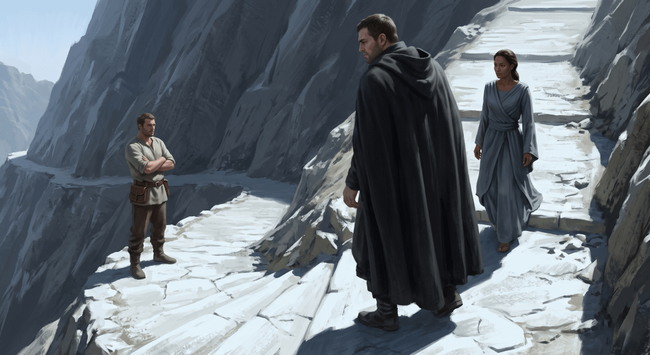
The quarters Tomson kept on Grandfather Ironheart’s lower terrace during the convergence extension were smaller than Breck expected for an elder of his standing — plain-furnished, working-warm, the walls hung with tools rather than decorations. Tomson himself stood at the window when Breck arrived, not looking out of it so much as using it to avoid the room, the way people use windows when they’ve decided to say something they haven’t fully decided they want said yet.

“I’m not your enemy,” Tomson said, without turning around.

“I know that.”

“I want to be clear about it, because I’ve been told I read as one.” He turned then, and looked at Breck the way men who’ve spent a long time in difficult work look at the people they have to trust whether they want to or not. “Daveron granted you standing. I didn’t argue against it once the vote was clear and I’m not arguing against it now. But I want you to understand something before this goes much further, and I want to say it where nobody’s deciding whether to look encouraged or worried by it.”

“I’m listening.”

Tomson moved to the table, sat heavily. “Three generations ago, when my grandfather’s grandfather held this elder seat, there were ground-dwellers who came here with a survey contract and letters from their own government expressing genuine concern about the Peak-rider clans and what they needed. The survey was honest. The letters were sincere. The men who carried them weren’t lying about their intentions.” He looked at the surface of the table as he said it, the look of a man reciting something he learned before he learned to doubt it. “They went back home. The letters made it into their own government’s records as evidence of goodwill and diplomatic engagement. The survey became the basis for a land-use agreement that granted ground-dweller caravans rights to the Shifting Plains corridor and gave the clans nothing in return, because the clans had already demonstrated, by allowing the survey, that the corridor was accessible, which meant it didn’t need to be purchased. The men who came weren’t malicious. They were simply working within a framework that always found a way to give them what they came for.” He looked up. “We tell that story in the Forge Clan the way other clans tell weather wisdom. Not as a warning against outsiders. As a caution against mistaking goodwill for outcome.”

Breck let it sit a moment. “That’s the right story to tell,” he said.

Tomson’s eyes sharpened slightly. He’d expected argument, clearly. “You don’t disagree.”

“Good intentions carried through a framework that doesn’t account for everyone in the room aren’t worth more than the paper they’re written on. I’ve spent three years watching people get hurt by things that were never designed to hurt them. The design is almost worse than malice would be, because at least malice understands what it’s doing.” He folded his hands, let Tomson take his time with the response. “I’m not asking you to trust me. I’m asking you to let me try to change the page the story keeps ending on. If it doesn’t work, you’ll have lost nothing you hadn’t already lost.”

“And if it works,” Tomson said slowly, “we’ll have let another ground-dweller come and go with something we gave him that we can’t take back.”

“Yes,” Breck said. “A ruling. That your peaks have standing. That harm done to them is harm the law is obligated to answer for.” He held Tomson’s eyes. “That’s the thing I’d be taking. If that costs you something, I want you telling me now how it costs you, because I’d rather know.”

Tomson stared at him for a long while, in the particular silence of a man stress-testing a structure he’d been expecting to find hollow. “If you fail,” he said, finally, “we’ve allowed ourselves to be documented as the party that participated in a Lumenvale process that considered the question and declined to grant us standing. That documentation can be used in future proceedings as settled precedent against us.” He said it carefully, the way a man who’s spent a lifetime reading the fine print says things. “That’s what failed petitions have given us before. I am not willing to go into another failed process blind.”

“You’re right to name that,” Breck said. “Caine’s referral isn’t a petition. It’s a case with a specific charter violation in evidence. A failed petition asks for something. A failed case, argued on the basis of documented harm, is harder to use as precedent against the party that was harmed. The question wouldn’t be whether you have standing — it would be whether this specific harm constituted harm under the existing framework. Those are different failure modes.” He paused. “But you should have a lawyer review that distinction before you tell Daveron to let me proceed. I’m a courier, not a lawyer. I believe what I just told you, and I might be wrong about the fine print.”

Something in Tomson’s expression shifted — not warmly, but honestly, the shift of a man adjusting a calibration. “You just told me you might be wrong.”

“I might be wrong about the fine print. I’m not wrong about the trench, or page forty-seven, or what Mira felt in that chamber, or what Bren read on Grandfather Ironheart’s crown.” He stood. “I’ll leave you to decide what weight to give the first of those against the rest.”

He was halfway down the switchback path from Ironheart’s lower terrace, Jenna a quiet three steps behind him, when he saw the man.

Ground-dweller, camp-worker’s clothes, standing at the junction where the switchback met the main path in the casual, unconvincing way of a man pretending to rest who hadn’t been walking hard enough to need rest. Broad through the chest, a foreman’s leather kit on his belt rather than a laborer’s. He wasn’t looking at Breck. He was very carefully not looking at Breck, which was its own kind of looking.

Breck kept his pace even, didn’t slow, didn’t glance back, and noted the exact location and the quality of the not-looking the way he noted everything that arrived sideways — without urgency, without reaction, simply filed.

“Who’s Garrow’s site manager,” he said to Jenna, quietly, once they were past.

“Hask,” Jenna said, equally quietly. “I don’t know him by sight.”

“I think I might,” Breck said, and said nothing else about it for the rest of the walk down.

He thought, going over the day’s material as he walked, about what Tomson’s story had done to the Forge Clan’s worldview, and about the question the day had put in front of it — what changed how a person sees the world. Not a book. Not a song. A thing told around fires in the Forge Clan’s particular keeping, a real event rendered into repeatable form because the real event had been too instructive to let rest in private memory. That was what certain stories did, the ones that mattered most — not entertain, not illuminate in the comfortable way of fiction that left you set down the same person who’d picked it up. The ones that mattered rewired the seeing itself. The Forge Clan looked at surveyors and letters of goodwill and saw, underneath them, the shape of the framework those things always served, because three generations ago the story had been lived first and told after, and the telling had made the pattern visible to people who’d never lived the original.

Breck thought about what story the mountains’ clans would tell three generations from now about this season, about these weeks of convergence and records and a courier from Lumenvale who’d turned up with a referral and a pencil. He thought about the two versions of that story — the one where the framework changed, even partially, even imperfectly — and the one where it didn’t.

He very much wanted the telling to land on the first.

He’d have to earn that, though, and the man at the junction who’d been so carefully not watching him suggested, with a clarity Breck trusted more than most things he could have been told directly, that whatever time he had left to earn it had just gotten shorter.

← Chapter Nine: The Ending No One Wrote | Chapter Eleven →

BRECK: Stone’s Rest is a serialized noble dark fantasy story by Chadwick Rye — Book Three of the BRECK series, crossing from Lumenvale into Nomados. Chapter 10 of 20. New chapters post daily.

✦ Enjoyed this chapter? “The Story That Made Us Careful” continues Book Three of the BRECK series — a skeptic’s honest warning, a foreman who’s started watching, and the question of which version of a story the clans will be telling three generations from now. Browse the full series, follow for daily chapters, or share this with a reader who knows that the stories we tell to survive are the ones that change us most.

#adventure #books #Breck #BRECKColdHarbor #BRECKDeadDelivery #BRECKSeries #BRECKStoneSRest #ChadwickRye #ChadwickRyeAuthor #characterDrivenFantasy #courier #dailyFantasyChapters #dailyprompt #dailyprompt2804 #DarkFantasy #darkFantasySeries #EpicFantasy #fantasy #FantasyConflict #fantasyCourierStory #FantasyFiction #FantasyNovel #FantasyPolitics #FantasyProtagonist #FantasySeries #fantasyWithMoralComplexity #fiction #Frostpeak #GRimdark #HighFantasy #legalFantasy #lowFantasy #Lumenvale #moralFantasy #nobleDarkFantasy #Nomados #onlineFiction #politicalFiction #readFantasyOnline #reading #sentientMountains #sentientWorldFantasy #serializedBook #serializedFantasy #serializedFantasyFiction #serializedFiction #shortStory #StoneSRest #storyteller #Storytelling #veteranCourierFantasy #webSerial #writing
BRECK: Stone’s Rest — Chapter Nine The Ending No One Wrote

Daily writing prompt If you could change the ending of any book, which one would it be? View all responses

BRECK: Stone’s Rest — Chapter Nine

The Ending No One Wrote

This is Chapter 9 of BRECK: Stone’s Rest, Book Three of the BRECK series — a serialized noble dark fantasy story by Chadwick Rye. New chapters post daily.

The Story So Far

Garrow was warm, precise, and honest about the trench in a way that made him harder to deal with, not easier. He handed over the survey records without much resistance. Breck took them back to Thunderstep’s terrace and started reading. He’s been reading for three days.

← Chapter Eight: The Man Who Built Something | Chapter Ten →

Chapter Nine: The Ending No One Wrote

This chapter asks what ending you’d rewrite — and finds the answer not in any story, but in a legal document whose last page was already decided before anyone thought to check who was missing from the draft.

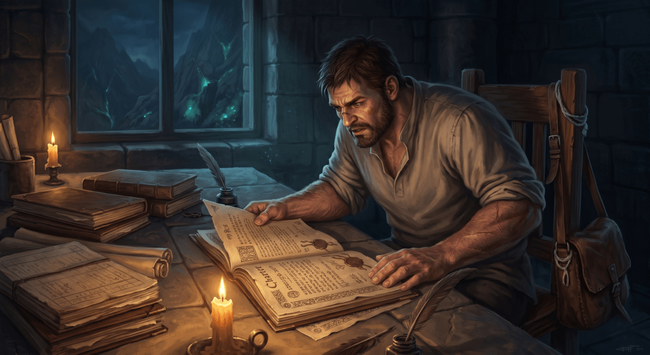
The records were good. That was the first thing Breck established, working through them across three days and two nights on the long table in his borrowed quarters on Thunderstep’s second terrace, the mountain’s faint bioluminescence providing just enough light that he’d only needed to burn through half his candles. Garrow’s people kept meticulous documentation — survey logs, extraction tallies, inspection reports, the full chain of correspondence with the Magisterium going back six years to the original charter application. Good records, professionally maintained, in the hand of at least three different clerks who had all been trained to the same standard.

That was also, by the end of the second day, recognizably the shape of the second problem. The first problem was the trench. The trench had a location, a measurement, a distance from the survey line that was not ambiguous and would not become ambiguous when read by anyone competent in Lumenvale charter law. That problem had a form it could be put in and an office it could be sent to and an outcome, Breck was reasonably confident, that would result in at minimum a cease-extraction order for the eastern boundary. That problem was solvable.

The second problem was what remained after the trench was filled.

He found it on the forty-seventh page of the original charter application, in language so standard it had clearly been copied from a template rather than written for this specific case, which was precisely why it had survived six years of renegotiations and three Magisterium inspections without anyone noticing what it quietly assumed. The charter defined affected parties as Lumenvale citizens, registered guild members, and landholders of record within the survey perimeter. Period. The definition had been written for disputes between miners and farmers, between charter-holders and neighboring estates, between competing extraction operations. It had been written in a city where the nearest walking mountain was a three-week journey and therefore a theoretical problem at best, and it had never been updated, because nobody in that city had ever needed to update it, because nobody in that city had ever successfully argued that something which wasn’t a citizen could be harmed in a way the law was obligated to answer for.

The mountains weren’t in the draft. They had never been in the draft. Not because anyone had decided to exclude them — that would have required someone to consider including them first — but because the document had been written to the edges of the world its authors knew, and the walking mountains of Nomados sat cleanly outside those edges, and so the ending had been decided before the story knew they were in it.

He was still sitting with that when Jenna appeared at the doorway around the second hour past midnight, carrying two cups of something that steamed, which told him she’d either been awake already or had been watching for his light.

“You found it,” she said, looking not at the records but at his face.

“Forty-seventh page. Three paragraphs defining affected parties. They didn’t leave the mountains out deliberately. They just wrote to the edge of their own knowledge and stopped.”

She set one cup in front of him — something warm and faintly mineral, a Nomados blend he’d been slowly developing a tolerance for — and took the chair across the table with the manner of someone who’d been expecting this conversation and had decided to have it at whatever hour it arrived. “That’s a harder problem than the trench.”

“Yes. Because I can report the trench and Garrow gets a cease-extraction order and the eastern boundary gets respected, and none of that changes what happens to Frostpeak next season, or the season after, or what happens to the children who can’t complete their bonding because the heartstone veins run thin. The charter doesn’t recognize that as harm. No charter does. The Magisterium has no mechanism for hearing a complaint from someone who doesn’t exist in its definition of someone.”

“What would it take to change that.”

“Precedent,” Breck said. “One successful case. A court — or Caine’s office acting in the court’s stead — formally recognizing a mountain as an affected party, allowing her testimony into the record, ruling on the basis of harm done to something the law currently pretends isn’t there. Everything after that first ruling has ground to stand on. Nothing before it does.”

Jenna wrapped both hands around her cup and was quiet for a moment in a way that meant she was deciding how much of something to say. “The clans have attempted, three times in my lifetime, to petition the Magisterium for some form of recognition. Not full personhood, not standing as citizens — just the acknowledgment that harm could be done to a mountain in ways that legal frameworks should be able to address. All three times the petition was returned as outside the Magisterium’s scope.” She looked at the stack of records on the table, then back at him. “We weren’t given a different answer each time. We were given the same answer each time, which is the Magisterium’s way of saying it considers the question settled.”

“It considers the question settled because it’s never had a case in front of it that forced it to unsettled it,” Breck said. “A petition is a request. Caine’s referral is a case.”

She studied him a long moment. “You think it can actually be done.”

“I think someone has to try it before we know whether it can be done, and that I am apparently the person positioned to try it.” He picked up the cup, drank, set it down. “I’ve been thinking about a question someone put to me recently. Whether there’s a book or a story you’d change the ending of, if you could. The kind of question that sounds like it’s about fiction.” He looked at the forty-seventh page, still open on the table in front of him. “This is a book. Six years of it. Four hundred and twelve names in the labor rolls, three renegotiations, eleven inspection reports, one exposed heartstone vein that nobody quite knew what to do with once they found it. The ending’s already been written into it, forty-seven pages in, in a template nobody questioned. The affected parties are citizens and guild members and landholders of record. The mountains are somewhere past the edge of the map, where the law simply stops having opinions.” He closed the charter. “I’d change that page. That specific page. Because once that page is different, everything that follows it is different too.”

“You can’t rewrite his charter,” Jenna said carefully.

“No. But I don’t need to rewrite his. I need one ruling that says his charter’s definition is incomplete — and that an incomplete definition of who can be harmed, applied to a case that involves parties the definition didn’t account for, doesn’t constitute a finding that those parties weren’t harmed. Just a finding that the question was never properly asked.” He looked at her. “Has Caine ever made a ruling that extended outside Lumenvale’s established jurisdiction?”

“I don’t know Caine.”

“I do.” Breck pulled the second-to-last page of the records toward him and made a note in the margin, the same pencil he’d used at the trench two days ago. “He opened a door for me, twice now. I think he understands that some questions don’t get asked until someone puts them in writing in front of the right office, and that the right office, most of the time, is whoever has the standing and the nerve to take the question seriously.” He looked up. “Mira said Frostpeak’s testimony was translatable. That she could render it in a form a Lumenvale proceeding could work with.”

“In theory. It’s never been attempted.”

“Most things that work were never attempted until the first time.” He closed the last of the records and stacked them neatly, the habit of a man who’d been trained to leave a workspace the way he’d found it, regardless of how long he’d been in it. “I need Mira to start working on what that translation would look like. Whatever form Frostpeak’s account can take — chronicle, affidavit, witnessed testimony — I need it in a shape Caine’s office can receive and argue from. Not because it’s guaranteed to work. Because the ending that’s currently written for this story is the one nobody questioned forty-seven pages in, and I am not willing to let it stand on the grounds that changing it is difficult.”

Jenna looked at him across the table for a long moment, and he was aware, not for the first time since arriving in Nomados, of the gap between what her face showed and what was happening behind it — the same quality he’d noticed in Daveron, in Mira, in everyone here who’d been carrying this a long time. They had learned not to invest in the look of hope before they’d confirmed the substance of it.

But she didn’t say no.

“I’ll take you to Mira in the morning,” she said. “Sleep first. You look like you’ve been fighting the records.”

“The records were winning,” Breck said, which was, he supposed, the closest he ever came to humor at two in the morning, and stood up to find his bedroll, leaving the stack of Garrow’s excellent documentation sitting on the table like a story that had just been told a different ending was possible.

← Chapter Eight: The Man Who Built Something | Chapter Ten →

BRECK: Stone’s Rest is a serialized noble dark fantasy story by Chadwick Rye — Book Three of the BRECK series, crossing from Lumenvale into Nomados. Chapter 9 of 20. New chapters post daily.

✦ Enjoyed this chapter? “The Ending No One Wrote” is the pivot chapter of Book Three — the moment the investigation stops being about a trench and starts being about whether a mountain can have standing in a court that was never built to ask the question. Browse the full series, follow for daily chapters, or share this with a reader who knows that the hardest problems aren’t the ones with villains. They’re the ones with incomplete definitions.

#books #BRECKSeries #ChadwickRye #chapterNine #dailyprompt #dailyprompt2803 #DarkFantasy #EpicFantasy #fantasy #FantasyFiction #fantasyWebSerial #fiction #freeFantasyStory #inheritanceFantasy #mentalHealth #nobleDarkFantasy #onlineFiction #readFantasyOnline #serializedFiction #shortStory #StoneSRest #writing

BRECK: Stone’s Rest — Chapter Seven The Kind of People Who Stay

Daily writing prompt Who are you most inspired by? View all responses

BRECK: Stone’s Rest — Chapter Seven

The Kind of People Who Stay

This is Chapter 7 of BRECK: Stone’s Rest, Book Three of the BRECK series — a serialized noble dark fantasy story by Chadwick Rye. New chapters post daily.

The Story So Far

Bren confirmed Frostpeak won’t see harvest. Breck stood at the edge of her failing terrace, let the Karithian valley all the way in for the first time in three years, and asked Mira to show him the rest of it. She said it was bad. He said he’d stood in worse rooms. Neither of them argued the point.

← Chapter Six: What Success Never Meant | Chapter Eight →

Chapter Seven: The Kind of People Who Stay

This chapter asks who inspires a man like Breck — and uses the answer to put him exactly where the series needs him to be.

Mira walked him the full length of Frostpeak’s eastern slope before dawn the next morning — every cracked support, every patch of failed light, every place where the stone had gone grey and cold in a way that clearly wasn’t seasonal. She didn’t narrate it. She simply walked and let him look, and he looked the way he always looked at damage, methodically and without sentiment, because sentiment was fine in the privacy of a terrace at dusk but evidence was what courts needed and evidence was what he was here to gather.

The concession began where a line of survey stakes drove into the ground at even intervals, pale-painted wood standing out sharp against the darker surrounding soil. Breck stopped at the first one, crouched, ran his thumb along the stake’s upper edge. Fresh paint, recently reset — the kind of detail that meant someone had walked this line in the last few weeks and confirmed it, which meant someone knew exactly where the legal boundary sat.

“The charter gives them rights to excavate within the designated survey perimeter,” Jenna said, from his left. She’d joined them at first light, quiet and prepared in a way that told him she’d been awake longer than they had. “Foundational stone only. Surface extraction on a separate writ they haven’t applied for and wouldn’t receive.”

“What did they actually do?”

“Come and see.”

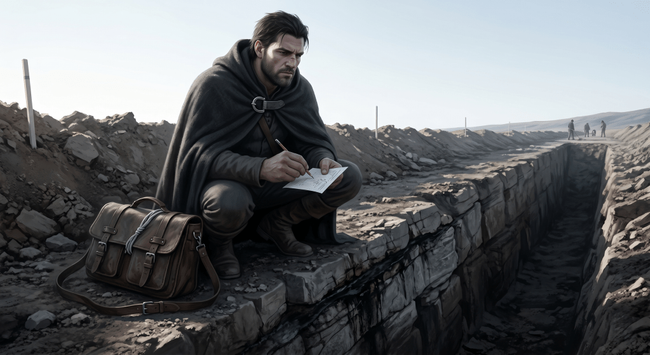
The first breach was half a mile east of the survey line, which on open grassland was not a small distance and not an easy mistake to make. A deep-cut trench ran forty yards into ground that no legitimate reading of the charter touched, the soil around it turned back and dried in long pale furrows, and at its far end, still visible in the pale early light, a mobile pulley system of the kind Breck recognized from the Lumenvale guild foundries sat unattended, waiting for its shift to begin. Below the trench’s lip, cut into stone that should never have been cut, a dark smear ran the length of the exposed face where something had been extracted that hadn’t been coal or iron or any mineral he had a name for.

“What’s that?” He pointed at the smear.

“Heartstone,” Mira said. “It’s what the bioluminescence runs through. What the bond runs through. What we — and the mountains — have never permitted to be extracted, because there’s no way to do it that doesn’t take the vein it runs in.” She kept her voice flat and informative, the way a person keeps their voice when anger has been too many years in residence to function usefully as a feeling anymore and has simply become texture. “There is no provision in Garrow’s charter for heartstone extraction. There is no provision for it in any charter Lumenvale has ever issued, because until the concession came out here and found it, no surveyor had ever mapped this deep.”

Breck straightened, looked the length of the trench, looked back at the survey stakes a half mile behind them, and felt the clean, unambiguous click of a picture finishing assembling itself. He’d been trained for twenty years to distrust conclusions that arrived feeling like certainty, because certainty was what bad intelligence felt like too, from the inside. This wasn’t certainty. This was simply a trench, in the wrong place, containing the wrong material, next to a pulley that wasn’t owned by anyone who had permission to be there.

He stayed long enough to sketch the trench dimensions on the back of an old dispatch sheet from his satchel, noting the distance from the survey line, the visible vein damage, the equipment markings. He was halfway through the equipment markings when the shift crew arrived.

There were seven of them, ground-dwellers, coming up the trail from the main camp with the particular loose energy of men early into a long working day, voices low and carrying in the cold air. They pulled up short when they saw him, collectively, the way men do when unexpected company appears at a worksite and they haven’t decided yet whether to be annoyed or alarmed.

One of them — a young man, not yet twenty-five, with the same deep-cut forearms as every foundry worker Breck had ever known and a sun-weathered face that put him somewhere between apprentice and journeyman — stepped forward from the group with the specific posture of someone who’d decided, in the three seconds it had taken him to assess the situation, that the right move was to handle it himself before anyone else handled it worse.

“You’re on a private work site,” he said. Not aggressive. Just stating it, the way an honest man states a fact he actually believes in.

“I know,” Breck said. “I’m just leaving.” He finished the last of the equipment markings, folded the dispatch sheet back into his satchel, and straightened to his full height, which did its usual work on the young man’s posture without any other effort required. “You work this trench?”

The young man’s eyes moved to the trench, to the survey line in the distance, and back to Breck. He wasn’t stupid. Breck filed that immediately. “I work the site,” he said carefully.

“How long?”

A pause. “Three seasons.”

“Who brought you out here?”

And here the young man’s posture changed, fractionally, in a way Breck recognized — the particular straightening of someone who’s been asked something that makes them want to stand a little taller before answering it. “Garrow did. Hired me out of Westmere. I’d been loading grain carts for a copperweight a week and going nowhere in it.” He said it without apology, the way people state conditions they didn’t choose and didn’t stay in. “He came through, told us what the work was, what it paid, what it could become. There were forty men from Westmere who said yes inside a day. I’ve sent money home every week for three seasons and that wasn’t something I thought I’d be saying at my age.” He glanced at the trench again, and something in that glance told Breck the young man had looked at it before, in the same direction, and not entirely liked what he’d found when he did. “I don’t set the survey lines.”

“I know you don’t,” Breck said, and meant it. He held the young man’s eyes a moment longer — not as pressure, simply as confirmation that what he’d just said had been heard and weighed and found honest — then picked up his satchel and walked back toward the survey stakes with Jenna and Mira behind him.

He didn’t say anything until the trench was well behind them and the camp had dropped below the rise.

The question the prompt had been pressing at all morning finally finished arriving, the way questions did when they’d been working on him from underneath without announcing themselves. Who had actually inspired him, across twenty years of this work, to be the kind of man who crossed a line onto a private worksite and sketched the evidence before the shift arrived rather than staying on the legal side of the stakes and writing a report about what the stakes implied?

Not commanders. Not the men he’d served under in the signal corps, most of whom had been competent and a few of whom had been brilliant and none of whom had been, at the particular bone-deep level he meant, inspiring in the way the question was asking. Not the adjudicators he’d carried letters for, not the lawyers he’d watched work in Crestfall and Cold Harbor both, though he respected the ones who were good at the thing.

It was people like that young man, actually. Not because of what they’d done, but because of the look in a person’s eyes when they understood they were standing in a situation that had been created dishonestly and were slowly deciding what they were going to do about it. Breck had seen that look a hundred times, in couriers who delivered orders they’d been given no context to evaluate, in locals who’d watched magistrates they trusted turn out to be men they didn’t, in clerks who kept honest records in systems that weren’t designed to want honest records. People who’d been handed a condition they didn’t choose and were working out, quietly, alone, without fanfare, whether they had the spine to do the honest thing once they’d identified what it was.

He couldn’t save all of them. He’d learned that. He probably couldn’t save Frostpeak. He was starting to learn that too, and the learning was costing him something different this time than the valley had, which meant it was teaching him something different.

But he could be the kind of man who showed up with a dispatch sheet and a pencil, who counted the distance from the survey stakes to the trench and wrote it down, who asked the young worker honest questions and heard honest answers and left him standing in a better-defined version of whatever decision he was already arriving at on his own. He couldn’t be the inspiration. He was never going to be the inspiration — he was the wrong shape for it, too abrasive, too quiet, too consistently disinclined to deliver the kind of speech that sent men home with fire in their chests. What he could be, and what he had apparently been choosing to be for long enough now that it had stopped feeling like a choice, was the kind of person who stayed.

He could stay here.

He looked at Jenna as they crossed back through the survey stakes and she read his face the same way she’d been reading him since the threshold station, with professional precision and no wasted words.

“You’ll need lodging,” she said. “I know a platform on Thunderstep’s second terrace that isn’t being used.”

“That’ll do,” Breck said.

He was going to need more dispatch sheets.

← Chapter Six: What Success Never Meant | Chapter Eight →

BRECK: Stone’s Rest is a serialized noble dark fantasy story by Chadwick Rye — Book Three of the BRECK series, crossing from Lumenvale into Nomados. Chapter 7 of 20. New chapters post daily.

✦ Enjoyed this chapter? “The Kind of People Who Stay” closes the first arc of Book Three — a courier who has never once been the inspiration, standing in front of evidence that can’t be argued away, deciding he’s staying anyway. Browse the full series, follow for daily chapters, or share this with a reader who’s always been quietly inspired by the people who just don’t leave.

#adventure #books #Breck #ChadwickRye #chapterSeven #dailyprompt #dailyprompt2800 #DarkFantasy #darkFiction #EpicFantasy #fantasy #FantasyFiction #fiction #Frostpeak #HighFantasy #inspiration #moralCourage #nobleDarkFantasy #serializedFantasy #serializedFiction #shortStory #StoneSRest #webFiction #writing

BRECK: Stone’s Rest — Chapter Six What Success Never Meant

Daily writing prompt What’s your top tip to be successful in life? View all responses

BRECK: Stone’s Rest — Chapter Six

What Success Never Meant

This is Chapter 6 of BRECK: Stone’s Rest, Book Three of the BRECK series — a serialized noble dark fantasy story by Chadwick Rye. New chapters post daily.

The Story So Far

Mira showed Breck what a Council hearing could only describe secondhand — the scope of the harm spreading through the deep stone, and underneath it, a silence where a mountain’s voice should be. She named it Frostpeak. There was no more room left for investigating slowly.

← Chapter Five: What Can’t Be Felt Twice | Chapter Seven →

Chapter Six: What Success Never Meant

This chapter asks what people get wrong about being successful — and what a man who has already failed at the only definition that ever mattered to him does when he’s handed a second chance to define it differently.

The wind-ship Mira arranged left within the hour, a narrow vessel of stretched hide and lacquered ribbing that rode the thermals along the mountains’ flanks the way a gull rides a coastline, and Breck spent the first stretch of the crossing learning that his stomach had opinions about altitude that two decades of ground-bound work had never required of it. Mira didn’t seem to notice his discomfort, or noticed and declined to comment on it, which amounted to the same kindness either way.

“Daveron is sending Bren ahead by the faster route,” she said, somewhere into the second hour, when the worst of the climb had leveled into something closer to gliding. “He felt Frostpeak from Grandfather Ironheart’s crown, which by every account I’ve ever heard shouldn’t have been possible at that distance. Daveron wants to know what the boy reads standing on her directly. So do I, if I’m honest about it.”

“You think it’ll be worse.”

“I think distance softens everything, even grief. I’d rather know the true shape of it before I have to explain it to a Council that’s already frightened.” She was quiet a moment, watching the terrain slide past below — grassland giving way gradually to harder country, granite outcrops and the first thin scatter of true mountain pines. “Do you know what we measure a life by, courier? Out here, among the clans.”

“I’d guess it isn’t years.”

“It isn’t years. A peak who walks four centuries and never once lets her people truly know her is remembered as a stranger, regardless of the distance she covered. A peak who walks forty and is fully known — fully witnessed, by everyone who rode her — that’s the life every clan elder I’ve ever served under would call successful, without a moment’s hesitation. Ground-dwellers measure a thing by how much it produced, how far it reached, how long it lasted against the wearing-down of time. We’ve never measured it that way. We measure it by how well a life let itself be seen.” She glanced at him, and there was nothing idle in the look. “I tell you this because I suspect you’re about to need it, whatever happens at Frostpeak. The ground-dweller answer to success isn’t going to serve you here. I don’t think it’s served you anywhere, if I’m reading you right.”

Breck didn’t answer that directly. He filed it instead, the way he filed everything Mira had given him so far, true and heavy and not yet finished costing him.

Frostpeak came into view an hour before they landed, and even at that distance, even through eyes that had only recently learned what a healthy mountain’s bioluminescence was supposed to look like, Breck understood immediately what he was seeing. Where Thunderstep’s light had bloomed slow and confident under his feet, what crawled along Frostpeak’s flank now came in dim, irregular pulses, dying out in patches before it finished spreading, like a fire fed too little air. Her stride, when she moved at all, came slower than anything he’d watched a mountain do — a long, dragging effort followed by stillness that lasted far past what looked natural, the way a wounded animal favors a leg until favoring it becomes simply how it walks. Along one flank, visible even from the air, ran a series of raw pale scars where something had bitten deep into the stone and never properly healed, the rock around them grey and lifeless in a way that reminded Breck, with a lurch he didn’t examine too closely in the moment, of old burn scarring on human skin.

They landed on a terrace that should have hummed the way Thunderstep’s had and instead sat nearly silent, lit by light so faint Breck found himself straining without meaning to, the way a man strains to hear a voice going hoarse. A handful of her people moved across the terrace with the careful, economical motion of those who’d been doing difficult work too long to waste effort on anything but the task in front of them — checking supports, tending small lanterns where the bioluminescence had failed entirely, speaking to each other in low voices that didn’t carry. Nobody looked up as Breck and Mira crossed toward them. Grief, he understood, looking at their faces. Not the sharp kind. The kind that had been wearing a groove into people for so long it had started to look like exhaustion instead.

Bren was already there when they arrived, kneeling at the terrace’s edge in the same posture Breck had watched him hold at the convergence, except where that reading had taken him a long careful minute to settle into, this one had clearly taken him no time at all — the wrongness here, evidently, didn’t require searching for.

He looked up when Mira’s shadow fell across him, and Breck saw immediately that whatever the boy had felt from Grandfather Ironheart’s crown, it hadn’t prepared him for this. His face had the particular pale stillness of someone working hard not to let an adult audience see exactly how frightened he was.

“Tell us,” Mira said, gently, kneeling beside him.

“Weeks,” Bren said. “Not seasons. I thought — I hoped, when Daveron sent me, that what I felt before was the worst of it carrying a long way. It isn’t. It’s worse here, and it’s getting worse faster than it was even a few days ago, I can feel that too, like a current finally hitting open water.” He looked up at Breck directly, something raw and unguarded in it that made Breck think, unwillingly, of every young face he’d ever had to deliver bad news to in twenty years of carrying messages nobody wanted. “She’s not going to make it to deep winter. I don’t think she’s going to make it past harvest.”

Nobody said anything for a long moment. Somewhere below them, faint and irregular, came the slow grinding groan of stone settling, a sound Breck understood now wasn’t simply geology. It was breathing. Labored, and growing more labored, and entirely audible if a person finally knew to listen for it.

He walked to the terrace’s edge alone, away from the others, and stood looking out at the scarred country beyond Frostpeak’s flank — the raw mining cuts visible even from here, small distant figures moving among them with the unhurried industry of men who had no idea, or had decided not to know, what their work sounded like from this terrace at night. He pressed his thumb against the bracelet without deciding to, the old reflex arriving before thought had caught up to it, and for the first time since Cold Harbor, he let the memory all the way in instead of holding it at the door the way he usually managed.

He’d been twenty-three. The valley had a name in Karithian he’d never learned to pronounce properly and had stopped trying to, out of some half-formed sense that getting it wrong dishonored it worse than not saying it at all. He’d been three days behind the relief column, running messages between positions that had already stopped existing by the time the ink dried, and by the time he’d reached the last house at the valley’s eastern edge, the only sound left in the whole place had been wind moving through what the occupation had left standing. He’d found the girl in the root cellar, where someone — her, probably, in the last clear-headed hour she’d had — had dragged enough supplies to last a child who knew she was hiding alone. He’d been too late by what he estimated, afterward, turning it over and over the way a man turns over a wound to make sure it’s really as bad as it felt, to be somewhere between one day and two.

He had buried her himself, with a shovel borrowed from a barn nobody was using anymore, because there had been no one else left in the valley to do it and he had refused, with a stubbornness that had cost him something he never fully got back, to leave that task to strangers who hadn’t known her name. The bracelet had been on the cellar floor beside her, pale cord, a child’s careful knotwork, clearly meant as a gift for someone who’d never come to collect it. He’d worn it ever since. Not as a wound he wanted kept open. As a witness. The only one that valley was ever going to get, carried forward in the only form he knew how to carry anything — on his own body, where he couldn’t pretend later that it hadn’t happened.

He understood, standing at the edge of Frostpeak’s failing terrace with that memory finally let all the way into the light, what Mira had been handing him on the wind-ship without either of them naming it directly yet. He had spent three years believing, underneath everything else he told himself about the job and the road and the next town that needed him, that he’d failed that valley because he hadn’t been fast enough. That speed was the entire measure of it — that if he’d run harder, started sooner, slept less, the girl would still be alive and the bracelet would still be sitting unclaimed on a shelf somewhere instead of riding his satchel strap through two wars and three books’ worth of road.

But she hadn’t needed him to be fast. Fast wouldn’t have changed when the occupation reached that valley. What she’d needed, and what he’d actually managed to give her, three days too late for anything else, was someone willing to know her name was a person who’d existed, and to carry that knowledge somewhere it could still matter. That had been the only success available to him in that cellar. He had simply never let himself call it that, because it didn’t feel like winning, and for three years he’d quietly believed those were the same word.

Frostpeak might not make it to harvest. He understood that now, standing here, in a way the wind-ship conversation hadn’t quite let him understand it yet. Maybe nothing he did in the weeks ahead would change that outcome by so much as a single day. But there was a difference — the only difference that had ever actually mattered, in that cellar or in this one — between a thing that ended unwitnessed and a thing that ended known. Between erasure and record. He had one shot at making sure Frostpeak, however this went, was the second kind and not the first.

He turned back toward the others. Mira was watching him from across the terrace with an expression that suggested she’d guessed, accurately, at least the shape of where his thoughts had gone, and didn’t intend to make him say any of it aloud to confirm it.

“Show me the rest of her,” Breck said. “All of it. However bad.”

“It’s bad,” Mira said.

“I’ve stood in worse rooms,” Breck said, which was true, and didn’t say which room he meant, and didn’t need to.

← Chapter Five: What Can’t Be Felt Twice | Chapter Seven →

BRECK: Stone’s Rest is a serialized noble dark fantasy story by Chadwick Rye — Book Three of the BRECK series, crossing from Lumenvale into Nomados. Chapter 6 of 20. New chapters post daily.

✦ Enjoyed this chapter? “What Success Never Meant” continues Book Three of the BRECK series — noble dark fantasy, a dying mountain measured against a definition of success Breck spent three years refusing to believe applied to him too. Browse the full series, follow for daily chapters, or share this with a reader who needed reminding that being known is its own kind of winning.

#books #BRECKSeries #ChadwickRye #ChadwickRyeAuthor #dailyprompt #dailyprompt2799 #DarkFantasy #earthSpeaker #EpicFantasy #fantasy #FantasyFiction #FantasySeries #fiction #HighFantasy #nobleDarkFantasy #serializedFantasy #shortStory #StoneSRest #writing