 Chadwick Rye
BRECK: Dead Delivery — Chapter 13: The First Time
Daily writing prompt If you could erase one movie from your memory and watch it again for the first time, which one would it be? View all responsesBRECK: Dead Delivery — Chapter Thirteen
The First Time
This is Chapter 13 of BRECK: Dead Delivery, a serialized noble dark fantasy story written by Chadwick Rye, set in the world of Lumenvale. BRECK follows Breck, a veteran courier and former Crystal Wars special operations soldier, as he moves through a medieval world one delivery at a time — and can’t always walk away from what he finds. New chapters post daily at noon Eastern on chadwickrye.wordpress.com.
The Story So Far
Breck is a veteran courier — 6’5″, 285 pounds, former Crystal Wars special operations — who arrived in Crestfall on a routine delivery and found a town quietly strangled by a corrupt magistrate named Voss. Over twelve days he has built a case from the inside out: the hidden ledger kept by a dead miller’s widow, the chalk map drawn by a twelve-year-old boy named Pell who has been watching this town come apart from a cooperage step, the gap in the magistrate’s patrol created by a young enforcer named Jorin who moved his post eight feet west every night for four months on the silent hope it would matter. Last night, Breck dismantled Pelk — Voss’s collection enforcer — in four seconds in an alley behind the granary. This morning, Drav sat two stools down at the inn bar and asked which side of the war Breck had been on. Breck told him. Tonight, the side door is unlatched. Tonight, the gap opens between the eighth bell and the ninth. Tonight, everything Breck has been building comes due.
← Chapter Twelve — The Learning Curve | Chapter Fourteen — Coming Tomorrow →
Chapter Thirteen: The First Time
This chapter explores what it feels like to see something for the first time — and what it costs when you can’t go back.
Chapter 13 Summary: Breck executes the plan that twelve days of groundwork made possible — slipping through the unlatched side door of the civic building between the eighth and ninth bells, retrieving the original documents stolen from miller Aldric Moss fourteen months ago, and exiting the way he came. In the corridor of the inn, he finds Drav waiting. They say almost nothing. Drav steps aside. Breck goes upstairs with the documents and the evidence he has been carrying, and counts the ninth bell.
He went in through the side door at half past the eighth bell.
Maret had left it unlatched exactly as he’d asked — the hinges oiled at some point in the recent past, because they made no sound, which was either coincidence or the innkeeper’s particular brand of thorough preparation, and Breck suspected coincidence had very little to do with how Maret ran her building. He eased the door open the width of his shoulders — considerable — and stepped into the narrow service corridor that ran between the inn’s rear wall and the magistrate’s stable yard next door.
The corridor smelled of horse and wet straw and the particular cold that collected in spaces between buildings, the cold that had nowhere to go and simply accumulated. A single tallow stub burned in a tin holder on a wall bracket, throwing just enough light to move by and not enough to be seen from either end of the corridor. He stood still for thirty seconds, listening to the night.
Crestfall at the eighth bell had its own specific silence — not the silence of an empty place but the silence of a populated place that had learned to hold its breath on schedule. The market square would be clear. The few remaining vendors who hadn’t packed before the third bell would have packed before the sixth. The streets would hold nothing but the magistrate’s men on their routes and the particular quality of dark that accumulated in a town that had learned not to put lights in windows after sundown if it could be helped.
He moved down the corridor toward the stable yard.
Jorin’s gap ran from the eighth bell to the ninth on the west face of the magistrate’s building — a forty-foot section of wall where the coverage went thin because Jorin had been moving his patrol point eight feet west over the course of four months, one measured increment at a time, building the gap so gradually that no one with oversight responsibility had noticed the pattern. Breck had stood across from that wall in daylight and in rain and had counted the windows and the distances between them and had built the picture of what lay inside from the outside in, the way he’d always built pictures during the war.
Three rooms on the ground floor facing the stable yard. The leftmost would be the clerk’s office — he’d confirmed this from the shadow pattern through the shutters during business hours, the particular stillness of a room occupied by someone who sat at a desk. The middle room was storage — the shadow pattern showed no movement and the smell coming through the gap in the shutters on his third observation pass had been the dry, papery smell of documents and sealed boxes. The rightmost would be Voss’s private office — the room with the heaviest shutters, the room that showed light longest into the evening, the room from which a thin thread of pipe smoke drifted at the end of the working day, suggesting a man who sat with his accounts after the clerks had gone.
It was the middle room he wanted.
Not because of what was there now. Because of what had been put there fourteen months ago — documents taken from a miller’s office in the night along with his correspondence and a deed to river land his father had left him, taken and filed away in the place where taken things went in a town run by a man like Voss. Aldric Moss had been careful enough to make a copy. Breck had that copy against his ribs in the oilskin packet. But the originals would have more weight with whatever authority came after this — and Breck intended there to be an authority that came after this.
The storage room window had a single iron latch that he’d felt through the gap in the shutters on his second observation pass, running his fingers along it in the dark with the particular careful attention of a blind man reading. Standard construction. Nothing complicated. The kind of latch that had been adequate for fourteen years and had never been asked to be more than adequate.
He asked it to be more than adequate now.
It held for approximately three seconds.
The room was exactly what the shadow pattern and the smell had suggested — shelves along three walls, floor to ceiling, carrying the accumulated administrative weight of Voss’s three years in office. Ledger books. Correspondence boxes, each labeled in the neat hand of the clerk who’d processed them. Rolled documents in wooden tubes, sealed and dated. The particular archaeology of a corrupt administration, layered like sediment, oldest at the bottom and working toward the present.
He didn’t light a candle. He worked by the thin thread of the tallow stub’s light through the open window, and by the older light of his own spatial memory, which was a map he’d built of this room from the outside and was now confirming from the inside. They matched. They generally did, if you paid the right kind of attention.
He found what he was looking for in the third box on the second shelf from the bottom, where documents from fourteen months prior had been filed in the methodical, chronological order of a clerk who had no particular feelings about what he was archiving and was simply doing the work. A miller’s license. A deed to river land. A bound collection of correspondence in a hand he recognized from the oilskin packet against his ribs — the same neat, architectural handwriting, the same careful precision of a man who had understood exactly what he was building.
Aldric Moss had been thorough in everything.
Breck placed the documents inside his cloak, against his chest, alongside the copy that had been kept warm beside a hearthstone for fourteen months by a woman who had learned to hope in very small, very careful amounts. Then he stood still for a moment in the dark room, among the filed evidence of three years of quiet theft, and let the weight of it settle.
The first time he’d broken into an enemy position — a Karithian supply cache, second year of the Crystal Wars, a river crossing that had taken three attempts to cross — he had felt afterward something he hadn’t expected and hadn’t been able to name until much later. Not triumph. Not relief. Something more like the specific grief of a man who has seen, for the first time, clearly, the shape of what he is capable of — and understands that having seen it, he can never quite see himself the previous way again.
He felt something adjacent to that now.
Not grief exactly. But the awareness of a threshold crossed. The documents in Aldric Moss’s hand, filed in a box labeled with the date of a night when three men had come and taken them along with the miller himself — those documents existed now in a different place than they had existed this morning. The case had been built. The copy was the argument. The originals were the proof.
Whatever came next, this had happened. That was the nature of certain kinds of action. They existed in the past tense from the moment they were completed, permanent and unalterable, the way a thing seen for the first time could not be unseen.
He crossed back to the window. Eased it open. Stepped out into the corridor and pulled it closed behind him, feeling the latch seat itself back in its frame with a small, final sound.
He heard Drav before he saw him.
Not because Drav made a sound — he didn’t. Because the quality of the silence at the far end of the corridor changed in the specific way that silence changed when it was occupied by someone who had learned, the same way Breck had learned, not to announce themselves.
Breck stopped.
The corridor held them both, twenty feet apart, in the thin light of the tallow stub. Drav stood at the corridor’s entrance to the stable yard, in the plain dark clothing he always wore, his hands at his sides. The scar caught the faint light. His expression was the expression he’d had at the bar that morning — old and complicated and stripped of everything that wasn’t strictly necessary.
He looked at the shape of Breck’s cloak. At the place where it sat differently than it had on any previous day — the bulk of documents against his chest, invisible but present.
He didn’t say anything.
Breck didn’t say anything.
The tallow stub burned its patient fraction lower. Somewhere in the stable yard a horse shifted its weight and blew through its nose in the mild, unconcerned way of animals uninvested in human complications.
Then Drav stepped aside.
Not a wide step. Just enough. The corridor was adequate for a large man to pass if both parties were willing to be in it simultaneously without incident. Drav’s positioning made it clear that he was willing.
Breck walked past him.
At the corridor’s end, at the door that opened back into the inn’s rear passage, he stopped without turning around.
“The north road,” Drav said quietly, from behind him. His voice was the same as it had been at the bar. Low. Stripped. “Tomorrow morning. Before the bells.”
“I know,” Breck said.
“He’ll know by the second bell. When the clerk opens the room.”
“I know that too.”
A pause that contained several things that neither of them was going to say.
“Drav,” Breck said.
“Don’t.”
He didn’t. He opened the door and stepped back into the warmth of the inn, and the door closed behind him, and in the corridor Drav stood alone in the thin tallow light for a moment before the silence resettled over everything.
Breck went upstairs. Set the documents on the table beside the oilskin packet and looked at them together in the candlelight — the copy and the originals, the evidence kept in hope and the evidence filed in certainty, reunited after fourteen months in the dark.
He sat on the edge of the bed and looked at them for a long time.
Then he moved the bracelet from his wrist to the satchel strap, the nighttime version of the habit, and lay down on the narrow bed and stared at the ceiling and thought about a man seeing something clearly for the first time, and the specific irreversibility of that.
Outside, the ninth bell rang across Crestfall’s quiet rooftops.
Right on schedule.
BRECK: Dead Delivery is a serialized noble dark fantasy story written by Chadwick Rye, published free on chadwickrye.wordpress.com. Set in the world of Lumenvale, it follows Breck — a veteran courier and former Crystal Wars special operations soldier — as he moves through a medieval world one delivery at a time, and can’t always walk past what he finds. New chapters post daily at noon Eastern. Chapter 13: The First Time — Breck retrieves stolen documents from the magistrate’s archive and crosses paths with Drav in the corridor.
← Chapter Twelve — The Learning Curve | Chapter Fourteen — Coming Tomorrow →
#adventure #books #BRECKDeadDelivery #ChadwickRye #dailyprompt #dailyprompt2765 #DarkFantasy #EpicFantasy #fantasy #FantasyFiction #fantasyThriller #fiction #FreeFantasyFiction #freeFantasyFictionOnline #FreeStory #lowFantasy #Lumenvale #nobleDarkFantasy #serializedFantasy #shortStory #thriller #writing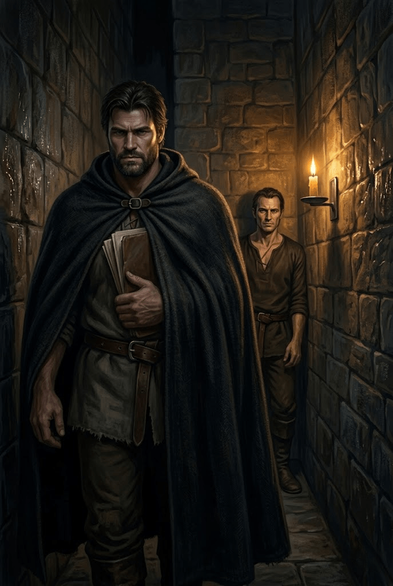
 S. E. Wigget