 Chadwick Rye
BRECK: Stone’s Rest — Chapter Nine The Ending No One Wrote
Daily writing prompt If you could change the ending of any book, which one would it be? View all responsesBRECK: Stone’s Rest — Chapter Nine
The Ending No One Wrote
This is Chapter 9 of BRECK: Stone’s Rest, Book Three of the BRECK series — a serialized noble dark fantasy story by Chadwick Rye. New chapters post daily.
The Story So Far
Garrow was warm, precise, and honest about the trench in a way that made him harder to deal with, not easier. He handed over the survey records without much resistance. Breck took them back to Thunderstep’s terrace and started reading. He’s been reading for three days.
← Chapter Eight: The Man Who Built Something | Chapter Ten →
Chapter Nine: The Ending No One Wrote
This chapter asks what ending you’d rewrite — and finds the answer not in any story, but in a legal document whose last page was already decided before anyone thought to check who was missing from the draft.
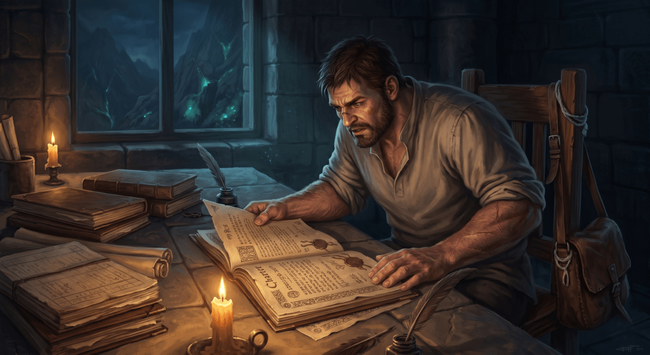
The records were good. That was the first thing Breck established, working through them across three days and two nights on the long table in his borrowed quarters on Thunderstep’s second terrace, the mountain’s faint bioluminescence providing just enough light that he’d only needed to burn through half his candles. Garrow’s people kept meticulous documentation — survey logs, extraction tallies, inspection reports, the full chain of correspondence with the Magisterium going back six years to the original charter application. Good records, professionally maintained, in the hand of at least three different clerks who had all been trained to the same standard.
That was also, by the end of the second day, recognizably the shape of the second problem. The first problem was the trench. The trench had a location, a measurement, a distance from the survey line that was not ambiguous and would not become ambiguous when read by anyone competent in Lumenvale charter law. That problem had a form it could be put in and an office it could be sent to and an outcome, Breck was reasonably confident, that would result in at minimum a cease-extraction order for the eastern boundary. That problem was solvable.
The second problem was what remained after the trench was filled.
He found it on the forty-seventh page of the original charter application, in language so standard it had clearly been copied from a template rather than written for this specific case, which was precisely why it had survived six years of renegotiations and three Magisterium inspections without anyone noticing what it quietly assumed. The charter defined affected parties as Lumenvale citizens, registered guild members, and landholders of record within the survey perimeter. Period. The definition had been written for disputes between miners and farmers, between charter-holders and neighboring estates, between competing extraction operations. It had been written in a city where the nearest walking mountain was a three-week journey and therefore a theoretical problem at best, and it had never been updated, because nobody in that city had ever needed to update it, because nobody in that city had ever successfully argued that something which wasn’t a citizen could be harmed in a way the law was obligated to answer for.
The mountains weren’t in the draft. They had never been in the draft. Not because anyone had decided to exclude them — that would have required someone to consider including them first — but because the document had been written to the edges of the world its authors knew, and the walking mountains of Nomados sat cleanly outside those edges, and so the ending had been decided before the story knew they were in it.
He was still sitting with that when Jenna appeared at the doorway around the second hour past midnight, carrying two cups of something that steamed, which told him she’d either been awake already or had been watching for his light.
“You found it,” she said, looking not at the records but at his face.
“Forty-seventh page. Three paragraphs defining affected parties. They didn’t leave the mountains out deliberately. They just wrote to the edge of their own knowledge and stopped.”
She set one cup in front of him — something warm and faintly mineral, a Nomados blend he’d been slowly developing a tolerance for — and took the chair across the table with the manner of someone who’d been expecting this conversation and had decided to have it at whatever hour it arrived. “That’s a harder problem than the trench.”
“Yes. Because I can report the trench and Garrow gets a cease-extraction order and the eastern boundary gets respected, and none of that changes what happens to Frostpeak next season, or the season after, or what happens to the children who can’t complete their bonding because the heartstone veins run thin. The charter doesn’t recognize that as harm. No charter does. The Magisterium has no mechanism for hearing a complaint from someone who doesn’t exist in its definition of someone.”
“What would it take to change that.”
“Precedent,” Breck said. “One successful case. A court — or Caine’s office acting in the court’s stead — formally recognizing a mountain as an affected party, allowing her testimony into the record, ruling on the basis of harm done to something the law currently pretends isn’t there. Everything after that first ruling has ground to stand on. Nothing before it does.”
Jenna wrapped both hands around her cup and was quiet for a moment in a way that meant she was deciding how much of something to say. “The clans have attempted, three times in my lifetime, to petition the Magisterium for some form of recognition. Not full personhood, not standing as citizens — just the acknowledgment that harm could be done to a mountain in ways that legal frameworks should be able to address. All three times the petition was returned as outside the Magisterium’s scope.” She looked at the stack of records on the table, then back at him. “We weren’t given a different answer each time. We were given the same answer each time, which is the Magisterium’s way of saying it considers the question settled.”
“It considers the question settled because it’s never had a case in front of it that forced it to unsettled it,” Breck said. “A petition is a request. Caine’s referral is a case.”
She studied him a long moment. “You think it can actually be done.”
“I think someone has to try it before we know whether it can be done, and that I am apparently the person positioned to try it.” He picked up the cup, drank, set it down. “I’ve been thinking about a question someone put to me recently. Whether there’s a book or a story you’d change the ending of, if you could. The kind of question that sounds like it’s about fiction.” He looked at the forty-seventh page, still open on the table in front of him. “This is a book. Six years of it. Four hundred and twelve names in the labor rolls, three renegotiations, eleven inspection reports, one exposed heartstone vein that nobody quite knew what to do with once they found it. The ending’s already been written into it, forty-seven pages in, in a template nobody questioned. The affected parties are citizens and guild members and landholders of record. The mountains are somewhere past the edge of the map, where the law simply stops having opinions.” He closed the charter. “I’d change that page. That specific page. Because once that page is different, everything that follows it is different too.”
“You can’t rewrite his charter,” Jenna said carefully.
“No. But I don’t need to rewrite his. I need one ruling that says his charter’s definition is incomplete — and that an incomplete definition of who can be harmed, applied to a case that involves parties the definition didn’t account for, doesn’t constitute a finding that those parties weren’t harmed. Just a finding that the question was never properly asked.” He looked at her. “Has Caine ever made a ruling that extended outside Lumenvale’s established jurisdiction?”
“I don’t know Caine.”
“I do.” Breck pulled the second-to-last page of the records toward him and made a note in the margin, the same pencil he’d used at the trench two days ago. “He opened a door for me, twice now. I think he understands that some questions don’t get asked until someone puts them in writing in front of the right office, and that the right office, most of the time, is whoever has the standing and the nerve to take the question seriously.” He looked up. “Mira said Frostpeak’s testimony was translatable. That she could render it in a form a Lumenvale proceeding could work with.”
“In theory. It’s never been attempted.”
“Most things that work were never attempted until the first time.” He closed the last of the records and stacked them neatly, the habit of a man who’d been trained to leave a workspace the way he’d found it, regardless of how long he’d been in it. “I need Mira to start working on what that translation would look like. Whatever form Frostpeak’s account can take — chronicle, affidavit, witnessed testimony — I need it in a shape Caine’s office can receive and argue from. Not because it’s guaranteed to work. Because the ending that’s currently written for this story is the one nobody questioned forty-seven pages in, and I am not willing to let it stand on the grounds that changing it is difficult.”
Jenna looked at him across the table for a long moment, and he was aware, not for the first time since arriving in Nomados, of the gap between what her face showed and what was happening behind it — the same quality he’d noticed in Daveron, in Mira, in everyone here who’d been carrying this a long time. They had learned not to invest in the look of hope before they’d confirmed the substance of it.
But she didn’t say no.
“I’ll take you to Mira in the morning,” she said. “Sleep first. You look like you’ve been fighting the records.”
“The records were winning,” Breck said, which was, he supposed, the closest he ever came to humor at two in the morning, and stood up to find his bedroll, leaving the stack of Garrow’s excellent documentation sitting on the table like a story that had just been told a different ending was possible.
← Chapter Eight: The Man Who Built Something | Chapter Ten →
BRECK: Stone’s Rest is a serialized noble dark fantasy story by Chadwick Rye — Book Three of the BRECK series, crossing from Lumenvale into Nomados. Chapter 9 of 20. New chapters post daily.
✦ Enjoyed this chapter? “The Ending No One Wrote” is the pivot chapter of Book Three — the moment the investigation stops being about a trench and starts being about whether a mountain can have standing in a court that was never built to ask the question. Browse the full series, follow for daily chapters, or share this with a reader who knows that the hardest problems aren’t the ones with villains. They’re the ones with incomplete definitions.
#books #BRECKSeries #ChadwickRye #chapterNine #dailyprompt #dailyprompt2803 #DarkFantasy #EpicFantasy #fantasy #FantasyFiction #fantasyWebSerial #fiction #freeFantasyStory #inheritanceFantasy #mentalHealth #nobleDarkFantasy #onlineFiction #readFantasyOnline #serializedFiction #shortStory #StoneSRest #writing