 Chadwick Rye
BRECK: Stone’s Rest — Chapter Seven The Kind of People Who Stay
Daily writing prompt Who are you most inspired by? View all responsesBRECK: Stone’s Rest — Chapter Seven
The Kind of People Who Stay
This is Chapter 7 of BRECK: Stone’s Rest, Book Three of the BRECK series — a serialized noble dark fantasy story by Chadwick Rye. New chapters post daily.
The Story So Far
Bren confirmed Frostpeak won’t see harvest. Breck stood at the edge of her failing terrace, let the Karithian valley all the way in for the first time in three years, and asked Mira to show him the rest of it. She said it was bad. He said he’d stood in worse rooms. Neither of them argued the point.
← Chapter Six: What Success Never Meant | Chapter Eight →
Chapter Seven: The Kind of People Who Stay
This chapter asks who inspires a man like Breck — and uses the answer to put him exactly where the series needs him to be.
Mira walked him the full length of Frostpeak’s eastern slope before dawn the next morning — every cracked support, every patch of failed light, every place where the stone had gone grey and cold in a way that clearly wasn’t seasonal. She didn’t narrate it. She simply walked and let him look, and he looked the way he always looked at damage, methodically and without sentiment, because sentiment was fine in the privacy of a terrace at dusk but evidence was what courts needed and evidence was what he was here to gather.
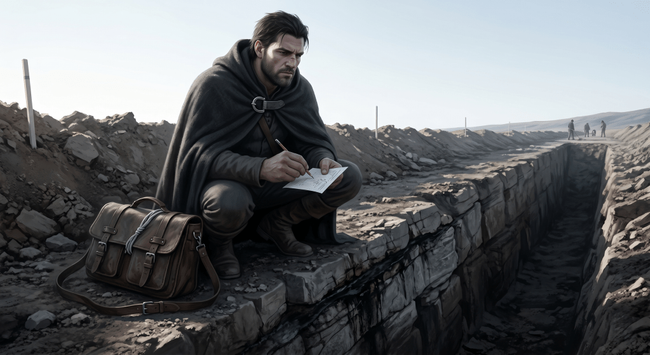
The concession began where a line of survey stakes drove into the ground at even intervals, pale-painted wood standing out sharp against the darker surrounding soil. Breck stopped at the first one, crouched, ran his thumb along the stake’s upper edge. Fresh paint, recently reset — the kind of detail that meant someone had walked this line in the last few weeks and confirmed it, which meant someone knew exactly where the legal boundary sat.
“The charter gives them rights to excavate within the designated survey perimeter,” Jenna said, from his left. She’d joined them at first light, quiet and prepared in a way that told him she’d been awake longer than they had. “Foundational stone only. Surface extraction on a separate writ they haven’t applied for and wouldn’t receive.”
“What did they actually do?”
“Come and see.”
The first breach was half a mile east of the survey line, which on open grassland was not a small distance and not an easy mistake to make. A deep-cut trench ran forty yards into ground that no legitimate reading of the charter touched, the soil around it turned back and dried in long pale furrows, and at its far end, still visible in the pale early light, a mobile pulley system of the kind Breck recognized from the Lumenvale guild foundries sat unattended, waiting for its shift to begin. Below the trench’s lip, cut into stone that should never have been cut, a dark smear ran the length of the exposed face where something had been extracted that hadn’t been coal or iron or any mineral he had a name for.
“What’s that?” He pointed at the smear.
“Heartstone,” Mira said. “It’s what the bioluminescence runs through. What the bond runs through. What we — and the mountains — have never permitted to be extracted, because there’s no way to do it that doesn’t take the vein it runs in.” She kept her voice flat and informative, the way a person keeps their voice when anger has been too many years in residence to function usefully as a feeling anymore and has simply become texture. “There is no provision in Garrow’s charter for heartstone extraction. There is no provision for it in any charter Lumenvale has ever issued, because until the concession came out here and found it, no surveyor had ever mapped this deep.”
Breck straightened, looked the length of the trench, looked back at the survey stakes a half mile behind them, and felt the clean, unambiguous click of a picture finishing assembling itself. He’d been trained for twenty years to distrust conclusions that arrived feeling like certainty, because certainty was what bad intelligence felt like too, from the inside. This wasn’t certainty. This was simply a trench, in the wrong place, containing the wrong material, next to a pulley that wasn’t owned by anyone who had permission to be there.
He stayed long enough to sketch the trench dimensions on the back of an old dispatch sheet from his satchel, noting the distance from the survey line, the visible vein damage, the equipment markings. He was halfway through the equipment markings when the shift crew arrived.
There were seven of them, ground-dwellers, coming up the trail from the main camp with the particular loose energy of men early into a long working day, voices low and carrying in the cold air. They pulled up short when they saw him, collectively, the way men do when unexpected company appears at a worksite and they haven’t decided yet whether to be annoyed or alarmed.
One of them — a young man, not yet twenty-five, with the same deep-cut forearms as every foundry worker Breck had ever known and a sun-weathered face that put him somewhere between apprentice and journeyman — stepped forward from the group with the specific posture of someone who’d decided, in the three seconds it had taken him to assess the situation, that the right move was to handle it himself before anyone else handled it worse.
“You’re on a private work site,” he said. Not aggressive. Just stating it, the way an honest man states a fact he actually believes in.
“I know,” Breck said. “I’m just leaving.” He finished the last of the equipment markings, folded the dispatch sheet back into his satchel, and straightened to his full height, which did its usual work on the young man’s posture without any other effort required. “You work this trench?”
The young man’s eyes moved to the trench, to the survey line in the distance, and back to Breck. He wasn’t stupid. Breck filed that immediately. “I work the site,” he said carefully.
“How long?”
A pause. “Three seasons.”
“Who brought you out here?”
And here the young man’s posture changed, fractionally, in a way Breck recognized — the particular straightening of someone who’s been asked something that makes them want to stand a little taller before answering it. “Garrow did. Hired me out of Westmere. I’d been loading grain carts for a copperweight a week and going nowhere in it.” He said it without apology, the way people state conditions they didn’t choose and didn’t stay in. “He came through, told us what the work was, what it paid, what it could become. There were forty men from Westmere who said yes inside a day. I’ve sent money home every week for three seasons and that wasn’t something I thought I’d be saying at my age.” He glanced at the trench again, and something in that glance told Breck the young man had looked at it before, in the same direction, and not entirely liked what he’d found when he did. “I don’t set the survey lines.”
“I know you don’t,” Breck said, and meant it. He held the young man’s eyes a moment longer — not as pressure, simply as confirmation that what he’d just said had been heard and weighed and found honest — then picked up his satchel and walked back toward the survey stakes with Jenna and Mira behind him.
He didn’t say anything until the trench was well behind them and the camp had dropped below the rise.
The question the prompt had been pressing at all morning finally finished arriving, the way questions did when they’d been working on him from underneath without announcing themselves. Who had actually inspired him, across twenty years of this work, to be the kind of man who crossed a line onto a private worksite and sketched the evidence before the shift arrived rather than staying on the legal side of the stakes and writing a report about what the stakes implied?
Not commanders. Not the men he’d served under in the signal corps, most of whom had been competent and a few of whom had been brilliant and none of whom had been, at the particular bone-deep level he meant, inspiring in the way the question was asking. Not the adjudicators he’d carried letters for, not the lawyers he’d watched work in Crestfall and Cold Harbor both, though he respected the ones who were good at the thing.
It was people like that young man, actually. Not because of what they’d done, but because of the look in a person’s eyes when they understood they were standing in a situation that had been created dishonestly and were slowly deciding what they were going to do about it. Breck had seen that look a hundred times, in couriers who delivered orders they’d been given no context to evaluate, in locals who’d watched magistrates they trusted turn out to be men they didn’t, in clerks who kept honest records in systems that weren’t designed to want honest records. People who’d been handed a condition they didn’t choose and were working out, quietly, alone, without fanfare, whether they had the spine to do the honest thing once they’d identified what it was.
He couldn’t save all of them. He’d learned that. He probably couldn’t save Frostpeak. He was starting to learn that too, and the learning was costing him something different this time than the valley had, which meant it was teaching him something different.
But he could be the kind of man who showed up with a dispatch sheet and a pencil, who counted the distance from the survey stakes to the trench and wrote it down, who asked the young worker honest questions and heard honest answers and left him standing in a better-defined version of whatever decision he was already arriving at on his own. He couldn’t be the inspiration. He was never going to be the inspiration — he was the wrong shape for it, too abrasive, too quiet, too consistently disinclined to deliver the kind of speech that sent men home with fire in their chests. What he could be, and what he had apparently been choosing to be for long enough now that it had stopped feeling like a choice, was the kind of person who stayed.
He could stay here.
He looked at Jenna as they crossed back through the survey stakes and she read his face the same way she’d been reading him since the threshold station, with professional precision and no wasted words.
“You’ll need lodging,” she said. “I know a platform on Thunderstep’s second terrace that isn’t being used.”
“That’ll do,” Breck said.
He was going to need more dispatch sheets.
← Chapter Six: What Success Never Meant | Chapter Eight →
BRECK: Stone’s Rest is a serialized noble dark fantasy story by Chadwick Rye — Book Three of the BRECK series, crossing from Lumenvale into Nomados. Chapter 7 of 20. New chapters post daily.
✦ Enjoyed this chapter? “The Kind of People Who Stay” closes the first arc of Book Three — a courier who has never once been the inspiration, standing in front of evidence that can’t be argued away, deciding he’s staying anyway. Browse the full series, follow for daily chapters, or share this with a reader who’s always been quietly inspired by the people who just don’t leave.
#adventure #books #Breck #ChadwickRye #chapterSeven #dailyprompt #dailyprompt2800 #DarkFantasy #darkFiction #EpicFantasy #fantasy #FantasyFiction #fiction #Frostpeak #HighFantasy #inspiration #moralCourage #nobleDarkFantasy #serializedFantasy #serializedFiction #shortStory #StoneSRest #webFiction #writing