 Chadwick Rye
BRECK: Cold Harbor — Chapter Fifteen
The Key It’s In
Daily writing prompt What’s a song that always puts you in a good mood? View all responsesBRECK: Cold Harbor — Chapter Fifteen
The Key It’s In
This is Chapter 15 of BRECK: Cold Harbor, Book Two of the BRECK series — a serialized noble dark fantasy story by Chadwick Rye, set in the world of Lumenvale. New chapters post daily.
The Story So Far
BRECK arrived in Cold Harbor on a routine delivery and stayed. He has survived the alley. He reached Jorin Caswick before Solt’s deadline closed the window. The letter to Regional Adjudicator Harvel Caine is in transit, carrying Varrow’s treatise and Sela Rauth’s testimony. Solt is recalibrating. The escalation arc is open and neither man has found the edge of the other yet.
← Chapter Fourteen: Before the Window Closes | Chapter Sixteen →
Chapter Fifteen: The Key It’s In
This chapter holds what music actually carries — not its notes, but the specific emotional key that unlocks something in you without asking permission.
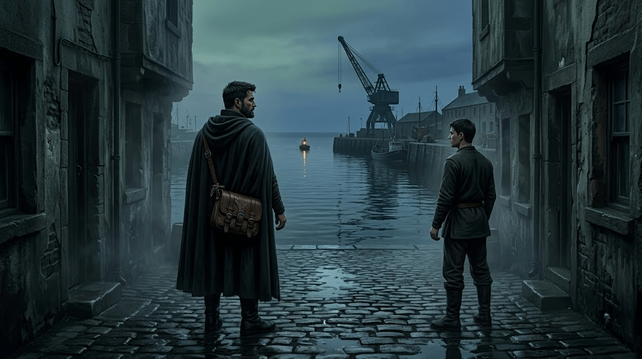
He heard it on the way back from Caswick’s salting house, the morning still grey and cold and smelling of brine and low tide, the harbor district gathering itself for the day’s work in the patient incremental way of places whose rhythms had been set long before anyone currently living was born.
A fisherman — old, barrel-chested, working alone at the far dock with a net spread across his knees and his hands moving through it with the automatic certainty of long practice — was singing.
Not performing. Not for Breck, not for anyone. Just singing the way people sang when the work and the hour and the quality of the morning aligned into something that required more than silence to contain it. An old harbor song — Breck didn’t know its name or its origin, had never heard it in quite this form, but recognized its bones immediately, the way you recognized the structure of something older than its current version, the melodic logic that had been in Lumenvale’s fishing towns for longer than the towns themselves had had names. A low, unhurried thing, built for open water and grey mornings and the kind of labor that gave the hands something to do while the mind settled into its own weather.
He stopped walking.
He could not have said why, precisely. He was not a sentimental man about music — had not been, particularly, even before the campaign had stripped most non-functional responses to a manageable minimum. But something in the song’s key, its particular position in the spectrum of sound between the minor and the not-quite-major, opened a door in him that he had not known was closed.
It was a Karithian fishermen’s variant, he realized after a moment. The coastal villages along the secondary theater had their own version — lighter in its upper notes, the rhythm slightly compressed for the narrower harbors, but the same bones underneath, the same emotional architecture. He had heard it in the third year of the campaign from a window while moving through an occupied coastal settlement at dusk, doing the kind of work that required absolute attention and offered no room for anything else, and it had gotten into him anyway — had found the gap between focused and human and lodged there, had stayed.
He had not thought of it in years. Had not known he still carried it until this grey harbor morning when an old man’s hands moved through a net and the key of the thing found him across thirty yards of salt-cold air and unlocked something that had been closed without his noticing.
Something lifted in him. Not joy — he was not running on the register that produced joy at this particular juncture — but its functional cousin, the specific buoyancy that arrived when the weight had been fully acknowledged and the body was given a moment to remember it was not only weight. He stood at the dock road’s edge and listened to the old man sing and let the harbor morning be what it was for a full thirty seconds, which was a luxury he did not generally afford himself and which the situation probably did not technically warrant.
Then the innkeeper’s boy found him.
He was perhaps fourteen, the boy, with the loose-limbed urgent energy of someone running an errand that had been impressed upon him as important and who had taken the impression seriously. He carried a sealed envelope with the particular careful grip of someone who had been told the thing in his hands mattered, and he extended it to Breck with the solemnity of a boy who understood he was part of something larger than the delivery of one piece of mail.
Breck turned the envelope over. The seal was official — the Regional Adjudicator’s office, Harvel Caine’s personal mark pressed into grey-green wax, a color he recognized from the letter he’d been carrying in his document sleeve since Crestfall.
He broke it open.
Mr. Breck — Your correspondence arrived this morning by night rider from Cold Harbor. I have read what you sent and I have no doubt about what it describes. An inquiry team departs within three days. I require you to remain in Cold Harbor as material witness and I require the people who can confirm the accounts to be available for private statement. Do not move against Solt directly. The inquiry will be sufficient. Keep yourself intact. — H. Caine, Regional Adjudicator
He read it twice. The second time more slowly, letting each sentence do its specific work. I have no doubt about what it describes. Not I am considering the matter, not I will review the evidence — the unambiguous language of a man who had read forty pages of Varrow’s careful thinking and Sela Rauth’s exact testimony and had arrived at the same place Breck had arrived at from the inside of the situation.
Three days.
The fisherman was still singing, his hands still moving through the net, the harbor still assembling itself around the sound with the patient indifference of water.
Breck folded the letter. Put it in his document sleeve beside the space where Caine’s first letter had lived for weeks. Stood for a moment in the grey morning with the cold air on his face and the brine smell and the low unhurried music working its way through the registered frequencies of him.
He had not allowed himself, since arriving in Cold Harbor, to feel the weight lift. There had been too many open windows, too many unclosed angles, too many mornings where Solt’s next move was unknown and the situation’s momentum was not yet established enough to trust. He had operated in the register of necessary tension — not fear, but its functional equivalent, the sustained elevation of attention that kept the peripheral vision sharp and the body’s response architecture accessible.
Now, for the first time, the weight had a shape and a duration. Three days. An inquiry team. A man in an official office who had read the true account and had no doubt. The structure Breck had been building — Varrow’s pages, Sela’s testimony, Fenn’s night rider, Caswick’s refusal to sign — had arrived where it needed to arrive and had been received by the person who could do what Breck could not do: make it institutional, make it durable, make it the kind of change that outlasted the man who started it.
He thought about Ceth Varrow writing in the margins of his treatise at the outer edge of the page, pressing forty pages of careful observation and careful thinking into the world with the understanding that he would not be present to see what they produced. Tending something for a future he might not inhabit. The same impulse that turned garden beds for spring. The same impulse that braided grain stalks and pressed them into a soldier’s hand.
The song ended.
The old fisherman gathered the net with a practiced rolling motion, stood with the deliberate care of a man whose knees had decided years ago to participate only under protest, and moved back along the dock toward his vessel without acknowledgment of the morning, of the letter, of the large man standing at the road’s edge who had stopped walking to listen.
Breck watched him go. Thought about what music actually did — not the notes themselves, not the formal structure of it, but the specific function it served in the human machinery. It found the key you were in. Not the key you wanted to be in, not the key the occasion called for, but the one you were actually running on underneath the operational surface, and it named it, and the naming was the lifting, and the lifting was the reminder that the thing you were carrying had a bottom to it, that the weight was not infinite, that on the other side of the weight there was something else that was also true.
He was, he realized, in the key of something close to hope.
Not certainty. He was not built for certainty and did not trust people who were. Solt had three days to move before the inquiry team arrived, and Solt was precise and intelligent and not yet finished with the options available to him. Three days in Cold Harbor with the geometry declared and the accounts in official hands was three days in which something could still go badly wrong.
But Caine was coming. The letter existed. The true account was outside this harbor and in official hands and had been read by a man with authority who had no doubt about what it described.
He started walking.
The harbor road was waking around him — carts and voices and the smell of morning bread from the bakehouse two streets back, the accumulated ordinary texture of a town at the start of its day. Cold Harbor, going about its business. Orderly, quiet, functional — and underneath all of that, three days from the moment when the architecture of the last three years began to come apart.
The key it was in, Breck thought, was not triumph. It was not even relief. It was the specific emotional register of a man who had been moving through the dark for long enough that the first grey light on the horizon, barely visible, barely certain, was sufficient.
He passed the salting house. Looked at its dark timber roofline against the grey sky, at the salt-crystal haze that gave it its particular permanent appearance of having just emerged from the water.
Dara, he thought. Her name is Dara.
He walked on.
← Chapter Fourteen: Before the Window Closes | Chapter Sixteen →
BRECK: Cold Harbor is a serialized noble dark fantasy story by Chadwick Rye, set in Lumenvale. Chapter 15 of 20. New chapters post daily.
✦ Enjoyed this chapter? “The Key It’s In” is part of the BRECK series — cozy dark fantasy, moral weight, and a courier learning, slowly, that the weight has a bottom to it. Browse the full series, follow for daily chapters, or share this with a reader who knows what earned hope feels like.
#books #BRECKSeries #ChadwickRye #ColdHarbor #dailyprompt #dailyprompt2788 #darkFantasyNovel #fantasy #fantasyShortChapters #fiction #Lumenvale #nobleDarkFantasy #onlineFiction #serializedFantasy #shortStory #writing