Ever wonder how your brain navigates the real world? 🧠

Most laboratory neuroscience studies look at spatial navigation in flat, 2D mazes.

But the real world is hilly, irregular, and bumpy! ⛰️

In our new paper out in #ScienceAdvances we asked a simple question: How does the brain map uneven terrain? 🗺️🐀
📄 https://doi.org/10.1126/sciadv.adz9893
🧵👇️️1/
#Neuroscience #science #spatiaCognition
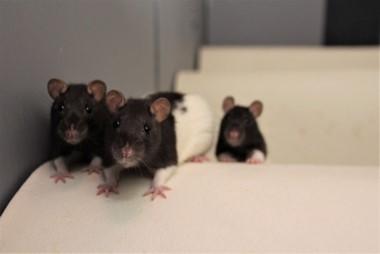
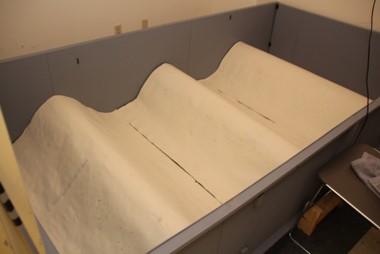
To find out, we recorded from hippocampal place cells, which are thought to underlie the brain's internal map, while rats foraged in a large (3x1.5 meters!) custom-built 3D "Hillscape" featuring three sinusoidal ridges.
⛰️ ⛰️ ⛰️

#placecells #hippocampus
2/

Side-note:
What exactly are "place cells"? ⁉️

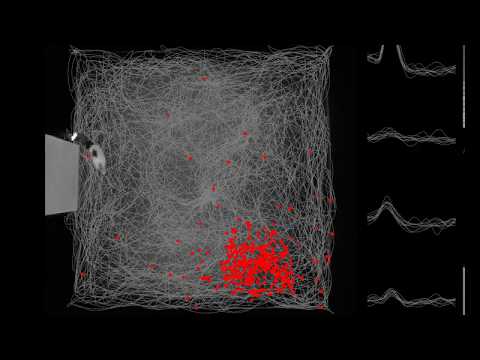
When you walk around your kitchen, a specific neuron activates (fires action potentials) only when you stand next to the fridge. Move over to the sink, and a completely different neuron activates.

Because these cells are tied to specific physical locations in your environment, we call them "place cells". Together, they underlie what we call a "cognitive map" - an internal representation of the world around you.

These cells are mostly found in a really cool brain region called the hippocampus 🧠 which is very similar in rats and humans.

The area where a place cell becomes active is known as its "place field" (we will talk about these in a minute).

Here is a video showing the activity of a single place cell: https://www.youtube.com/watch?v=ZNEEvfZz4hU
#PlaceCells #CognitiveMap #Hippocampus
3/

Place cell (rat hippocampus CA1) activity recorded over 50 minutes of foraging

YouTube

Back to the paper 📄

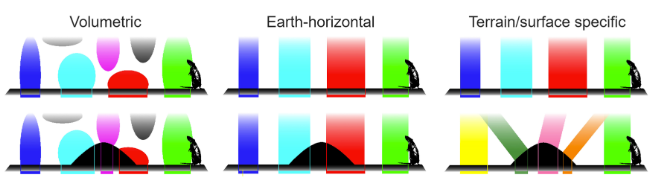
We had 3 main hypotheses, the brain could map space:

1️⃣ volumetrically (like a 3D cake with terrain 'slicing' through it)

2️⃣ earth-horizontally (like a paper map, with everything in a horizontal sheet)

3️⃣ surface-bound (stuck to the surface of the terrain like a layer of paint)

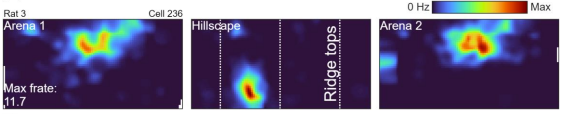
The answer: compared to a flat floor, the place cells formed a completely new map in the hills!

They didn't care about absolute 3D space or horizontal locations; they formed a totally unique map depending on the terrain - like a brand new layer of paint, so hypothesis 3️⃣ !
4/

This new map for the hills was also a little weird.

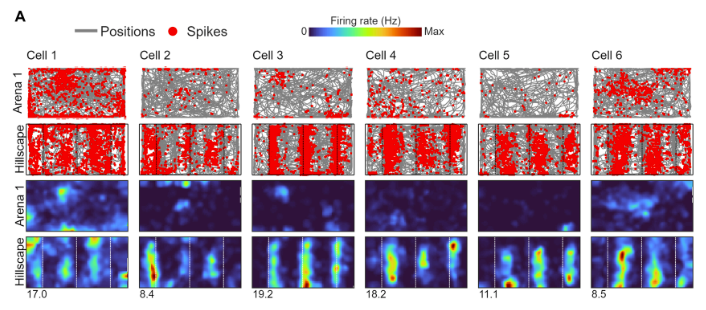
On the Hillscape, the place fields we saw were smaller and more numerous - maybe because there was more information now for the brain to make its map with?

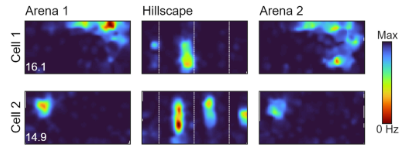
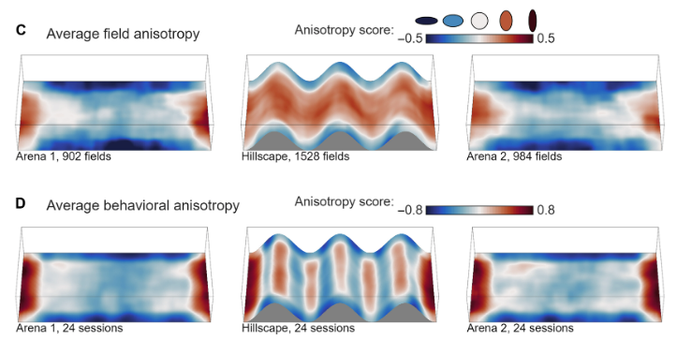
Fields were also elongated parallel to the ridge contours (perpendicular to the slopes). As if the fields were mapping topographical contour lines.
5/

"Ah!" says the predictive coding crowd, "That's just because of how the rats move!" 💡 Except... that doesn't seem to be the case.

In 'normal' 2D laboratory environments place fields tend to be elongated parallel to walls or boundaries and rats also tend to move parallel to walls or boundaries, so it has been suggested that movement statistics and place field elongation are linked.

But... in the Hillscape rats preferred to move orthogonally (up and down the slopes) when climbing, but the place fields stretched out along the slopes.

This means the cognitive map is driven by the physical geometry of the terrain itself, independent of behavioral biases!
6/

Even stranger: about a third of place cells exhibited repeating firing fields on each ridge.

Even though the ridges were in completely different parts of the room, the brain seemed to map them similarly based on their shape.
7/

Repeating place fields have been seen in environments with repeating elements, like 4 identical rooms connected by a corridor: https://doi.org/10.1002/hipo.22496

This effect can be explained using a computational model based on neurons that really like walls (boundary cells): https://doi.org/10.1080/13875868.2018.1437621

Poulter et al. (2021) recently showed that in the brain these boundary cells respond more than just walls, they also activate for uneven terrain (bricks): https://www.nature.com/articles/s41593-020-00761-w

A lot of info, I know - threading all of this together 🧵 :

Boundary cells are usually thought of as "wall" cells but they could actually be "terrain" cells (which would be a much more useful signal in the real world!) and their input might be driving place field repetition in our Hillscape.

This would suggest that boundary cells are really important for real-world mapping and a cool model from the Bicanski lab recently showed how this might work: https://doi.org/10.64898/2026.04.04.716474
8/

To wrap it all up, the main takeaways are:
1️⃣ The brain maps space in a terrain-specific way: place cells don't ignore verticality, but they also don't form a 3D map; they map space in a way that reflects the local terrain.
2️⃣ Geometry > Behavior: place field elongation is driven by terrain, or geometry, not by how an animal chooses to move.
3️⃣ Place field repetition: some place cells respond to the same terrain feature in different places, this suggests there is some terrain sensitive input to hippocampus, possibly boundary cells?

Ultimately, cognitive maps are far more dynamic, surface-bound, and attuned to the real, bumpy world than we previously thought! 🗺️
9/

Huge thanks to my co-authors Éléonore Duvelle @elduvelle_neuro & Jeff Taube, and the University of Glasgow / Dartmouth College!

TL;DR: Your brain's cognitive map isn't a flat map or a 3D cloud; it is sensitive to the topography under your feet ⛰️ Check out the full paper for the details 👇️️

https://doi.org/10.1126/sciadv.adz9893
/end

@rmgrieves

Can you say something about how these place cells with repeating fields are or aren't related to grid cells? (I'm not a neuroscientist but I'm the level of passionate amateur where I've heard of grid cells.)