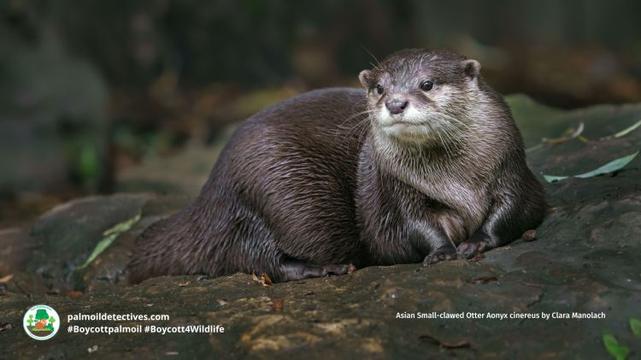
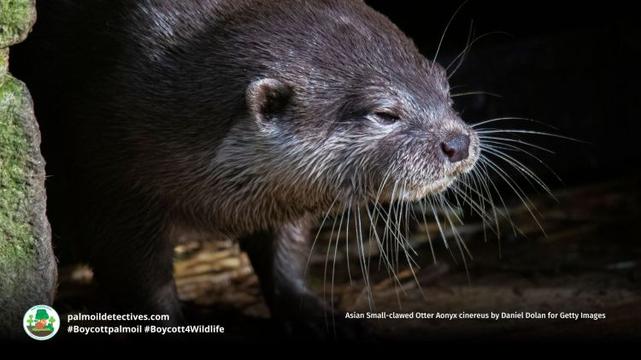
Asian Small-clawed Otter Aonyx cinereus

Asian Small-clawed Otter Aonyx cinereus

IUCN Red List Status: Vulnerable

Locations: India, Nepal, Bangladesh, Bhutan, China, Taiwan, Myanmar, Thailand, Laos, Cambodia, Vietnam, Malaysia, Indonesia (Sumatra, Borneo, Java), The Philippines (Palawan)

Found in freshwater wetlands, peat swamps, mangroves, hill streams and rice fields across South and Southeast Asia, with a genetically distinct and critically impacted subspecies (Aonyx cinereus nirnai) in the Western Ghats of India.

The Asian Small-clawed #Otter, the world’s smallest otter species — is inquisitive, intelligent, and highly social. They are listed as #Vulnerable on the IUCN Red List and are declining rapidly due to #palmoil #tea and #coffee #deforestation, #poaching, #pesticide #pollution, and the illegal pet trade. Their fragile habitat in the Western Ghats, India home to the subspecies Aonyx cinereus nirnai, is being destroyed at an alarming rate for palm oil monocultures, plantations, and hydropower development. Boycott #palmoil and demand protection for these sensitive and intelligent wetland sentinels. #BoycottPalmOil #Boycott4Wildlife #Vegan #BoycottMeat

The Asian Small-Clawed Otter 🦦🩷 is the smallest #otter in the 🌎. A tenacious survivor in #Asia’s vast #rivers, #pesticide pollution and #palmoil #ecocide now pose grave threats. Help them when you #Boycottpalmoil 🌴⛔️ #Boycott4Wildlife @palmoildetect https://palmoildetectives.com/2026/03/22/asian-small-clawed-otter-aonyx-cinereus/

Share to BlueSky Share to Twitter

Communicating with chirps and whistles, endearing Asian Small-Clawed #Otters live in rowdy groups 🦦😘 They’re #vulnerable from the illegal #pet trade and #palmoil #deforestation. #Boycottpalmoil 🌴🩸❌ #Boycott4Wildlife in the supermarket! @palmoildetect https://palmoildetectives.com/2026/03/22/asian-small-clawed-otter-aonyx-cinereus/

Share to BlueSky Share to Twitter

https://youtu.be/R9L-N1WgFig

Appearance and Behaviour

With silky chocolate-brown fur, pale undersides and a broad, flat face, the Asian Small-clawed Otter has a distinct charm. Their tiny claws don’t extend past their fingers — an adaptation that gives them remarkable dexterity for catching prey. They weigh only 2.7 to 3.5 kg and reach lengths of 73 to 96 cm, making them the smallest otter species in the world.

Highly vocal and playful, these otters live in tight-knit family groups of up to 15. They communicate with at least a dozen vocalisations — chirps, squeals and whistles — and use communal latrines to mark their territories. In the Western Ghats, they are more active at night and prefer rugged hill streams with dense grasses and rocky pools for cover and escape routes.

Threats

Palm oil deforestation and peat swamp destruction

Across Southeast Asia, especially in Indonesia and Malaysia, vast areas of peat swamp forests and mangroves — critical habitats for Asian Small-clawed Otters — have been destroyed to make way for palm oil plantations. These plantations drain wetlands, replace diverse ecosystems with monocultures, and leave otters with no access to food or cover. In India, the expansion of palm oil into the Western Ghats under so-called ‘green development’ initiatives is now destroying the rocky hill stream habitats used by the Aonyx cinereus nirnai subspecies. This deforestation not only eliminates their shelter and food sources but also causes soil erosion and alters the hydrology of entire watersheds.

Conversion of forests to palm oil, tea and coffee plantations in the Western Ghats

In southern India, particularly in Tamil Nadu and Kerala, large-scale conversion of native forests to palm oil, tea and coffee plantations is reducing the range of Aonyx cinereus nirnai. These monocultures fragment stream habitats and introduce pesticides that poison aquatic life. Studies have found the otters avoiding plantation areas due to lack of vegetation cover and prey (Raha & Hussain, 2016). As a result, the Western Ghats population is now restricted to narrow, isolated pockets, surrounded by human-altered landscapes that are increasingly inhospitable to them.

Capture for the Illegal pet trade and cruel conditions in pet cafés

The Asian Small-clawed Otter is the most heavily trafficked otter species in Asia’s exotic pet trade. Between 2016 and 2017, over 700 individuals were recorded for sale online in countries like Indonesia, Thailand, Malaysia, and Vietnam (Gomez & Bouhuys, 2018). Many are poached from the wild as pups, leading to the death of their parents and collapse of social groups. Captive conditions in pet cafés and private homes cause extreme stress and suffering — and demand is rising due to social media content that normalises otter ownership.

Poaching for pelts and traditional use

Poaching continues to be a severe threat in South Asia. In the Western Ghats, otters are hunted for their pelts and body parts, which are used in traditional medicine or sold on the black market. Reports from protected areas in India reveal organised trapping and trade routes extending across state lines (Prakash et al., 2012). These killings often go undocumented due to weak enforcement, and they rapidly deplete already fragile local populations.

Overfishing and prey depletion

In many parts of Asia, otters face competition from humans for aquatic prey. Overfishing in rivers, lakes, and mangroves has drastically reduced populations of crabs, mudskippers, and fish species that form the core of the otter’s diet. Pollution from fish farms and chemical runoff further weakens these food webs, making otter survival harder during dry or lean seasons. In some areas, otters are also deliberately killed by fishers who perceive them as pests competing for the same resources.

Pesticide run-off pollution from agriculture

Agricultural runoff from palm oil, tea and coffee plantations containing pesticides, herbicides, and heavy metals has been shown to poison water sources throughout the otter’s range. In the Western Ghats of India and parts of Southeast Asia, such contaminants accumulate in the food chain and affect the physiology of aquatic mammals. Polluted waterways reduce prey availability and can lead to bioaccumulation of toxins in otters, weakening their immune systems and reproductive capacity. This is especially critical in closed or stagnant freshwater systems like rice paddies and irrigation channels, where contamination is concentrated.

Hydropower development and infrastructure fragmentation

Dams and hydroelectric projects throughout the Western Ghats and Southeast Asia have altered river flow, submerged natural habitats, and fragmented otter territories. These developments destroy riverine connectivity, which otters rely on to forage and disperse. For the nirnai subspecies, hill streams once connected across forest corridors are now interrupted by roads, canals, and dams — leading to isolated, unsustainable populations. Infrastructure development often proceeds without proper environmental assessments, disregarding the needs of aquatic species like otters.

Climate change and habitat drying

Shifts in monsoon patterns, increased droughts, and rising temperatures are affecting the wetlands and rivers that Asian Small-clawed Otters depend on. Reduced water flow in dry seasons can strand otter families and eliminate key feeding pools. In the Western Ghats, erratic rainfall is already altering seasonal resource use patterns for A. c. nirnai, increasing their vulnerability to disturbance (Narasimmarajan et al., 2024). Climate stress, combined with other threats, compounds the likelihood of local extinctions.

Geographic Range

Their range stretches across India, Nepal, Bhutan, Bangladesh, Myanmar, Thailand, Laos, Cambodia, Vietnam, Malaysia, Indonesia (including Borneo, Sumatra, Java), the Philippines (Palawan), China and Taiwan. In India, they are found in Arunachal Pradesh, Assam, West Bengal, Odisha, Kerala, Karnataka and Tamil Nadu. They are absent from large swathes of their historical range, including the Western Himalayas.

The genetically distinct subspecies Aonyx cinereus nirnai is restricted to the Western Ghats’ Moyar River and surrounding hill streams. This biodiverse stronghold is currently being cleared for palm oil plantations, hydropower projects, and invasive monocultures, putting this population in grave danger.

Diet

Asian Small-clawed Otters are primarily crustacean specialists. Their diet includes crabs, snails, molluscs, fish such as mudskippers and catfish, amphibians, insects, snakes, and even rodents. Scat analysis in Malaysia and Thailand revealed crabs to be the most frequent prey, often making up over 80% of their diet.

In rice fields and mangroves, they may leave molluscs out in the sun to soften the shells before eating — a sign of their intelligence and adaptability. Seasonal changes in water levels influence the availability of prey, leading to subtle shifts in their dietary habits throughout the year.

Mating and Reproduction

These otters are monogamous and breed year-round, with gestation lasting 62–86 days. Litters typically include 2–7 pups. In captivity, they start breeding at around 18 months of age, and may live up to 11 years. Parents build nests together before birth and both contribute to raising the young. Pups begin to open their eyes around five weeks old and start swimming with their mothers at around three months.

FAQs

How many Asian Small-clawed Otters are left in the wild?

There is no global population estimate, but their numbers are declining throughout their range. In China and Cambodia, they are now almost locally extinct, with only a few scattered sightings since 2006 (Li & Chan, 2017; Heng et al., 2016). Surveys in India confirm drastic reductions in range, especially from west to east, over the past 60 years (Hussain et al., 2011).

What is the lifespan of the Asian Small Clawed Otter?

In captivity, Asian Small-clawed Otters can live up to 11 years (Crandall, 1964). Their lifespan in the wild is likely shorter due to environmental pressures and poaching.

Why are Asian Small Clawed Otters endangered?

They are threatened by habitat loss from logging, plantations, palm oil, pollution, and construction of dams. In the Western Ghats, the genetically distinct nirnai subspecies is losing habitat to hydropower development and palm oil monocultures, which destroy the narrow, rocky streams they depend on (Narasimmarajan et al., 2024).

Do Asian Small-clawed Otters make good pets?

Absolutely not. Keeping them as pets is cruel and selfish. They are wild animals with complex social and environmental needs. The illegal pet trade is driving them towards extinction, causing immense suffering and ripping family groups apart (Gomez & Bouhuys, 2018). Buying a pet otter and also sharing pet otter content on social media fuels this horrific industry — if you love otters, protect them in the wild! Do not buy them as pets or support this cruel industry!

How is palm oil affecting their survival?

Palm oil plantations have destroyed vast tracts of mangroves, peat swamps, and wetlands in Malaysia, Indonesia, and now India. In the Western Ghats, forests are being cleared for palm oil under the guise of “afforestation” and “reforestation” using non-native species. This directly threatens the survival of A. c. nirnai (Narasimmarajan et al., 2024).

Take Action!

Raise your voice for the smallest otter in the world. Every time you shop, Boycott palm oil and reject products linked to deforestation and wetland destruction. Support indigenous-led conservation efforts in the Western Ghats and Southeast Asia.

Never buy otters or exotic animals — their capture fuels extinction. Adopt a plant-based lifestyle to protect wetlands, rivers and biodiversity. #BoycottPalmOil #Boycott4Wildlife #Vegan #BoycottMeat

Support Asian Small-Clawed Otters by going vegan and boycotting palm oil in the supermarket, it’s the #Boycott4Wildlife

Support the conservation of this species

This animal has no protections in place. Read about other forgotten species here. Create art to support this forgotten animal or raise awareness about them by sharing this post and using the #Boycottpalmoil #Boycott4Wildlife hashtags on social media. Also you can boycott palm oil in the supermarket.

Further Information

Gomez, L., & Bouhuys, J. (2018). Illegal otter trade: An analysis of seizures in selected Asian countries (1980–2015). TRAFFIC. https://www.traffic.org/site/assets/files/2402/illegal-otter-trade-asia.pdf

Narasimmarajan, K., Mathai, M. T., Hayward, M. W., & Palanivel, S. (2024). Lesser-known sentinels: Role of environmental variables influencing the seasonal resource use patterns of Asian Small-clawed Otters (Aonyx cinereus nirnai) in the Western Ghats Moyar River Biodiversity Hotspots. IUCN Otter Spec. Group Bull., 41(5), 296–310. https://iucnosgbull.org/Volume41/Narasimmarajan_et_al_2024a.pdf

Wikipedia contributors. (n.d.). Asian small-clawed otter. Wikipedia. https://en.wikipedia.org/wiki/Asian_small-clawed_otter

Wright, L., de Silva, P.K., Chan, B.P.L., Reza Lubis, I. & Basak, S. 2021. Aonyx cinereusThe IUCN Red List of Threatened Species 2021: e.T44166A164580923. https://dx.doi.org/10.2305/IUCN.UK.2021-3.RLTS.T44166A164580923.en. Accessed on 17 April 2025.

How can I help the #Boycott4Wildlife?

Take Action in Five Ways

1. Join the #Boycott4Wildlife on social media and subscribe to stay in the loop: Share posts from this website to your own network on Twitter, Mastadon, Instagram, Facebook and Youtube using the hashtags #Boycottpalmoil #Boycott4Wildlife.

✓ Subscribed

2. Contribute stories: Academics, conservationists, scientists, indigenous rights advocates and animal rights advocates working to expose the corruption of the palm oil industry or to save animals can contribute stories to the website.

Wildlife Artist Juanchi Pérez

Read more

Mel Lumby: Dedicated Devotee to Borneo’s Living Beings

Read more

Anthropologist and Author Dr Sophie Chao

Read more

Health Physician Dr Evan Allen

Read more

The World’s Most Loved Cup: A Social, Ethical & Environmental History of Coffee by Aviary Doert

Read more

How do we stop the world’s ecosystems from going into a death spiral? A #SteadyState Economy

Read more

3. Supermarket sleuthing: Next time you’re in the supermarket, take photos of products containing palm oil. Share these to social media along with the hashtags to call out the greenwashing and ecocide of the brands who use palm oil. You can also take photos of palm oil free products and congratulate brands when they go palm oil free.

https://twitter.com/CuriousApe4/status/1526136783557529600?s=20

https://twitter.com/PhillDixon1/status/1749010345555788144?s=20

https://twitter.com/mugabe139/status/1678027567977078784?s=20

4. Take to the streets: Get in touch with Palm Oil Detectives to find out more.

5. Donate: Make a one-off or monthly donation to Palm Oil Detectives as a way of saying thank you and to help pay for ongoing running costs of the website and social media campaigns. Donate here

Pledge your support

Learn about other animals endangered by palm oil and other agriculture

Global South America S.E. Asia India Africa West Papua & PNG

Asian Small-clawed Otter Aonyx cinereus

Keep reading

Marsupials thought extinct for 6,000 years found in West Papua

Keep reading

Gursky’s Spectral Tarsier Tarsius spectrumgurskyae

Keep reading

Sunda Flying Lemur Galeopterus variegatus

Keep reading

Western Parotia Parotia sefilata

Keep reading

Capped Langur Trachypithecus pileatus

Keep reading

Learn about “sustainable” palm oil greenwashing

Read more about RSPO greenwashing

Lying Fake labels Indigenous Land-grabbing Human rights abuses Deforestation Human health hazards

A 2019 World Health Organisation (WHO) report into the palm oil industry and RSPO finds extensive greenwashing of palm oil deforestation and the murder of endangered animals (i.e. biodiversity loss)

Read more

#animals #Asia #AsianSmallClawedOtterAonyxCinereus #Bangladesh #Bhutan #Borneo #Boycott4wildlife #BoycottMeat #BoycottPalmOil #Cambodia #China #climateChange #coffee #dams #deforestation #ecocide #ForgottenAnimals #hunting #illegalPetTrade #India #Indonesia #infrastructure #Laos #Mammal #mangroves #Myanmar #Nepal #Otter #Otters #PalmOil #palmOilDeforestation #palmoil #pesticide #pet #Philippines #poachers #poaching #pollution #rivers #SouthEastAsia #Sumatra #tea #Thailand #vegan #Vietnam #vulnerable #VulnerableSpecies #Wetlands


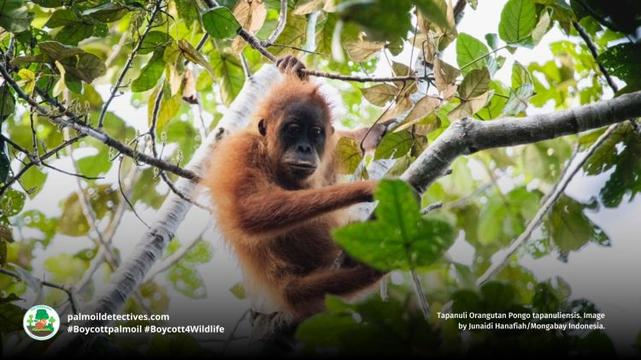
Tapanuli Orangutan Faces Extinction From Forest Protection Rollback

The world’s rarest great ape, the Tapanuli orangutan, is facing a population collapse after a devastating cyclone and a proposed zoning overhaul that threatens to strip protections from their last remaining habitat. Experts warn that weakening environmental laws and oversight now would be the “nail in the coffin” for this beautiful and intelligent species.

#News: After the deadly floods in #Sumatra, Tapanuli #orangutans face a bleak future. Now their legal protections are being stripped back to make way for more #mining. Fight back when you shop! 🧐🛍️ #BoycottPalmOil 🌴🚫 #Boycott4Wildlife @palmoildetect https://wp.me/pcFhgU-iSk

Share to BlueSky Share to Twitter

Learn more: Jong, H. N., & Muazam, A. R. (2025, December 18). Tapanuli orangutan, devastated by cyclone, now faces habitat loss under zoning plans. Mongabay.  https://news.mongabay.com/2025/12/tapanuli-orangutan-devastated-by-cyclone-now-faces-habitat-loss-under-zoning-plans/

https://youtu.be/Mf0mABb4AKQ

Reeling from a catastrophic cyclone that may have killed or displaced dozens of Tapanuli orangutans, the critically endangered species now faces a new threat: a proposed zoning overhaul in Indonesia’s North Sumatra province. Local authorities have called for scaling back the Batang Toru “provincial strategic area” by nearly a third, a move that would significantly weaken legal protections and environmental scrutiny for mining and plantation projects. If approved, approximately 39,000 hectares—nearly a third of the orangutan’s forest range—would lose the safeguards that currently prioritise ecological function and landscape-scale assessment.

The timing of this proposal is especially alarming. A recent tropical storm unleashed torrential rains and landslides that severely damaged at least 3,964 hectares of previously intact forest, potentially impacting up to 54 individuals from a total population of just 800. Scientists warn that this extreme weather event, combined with the loss of forest cover, could push the Tapanuli orangutan toward population collapse. Removing strategic protections would also facilitate the expansion of extractive industries, including a nearby gold mine that has already faced intense scrutiny for its potential impact on the species.

Provincial officials suggested the downscaling was due to a lack of capacity and budget to manage such a vast area, even proposing that the central government take over as a “national strategic area.” However, conservation groups like Mighty Earth argue that opening the door to further extractive industries in the wake of a natural disaster is an “insane idea.” They are calling for emergency protections, a halt to habitat-damaging development, and the restoration of critical forest corridors to prevent the Tapanuli orangutan from becoming the first great ape species to go extinct in modern history.

While the central government has moved to suspend some industrial operations and review logging permits in response to the floods, the future of the Batang Toru ecosystem remains uncertain. Conservationists stress that this is a critical opportunity for the government to fulfill its environmental promises rather than allowing administrative or commercial interests to seal the fate of a species on the brink.

Tapanuli Orangutan Faces Extinction From Forest Protection Rollback

Keep reading by Palm Oil Detectives

Deforestation Devastates Tesso Nilo National Park’s Endangered Creatures

Keep reading by Palm Oil Detectives

Research: AI Helps Unlock the Curious Secrets of Orangutan Chatter

Keep reading by Palm Oil Detectives

August 19th is #WorldOrangutanDay

Keep reading by Palm Oil Detectives

Apes Enjoy Joking and Teasing Each Other

Keep reading by Palm Oil Detectives

Primates are facing an impending extinction crisis – but we know very little about what will actually protect them

Keep reading by Palm Oil Detectives Load more posts

Something went wrong. Please refresh the page and/or try again.

Learn more: Jong, H. N., & Muazam, A. R. (2025, December 18). Tapanuli orangutan, devastated by cyclone, now faces habitat loss under zoning plans. Mongabay.  https://news.mongabay.com/2025/12/tapanuli-orangutan-devastated-by-cyclone-now-faces-habitat-loss-under-zoning-plans/

ENDS

Learn about other animals endangered by palm oil and other agriculture

Global South America S.E. Asia India Africa West Papua & PNG

Marsupials thought extinct for 6,000 years found in West Papua

Keep reading

Gursky’s Spectral Tarsier Tarsius spectrumgurskyae

Keep reading

Sunda Flying Lemur Galeopterus variegatus

Keep reading

Western Parotia Parotia sefilata

Keep reading

Capped Langur Trachypithecus pileatus

Keep reading

Mountain Tapir Tapirus pinchaque

Keep reading

Learn about “sustainable” palm oil greenwashing

Read more about RSPO greenwashing

Lying Fake labels Indigenous Land-grabbing Human rights abuses Deforestation Human health hazards

A 2019 World Health Organisation (WHO) report into the palm oil industry and RSPO finds extensive greenwashing of palm oil deforestation and the murder of endangered animals (i.e. biodiversity loss)

Read more

Take Action in Five Ways

1. Join the #Boycott4Wildlife on social media and subscribe to stay in the loop: Share posts from this website to your own network on Twitter, Mastadon, Instagram, Facebook and Youtube using the hashtags #Boycottpalmoil #Boycott4Wildlife.

Enter your email address

Sign Up

Join 3,180 other subscribers

2. Contribute stories: Academics, conservationists, scientists, indigenous rights advocates and animal rights advocates working to expose the corruption of the palm oil industry or to save animals can contribute stories to the website.

Wildlife Artist Juanchi Pérez

Read more

Mel Lumby: Dedicated Devotee to Borneo’s Living Beings

Read more

Anthropologist and Author Dr Sophie Chao

Read more

Health Physician Dr Evan Allen

Read more

The World’s Most Loved Cup: A Social, Ethical & Environmental History of Coffee by Aviary Doert

Read more

How do we stop the world’s ecosystems from going into a death spiral? A #SteadyState Economy

Read more

3. Supermarket sleuthing: Next time you’re in the supermarket, take photos of products containing palm oil. Share these to social media along with the hashtags to call out the greenwashing and ecocide of the brands who use palm oil. You can also take photos of palm oil free products and congratulate brands when they go palm oil free.

https://twitter.com/CuriousApe4/status/1526136783557529600?s=20

https://twitter.com/PhillDixon1/status/1749010345555788144?s=20

https://twitter.com/mugabe139/status/1678027567977078784?s=20

4. Take to the streets: Get in touch with Palm Oil Detectives to find out more.

5. Donate: Make a one-off or monthly donation to Palm Oil Detectives as a way of saying thank you and to help pay for ongoing running costs of the website and social media campaigns. Donate here

Pledge your support #animalBehaviour #AnimalBiodiversityNews #animalCruelty #animalExtinction #animalIntelligence #animalRights #Boycott4wildlife #BoycottPalmOil #deforestation #Indonesia #orangutan #orangutans #PalmOil #palmOilDeforestation #Sumatra #Tapanuli #TapanuliOrangutanPongoTapanuliensis

Marsupials thought extinct for 6,000 years found in West Papua

In an astonishing discovery, two marsupial species believed to be extinct for 6,000 years have been rediscovered alive and well in the remote rainforests of West Papua. The pygmy long-fingered possum and the ring-tailed glider were located with the crucial assistance of local indigenous Vogelkop clans. However, their survival remains precarious as their habitats are increasingly threatened by logging and the expansion of the palm oil colonialism in West Papua. Laws and native title to protect this region is essential for indigenous land defenders. We musn’t let them disappear again #BoycottPalmOil #Boycott4Wildlife

Two #extinct #marsupials in #WestPapua found alive! The #marsupials highlight the need to protect #Papuan forests or they are gone for good! Resist for them and #BoycottPalmOil #Boycott4Wildlife when you shop 🌴🙊🔥☠️🚫 @palmoildetect #Boycott4Wildlife https://wp.me/pcFhgU-iOH

Share to BlueSky Share to Twitter

Two #possums thought extinct for 6000 years are alive in #WestPapua! The pygmy #possum and sacred ring-tailed #glider deserve a break from #palmoil #ecocide. Stand with #indigenous defenders against #colonialism! 🌴🚫 @palmoildetect #BoycottPalmOil https://wp.me/pcFhgU-iOH

Share to BlueSky Share to Twitter

https://youtu.be/T1uWC5ZE4KI


Two extraordinarily rare marsupials, entirely believed to have been extinct for over six thousand years, have been discovered alive in the remote, Vogelkop mountain forests of the Bird’s Head peninsula in West Papua. This remarkable rediscovery of the pygmy long-fingered possum and the ring-tailed glider was confirmed by Australian scientist Professor Tim Flannery, alongside a team of local indigenous experts and university researchers.

“More important than finding a living thylacine in Tasmania.”

Scott Hucknull from Central Queensland University describes the magnitude of the discovery.

These species are rare examples of “Lazarus taxa”. Animals who disappear from the fossil record only to be found alive centuries later. Flannery noted that the likelihood of finding even one lost mammal was almost zero, let alone two.

“It’s unprecedented and groundbreaking, really, to find two Lazarus taxa,” Flannery says. “We’ve been able to finalise two pieces of work that are incredibly important from a biological and a conservation perspective, documenting the existence of rare marsupials in an area under threat. It’s sort of a crowning glory in my career as a biologist.”

The first of the resurrected species is the pygmy long-fingered possum, Dactylonax kambuayai. This tiny, striped marsupial possesses an extraordinary evolutionary trait: an elongated fourth finger on each hand that is double the length of other digits. Flannery explains that they use this finger to extract grubs from timber.

“They’ve got a whole lot of specialisations in their ear region as well, which seem to be related to detection of low-frequency sound. So presumably they’re listening for wood-boring beetle larvae, and they then rip open the rotting wood and use that finger to fish out the grub,” Flannery says.

The second species, the ring-tailed glider (Tous ayamaruensis), features unfurred ears and a strong, prehensile tail used for gripping branches. Flannery calls it “one of the most photogenic animals, most beautiful marsupials you’ll ever see.”

Crucially, the rediscovery of these elusive creatures was entirely dependent on the profound ecological knowledge of the local Tambrauw and Maybrat clans. These indigenous communities view the ring-tailed glider as deeply sacred, believing them to be manifestations of their ancestors’ spirits, and actively protect them from hunting. Rika Korain, a Maybrat woman and co-author of the research, emphasised that identifying the species relied entirely on traditional owners. “This connection has been essential,” she says.

“I’m very proud that Papuan researchers contributed to these landmark discoveries, and want to thank the people of the Misool, Maybrat and Tambrouw regions who supported us in the field,”

Dr Aksamina Yohanita of the University of Papua said.

“The Vogelkop is an ancient piece of the Australian continent that has become incorporated into the island of New Guinea. Its forests may shelter yet more hidden relics of a past Australia,”

Tim Flannery

To protect the remaining populations from the illegal wildlife trade, researchers are keeping their exact locations highly classified. Flannery delivered a stark warning to potential poachers regarding the animals’ survival in captivity: “They would be incredibly difficult to keep in captivity. because their diet is so highly specialised. Advanced warning for anyone who’s thinking of keeping one as a pet: it won’t live long,” he says.

While their rediscovery is a triumph, their future is highly uncertain. The proximity of power-hungry corporates intent on razing the rainforest for palm oil and timber casts a dark shadow over the region.

David Lindenmayer, an ecologist at the Australian National University, who was not involved in the study said “I am also hugely concerned about the extent of logging and land clearing happening in New Guinea,” he says. “It also makes me wonder what might have been lost in Australia as a result of all of the land clearing that has taken place here.”

The findings underline strong calls from scientists, environmentalists and indigenous rights advocates for Native Title legal land rights and indigenous-led protections of West Papua and its imperilled Vogelkop rainforest where these delightful marsupials are found.

Further information

Lam, L. (2026, March 6). Tiny possum and glider thought extinct for 6,000 years found in remote West Papua. BBC News. https://www.bbc.co.uk/news/articles/cwyg6p8g6yjo

Morton, A. (2026, March 6). Marsupials previously thought extinct for millennia discovered in New Guinea. The Guardian. https://www.theguardian.com/environment/2026/mar/05/marsupials-discovered-new-guinea

Woodford, J. (2026, March 5). Two marsupials believed extinct for 6000 years found alive. New Scientist. https://www.newscientist.com/article/2518082-two-marsupials-believed-extinct-for-6000-years-found-alive/

ENDS

Learn about other animals endangered by palm oil and other agriculture

Global South America S.E. Asia India Africa West Papua & PNG

Marsupials thought extinct for 6,000 years found in West Papua

Keep reading

Gursky’s Spectral Tarsier Tarsius spectrumgurskyae

Keep reading

Sunda Flying Lemur Galeopterus variegatus

Keep reading

Western Parotia Parotia sefilata

Keep reading

Capped Langur Trachypithecus pileatus

Keep reading

Mountain Tapir Tapirus pinchaque

Keep reading

Learn about “sustainable” palm oil greenwashing

Read more about RSPO greenwashing

Lying Fake labels Indigenous Land-grabbing Human rights abuses Deforestation Human health hazards

A 2019 World Health Organisation (WHO) report into the palm oil industry and RSPO finds extensive greenwashing of palm oil deforestation and the murder of endangered animals (i.e. biodiversity loss)

Read more

Take Action in Five Ways

1. Join the #Boycott4Wildlife on social media and subscribe to stay in the loop: Share posts from this website to your own network on Twitter, Mastadon, Instagram, Facebook and Youtube using the hashtags #Boycottpalmoil #Boycott4Wildlife.

✓ Subscribed

2. Contribute stories: Academics, conservationists, scientists, indigenous rights advocates and animal rights advocates working to expose the corruption of the palm oil industry or to save animals can contribute stories to the website.

Wildlife Artist Juanchi Pérez

Read more

Mel Lumby: Dedicated Devotee to Borneo’s Living Beings

Read more

Anthropologist and Author Dr Sophie Chao

Read more

Health Physician Dr Evan Allen

Read more

The World’s Most Loved Cup: A Social, Ethical & Environmental History of Coffee by Aviary Doert

Read more

How do we stop the world’s ecosystems from going into a death spiral? A #SteadyState Economy

Read more

3. Supermarket sleuthing: Next time you’re in the supermarket, take photos of products containing palm oil. Share these to social media along with the hashtags to call out the greenwashing and ecocide of the brands who use palm oil. You can also take photos of palm oil free products and congratulate brands when they go palm oil free.

https://twitter.com/CuriousApe4/status/1526136783557529600?s=20

https://twitter.com/PhillDixon1/status/1749010345555788144?s=20

https://twitter.com/mugabe139/status/1678027567977078784?s=20

4. Take to the streets: Get in touch with Palm Oil Detectives to find out more.

5. Donate: Make a one-off or monthly donation to Palm Oil Detectives as a way of saying thank you and to help pay for ongoing running costs of the website and social media campaigns. Donate here

Pledge your support #animalBehaviour #AnimalBiodiversityNews #animalExtinction #animalIntelligence #animalRights #biodiversity #Boycott4wildlife #BoycottPalmOil #deforestation #ForgottenAnimals #Marsupial #marsupials #PalmOil #palmOilDeforestation #PapuaNewGuinea #PapuaNewGuineaSpeciesEndangeredByPalmOilDeforestation #possum #possums #WestPapua

Trash into Treasure: Turning E-Waste and CO2 into Gold

Trash into Treasure: Turning E-Waste and CO2 into Gold | Researchers at Cornell University have developed a sustainable technique to extract gold from electronic waste and repurpose it as a catalyst to convert carbon dioxide (CO₂) into valuable organic compounds. This method addresses e-waste challenges and contributes to CO₂ reduction efforts. Help with the transition when you #BoycottGold #BoycottGold4Yanomami

#News: Cornell researchers have developed a viable method to extract #gold from #ewaste. They can convert #CO2 into #gold, tackling both electronic waste and #GHG emissions. #BoycottGold @palmoildetect #BoycottGold4Yanomami https://wp.me/pcFhgU-9PR

Share to BlueSky Share to Twitter

Cornell University. (2025, January 2). New method turns e-waste to gold. ScienceDaily. Retrieved from https://www.sciencedaily.com/releases/2025/01/250102162300.htm

In a groundbreaking study, Cornell University researchers have introduced an eco-friendly method to extract gold from electronic waste (e-waste) and utilize it as a catalyst for converting carbon dioxide (CO₂) into useful organic materials. This dual-purpose approach offers a sustainable solution to two pressing environmental issues: e-waste accumulation and CO₂ emissions.

E-waste, comprising discarded electronic devices, is a rapidly growing environmental concern, with approximately 50 million tons generated annually worldwide. Notably, a ton of e-waste contains significantly more gold than a ton of mined ore, highlighting the potential for resource recovery. Traditional gold extraction methods involve hazardous chemicals like cyanide, posing environmental and health risks. The Cornell team’s method employs chemical adsorption using vinyl-linked covalent organic frameworks (VCOFs) to selectively capture 99.9% of gold ions and nanoparticles from e-waste without harmful substances.

Once recovered, the gold-loaded VCOFs serve as catalysts to transform CO₂—a major greenhouse gas contributing to climate change—into valuable organic compounds. This process not only mitigates CO₂ levels but also produces materials beneficial for various industrial applications. Lead researcher Amin Zadehnazari emphasised the environmental and practical benefits of this approach, stating, “By transforming CO₂ into value-added materials, we not only reduce waste disposal demands, we also provide both environmental and practical benefits. It’s kind of a win-win for the environment.”

This innovative method represents a significant advancement in technology, offering a promising avenue for addressing electronic waste and carbon emissions simultaneously. The research underscores the potential of integrating waste management with environmental remediation strategies to develop comprehensive solutions for global ecological challenges.

Cornell University. (2025, January 2). New method turns e-waste to gold. ScienceDaily. Retrieved from https://www.sciencedaily.com/releases/2025/01/250102162300.htm

ENDS

Read more about deforestation and ecocide in the palm oil industry

Trash into Treasure: Turning E-Waste and CO2 into Gold

Turning E-Waste and CO2 into Gold addresses e-waste challenges and contributes to CO₂ reduction efforts. Take action and boycott gold for Yanomami people!

Read more

Do you love animals? Make every day #WorldWildlifeDay

This #WorldWildlifeDay take action for animals great and small! Reptiles insects, mammals and birds deserve better than palm oil ecocide and extinction. Make sure you Boycott palm oil

Read more

So-called ‘Net Zero’ Flights Flush Rainforest Carbon Into the Sky

Virgin Atlantic airlines now uses ‘sustainable aviation fuel’ however experts call it greenwashing and industry spin causing climate change. Boycott palm oil!

Read more

Gursky’s Spectral Tarsier Tarsius spectrumgurskyae

Gursky’s spectral tarsiers AKA Wusing of North Sulawesi are vulnerable due to palm oil and timber deforestation. Take action for them and boycott palm oil!

Read more

Forest Protection Equals Climate Protection

Forests offer climate protection and safeguard indigenous peoples, endangered animals and rare plants. Deforestation is a major threat. Boycott palm oil!

Read more Load more posts

Something went wrong. Please refresh the page and/or try again.

Take Action in Five Ways

1. Join the #Boycott4Wildlife on social media and subscribe to stay in the loop: Share posts from this website to your own network on Twitter, Mastadon, Instagram, Facebook and Youtube using the hashtags #Boycottpalmoil #Boycott4Wildlife.

✓ Subscribed

2. Contribute stories: Academics, conservationists, scientists, indigenous rights advocates and animal rights advocates working to expose the corruption of the palm oil industry or to save animals can contribute stories to the website.

Wildlife Artist Juanchi Pérez

Read more

Mel Lumby: Dedicated Devotee to Borneo’s Living Beings

Read more

Anthropologist and Author Dr Sophie Chao

Read more

Health Physician Dr Evan Allen

Read more

The World’s Most Loved Cup: A Social, Ethical & Environmental History of Coffee by Aviary Doert

Read more

How do we stop the world’s ecosystems from going into a death spiral? A #SteadyState Economy

Read more

3. Supermarket sleuthing: Next time you’re in the supermarket, take photos of products containing palm oil. Share these to social media along with the hashtags to call out the greenwashing and ecocide of the brands who use palm oil. You can also take photos of palm oil free products and congratulate brands when they go palm oil free.

https://twitter.com/CuriousApe4/status/1526136783557529600?s=20

https://twitter.com/PhillDixon1/status/1749010345555788144?s=20

https://twitter.com/mugabe139/status/1678027567977078784?s=20

4. Take to the streets: Get in touch with Palm Oil Detectives to find out more.

5. Donate: Make a one-off or monthly donation to Palm Oil Detectives as a way of saying thank you and to help pay for ongoing running costs of the website and social media campaigns. Donate here

Pledge your support

#Boycott4wildlife #BoycottGold #BoycottGold4Yanomami #CO2 #corruption #deforestation #ewaste #GHG #gold #News #PalmOil #palmOilBiofuel #palmOilDeforestation

Do you love animals? Make every day #WorldWildlifeDay

This #WorldWildlifeDay, please remember the wild animals you love who are running out of time and land to live on. Research recently found that converting partly logged areas into palm oil plantations sounds the death knell for that ecosystem. Across the globe, from Indonesia to Brazil and Nigeria, vibrant rainforests and animals like reptiles and insects are under threat from palm oil, timber, and meat. This ecocide leaves majestic animals struggling to survive against chainsaws, bulldozers, pesticides and destruction for palm oil and meat agriculture. A multi-billion dollar industry has grown up around legitimising palm oil and meat ecocide, primarily through the RSPO but also other greenwashing schemes as well. Read on to discover more and how you can shine a light on the lives of elusive animals.

This #WorldWildlifeDay take action for #animals great and small 🦋🐦🐘🐒🐍 because #reptiles #insects #mammals and #birds deserve better than #palmoil ecocide and #extinction! When you shop always #Boycottpalmoil #Boycott4Wildlife @palmoildetect https://wp.me/pcFhgU-iMO

Share to BlueSky Share to Twitter

#Palmoil and #meat #agriculture 🥩💀 are some of the biggest threats to wild #animals and farmed animals. This #WorldWildlifeDay and every single day, make sure fight for them and go #vegan 🥕🍆🍅 #BoycottPalmOil 🌴🩸☠️🧐⛔️ and #Boycott4Wildlife https://wp.me/pcFhgU-iMO

Share to BlueSky Share to Twitter

https://youtu.be/98s3YF9UAfs

Protecting Sumatra’s last remaining tigers

The Sumatran tiger is teetering on the brink of extinction. Recent findings underscore the urgency of protecting the last remaining populations of these majestic apex predators. Deforestation for palm oil and illegal poaching are wiping out their homes. In the Ulu Masen Ecosystem, a recent study detected only 11 tigers, highlighting severe population stress from snares and habitat loss. Without immediate action, they face the same tragic fate as the extinct Javan and Balinese tigers. Strict global rainforest laws, enforcement of anti-poaching units, and a consumer boycott of palm oil hold the key to protecting Sumatra’s last living tigers.​

https://youtu.be/0g2Nv4cfBfo

Animals of Tesso Nilo in Sumatra are vanishing

Tesso Nilo National Park in Sumatra has lost an alarming 78% of primary forest between 2009 and 2023. The primary driver of this devastation is the expansion of illegal palm oil plantations. This rampant deforestation threatens the homes of critically endangered species like tigers, orangutans, and elephants. When palm oil companies build roads, they increase accessibility for poachers, further endangering the animals who live there. Advocating for indigenous-led conservation efforts and adopting a plant-based lifestyle are vital steps to protect these ecosystems.​

https://www.youtube.com/watch?v=z7FUBg_AqjA

56% of ‘data deficient’ species on the Red List are endangered

The destruction of wild ecosystems continues to push thousands of obscure species towards extinction finds a study by Norwegian University of Science and Technology. Researchers used advanced machine learning algorithms to assess the survival probability of thousands of under-researched animals, predicts that a staggering fifty-six percent of all “data deficient” species are currently threatened with extinction. 85% of unassessed amphibians face immediate existential threats, primarily driven by anthropogenic habitat degradation such as the unchecked expansion of palm oil plantations, meat agriculture, mining and timber logging. Right now is the time to fight for all life and reject products linked to ecocide. Always remember them and share out their posts! Start here on the forgotten animals page.

These are the forgotten animals of the secretly destroyed forests

Sumatran elephants trapped by endless palm oil

In Indonesia’s North Aceh district, Sumatran elephants find themselves increasingly encircled by shrinking patches of forest, hemmed in all all sides by massive palm oil expansion. Just 924 to 1,360 individual Sumatran elephants remain alive. They are trapped in dead lands, surrounded by the very industry that is eradicating their food sources. Ongoing attempts by researchers to measure their populations have been hampered by the Indonesian government, which attempts to hide the truth from the media. Boycott palm oil when you shop to protect these irreplaceable beings.​

https://youtu.be/S5olrnYKT4Q

Toxic palm oil pesticides are killing baby macaques

In Peninsular Malaysia, infant southern pig-tailed macaques are dying at alarmingly high rates due to palm oil plantations. A recent study found that agricultural chemicals and pesticides cross the placental barrier of unborn macaques, impacting their development. Prolonged exposure to these toxic plantations during infancy makes baby macaques three times more likely to die. These intelligent primates face increased risks from predators, human encounters, and poisons. Take action and boycott palm oil to protect these precious infants.

The fight for the lives of Wondiwoi tree kangaroos

The Wondiwoi tree kangaroo is the world’s most endangered kangaroo. Rediscovered in 2018 in West Papua’s lush forests, these rare animals have beautiful soulful eyes and burnt umber fur. Tragically, fewer than 50 of them remain alive. They face severe threats from hunting and palm oil deforestation. Protecting them requires urgent conservation efforts that prioritise indigenous sovereignty. You can help save these remarkable creatures by refusing to buy products with palm oil that destroy their homes.​

Nigeria’s forest elephants face extinction

African forest elephants in Nigeria have seen their numbers decline massively in recent years. The main cause is human activity, specifically logging, cocoa agriculture, and palm oil plantations. These industries threaten their survival by destroying their natural habitat. As a result, fragmented elephant populations are highly vulnerable to poachers and retaliatory killings by farmers. We must halt the expansion of palm oil to secure a safe future for these majestic animals.​

https://youtu.be/s584AP-BYm0

The deadly green lie of “sustainable” palm oil

For decades, the palm oil industry has misled consumers with the false promise of “sustainable” palm oil. Industry watchdogs have repeatedly exposed the RSPO’s certification as a multi-stakeholder sham. Behind this green façade lies a brutal reality of deforestation, human rights abuses, and the destruction of endangered species’ habitats. There is no such thing as sustainable palm oil. We must not fall for their corporate greenwashing.​

https://www.youtube.com/watch?v=eG8V-Cmj4Es

Take action to protect rainforest animals

By holding to account the powerful corporations that control the world, we have the power to fight back against this ecocide. Here is how you can stand up for rainforest animals, farmed animals, indigenous people, and rainforests:

Make powerful lifestyle changes

The most impactful thing you can do is go plant-based in your diet. Boycott meat, boycott palm oil, and boycott dairy. These industries are the leading causes of global deforestation and animal cruelty.​

Supermarket sleuthing

Next time you are in the supermarket, take photos of products containing palm oil. Share these on social media to call out the greenwashing and ecocide of the brands who use it. Congratulate brands when they go completely palm oil-free.​

Join the #Boycott4Wildlife movement

Follow and join the Boycott4Wildlife movement on this website and social media. Share stories on BlueSky, Mastodon, Twitter and YouTube using the hashtags #Boycottpalmoil and #Boycott4Wildlife to be part of it!

Support indigenous sovereignty and agroecology

A viable path forward is to champion indigenous-led agroecology. Indigenous peoples possess the deep ecological knowledge required to protect forests and the intricate web of life that includes insects, birds, mammals and reptiles. Stand strongly with indigenous land defenders to protect what remains of the wild.

Learn about other animals endangered by palm oil and other agriculture

Global South America S.E. Asia India Africa West Papua & PNG

Gursky’s Spectral Tarsier Tarsius spectrumgurskyae

Keep reading

Sunda Flying Lemur Galeopterus variegatus

Keep reading

Western Parotia Parotia sefilata

Keep reading

Capped Langur Trachypithecus pileatus

Keep reading

Mountain Tapir Tapirus pinchaque

Keep reading

Saola Pseudoryx nghetinhensis

Keep reading

Learn about “sustainable” palm oil greenwashing

Read more about RSPO greenwashing

Lying Fake labels Indigenous Land-grabbing Human rights abuses Deforestation Human health hazards

A 2019 World Health Organisation (WHO) report into the palm oil industry and RSPO finds extensive greenwashing of palm oil deforestation and the murder of endangered animals (i.e. biodiversity loss)

Read more

Take Action in Five Ways

1. Join the #Boycott4Wildlife on social media and subscribe to stay in the loop: Share posts from this website to your own network on Twitter, Mastadon, Instagram, Facebook and Youtube using the hashtags #Boycottpalmoil #Boycott4Wildlife.

✓ Subscribed

2. Contribute stories: Academics, conservationists, scientists, indigenous rights advocates and animal rights advocates working to expose the corruption of the palm oil industry or to save animals can contribute stories to the website.

Wildlife Artist Juanchi Pérez

Read more

Mel Lumby: Dedicated Devotee to Borneo’s Living Beings

Read more

Anthropologist and Author Dr Sophie Chao

Read more

Health Physician Dr Evan Allen

Read more

The World’s Most Loved Cup: A Social, Ethical & Environmental History of Coffee by Aviary Doert

Read more

How do we stop the world’s ecosystems from going into a death spiral? A #SteadyState Economy

Read more

3. Supermarket sleuthing: Next time you’re in the supermarket, take photos of products containing palm oil. Share these to social media along with the hashtags to call out the greenwashing and ecocide of the brands who use palm oil. You can also take photos of palm oil free products and congratulate brands when they go palm oil free.

https://twitter.com/CuriousApe4/status/1526136783557529600?s=20

https://twitter.com/PhillDixon1/status/1749010345555788144?s=20

https://twitter.com/mugabe139/status/1678027567977078784?s=20

4. Take to the streets: Get in touch with Palm Oil Detectives to find out more.

5. Donate: Make a one-off or monthly donation to Palm Oil Detectives as a way of saying thank you and to help pay for ongoing running costs of the website and social media campaigns. Donate here

Pledge your support #animalBehaviour #AnimalBiodiversityNews #animalCommunication #animalCruelty #animalExtinction #animalIntelligence #animalRights #biodiversity #Boycott4wildlife #BoycottPalmOil #deforestation #PalmOil #palmOilDeforestation #WorldWildlifeDay

So-called ‘Net Zero’ Flights Flush Rainforest Carbon Into the Sky

Virgin Atlantic airlines now uses ‘sustainable aviation fuel’ – a technology it claims will result in ‘Net Zero’ flights. However experts and researchers have lambasted this #aviation and #palmoil industry promotion as #greenwashing. They cite problematic evidence that using Sustainable Aviation Fuel or #SAF in #airlinefuel will undermine goals of keeping climate warming below 1.5°. In the meantime, despite the greenwash and industry spin, SAF is poised to flush gigatonnes of #rainforest #carbon into the sky exacerbating #climatechange. #BoycottPalmOil #Boycott4Wildlife

Is #SAF or “Sustainable” Aviation Fuel really a #climate saviour? Or just a greedy #greenwashing lie about #palmoil #deforestation? 🤮🌴🔥 Cut through the BS with this article by Open Democracy #Boycottpalmoil #Boycott4Wildlife @palmoildetect https://wp.me/pcFhgU-9cg

Share to BlueSky Share to Twitter

Despite #aviation ✈️ and #palmoil industry #greenwashing, #climate experts predict “Sustainable” Aviation Fuel or #SAF will flush gigatonnes of rainforest #carbon into the sky. We demand better! #Boycottpalmoil #Boycott4Wildlife 🌴 🔥🚫 @palmoildetect https://wp.me/pcFhgU-9cg

Share to BlueSky Share to Twitter

Written by Ben Webster for Open Democracy, read original article. Republished under the Creative Commons Attribution Licence.

Virgin Atlantic and the UK government have been accused of misleading the public over what they claim will be “the world’s first net zero transatlantic flight” ahead of next week’s COP28 summit.

The Department for Transport said the flight, scheduled for Tuesday, was “ushering in a new era of guilt-free flying” because it will run entirely on so-called “sustainable aviation fuel” (SAF).

But openDemocracy revealed concerns earlier this year that SAF production in the UK may be linked to deforestation.

A stock image of a Virgin Atlantic Airways Boeing 787 Dreamliner, pictured on the approach to Heathrow Airport | Nicolas Economou/NurPhoto via Getty Images

“There are some incredible double standards at play here,” said Matt Finch, UK policy manager of green campaign group Transport & Environment.

The SAF market in the UK is largely dependent on used cooking oil from Asia – where sellers are suspected of passing off unused palm oil as waste in order to attract lucrative credits. This is a particular problem for the environment, as producing palm oil drives deforestation.

Virgin last year bought more than 600,000 litres of “used” cooking oil from China and Indonesia to turn into SAF and mix with regular fuel for routine flights. Although it says the raw material for next week’s flight from London to New York will come purely from Europe and the US, the airline admitted it was still buying “feedstocks” from Asia for further SAF production this year.

“Some British airlines are – right now – greenwashing themselves by using used cooking oil made from Asian feedstocks,” said Finch.

“If airlines were genuinely trying to be sustainable, they would stop right now because of the huge risk of rogue palm oil getting into the SAF supply chain.”

https://youtu.be/1Ly5kJcsFhc?si=Q4ejK3-8KA0lwD8R

Green Lie of “Sustainable” Aviation Biofuel

“Sustainable” Aviation Fuel (SAF) is a biofuel alternative to using fossil fuels for powering planes and cars. SAF is being aggressively marketed by multiple industries as a greener alternative to burning fossil fuels in cars and airplanes.

However, SAF is produced from food crops such as rapeseed, palm oil, soy and sugar cane. This…

by Palm Oil DetectivesJanuary 7, 2024March 23, 2025

Net zero target

The aviation industry claims that SAF – which is almost all made from either biofuel crops or waste – could deliver around 65% of the reduction in emissions needed for airlines to reach net zero in 2050.

Under the Renewable Transport Fuels Obligation (RTFO), the government allows used cooking oil to be used to make the fuel. It currently accounts for the vast majority of SAF declared in the UK, most of which comes from Asia.

In 2024 alone, British airlines have bought more than 26 million litres of used Asian cooking oil – including 18 million litres from Malaysia, five million from China and two million from Indonesia.

Only about 15% of the used cooking oil purchased by airlines in 2023 has come from European sources, mainly the UK and the Netherlands.

Investigations suggest there is a high risk of fraud in the supply of biofuel from Asia, with particular concern over virgin palm oil being passed off as used cooking oil.

Labelling virgin palm oil as used makes it more valuable, partly because waste products earn double credits under the UK government’s rules for sustainable fuels.

Even genuine used cooking oil can indirectly cause deforestation because countries export waste oil they would otherwise have used domestically, and instead use virgin palm oil to meet their own local demand, according to T&E.

The campaign group says used cooking oil from Asia would be more effective at cutting emissions if it were used to replace diesel in road vehicles in the countries where it was produced – rather than being shipped across the world to be refined, using additional energy, into jet fuel.

The Royal Society, which represents the UK’s leading scientists, has also warned that an area at least half the size of the UK would be needed to grow enough biofuel crops to meet existing aviation demand in the UK alone. Increased levels of recycling are also likely to mean less waste material is available for making the fuel.

Green fuel mandate

Commercial jet engines are currently allowed to burn a maximum of 50% SAF, which is blended with traditional kerosene jet fuel. But next week’s demonstration flight is expected to show that it is safe to use 100% SAF. It is being funded with a government grant of up to £1m.

It comes only weeks before the government is due to announce details about the so-called “SAF mandate”, which will require at least 10% of jet fuel in the UK to come from “sustainable sources” by 2030.

The Department for Transport (DfT) is planning to cap the amount of used cooking oil and animal fat that airlines can use to meet this obligation, because demand could divert the products away from efforts to decarbonise road transport.

The cap, though, could be as high as 250 million litres a year of waste fats and oils.

Finch of T&E said: “The SAF mandate will be the biggest environmental regulation applied to UK aviation ever, and the government has a choice to make: should it carry on allowing SAF to be made from feedstocks that have dubious environmental benefits, or should it ensure that the sustainability criteria it sets genuinely achieve carbon reductions? Used cooking oil should be banned from UK planes.”

‘Undermining’ climate goals

Virgin and other UK airlines say their SAF has been certified by International Sustainability and Carbon Certification (ISCC), a scheme governed by a board that includes an executive from Air BP – one of Virgin’s SAF suppliers.

ISCC has nonetheless taken some action over SAF mis-selling. It launched an investigation this year into “potentially fraudulent behaviour” involving biodiesel that had been declared as waste from Indonesia or Malaysia and then exported from China to Europe.

It also suspended the sustainability certification of three Chinese biofuel exporters and last month pledged to clamp down on fraud by implementing “a traceability database by the end of the year”.

A Virgin Atlantic spokesperson told openDemocracy: “With all SAF purchases, we require suppliers to comply with applicable sustainability standards. In respect of HEFA (Hydrogenated Esters and Fatty Acids) SAF, we ask suppliers to ensure that feedstocks do not contain palm oil or its derivatives.

“SAF is an emerging industry and we source feedstocks from regions around the world and ask that suppliers undertake robust due diligence to ensure there is no palm oil or derivatives.”

However, the Aviation Environment Federation says the aviation industry’s enthusiasm for SAF is obscuring the urgent need for genuinely sustainable solutions to aviation emissions, including development of zero emission aircraft and an overall reduction in flying.

Even if every drop of used cooking oil available globally were refined into jet fuel, there would only be enough to power about one in every 40 flights, according to estimates by sustainable fuel consultancy Cerulogy.

The aviation industry says it is developing alternative sources of sustainable aviation fuel, including “non-edible industrial corn”, “forestry residues” and household waste.

But a study in August by Manchester Metropolitan University challenged the industry’s claims that sustainable aviation fuel can drastically cut emissions.

It said: “The scaling up of SAF to not only maintain but grow global aviation is problematic as it competes for land needed for nature-based carbon removal, clean energy that could more effectively decarbonise other sectors, and captured CO2 to be stored permanently. As such, SAF production undermines global goals of limiting warming to 1.5°C.”

Cait Hewitt, policy director of the Aviation Environment Federation, said one flight using 100% SAF “will make no difference to the fact that only 2.6% of UK aviation fuel is anything other than kerosene. And globally, the figure is more like 0.1%.”

She said the industry and DfT were wrong to suggest that waste-based SAF could be scaled up sustainably.

“It’s a nice idea to make fuel out of rubbish, which is what the UK government and others are pushing for, but producing more rubbish to turn into plane fuel is pretty obviously not a sustainable long-term option.”

She also said it was misleading to claim, as the DfT has, that SAF cuts greenhouse gas emissions by 70%.

“Even using 100% SAF, as with the forthcoming Virgin Atlantic flight, reduces tailpipe emissions by 0% compared with using kerosene. Any CO2 savings will be net savings, just as with carbon offsets.”

She said the flight would not achieve any net CO2 savings unless Virgin and the DfT could demonstrate that more carbon had been captured than would have happened anyway.

A Department for Transport spokesperson said: “Our sustainable aviation fuel programme is one of the most comprehensive in the world.

“We require that the fuel used [for the 100% SAF flight] must meet the specified sustainability criteria. However, it is for the operator and their fuel suppliers to determine the exact nature of the fuel within these parameters. Fuel suppliers are subject to independently verified checks to confirm the authenticity of their materials.”

Written by Ben Webster for Open Democracy, read original article. Republished under the Creative Commons Attribution Licence.

ENDS

Read more about deforestation and air pollution, climate change and palm oil deforestation

So-called ‘Net Zero’ Flights Flush Rainforest Carbon Into the Sky

Virgin Atlantic airlines now uses ‘sustainable aviation fuel’ however experts call it greenwashing and industry spin causing climate change. Boycott palm oil!

Read more

Forest Protection Equals Climate Protection

Forests offer climate protection and safeguard indigenous peoples, endangered animals and rare plants. Deforestation is a major threat. Boycott palm oil!

Read more

World’s Wealthiest Drive Two Thirds of Global Warming Since 1990

Wealthiest people in USA and China responsible for 2/3 of global warming since 1990. Climate policies needed to target the richest people on the planet now!

Read more

Mountain Tapir Tapirus pinchaque

Mountain Tapirs are the most threatened large mammals of the northern Andes, hunting, climate change and mining are threats, take action and boycott gold!

Read more

Saola Pseudoryx nghetinhensis

Saolas are rare and considered Southeast Asia’s ‘unicorns’, this Critically Endangered antelope is facing imminent extinction due to hunting and deforestation

Read more Load more posts

Something went wrong. Please refresh the page and/or try again.

Take Action in Five Ways

1. Join the #Boycott4Wildlife on social media and subscribe to stay in the loop: Share posts from this website to your own network on Twitter, Mastadon, Instagram, Facebook and Youtube using the hashtags #Boycottpalmoil #Boycott4Wildlife.

Enter your email address

Sign Up

Join 3,178 other subscribers

2. Contribute stories: Academics, conservationists, scientists, indigenous rights advocates and animal rights advocates working to expose the corruption of the palm oil industry or to save animals can contribute stories to the website.

Wildlife Artist Juanchi Pérez

Read more

Mel Lumby: Dedicated Devotee to Borneo’s Living Beings

Read more

Anthropologist and Author Dr Sophie Chao

Read more

Health Physician Dr Evan Allen

Read more

The World’s Most Loved Cup: A Social, Ethical & Environmental History of Coffee by Aviary Doert

Read more

How do we stop the world’s ecosystems from going into a death spiral? A #SteadyState Economy

Read more

3. Supermarket sleuthing: Next time you’re in the supermarket, take photos of products containing palm oil. Share these to social media along with the hashtags to call out the greenwashing and ecocide of the brands who use palm oil. You can also take photos of palm oil free products and congratulate brands when they go palm oil free.

https://twitter.com/CuriousApe4/status/1526136783557529600?s=20

https://twitter.com/PhillDixon1/status/1749010345555788144?s=20

https://twitter.com/mugabe139/status/1678027567977078784?s=20

4. Take to the streets: Get in touch with Palm Oil Detectives to find out more.

5. Donate: Make a one-off or monthly donation to Palm Oil Detectives as a way of saying thank you and to help pay for ongoing running costs of the website and social media campaigns. Donate here

Pledge your support

#airPollution #airlinefuel #aviation #Boycott4wildlife #BoycottPalmOil #carbon #Climate #climateChange #climatechange #corruption #deforestation #greenwashing #PalmOil #palmOilBiofuel #palmOilDeforestation #palmoil #rainforest #SAF

Gursky’s Spectral Tarsier Tarsius spectrumgurskyae

Gursky’s Spectral Tarsier Tarsius spectrumgurskyae

IUCN Red List Status: Vulnerable

Location: Indonesia (Sulawesi)

Found across the northern peninsula of Sulawesi in Indonesia, including from the northern tip to the Isthmus of Gorontalo, in primary forest, mangroves, and disturbed habitats with dense cover.

The Gursky’s spectral tarsier Tarsius spectrumgurskyae, also known locally as Wusing, is a recently recognised species of tarsier from northern Sulawesi. Listed as Vulnerable by the IUCN, they have lost more than 30% of their habitat in the past two decades. #Deforestation for #palmoil and #timber, agricultural encroachment, illegal logging, and the #pettrade all threaten their fragile populations. Their survival depends on wild spaces thick with shrubby undergrowth—the very places being rapidly erased. If you love unique #primates like the spectral #tarsier, use your voice and wallet to protect their forest home. #BoycottPalmOil #Boycott4Wildlife

https://youtu.be/FqrauXhLBcY

Known locally as ‘Wusing’, Gursky’s Spectral #Tarsiers have enormous moon-like eyes to help them see in dark forests 🌛👀😽 #Palmoil and the #pet trade are serious threats. Help them survive when you #Boycottpalmoil 🌴🚜❌ #Boycott4Wildlife @palmoildetect https://palmoildetectives.com/2026/02/22/gurskys-spectral-tarsier-tarsius-spectrumgurskyae/

Share to BlueSky Share to Twitter

Found in tree hollows of #Sulawesi #Indonesia, tiny #primates 🐵🧐 Gursky’s Spectral #Tarsiers are #carnivores with their food, #insects 🪲🦗 being poisoned by #palmoil and #pesticides ☠️ Fight for them! #Boycottpalmoil #Boycott4Wildlife @palmoildetect https://palmoildetectives.com/2026/02/22/gurskys-spectral-tarsier-tarsius-spectrumgurskyae/

Share to BlueSky Share to Twitter

Appearance & Behaviour

Gursky’s spectral tarsiers also known locally as ‘Wusing’ are hauntingly beautiful tiny #primates with enormous, forward-facing eyes that shine like twin moons in the night. These tiny nocturnal primates have a soft, greyish pelage and elongated fingers adapted for gripping tree branches. They are famed for their extreme leaping ability, known as vertical clinging and leaping (VCL), allowing them to spring through the forest canopy with precision and grace.

Highly social and vocal, they live in monogamous or polygamous groups of 2–11 individuals. At dawn, their eerie territorial duets echo through the forest just before they return to their sleeping sites in dense foliage or tree cavities. They are shy, elusive, and deeply dependent on forest structure to hide, hunt, and sleep.

Threats

Habitat Loss from Illegal Logging

The primary threat to Gursky’s spectral tarsier is the ongoing destruction of Sulawesi’s forests due to illegal logging. These small nocturnal primates depend on dense understorey vegetation and tree cavities for shelter and foraging. When forests are cleared, their sleeping sites vanish and prey becomes scarce, forcing them into smaller, fragmented patches of habitat. Even moderate disturbance causes a sharp drop in population density—from over 150 individuals/km² to as few as 45 in degraded areas (Merker, 2003).

Agricultural Expansion and Palm Oil Plantations

Much of the Gursky’s Spectral Tarsier’s lowland habitat has already been converted to palm oil and timber agriculture, and expansion continues. Between 1990 and 2000, 15.26% of Sulawesi’s forests were cleared for crops, with at least 10% more lost since then (Salim, pers. comm. in IUCN, 2020). Palm oil plantations are one of the main drivers of this forest conversion. Although the species can survive in agroforestry and disturbed areas, their numbers drastically decline when natural vegetation is replaced with monocultures.

Pesticide Exposure from Nearby Farms

Chemical pesticides used in adjacent agricultural zones contaminate the tarsiers’ insect prey, leading to bioaccumulation and poisoning. Tarsiers consume a diet entirely composed of live animal prey, mostly insects, which makes them highly vulnerable to pesticide residues. Ingestion of contaminated insects can lead to neurological damage, reproductive failure, or death, further weakening populations in edge habitats near farmlands.

Predation by Domestic Animals

Domestic dogs and cats introduced into forested areas pose a significant predation risk to tarsiers. These animals often accompany humans into disturbed or agricultural areas, where they hunt or scavenge. Tarsiers are small-bodied, slow on the ground, and often descend to low levels of the forest, making them easy targets. Predation by pets fragments already-vulnerable populations and disrupts group dynamics.

Illegal Capture for the Pet Trade

Although not widespread, the illegal pet trade is an emerging threat. Gursky’s spectral tarsiers are occasionally taken from the wild to be sold in local markets or online. These sensitive, nocturnal animals suffer tremendously in captivity, often dying due to stress, malnutrition, or improper care. Removing them from the wild also breaks apart family groups and contributes to long-term population decline.

Geographic Range

Gursky’s spectral tarsier is endemic to Indonesia, restricted to northern Sulawesi, from the northern tip of the peninsula to the Isthmus of Gorontalo. Their habitat includes lowland primary forests, secondary growth, mangroves, and areas with some human disturbance, such as agroforestry and selectively logged landscapes. However, their density drops dramatically as habitat degradation increases.

Diet

Their diet is 100% carnivorous, consisting entirely of live animal prey. They primarily consume insects such as moths and crickets but also hunt small vertebrates like frogs and lizards. Their night-time hunting is punctuated by bursts of movement and quiet observation as they stalk their prey through the understorey.

Mating and Reproduction

Although detailed reproductive data are scarce for this species, Gursky’s spectral tarsiers likely follow similar breeding patterns to other tarsiers. They are known to breed throughout the year, producing one offspring at a time after a gestation period of about six months. The young are born furred and open-eyed, clinging to their parent as they learn to navigate the trees.

FAQs

How many Gursky’s spectral tarsiers are left in the wild?

Precise population numbers of these tarsiers are not known, but density estimates suggest that in pristine habitats, up to 156 individuals per km² may exist (Gursky, 1997). However, in heavily degraded areas, this number can plummet to as low as 45 individuals per km² (Merker, 2003). Their fragmented range and habitat loss make accurate counts difficult, but population declines are expected to continue if deforestation is not halted.

What is their lifespan in the wild?

While specific data for Tarsius spectrumgurskyae is not available, other tarsier species can live between 8–12 years in the wild. In captivity, where threats like predation are removed, their lifespan may be slightly longer. However, these animals do not thrive in captivity and should never be kept as pets.

What challenges do they face in conservation?

One major challenge is habitat degradation due to logging, agriculture, and the spread of palm oil plantations. Though they can tolerate some disturbance, their population density drops significantly with increasing habitat destruction. Additionally, their small size and elusive nature make them difficult to monitor, and they are sometimes misidentified as other tarsier species, complicating conservation strategies.

Do Gursky’s spectral tarsiers make good pets?

No. These sensitive and social primates should never be kept as pets. Capturing them from the wild is cruel and contributes directly to population collapse. It destroys their family groups, causes immense suffering, and feeds into illegal wildlife trade networks. If you care about their survival, never buy a wild animal and advocate against exotic pet ownership.

Take Action!

The future of the Gursky’s spectral tarsier hangs by a thread. Forests are falling at an alarming rate, replaced with monocultures and poisoned with pesticides. Speak up. Refuse to fund deforestation-driven industries. Boycott palm oil. Protect what’s left of Sulawesi’s dwindling forests and support indigenous-led conservation efforts. Never buy wildlife as pets. #BoycottPalmOil #Boycott4Wildlife #Vegan #BoycottMeat

Support Gursky’s Tarsiers by going vegan and boycotting palm oil in the supermarket, it’s the #Boycott4Wildlife

Support the conservation of this species

This animal has no protections in place. Read about other forgotten species here. Create art to support this forgotten animal or raise awareness about them by sharing this post and using the #Boycottpalmoil #Boycott4Wildlife hashtags on social media. Also you can boycott palm oil in the supermarket.

Further Information

Shekelle, M., Groves, C. P., Maryanto, I., & Mittermeier, R. A. (2017). Two new tarsier species (Tarsiidae, Primates) and the biogeography of Sulawesi, Indonesia. Primate Conservation, 31, 37–56. https://researchportalplus.anu.edu.au/en/publications/two-new-tarsier-species-tarsiidae-primates-and-the-biogeography-o

Shekelle, M. 2020. Tarsius spectrumgurskyaeThe IUCN Red List of Threatened Species 2020: e.T162336422A162336580. https://dx.doi.org/10.2305/IUCN.UK.2020-3.RLTS.T162336422A162336580.en. Accessed on 06 April 2025.

Wikipedia. (n.d.). Gursky’s spectral tarsier. Retrieved April 6, 2025, from https://en.wikipedia.org/wiki/Gursky%27s_spectral_tarsier

How can I help the #Boycott4Wildlife?

Take Action in Five Ways

1. Join the #Boycott4Wildlife on social media and subscribe to stay in the loop: Share posts from this website to your own network on Twitter, Mastadon, Instagram, Facebook and Youtube using the hashtags #Boycottpalmoil #Boycott4Wildlife.

Enter your email address

Sign Up

Join 3,179 other subscribers

2. Contribute stories: Academics, conservationists, scientists, indigenous rights advocates and animal rights advocates working to expose the corruption of the palm oil industry or to save animals can contribute stories to the website.

Wildlife Artist Juanchi Pérez

Read more

Mel Lumby: Dedicated Devotee to Borneo’s Living Beings

Read more

Anthropologist and Author Dr Sophie Chao

Read more

Health Physician Dr Evan Allen

Read more

The World’s Most Loved Cup: A Social, Ethical & Environmental History of Coffee by Aviary Doert

Read more

How do we stop the world’s ecosystems from going into a death spiral? A #SteadyState Economy

Read more

3. Supermarket sleuthing: Next time you’re in the supermarket, take photos of products containing palm oil. Share these to social media along with the hashtags to call out the greenwashing and ecocide of the brands who use palm oil. You can also take photos of palm oil free products and congratulate brands when they go palm oil free.

https://twitter.com/CuriousApe4/status/1526136783557529600?s=20

https://twitter.com/PhillDixon1/status/1749010345555788144?s=20

https://twitter.com/mugabe139/status/1678027567977078784?s=20

4. Take to the streets: Get in touch with Palm Oil Detectives to find out more.

5. Donate: Make a one-off or monthly donation to Palm Oil Detectives as a way of saying thank you and to help pay for ongoing running costs of the website and social media campaigns. Donate here

Pledge your support

Learn about other animals endangered by palm oil and other agriculture

Global South America S.E. Asia India Africa West Papua & PNG

Gursky’s Spectral Tarsier Tarsius spectrumgurskyae

Keep reading

Sunda Flying Lemur Galeopterus variegatus

Keep reading

Western Parotia Parotia sefilata

Keep reading

Capped Langur Trachypithecus pileatus

Keep reading

Mountain Tapir Tapirus pinchaque

Keep reading

Saola Pseudoryx nghetinhensis

Keep reading

Learn about “sustainable” palm oil greenwashing

Read more about RSPO greenwashing

Lying Fake labels Indigenous Land-grabbing Human rights abuses Deforestation Human health hazards

A 2019 World Health Organisation (WHO) report into the palm oil industry and RSPO finds extensive greenwashing of palm oil deforestation and the murder of endangered animals (i.e. biodiversity loss)

Read more

#animals #Boycott4wildlife #BoycottMeat #BoycottPalmOil #BoycottPesticides #carnivores #deforestation #ForgottenAnimals #GurskySSpectralTarsierTarsiusSpectrumgurskyae #hunting #illegalPetTrade #Indonesia #insects #nocturnal #PalmOil #palmOilDeforestation #palmoil #pesticide #pesticides #pet #petTrade #pettrade #poaching #Primate #primates #primatology #Sulawesi #tarsier #tarsiers #timber #vegan #vulnerable #VulnerableSpecies

Forest Protection Equals Climate Protection

#Forests are critical for #climate protection and for safeguarding indigenous peoples, endangered animals and rare plants. However global #deforestation targets and environmental legislation is lax and falling short. Strong international law is needed to curb deforestation. Along with proactive support for #Indigenous land rights, #agroecology and decolonisation. Act now and help the climate, be #vegan #BoycottPalmOil #Boycott4Wildlife

Strict #legal protections are needed to protect #forests, #indigenous peoples and #endangered animals 🐒🦎🦬 from #extinction. Reject the #ecocide! When you shop be #vegan #Boycottpalmoil 🌴🚫 #Boycott4Wildlife @palmoildetect https://wp.me/pcFhgU-8U5

Share to BlueSky Share to Twitter

Governments and law-makers must urgently act to protect #rainforests 🌳🌲 #animals 🐘🐯🦍 and #indigenous peoples from disappearing finds new #report. Help them survive and #BoycottGold4Yanomami #Boycottpalmoil #Boycott4Wildlife @palmoildetect https://wp.me/pcFhgU-8U5

Share to BlueSky Share to Twitter

Written by Mary Gagen, Professor of Physical Geography, Swansea University This article is republished from The Conversation under a Creative Commons license. Read the original article.

The world is falling behind on commitments to protect and restore forests, according to the recent Forest Declaration Assessment. There is no serious pathway to fixing climate change while forest losses continue at current rates, because global climate targets, sustainable development goals and forest commitments depend on each other.

Around 1.6 billion people live close enough to forests to depend upon them for their livelihoods, and forests suck down about a third of our CO₂ emissions from fossil fuels.

Amazon rainforest. PxFuel

The UN estimates that forests directly generate US$250 billion (£206 billion) in economic activity a year. Their broader, indirect, value might be as much as US$150 trillion (£12 trillion) per year – double the value of global stocks – largely due to their ability to store carbon. Despite this, subsidies still provide incentives for people to convert forests into agriculture.

Big Business: Failing Promises

There have been multiple global commitments to forests, with hundreds of governments and businesses signing up to pledges named after cities they were signed in: Bonn in 2011, New York in 2014, Glasgow in 2021. But these pledges have not been realised, and deforestation reduction targets are slipping each year.

Global deforestation between 2010 and 2022, in million hectares. Forest Declaration Assessment 2023, CC BY-SA

Global forest loss in 2022 was 6.6 million hectares, an area about the size of Ireland. That’s 21% more than the amount that would keep us on track to meet the target of zero deforestation by 2030, agreed in Glasgow. The loss of tropical rainforest is even more pronounced: 33% over the target needed. Deforestation in 2022 marked a 4% step back on 2021 progress.

Why we are failing to protect forests

There isn’t one simple explanation for why forests are still disappearing. Factors include a lack of Indigenous Peoples rights to their territories, forest-harming financial and trade systems, and the physical effects of climate change and fire.

The lack of consistent and secure land tenure rights for Indigenous Peoples and local communities threatens forests and the people who depend upon them. Across the tropics, where forests are under their stewardship, the evidence is clear: deforestation and degradation are lower.

Subsidies that can lead to deforestation are worth between US$381 billion (£314 billion) and US$1 trillion (£825 billion) per year. These could include handing out public land to settlers, building roads or pipes to enable industrial-scale farming, keeping taxes on agricultural products artificially low, or subsidies on specific crops grown on formerly forested lands.

There are also illegal activities. By one recent estimate, 69% of the tropical forest cleared for agriculture between 2013 and 2019 violated national laws and regulations. The illegal timber trade is estimated to be worth US$150 billion per year globally.

There is simply not enough money going to support forests. Public finance for forests is less than 1% ”) of the amount invested in activities that are environmentally harmful or incentivise deforestation.

A warmer world means more forest fires. Ringo Chiu / shutterstock

Around the globe, forests are also being harmed by climate change and shifting patterns of wildfires. Climate change is causing more fires, including in forests that do not usually burn, and producing hotter fires which cause long-term damage even in fire-adapted forests. The length and severity of droughts is increasing, inducing water stress which kills trees. A combination of climate-related stresses means that trees in the tropics, temperate and boreal forests, are experiencing dying younger and massive “die offs” are happening more often.

If the effects of fire and climate change continue post-Anthropocene forests are likely to be smaller, simpler in species, emptied of wildlife and restricted to steeper ground where agriculture is less favoured.

Computer simulations of the future climate, known as climate models, depict very different outcomes for forests depending on whether we limit global warming or not. If emissions are reigned in and we leave some cultivated land to nature, 350 million hectares of forest could return by 2100. That’s an area roughly the size of India. However, in a future where emissions remain high and land use doesn’t change, the models suggest a loss of a further 500 million hectares of forest by 2100.

How To Get Back On Track

The new Forest Pathways Report I worked on sets out an action plan for getting back on track. It asks global leaders and businesses to:

  • Accelerate the recognition of Indigenous Peoples and local communities’ right to own and manage their lands, territories and resources.
  • Provide more money, both public and private, to support sustainable forest economies.
  • Reform the rules of global trade that harm forests, getting deforesting commodities out of global supply chains, and removing barriers to forest-friendly goods.
  • Shift towards nature-based and bio economies.

At the next COP28 climate summit in Dubai, there is the promise of bilateral announcements between wealthy donor nations and forested nations in the tropics, as part of the Forest and Climate Leaders’ Partnership signed in Glasgow, two years ago. These packages could support a move towards sustainable forest management and deforestation-free supply chains around the world.

This would be a valuable success, but leadership is desperately needed on other issues such as environmentally harmful subsidies or illegal logging, the financial scale of which both dwarf the funding provided to protect forests.

Written by Mary Gagen, Professor of Physical Geography, Swansea University This article is republished from The Conversation under a Creative Commons license. Read the original article.

ENDS

Read more about deforestation and ecocide in the palm oil industry

Forest Protection Equals Climate Protection

Forests offer climate protection and safeguard indigenous peoples, endangered animals and rare plants. Deforestation is a major threat. Boycott palm oil!

Read more

Beautiful and Doomed: Saving Bangladesh’s Langurs From Extinction

Critically endangered Phayre’s langurs and endangered capped langurs of Bangladesh, are interbreeding raising concerns about their survival, take action!

Read more

Sunda Flying Lemur Galeopterus variegatus

Sunda flying lemurs AKA Malayan colugos rely on ancient forests to survive, despite being skilful gliders, palm oil is a major threat, boycott palm oil!

Read more

Oreo Maker Linked to Ongoing Deforestation and Human Rights Abuses

Mondelēz International who make Oreos keep sourcing palm oil from suppliers linked to violence and deforestation. Their RSPO certification is pure greenwash!

Read more

Meat-Stinking Giant Flower Has A Delectable Aroma For Pollinators

Titan Arum AKA ‘Corpse Flowers’ is famous for its repulsive meat smell. Palm oil agriculture is a massive threat to these rare stinky plants. Take action!

Read more Load more posts

Something went wrong. Please refresh the page and/or try again.

Take Action in Five Ways

1. Join the #Boycott4Wildlife on social media and subscribe to stay in the loop: Share posts from this website to your own network on Twitter, Mastadon, Instagram, Facebook and Youtube using the hashtags #Boycottpalmoil #Boycott4Wildlife.

Enter your email address

Sign Up

Join 3,177 other subscribers

2. Contribute stories: Academics, conservationists, scientists, indigenous rights advocates and animal rights advocates working to expose the corruption of the palm oil industry or to save animals can contribute stories to the website.

Wildlife Artist Juanchi Pérez

Read more

Mel Lumby: Dedicated Devotee to Borneo’s Living Beings

Read more

Anthropologist and Author Dr Sophie Chao

Read more

Health Physician Dr Evan Allen

Read more

The World’s Most Loved Cup: A Social, Ethical & Environmental History of Coffee by Aviary Doert

Read more

How do we stop the world’s ecosystems from going into a death spiral? A #SteadyState Economy

Read more

3. Supermarket sleuthing: Next time you’re in the supermarket, take photos of products containing palm oil. Share these to social media along with the hashtags to call out the greenwashing and ecocide of the brands who use palm oil. You can also take photos of palm oil free products and congratulate brands when they go palm oil free.

https://twitter.com/CuriousApe4/status/1526136783557529600?s=20

https://twitter.com/PhillDixon1/status/1749010345555788144?s=20

https://twitter.com/mugabe139/status/1678027567977078784?s=20

4. Take to the streets: Get in touch with Palm Oil Detectives to find out more.

5. Donate: Make a one-off or monthly donation to Palm Oil Detectives as a way of saying thank you and to help pay for ongoing running costs of the website and social media campaigns. Donate here

Pledge your support

#agroecology #animalExtinction #animals #BoycottPalmOil #Boycott4wildlife #BoycottGold4Yanomami #BoycottPalmOil #Climate #climateChange #deforestation #ecocide #endangered #extinction #forests #indigenous #legal #meatDeforestation #PalmOil #palmOilDeforestation #plywood #rainforests #report #soyDeforestation #timber #vegan

Beautiful and Doomed: Saving Bangladesh’s Langurs From Extinction


A recent study has found hybridisation (interbreeding) between critically endangered Phayre’s #langurs and endangered capped langurs in #Bangladesh, raises serious concerns about their genetic health and future survival as distinct species. Hybridisation is a serious sign of ecological disruption, and researchers point to human-related threats such as #palmoil and #timber #deforestation, habitat fragmentation, and #hunting as key drivers for them interbreeding. These pressures not only push the species to hybridise but also threaten their long-term existence in the wild, highlighting the urgent need for conservation efforts to address habitat destruction and protect these seriously endangered primates. 🌿 Help them when you shop, go #vegan and #BoycottPalmOil #Boycott4Wildlife

Beautiful Capped Langurs and Phayre’s #Langurs are interbreeding, risking both #species’ survival. Pressures of #palmoil #deforestation and #hunting are pushing the #monkeys to the edge in #Bangladesh #Boycottpalmoil #Boycott4Wildlife 🌴🚫 @palmoildetect https://wp.me/pcFhgU-9bY

Share to BlueSky Share to Twitter

Hybridisation/interbreeding of two beautiful #langur 🐵🐒species in #Bangladesh puts both #animals in serious peril finds #research study 😭. #Palmoil #deforestation is a major threat. Fight back and #Boycottpalmoil #Boycott4Wildlife 🌴🛢️⛔ @palmoildetect.bsky.social https://wp.me/pcFhgU-9bY

Share to BlueSky Share to Twitter

This article was originally published in Mongabay and was written by Mohammad Al-Masum Molla, read the original article. Republished under Creative Commons attribution licence. Research by Ahmed, T., Hasan, S., Nath, S., Biswas, S. … Roos, C. (2024). Mixed-Species Groups and Genetically Confirmed Hybridization Between Sympatric Phayre’s Langur (Trachypithecus phayrei) and Capped Langur (T. pileatus) in Northeast Bangladesh. International Journal of Primatology. doi:10.1007/s10764-024-00459-x

  • Bangladesh is home to less than 500 Phayre’s langurs and 600 capped langurs in the rainforests in the country’s northeast.
  • A recent study has unveiled a trend of hybridisation between Phayre’s langurs and capped langurs in Bangladesh, which are listed as critically endangered and endangered, respectively, by IUCN.
  • Hybridisation is a vital indicator of ecological change, and researchers are raising serious concerns about the genetic health of the two species and their future existence in the wild.
  • The study holds human activities such as deforestation, habitat fragmentation and hunting as some of the causes responsible for increasing the risk of hybridisation cases.

A recent study revealed a troubling trend among the wild monkey population in Bangladesh’s northeastern forests. The study, conducted by the German Primate Centre, unveiled a concerning tendency of hybridisation between Phayre’s langurs (Trachypithecus phayrei) and capped langurs (Trachypithecus pileatus), listed as critically endangered and endangered, respectively, within Bangladesh by IUCN.

This hybridisation of the endangered primates, which researchers of the study say is caused by habitat loss due to deforestation and other human interferences, could push them to extinction in a few generations.

“Bangladesh’s langur populations are small and isolated, limiting gene flow. This hybridisation in restricted populations heightens their extinction risk. Furthermore, our laws primarily protect pure langurs, leaving hybrids unprotected. If hybrids persist into future generations, we’ll face tough decisions about their role in our ecosystem,” Tanvir Ahmed, the study’s lead researcher, told Mongabay.

Monirul H. Khan, a professor at Jahangirnagar University’s Zoology Department, agreed with Tanvir and said that the significance of interbreeding is that these langurs don’t survive for a long time.

“They are usually born infertile. So the population of langur will gradually decrease,” he said.

The study, published in the International Journal of Primatology, recently found that out of 98 langur groups observed, eight comprised both Phayre’s and capped langurs.

“We analysed genetic samples of the species in the lab and confirmed one case of hybridisation. This langur had a capped langur mother and a Phayre’s langur father. Another female with a hybrid appearance showed signs of motherhood, indicating that at least female hybrids are fertile and give birth to young,” Tanvir said.

“The genetic characteristics of a distinct species tend to become most threatened when their hybrid females can reproduce. Fertile hybrid females threaten to bring the two species closer together as the offsprings begin to mix characteristics. That is exactly what could be happening to them,” he said.

The research shows that the ‘spectacled’ Phayre’s langurs and the capped langurs, with their distinctive shock of black fur on their heads, are under threat of losing their distinct genetic makeup to hybridisation.

Researchers conducted the study over five years, between 2018 and 2023, in six forests in northeastern Bangladesh — Lawachara National Park, Satchari National Park, Rema-Kalenga Wildlife Sanctuary, Rajkandi Reserve Forest, Patharia Hill Reserve Forest and Atora Hill Reserve Forest.

The study involved field surveys for 92 days between March 2018 and April 2019 and from July to December 2022, employing three trained local eco-guides to monitor the mixed-species groups until October 2023.

(Left) A mixed-species group of Phayre’s and capped langurs in Satchari National Park. (Right) A male hybrid of Phayre’s and capped langurs in Rema-Kalenga Wildlife Sanctuary. Image by Auritro Sattar. Images by Rasel Debbarma and Auritro Sattar.

Why hybridisation is a concern

The study shows that, although it’s relatively rare, hybridisation among primates is an escalating concern worldwide, often driven by habitat loss and fragmentation. It serves as a stark reminder of the significant impacts of human activity on biodiversity. The situation in Bangladesh gradually becoming more common emphasizes the urgent need for strong conservation efforts.

The study mentions how hybridisation is a vital indicator of ecological change, raising serious concerns about species’ genetic health. Tanvir added that this study is groundbreaking, as it documents the first hybridisation incidents among these langurs in Bangladesh and their entire distribution range.

Hybrids being fertile could lead to the extinction of the parent species. “Additionally, mixing species can enable the spread of diseases between previously unconnected populations, posing risks to both wildlife and human health, since these animals are often hunted and traded,” said Sabit Hasan, a researcher of the study.

The study blamed human activities such as palm oil deforestation, habitat fragmentation, hunting and trapping of primates as some of the causes that can increase the risk of such hybridisation.

“The existence of fertile hybrids is particularly alarming because it suggests that gene flow between these two endangered species could irreversibly affect their future genetic composition,” Tanvir said.

The genetically confirmed hybrid with its half-sibling feeding on fruits at Satchari National Park. Image by Harish Debbarma.The genetically confirmed juvenile hybrid with its capped langur mother and Phayre’s langur father at Satchari National Park. Image by Mahmudul Bari.

Primates of Bangladesh

Ten of the 121 mammal species found in Bangladesh are primates. According to the hybridisation study, Bangladesh is home to less than 500 Phayre’s langurs and 600 capped langurs.

The Phayre’s langur has a brown to grey-brown back, white fur on its belly and face, and a “spectacled” appearance due to wide white rings around its eyes. Its face and extremities are black, and it has long hair on its head that points backward. Additionally, its tail is longer than its body and has a tuft of dark hair at the tip.

The capped langur is known for its distinctive crown of long, erect hairs on its head. It has a black face, grey to blackish-grey fur on top, and brownish-yellow or orange fur below, with the distal half of its tail being blackish.

The study suggested the government prioritize habitat preservation and create corridors to connect isolated primate populations, facilitating natural langur dispersal.

“If we don’t take action now, we risk losing not just two monkey species but also a vital part of Bangladesh’s biodiversity,” Tanvir said.

A juvenile hybrid with its Phayre’s langur father in Satchari National Park. Image by Rasel Debbarma.

Banner image: The genetically confirmed hybrid (right) with its capped langur mother at Satchari National Park. Image by Harish Debbarma.

This article was originally published in Mongabay and was written by Mohammad Al-Masum Molla, read the original article. Republished under Creative Commons attribution licence. Research by Ahmed, T., Hasan, S., Nath, S., Biswas, S. … Roos, C. (2024). Mixed-Species Groups and Genetically Confirmed Hybridization Between Sympatric Phayre’s Langur (Trachypithecus phayrei) and Capped Langur (T. pileatus) in Northeast Bangladesh. International Journal of Primatology. doi:10.1007/s10764-024-00459-x

ENDS

Learn about other animals endangered by palm oil and other agriculture

Global South America S.E. Asia India Africa West Papua & PNG

Sunda Flying Lemur Galeopterus variegatus

Keep reading

Western Parotia Parotia sefilata

Keep reading

Capped Langur Trachypithecus pileatus

Keep reading

Mountain Tapir Tapirus pinchaque

Keep reading

Saola Pseudoryx nghetinhensis

Keep reading

Tucuxi Sotalia fluviatilis

Keep reading

Learn about “sustainable” palm oil greenwashing

Read more about RSPO greenwashing

Lying Fake labels Indigenous Land-grabbing Human rights abuses Deforestation Human health hazards

A 2019 World Health Organisation (WHO) report into the palm oil industry and RSPO finds extensive greenwashing of palm oil deforestation and the murder of endangered animals (i.e. biodiversity loss)

Read more

Take Action in Five Ways

1. Join the #Boycott4Wildlife on social media and subscribe to stay in the loop: Share posts from this website to your own network on Twitter, Mastadon, Instagram, Facebook and Youtube using the hashtags #Boycottpalmoil #Boycott4Wildlife.

Enter your email address

Sign Up

Join 3,177 other subscribers

2. Contribute stories: Academics, conservationists, scientists, indigenous rights advocates and animal rights advocates working to expose the corruption of the palm oil industry or to save animals can contribute stories to the website.

Wildlife Artist Juanchi Pérez

Read more

Mel Lumby: Dedicated Devotee to Borneo’s Living Beings

Read more

Anthropologist and Author Dr Sophie Chao

Read more

Health Physician Dr Evan Allen

Read more

The World’s Most Loved Cup: A Social, Ethical & Environmental History of Coffee by Aviary Doert

Read more

How do we stop the world’s ecosystems from going into a death spiral? A #SteadyState Economy

Read more

3. Supermarket sleuthing: Next time you’re in the supermarket, take photos of products containing palm oil. Share these to social media along with the hashtags to call out the greenwashing and ecocide of the brands who use palm oil. You can also take photos of palm oil free products and congratulate brands when they go palm oil free.

https://twitter.com/CuriousApe4/status/1526136783557529600?s=20

https://twitter.com/PhillDixon1/status/1749010345555788144?s=20

https://twitter.com/mugabe139/status/1678027567977078784?s=20

4. Take to the streets: Get in touch with Palm Oil Detectives to find out more.

5. Donate: Make a one-off or monthly donation to Palm Oil Detectives as a way of saying thank you and to help pay for ongoing running costs of the website and social media campaigns. Donate here

Pledge your support

#animalBehaviour #AnimalBiodiversityNews #animalExtinction #animalRights #animals #Bangladesh #biodiversity #Boycott4wildlife #BoycottPalmOil #CappedLangur #CappedLangurTrachypithecusPileatus #deforestation #hunting #India #langur #Langurs #monkey #monkeys #PalmOil #palmOilDeforestation #palmoil #PhayreSLeafMonkeyTrachypithecusPhayrei #Primate #research #species #timber #vegan

Sunda Flying Lemur Galeopterus variegatus

Sunda Flying Lemur Galeopterus variegatus

Locations: Thailand, Cambodia, Vietnam, Laos, Myanmar, Peninsular Malaysia, Singapore, Brunei, Indonesia (Java, Sumatra, Kalimantan, Bali), and Borneo

The Sunda flying lemur, also known as the Malayan flying lemur or Malayan #colugo, silently glides through the tropical forests of Southeast Asia, relying on ancient forests to survive. Despite their name, they are not true lemurs, nor do they fly—they are gliders, and among the most skilful in the world. This species is experiencing population declines in several parts of their range. They are threatened by #deforestation from #timber, #palmoil plantations, and #hunting by local communities. Forest loss, particularly in #Java, #Vietnam, and #Thailand, is fragmenting their populations and endangering their survival. Use your wallet as a weapon every time you shop and protect these sensitive creatures #BoycottPalmOil #Boycott4Wildlife

https://youtu.be/NUukaAK4YSI

The elegant #Sunda flying #lemur AKA #Colugo can glide 100m through trees 🪽🕊️ in #Sumatra #Kalimantan and #Borneo. Totally reliant on trees, #palmoil is a major threat to them 😿 Fight back and🌴🩸🔥☠️🧐🚫 #Boycottpalmoil #Boycott4Wildlife @palmoildetect https://palmoildetectives.com/2026/02/08/sunda-flying-lemur-galeopterus-variegatus/

Share to BlueSky Share to Twitter

Hauntingly beautiful gliding #mammal, the Malayan #Colugo/ Sunda Flying #Lemur uses a cape-like skin membrane to slide 100’s of metres through the #rainforests of SE #Asia. Fight for them and #Boycottpalmoil 🌴🙊🤮🚜🔥❌ #Boycott4Wildlife @palmoildetect https://palmoildetectives.com/2026/02/08/sunda-flying-lemur-galeopterus-variegatus/

Share to BlueSky Share to Twitter

Appearance & Behaviour

Sunda flying lemurs are hauntingly beautiful gliding mammals, with their large, forward-facing eyes adapted for night vision and a delicate, kite-shaped membrane of skin called a patagium stretching from their neck to their fingertips, tail, and toes. This structure allows them to glide over 100 metres through the forest canopy, losing as little as 10 metres in elevation. On the ground, they are nearly helpless, but in the trees, they move with astonishing agility. These quiet, nocturnal mammals spend their days curled up in tree hollows or nestled in the dense fronds of coconut trees, becoming active at dusk when they begin foraging.

Threats

Palm oil deforestation

The widespread clearing of tropical rainforest to establish palm oil plantations is one of the greatest threats to the Sunda flying lemur. These gliders rely heavily on continuous tree canopy for movement, foraging, and breeding. When forests are fragmented or entirely removed for palm oil, flying lemurs become stranded, exposed to predators, and unable to access food or shelter. This process has caused severe habitat degradation across Peninsular Malaysia, Sumatra, and Borneo.

Human persecution and hunting

In Java and some other regions, Sunda flying lemurs are hunted by local communities, including the Baduy Tribe, who increase hunting activity every four years as part of cultural practices. Though the species yields little meat, they are still killed for consumption or perceived nuisance. Hunting disrupts already fragile populations, particularly in areas where habitat loss has already reduced numbers and isolated groups.

Logging and forest fragmentation for timber

Commercial and illegal logging contribute to the rapid degradation of forests across Southeast Asia. Even selective logging can cause fragmentation, which limits the flying lemur’s ability to glide and forces them to descend to the ground—where they are highly vulnerable to predators and human threats. Logging roads also increase human access to remote forests, further accelerating hunting and forest conversion.

Competition with invasive species

In degraded habitats and plantations, Sunda flying lemurs face increased competition for food and nesting sites from invasive and generalist species such as the Plantain Squirrel (Callosciurus notatus). These squirrels are more adaptable and can dominate food sources, leaving less for the more specialised colugo. Competition like this puts additional stress on the already fragile populations of flying lemurs, especially in fragmented or edge habitats.

Urban expansion and infrastructure development

Rapid urbanisation across Southeast Asia has resulted in the encroachment of cities and towns into previously forested areas. Roads, buildings, hydroelectric dams and agricultural expansion sever vital canopy corridors and isolate populations, making gliding impossible in many urban landscapes. As a result, Sunda flying lemurs are forced to navigate unsuitable environments, increasing their risk of vehicle collisions, electrocution from power lines, and conflict with humans.

Weak protections and lack of enforcement

Although the Sunda flying lemur is legally protected in several countries, enforcement is often weak or inconsistent. In areas like Sarawak and Java, data on current populations is outdated or incomplete, making it difficult to assess trends or plan effective conservation strategies. Without strong protections and ongoing monitoring, habitat loss and hunting will continue to drive the species toward future vulnerability or extinction.

Geographic Range

Sunda flying lemurs are found across Southeast Asia, including Thailand, Cambodia, Vietnam, Laos, southern Myanmar, Peninsular Malaysia, Singapore, Brunei, and Indonesia (Java, Bali, Sumatra, Kalimantan, and Borneo). They are patchily distributed, with population declines noted in Java and possibly Sarawak. They occur in both primary and secondary forests, and are sometimes seen in plantations and gardens—but dense forest canopy is critical for their survival. Populations in disturbed habitats are less viable due to limited gliding space and reduced food availability.

Diet

The Sunda flying lemur feeds primarily on young leaves, buds, shoots, flowers, and fruits of a wide variety of forest trees. In Bako National Park, Sarawak, they have been observed feeding on over 12 tree species, with Buchanania arborescens making up over 50% of their diet. They also consume tree sap and have even been seen licking bark for water and minerals. Interestingly, they have been recorded feeding on ants (Paratrechina longicornis) in rare cases, highlighting their adaptability in changing environments.

Mating and Reproduction

After a gestation period of about 60 days, females give birth to a single young, which clings to the mother’s belly and is cradled within the folds of the patagium. The mother’s gliding membrane acts like a living pouch, offering warmth and protection as she climbs and glides through the treetops. Not much else is known about their mating systems or breeding intervals, but juveniles stay with their mothers until they are old enough to glide on their own.

FAQs

How many Sunda flying lemurs are left in the wild?

Exact population numbers are unknown, but the species is believed to be in slow decline. Localised extinctions are suspected in parts of Java and mainland Southeast Asia due to hunting and habitat fragmentation. While still widespread, their dependence on intact forests makes them vulnerable to ongoing deforestation (Boeadi & Steinmetz, 2008).

How long do Sunda flying lemurs live?

In the wild, their lifespan is estimated to be around 10–15 years, though this can vary depending on threats and environmental conditions. Data from wild populations are limited due to their elusive, nocturnal habits (Wikipedia, n.d.).

Why are they threatened by palm oil?

Palm oil plantations destroy the lowland tropical forests that flying lemurs depend on. Unlike other adaptable mammals, colugos require dense canopy cover for safe gliding, resting, and breeding. When forests are cleared, these gliders lose their ability to navigate safely, exposing them to predators and starvation. The conversion of rainforest into monoculture plantations has led to significant declines in habitat quality across their range (Lim et al., 2013; Nasir & Abdullah, 2009).

Do Sunda flying lemurs make good pets?

Absolutely not. Sunda flying lemurs are wild animals with specialised needs. They are not domesticated, and keeping them as pets leads to extreme stress, injury, or death. Capturing these animals for trade disrupts family groups and contributes to their extinction. If you care about flying lemurs, advocate against the exotic pet trade and never support it.

What conservation efforts are underway?

National laws protect the Sunda flying lemur in many range countries, and studies have been conducted in places like Bako National Park and Singapore. However, much stronger protection is needed, particularly in habitat protection and indigenous-led conservation. Conservationists recommend protecting forest patches, especially those with >95% canopy cover, to ensure their survival (Lim et al., 2013).

Take Action!

Protect the Sunda flying lemur by choosing only products that are 100% palm oil-free. Avoiding palm oil directly combats deforestation and preserves vital canopy corridors these animals depend on. Support indigenous-led agroecology and forest protection movements. Never support the exotic pet trade or keep wild animals in captivity. Every purchase you make has the power to either destroy or safeguard their rainforest homes. #BoycottPalmOil #Boycott4Wildlife

Support Sunda Flying Lemurs by going vegan and boycotting palm oil in the supermarket, it’s the #Boycott4Wildlife

Support the conservation of this species

This animal has no protections in place. Read about other forgotten species here. Create art to support this forgotten animal or raise awareness about them by sharing this post and using the #Boycottpalmoil #Boycott4Wildlife hashtags on social media. Also you can boycott palm oil in the supermarket.

Further Information

Boeadi & Steinmetz, R. 2008. Galeopterus variegatusThe IUCN Red List of Threatened Species 2008: e.T41502A10479343. https://dx.doi.org/10.2305/IUCN.UK.2008.RLTS.T41502A10479343.en. Accessed on 06 April 2025.

Lim, N. T-L., Giam, X., Byrnes, G., & Clements, G. R. (2013). Occurrence of the Sunda colugo (Galeopterus variegatus) in the tropical forests of Singapore: A Bayesian approach. Mammalian Biology, 78(1), 63–67. https://doi.org/10.1016/j.mambio.2012.06.008

Nasir, D., & Abdullah, M. T. (2009). Foraging ecology of the Sunda colugo (Galeopterus variegatus) in Bako National Park, Sarawak, Malaysia. Malayan Nature Journal, 61(4), 285–294. https://www.researchgate.net/publication/290610443_Foraging_ecology_of_the_sunda_colugo_galeopterus_variegatus_in_bako_national_park_sarawak_malaysia

Wikipedia. (n.d.). Sunda flying lemur. Retrieved April 6, 2025, from https://en.wikipedia.org/wiki/Sunda_flying_lemur

How can I help the #Boycott4Wildlife?

Take Action in Five Ways

1. Join the #Boycott4Wildlife on social media and subscribe to stay in the loop: Share posts from this website to your own network on Twitter, Mastadon, Instagram, Facebook and Youtube using the hashtags #Boycottpalmoil #Boycott4Wildlife.

Enter your email address

Sign Up

Join 3,174 other subscribers

2. Contribute stories: Academics, conservationists, scientists, indigenous rights advocates and animal rights advocates working to expose the corruption of the palm oil industry or to save animals can contribute stories to the website.

Wildlife Artist Juanchi Pérez

Read more

Mel Lumby: Dedicated Devotee to Borneo’s Living Beings

Read more

Anthropologist and Author Dr Sophie Chao

Read more

Health Physician Dr Evan Allen

Read more

The World’s Most Loved Cup: A Social, Ethical & Environmental History of Coffee by Aviary Doert

Read more

How do we stop the world’s ecosystems from going into a death spiral? A #SteadyState Economy

Read more

3. Supermarket sleuthing: Next time you’re in the supermarket, take photos of products containing palm oil. Share these to social media along with the hashtags to call out the greenwashing and ecocide of the brands who use palm oil. You can also take photos of palm oil free products and congratulate brands when they go palm oil free.

https://twitter.com/CuriousApe4/status/1526136783557529600?s=20

https://twitter.com/PhillDixon1/status/1749010345555788144?s=20

https://twitter.com/mugabe139/status/1678027567977078784?s=20

4. Take to the streets: Get in touch with Palm Oil Detectives to find out more.

5. Donate: Make a one-off or monthly donation to Palm Oil Detectives as a way of saying thank you and to help pay for ongoing running costs of the website and social media campaigns. Donate here

Pledge your support

Learn about other animals endangered by palm oil and other agriculture

Global South America S.E. Asia India Africa West Papua & PNG

Sunda Flying Lemur Galeopterus variegatus

Keep reading

Western Parotia Parotia sefilata

Keep reading

Capped Langur Trachypithecus pileatus

Keep reading

Mountain Tapir Tapirus pinchaque

Keep reading

Saola Pseudoryx nghetinhensis

Keep reading

Tucuxi Sotalia fluviatilis

Keep reading

Learn about “sustainable” palm oil greenwashing

Read more about RSPO greenwashing

Lying Fake labels Indigenous Land-grabbing Human rights abuses Deforestation Human health hazards

A 2019 World Health Organisation (WHO) report into the palm oil industry and RSPO finds extensive greenwashing of palm oil deforestation and the murder of endangered animals (i.e. biodiversity loss)

Read more

#animals #Asia #Borneo #Boycott4wildlife #BoycottMeat #BoycottPalmOil #Brunei #Cambodia #colugo #dams #deforestation #ForgottenAnimals #glidingMammal #humanWildlifeConflict #hunting #hydroelectric #Indonesia #Java #Kalimantan #Laos #lemur #Malaysia #Mammal #Myanmar #nocturnal #PalmOil #palmOilDeforestation #palmoil #poaching #rainforests #Sumatra #Sunda #SundaFlyingLemurGaleopterusVariegatus #Thailand #timber #Vietnam #VulnerableSpecies