The potential link btwn red #meat consumption & #cancer may be partially mediated by the high intake of #heme iron. Vegetarian & #vegan diets often surpass the #iron intake of omnivorous #diets. Well-planned #plantbased diets can be nutritionally adequate: doi.org/10.1007/s136... #nutrition #health

Plant-Based Diet and Risk of I...
Plant-Based Diet and Risk of Iron-deficiency Anemia. A Review of the Current Evidence and Implications for Preventive Strategies - Current Nutrition Reports

Purpose of Review This review provides a comprehensive overview of iron metabolism, emphasizing the influence of dietary patterns—particularly vegetarian and vegan diets—on iron status and associated health outcomes. Recent Findings Concerns regarding iron deficiency anemia in individuals following plant-based diets necessitate a deeper comprehension of the factors affecting iron bioavailability and absorption. Non-heme iron, which is more abundant in plant-based sources, poses challenges about its lower bioavailability and this could contribute to an increased risk of anemia in these populations. However, recent studies challenge this assumption, revealing a more complex relationship between plant-based nutrition and iron status. Additionally, emerging evidence suggests that the potential association between red meat consumption and cancer may be partially mediated by the high intake of heme iron. Summary This review highlights the complex dynamics of dietary iron in vegetarian and vegan diets, which, despite offering less bioavailable iron, often surpass the intake levels of omnivorous diets. The potential involvement of adaptive physiological mechanisms suggests variability in non-heme iron absorption to meet nutritional requirements. While well-planned plant-based diets can be nutritionally adequate, further research is needed to better understand their long-term effects on iron metabolism.
SpringerLink
How Staphylococcus aureus 'steals' iron from our blood during infections

Researchers have revealed how Staphylococcus aureus bacteria extract iron from hemoglobin—a process crucial to their survival during infections. Using a novel time-resolved X-ray solution scattering (TR-XSS) technique, a research team at the ESRF, the European Synchrotron, Grenoble, France, has identified the full sequence of protein–protein interactions during this iron "theft."

old but interesting research article [2017]:

Extracellular glycine is necessary for optimal hemoglobinization of erythroid cells
https://pmc.ncbi.nlm.nih.gov/articles/PMC5541866/

"Vertebrate heme synthesis requires three substrates: succinyl-CoA, which regenerates in the tricarboxylic acid cycle, iron and glycine. For each heme molecule synthesized, one atom of iron and eight molecules of glycine are needed."

#biology #biochemistry #heme #RBCs #glycine #anemia

Extracellular glycine is necessary for optimal hemoglobinization of erythroid cells

Vertebrate heme synthesis requires three substrates: succinyl-CoA, which regenerates in the tricarboxylic acid cycle, iron and glycine. For each heme molecule synthesized, one atom of iron and eight molecules of glycine are needed. Inadequate ...

PubMed Central (PMC)
Creation of Heme and Hemoglobin Producers Based on Microorganisms - Cytology and Genetics

Abstract— At present, the production of hemoglobin using microorganisms is an actual and urgent problem for solving the needs of medicine and the food industry. Its microbiological synthesis using a precursor (heme) is one of the steps in obtaining this protein. The results of the studies on obtaining heme and heme-containing proteins from prokaryotic (Escherichia coli, Corynebacterium glutamicum) and eukaryotic (Saccharomyces cerevisiae, Pichia pastoris) microorganisms were analyzed. It was demonstrated that the producers created on the basis of E. coli and C. glutamicum synthesized a free heme exogenously, while the yeasts P. pastoris and S. cerevisiae are the most efficient producers for the synthesis of both endo- and exogenous complex heme-containing proteins (hemoglobin and leghemoglobin). It was demonstrated that the creation of efficient producers of heme and hemoglobin is based on a change in the genetic material of microorganisms, and the stages of heme synthesis and points of possible modifications of this process were determined. Genetically modified yeast models (producers of heme-containing proteins) were characterized. Based on a summary of the analyzed data, it was determined that yeast cells are the most promising producers for further improvement and oversynthesis of heme-containing proteins.

SpringerLink

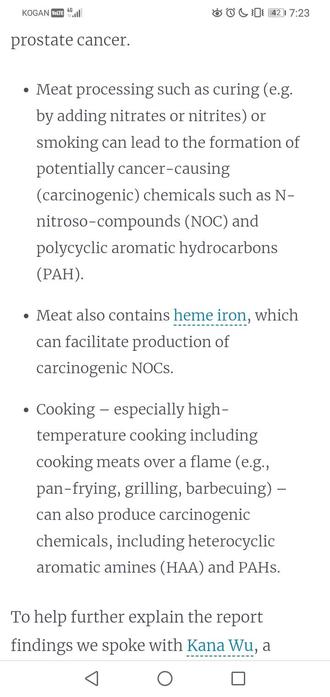
@itsveganjim Years ago the WHO listed #meat as #carcinogenic.

https://nutritionsource.hsph.harvard.edu/2015/11/03/report-says-eating-processed-meat-is-carcinogenic-understanding-the-findings/

Note the bit about #heme iron for those claiming that they must eat meat to treat #anaemia. Get an iron infusion. I promise that, in the long run, that's a more cost-effective treatment for the #healthcare system and #ecosystem.

WHO report says eating processed meat is carcinogenic: Understanding the findings • The Nutrition Source

Last week the World Health Organization (WHO)’s International Agency for Research on Cancer (IARC) announced that consumption of processed meat is

The Nutrition Source - Harvard Chan School

#Heme biosynthesis #Angigoenesis

Roles of #EndothelialCell FLVCR1a, a heme exporter to extracellular space in
✅Developmental Angiogenesis-🐭Retina🐟ISV
✅Tumor angiogenesis
❎Vascular homeostasis

Dr. Sara Petrillo lab Angiogenesis 2023
https://link.springer.com/article/10.1007/s10456-023-09865-w

FLVCR1a deficiency-> #EndothelialCell-autonomous defects in Mitochondria, ER stress & Angiogenic behaviors

Heme accumulation triggers #Paraptosis (Organelle swelling-> Cytoplasic vacuolation)💀

Dr. Emanuela Tolosano lab Cell Death Diff 2018
https://www.nature.com/articles/s41418-017-0001-7

Other enzymes in Heme metabolism in #Angiogensis👇

Ferrochelatase is a therapeutic target for ocular neovascularization
https://www.embopress.org/doi/full/10.15252/emmm.201606561

Serine Synthesis via PHGDH Is Essential for Heme Production in Endothelial Cells
https://www.cell.com/cell-metabolism/fulltext/S1550-4131(18)30391-7

Endothelial cells require functional FLVCR1a during developmental and adult angiogenesis - Angiogenesis

The Feline Leukemia Virus Subgroup C Receptor 1a (FLVCR1a) is a transmembrane heme exporter essential for embryonic vascular development. However, the exact role of FLVCR1a during blood vessel development remains largely undefined. Here, we show that FLVCR1a is highly expressed in angiogenic endothelial cells (ECs) compared to quiescent ECs. Consistently, ECs lacking FLVCR1a give rise to structurally and functionally abnormal vascular networks in multiple models of developmental and pathologic angiogenesis. Firstly, zebrafish embryos without FLVCR1a displayed defective intersegmental vessels formation. Furthermore, endothelial-specific Flvcr1a targeting in mice led to a reduced radial expansion of the retinal vasculature associated to decreased EC proliferation. Moreover, Flvcr1a null retinas showed defective vascular organization and loose attachment of pericytes. Finally, adult neo-angiogenesis is severely affected in murine models of tumor angiogenesis. Tumor blood vessels lacking Flvcr1a were disorganized and dysfunctional. Collectively, our results demonstrate the critical role of FLVCR1a as a regulator of developmental and pathological angiogenesis identifying FLVCR1a as a potential therapeutic target in human diseases characterized by aberrant neovascularization.

SpringerLink
Dem gibt es nichts hinzuzufügen. #spreewald #mundart #heme
Hi @DNPFred
In grad school I worked on heme proteins using #paramagnetic #NMR and #NRVS. Then I shifted to #XRayCrystallography, using #EPR #UVVis and #EDX on #crystals when a postdoc. My research group works on #NonHemeIron #enzymes, & #heme, #copper & #manganese #metalloproteins. Really interested in combining #spectroscopy on #protein #crystals to examine #structure #function relationships.

Serious heart damage is the most severe side effect of doxorubicin in cancer chemo, but the cause is not clear.
New work from Abe et al shows that

"DOX accumulated in mitochondria by intercalating into mitochondrial DNA (mtDNA), inducing ferroptosis in an mtDNA content-dependent manner. In addition, DOX disrupted heme synthesis by decreasing the abundance of 5'-aminolevulinate synthase 1 (Alas1), the rate-limiting enzyme in this process, thereby impairing iron utilization, resulting in iron overload and ferroptosis in mitochondria in cultured cardiomyocytes."

#Chemotherapy #doxorubicin #mitochondria #heme

https://www.science.org/doi/10.1126/scisignal.abn8017?utm_campaign=SciMag&utm_source=Twitter&utm_medium=ownedSocial