@kravietz Here's one possible scenario.
The problem is that a huge portion of the financial system based in assets which are backed by mineral resources which must be permanently stranded in the ground. For all the discussion of technology, the likely workable solutin is actually financing, accounting, tax, and liability changes which effectively financially immobilise those assets. This will freeze the financial system through both uncertainty over asset values (and balance sheets), and through a massive drop in their market value.
One solution is a "bad assets" bank. That is: a new financial institution set up to buy either stranded assets or securities backed by them, in exchange for newly-created money, with a corresponding control interest in the institution selling the assets. (That is: banks selling such assets are effectively selling themselves.)
This is based on the notion of "bad asset banks" or a "bad bank". This has been used in several financial crises of the past few decades to address otherwise insolvent banks.
A "bad bank" is effectively a n adjunct of a central bank. Its own purchasing power comes from the central bank's own inherent power to create money from nothing.
Following is my understanding of Central Bank's role and operation.
Central banks (CB)) are not business organisations which operate on a profit motive, but financial institutions whose role and remit is to manage the money supply. (CBs can make profits ... and usually roll them over to the appropriate treasury. But that's not their goal or requirement.)
Central banks create money by buying assets. They destroy money by selling them. They do so via "open market transactions", that is, where the counterparty institution (which is a profit-making enterprise and doesn't have the same unrestricted ability to create money) competes among others in the purchase or sale. The total quantity of money created or destroyed is set by the CB's liquidity / money supply targets.
In the case of fossil fuel assets, a given monetary target would be defined, and institutions would offer specific assets for payment. The CB's interest is not in profit on the transaction but in the injection of a specific amount of liquidity. Since the seller is also selling ownership in itself, it's incentivised to not overstate the value of assets (as that means a greater loss of control), and it is weighing the option of selling to the Bad Bank vs. a conventional asset sale in the private market.
(My understanding here is a bit weak, but this is how I understand the limit on offering some utterly bogus asset for a high-ticket value to function. That is, the market mechanism at work.)
Note that a CB itself cannot ensure an equitable distribution of liquidity. There's still a requirement for households and small businesses to have a sufficient income (not merely "access to credit") to ensure ongoing operations. That should be accomplised via government taxation and spending mechanisms ("fiscal poliicy"). These also destroy and create money, respectively, though also provide direct control over where that creation/destruction occurs.
If you think of the financial system as a heating/cooling system, the CB is the furnace creating heat or cold (though without requiring an energy source), whilst the taxation/spending function is the blower distributing money evenly throughout the system. The free market is also a distribution system, though one with numerous deficiencies and biases.
Upshot:
- The bad bank absorbs the bad assets. It takes legal ownership over the frozen mineral resources.
- The bad bank injects new liquidity into the system, in exchange for control.
- Asset holdings are unwound.
- Government fiscal policies sustain individuals and firms as the financial system is re-juggled.
- Additional taxes on carbon emissions and extraction, transport, refining, storage, and usage operations additionally increase the costs of using any fossil fuels. Again: at every point in the system, make fossil fuels economically nonviable.
I'm not positive this would work. I think it may actually be the outlines of a viable solution.
#StrandedAssets #UnwindingTheFossilAge #TheMonetarySolution #FossilFuels #BadBank #Decarbonisation
@openrisk
 DieBayern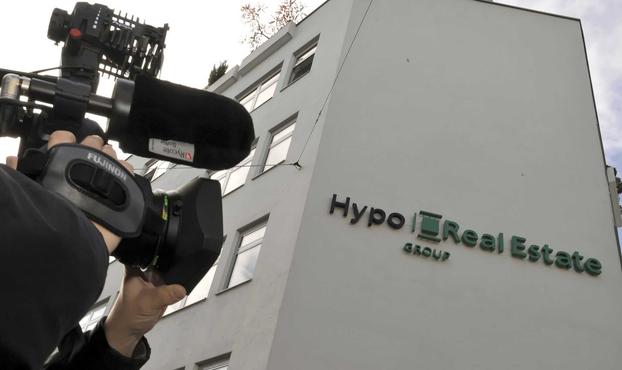
 STOP🚗🚘🚛BlechTerror🛑Fascism
 Alexander Gerber
 Jonas
Jonas betamax65
 IMMOFUX ® Immobilien
 Groms
Groms CPIM Tamilnadu
 Doc Edward Morbius ⭕