Chris MacLellan

155 Followers
168 Following
450 Posts

Assistant Professor at Georgia Tech's School of Interactive Computing.

I do research at the intersection of #CognitiveSystems, #AI, #HCI, #CognitiveScience, and #LearningScience. My work focuses on understanding how people teach and learn and building computational systems that can teach and learn like people do.


Outside work, I am into #dogs, #backyardchickens, #beekeeping, and #sourdough. I love #scifi and #fantasy.

Personal Websitehttps://chrismaclellan.com
Lab Websitehttps://tail.cc.gatech.edu
Google Scholarhttps://scholar.google.com/citations?hl=en&user=q_K8iFQAAAAJ
"The friction is the meaning"
https://catandgirl.com/the-genius/
via @tehn on izzzzzi
Cat and Girl

The student approached the Master and said "He wants to put a million people on Mars by 2040! That's so amazing!"

The Master replied. "I have a better plan. I will put a million people on Antarctica by 2040."

"But that sounds fucking insane. Why would you want to do something that stupid? It's a barren wasteland that's difficult to populate and would provide us with absolutely nothing!"

At that moment, the student was enlightened.

If you were to write a more inclusive history of #HCI, whom would you include?

Context: prepping for my user-centered interface design course, the day on historical foundations is ALL WHITE DUDES: Vannevar Bush, Ivan Sutherland, Douglas Englebart, J.R. Licklider, Alan Kay, Ted Nelson, etc etc...

Who else belongs in this canon?

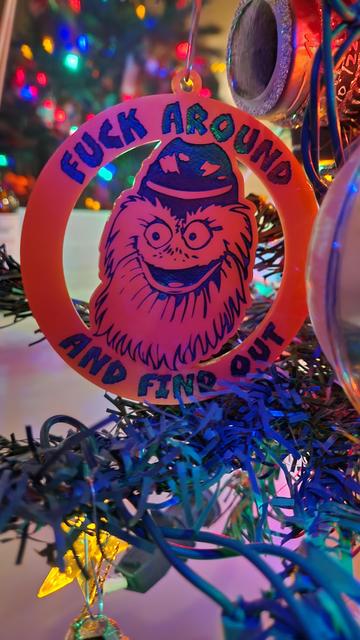
@RickiTarr My favorite Etsy purchase
You may not believe in The Gritch, but The Gritch is still coming to town

“Creating AI caricatures of disabled people does not help us dismantle systemic ableism. By taking us out of the equation, and positioning fake, digital characters as more credible narrators of our stories than we who actually live those stories, accessibility is literally dehumanized.”

Ashlee M Boyer’s response to an “AI”-enabled “accessibility” product is very good, and worth your time: https://ashleemboyer.com/blog/how-to-dehumanize-accessibility-with-ai/

How to Dehumanize Accessibility with AI | Ashlee M Boyer

Hire disabled people, not AI-generated caricatures.

I'm teaching my first lecture at the new job today, about probabilistic logic programming, probabilistic inference, and (weighted) model counting.

Some of the required reading is a paper (https://eccc.weizmann.ac.il/eccc-reports/2003/TR03-003/index.html) that was written by a great mentor of mine, prof. dr. Fahiem Bacchus. He passed away just over 2 years ago, and I am honoured to keep his memory alive by teaching his ideas to a new generation of students. Hope to do him proud. 🌱

Please send good vibes? 🥺

#AcademicChatter #AcademicLife #AcademicMastodon #Teaching #Probability #ProbabilisticInference #Probabilities #Logic #LogicProgramming #PropositionalModelCounting #ProbabilisticLogicProgramming #ModelCounting #PropositionalLogic #WeightedModelCounting #DPLL #BayesianProbability #BayesNets #BasianStatistics #BayesianInference #BayesianNetworks #KnowledgeCompilation #DecisionDiagrams #BinaryDecisionDiagrams

ECCC - TR03-003

Homepage of the Electronic Colloquium on Computational Complexity located at the Weizmann Institute of Science, Israel

There's a movement in neuroscience suggesting we should be pursuing bigger bets with larger teams. I think there's a case for doing a bit of this, but I think it's a bad idea to prioritise it for two reasons, and a good case for saying we should be moving in the exact opposite direction.

Bigger bets generally means less money available for the smaller bets. This means fewer ideas being pursued. Similarly, larger teams means fewer people in leadership roles with ownership over their research direction. Again, fewer ideas and less diversity.

This is bad for neuro because most ideas have turned out to be wrong in the sense that they haven't moved us closer to a global understanding of how our brain's work. (By this I don't mean that they were bad ideas, or that they weren't worth pursuing!) This is maybe controversial so let me explain.

When I read papers from 50 or 100 years ago speculating about how the brain might work, I don't see a huge difference with how we talk about it now. Few (none?) of the big debates have been settled: innate versus learned, spikes versus rates, behaviourism versus cognitivism, ...

The second reason big bets/teams shouldn't be our focus is that it limits opportunities for the autonomy and development of less senior researchers. Let's be honest, if we start pursuing 'big bets' those bets will be the bets of the most senior scientists, not the junior ones.

Junior scientists will - to an even greater extent than currently - be relegated to implementing the ideas of senior scientists. That's bad for diversity of ideas, but it's also bad for developing a new generation of thinkers who might be able to break us out of our (proven unsuccessful) patterns.

That's why I think we should go in the opposite direction. Empower junior scientists. Don't make junior PIs beg for grant funding in competitions decided by the opinions of senior scientists. Don't make them postdocs subordinate to their supervisors.

Instead, fund junior scientists directly and independently. Let senior scientists compete with each other to work with these talented younger scientists. Give senior scientists a non-binding advisory role to help develop the talents of the junior scientists.

If we think larger teams might be important, let's find ways to empower groups of secure and independent scientists to work together positively and voluntarily - because it makes their work more impactful - rather than negatively and through necessity - because they need to get a job.

#neuroscience