Raphael_Brito

180 Followers
53 Following
20 Posts

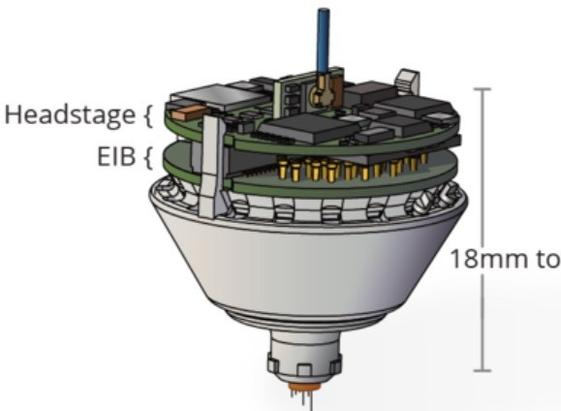
Do I know anyone using the #NeuroMouse version of the #ShuttleDrive?
(Small, 32 (or 16?) tetrodes version)

If so can you tell me what you think in terms of stability, recording quality etc?
https://open-ephys.org/shuttledrive

Edit: still looking for labs using this in 2025!

#OpenEphys #HyperDrive #Tetrodes #NeuroMethods

I am excited to share an updated preprint from my postdoc work with Mark Plitt and @giocomo, where we found that the hippocampus encodes experience relative to reward and space through parallel sequences of activity:

Hippocampal sequences span experience relative to rewards
https://www.biorxiv.org/content/10.1101/2023.12.27.573490v2

I guess we do #introduction posts over here? I work on the #neuroscience (am I doing those hashtags right!?) of learning and memory, specifically how we learn while we navigate space and context. To do this, I take in vivo recordings (currently calcium imaging but ephys has my heart) of freely moving rats! After that, I use computational and mathematical approaches to analyze their neural activity! I am currently a BRAIN Initiative K99/R00 postdoc at Northwestern working with John Disterhoft and Sara Solla. I was trained at MIT with Matt Wilson, where I got my PhD in biology, and my BS is from Carnegie Mellon. Welcome!

New paper from the lab!

We observed beautiful sequences of spiking activity during sleep in the « head-direction cortex Â» (aka post-subiculum), traveling along its dorsoventral axis. Using in vivo data analysis, computation models, and slice physiology, we show that the hyperpolarization-activated current (Ih) supports this sequential neuronal activation. Analyzing data from other cortical regions, we believe that this is a general mechanism of spiking sequences during sleep.

See our preprint:
https://www.biorxiv.org/content/10.1101/2023.09.12.557442v1

This manuscript contains obviously more than the short summary above. Comments are more than welcome!

Huge kudos to @dlevenstein and @dhruvmehrotra5 for their hard work, Adrian Duszkiewicz, Brendon Watson, and Sofia Skromne Carrasco for the data. Also, great collaboration on the slice physiology with Sam Booker and Angelika Kwiatkowska at the University or Edinburgh. Big thanks to all the funding agencies (I mean, the tax payers) and other organizations for the financial support!

We are finally on Mastodon, time for a little #introduction 👋 !

Brian is a #FOSS simulator for biological #SpikingNeuralNetworks, for research in #ComputationalNeuroscience and beyond. It makes it easy to go from a high-level model description in Python, based on mathematical equations and physical units, to a simulation running efficiently on the CPU or GPU.

We have a friendly community and extensive documentation, links to everything on our homepage: https://briansimulator.org

This account will mostly announce news (releases, other notable events), but we're also looking forward to discussing with y'all 💬

#opensource #neuroscience #researchsoftware #introductions

The Brian Simulator

Brian is a free, open source simulator for spiking neural networks.

The Brian spiking neural network simulator

@NicoleCRust @tdverstynen

Right.

My plan, as far as I'm allowed to carry it out, is to start small (mapping and analysing the connectomes of small animals) and continue growing the sample size until reaching that of mammals: https://albert.rierol.net/tell/20230823_connectomics_research_base.html

The study of a brain of an animal with a small number of neurons enables experiments and hypothesis-testing to prod into how circuits work, and how circuits of circuits are organised, towards deriving the fundamentals of neural circuit architecture. It is a slow approach but it has been, so far, rewarding.

I am frankly not in a hurry; what's more, I am unable to see how studying a larger brain at less resolution is a shortcut to anything, if it is to be accepted that neurons and synapses are the basic units of operation, organised into local circuits that are further organised into larger circuits, each level of organisation having its own circuit architecture. The bottom up approach makes sense to me. Starting from the top down seems hard, given how underdetermined – with regard to circuit architectures and choice of functions at the level below. There's a degeneracy of the code there, borrowing from the early days of DNA encoding of protein sequences.

Tell (it like it is)

The strain on scientific publishing 📄:

The publishing sector has a problem. Scientists are overwhelmed, editors are overworked, special issue invitations are constant, research paper mills, article retractions, journal delistings… JUST WHAT IS GOING ON!?

Myself, pablo, @paolocrosetto and Dan have spent the last few months investigating just that.
https://arxiv.org/abs/2309.15884

A thread🧵1/n

#AcademicChatter #PublishOrPerish #Elsevier #Springer #MDPI #Wiley #Frontiers #PhDAdvice #PhDChat #SciComm

The strain on scientific publishing

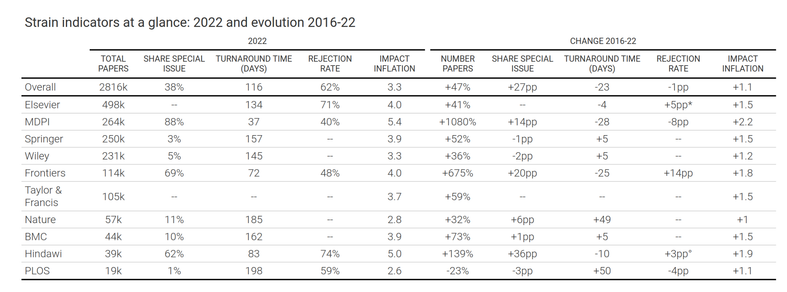
Scientists are increasingly overwhelmed by the volume of articles being published. Total articles indexed in Scopus and Web of Science have grown exponentially in recent years; in 2022 the article total was approximately ~47% higher than in 2016, which has outpaced the limited growth - if any - in the number of practising scientists. Thus, publication workload per scientist (writing, reviewing, editing) has increased dramatically. We define this problem as the strain on scientific publishing. To analyse this strain, we present five data-driven metrics showing publisher growth, processing times, and citation behaviours. We draw these data from web scrapes, requests for data from publishers, and material that is freely available through publisher websites. Our findings are based on millions of papers produced by leading academic publishers. We find specific groups have disproportionately grown in their articles published per year, contributing to this strain. Some publishers enabled this growth by adopting a strategy of hosting special issues, which publish articles with reduced turnaround times. Given pressures on researchers to publish or perish to be competitive for funding applications, this strain was likely amplified by these offers to publish more articles. We also observed widespread year-over-year inflation of journal impact factors coinciding with this strain, which risks confusing quality signals. Such exponential growth cannot be sustained. The metrics we define here should enable this evolving conversation to reach actionable solutions to address the strain on scientific publishing.

arXiv.org

I have presented this poster on #HippocampalReplay at #SFN23 !

I'm also uploading the poster as an image here, and it's on the SFN website: https://cattendee.abstractsonline.com/meeting/10892/presentation/33535

Little summary below:

Our goal was to investigate if replay of hippocampal #PlaceCells was indeed reflecting immediate #SpatialPlanning.

The existing literature is a little unclear: some studies find 'planning replay' and some do not. Most of the time, planning is not dissociated from reward consumption in these studies as they can generally be simplified to an alternation between two rewarded locations. In our case, we separate the location of planning from the location of reward and focus on replay happening at the planning time.

At the location of planning, we find that:

1) there is actually almost no replay at the time of planning
2) the rare 'start replay' events do NOT over-represent the future trajectory, or even the goal
3) the rare 'start replay' events do not differ for successful vs unsuccessful planning.

At the goal location, we find that:

4) Many replays occur at the goal, even before the reward delivery!
5) 'goal replays' strongly over-represent the goal (either before or after reward delivery)
6) 'goal replays' do not over-represent the current trajectory compared to the alternative trajectory, or even the optimal path if the less-optimal path was taken
7) 'goal replays' were strongly affected by errors and were quasi-absent during error trials (choosing an unrewarded end box)

In conclusion:

Reward (received or expected), but not planning, drives hippocampal replay!

Let me know if you have any questions after looking at the poster :D

Edit: updated because this is in the past now (but hoping to publish it soon!)

cAttendee

Looking for outstanding postdocs with computational and/or physics background to lead a #MSCA COFUND project under the #AIHub #csic strategy. Starting in 2024. Contact me directly.

Fruit fly neuroscience is on fire. Earlier in the year we saw this:

"Hierarchical architecture of dopaminergic circuits enables second-order conditioning in Drosophila" by Yamada et al. 2023 (Aso's group) https://elifesciences.org/articles/79042

"The Drosophila mushroom body comprises a series of dopaminergic compartments, each of which exhibits distinct memory dynamics. We find that a slow and stable memory compartment can serve as an effective ‘teacher’ by instructing other faster and transient memory compartments via a single key interneuron", SMP108.

In larval brain parlance, neuron SMP108 is an FB2N: a second-order feedback neuron, meaning, it is the second hop of the 2-hop polysynaptic pathway from MBONs to DANs. See Eschbach et al. 2020 https://www.nature.com/articles/s41593-020-0607-9

#Drosophila #neuroscience

Hierarchical architecture of dopaminergic circuits enables second-order conditioning in Drosophila

A slow and stable memory unit instructs fast and transient units by activating dopaminergic neurons via an excitatory hub interneuron connecting those units during second-order conditioning in Drosophila.

eLife