„Nach einer kurzen Vorstellungsrunde führte Herr Roth in die Präsentation des Verlags ein, der durchaus polarisiere und für viele ein Kuriosum sei. Vor fast 30 Jahren als Außenseiter außerhalb des klassischen Subskriptionssystems tradierter Verlage angetreten, werde MDPI mit zunehmendem Erfolg trotz hoher Nachfrage von einem Teil der Forschenden auch misstrauisch begegnet. Ein Beispiel sei der deutschsprachige Wikipedia-Eintrag zu #MDPI, dessen Diskussionsverlauf tatsächlich den Eindruck erwecken kann, dass er stark auf Kritik fokussiert und weniger auf Aspekte, die eine neutralere Beurteilung erlauben. Auch sei MDPI auf einer anonym betriebenen Webseite, die sich als seriöses Informationsportal ausgab, jedoch kriminelle Machenschaften verfolgte, als #Raubverlag gelistet gewesen.“

https://blog.ub.uni-kassel.de/blog/2025/12/17/mit-mdpi-im-dialog-ein-bericht-vom-transparenzworkshop-an-der-ub-kassel/

Mit MDPI im Dialog: Ein Bericht vom Transparenzworkshop an der UB Kassel - UB-Blog

Der schweizerische Verlag MDPI mit seinen knapp 500 Open-Access-Zeitschriften ist Gegenstand kontroverser Diskussionen. Hinsichtlich seiner Praktiken zur Qualitätssicherung wird er von Forschenden sehr unterschiedlich bewertet. Ein Blick auf verschiedene Qualitätsaspekte zeigt dagegen, dass MDPI sich oftmals gar nicht so sehr von anderen Verlagen unterscheidet. Um direkt mit MDPI in den Dialog zu gehen und kritische […]

UB-Blog
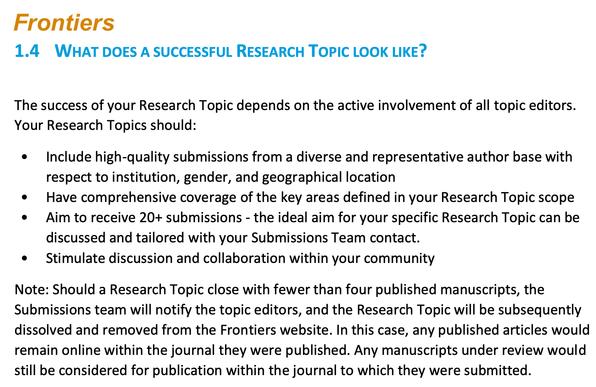
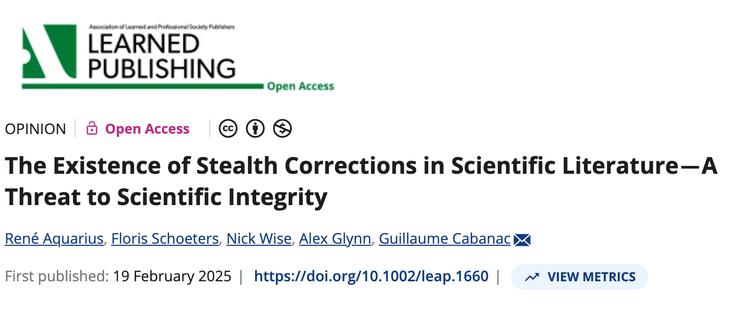
Far from enforcing their policies, publishers *hide* PISS. We learned most publisher policies ACTIVELY hide PISS by altering article metadata post-hoc. At a *minimum* #Frontiers, #Elsevier, #MDPI all do it publicly! Yikes. 🤯 Thanks to @deevybee.bsky.social@bsky.brid.gy et al. for noting this (see pics). 11/n
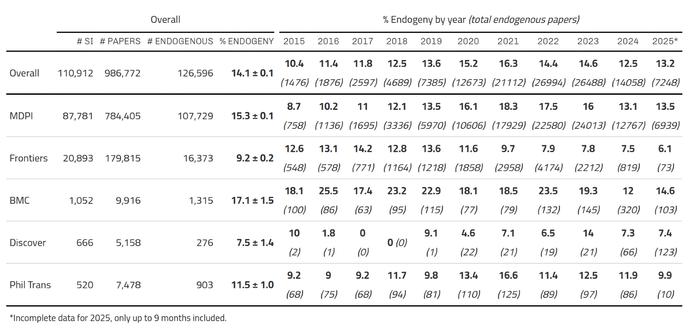
In fact we actually saw pretty similar rates of PISS across all publishers tested: #MDPI, #Frontiers, #BMC, #Discover, but also the non-profit RSoc. Give authors a chance to guest edit and they'll PISS. Relative rate: 1 in 7 editors PISS 😬 Still, the real problem is about ABSOLUTE quantity... 6/n
In the strain on scientific publishing, we showed that total publications have grown out of control. A huge part of that was guest edited special issues by groups like #MDPI and #Frontiers. This ongoing practice is the largest delegation of editorial power academia has ever seen. 2/n

The strain on scientific publi...
The strain on scientific publishing

Abstract. Scientists are increasingly overwhelmed by the volume of articles being published. The total number of articles indexed in Scopus and Web of Science has grown exponentially in recent years; in 2022 the article total was ∼47% higher than in 2016, which has outpaced the limited growth—if any—in the number of practicing scientists. Thus, publication workload per scientist has increased dramatically. We define this problem as “the strain on scientific publishing.” To analyze this strain, we present five data-driven metrics showing publisher growth, processing times, and citation behaviors. We draw these data from web scrapes, and from publishers through their websites or upon request. Specific groups have disproportionately grown in their articles published per year, contributing to this strain. Some publishers enabled this growth by hosting “special issues” with reduced turnaround times. Given pressures on researchers to “publish or perish” to compete for funding, this strain was likely amplified by these offers to publish more articles. We also observed widespread year-over-year inflation of journal impact factors coinciding with this strain, which risks confusing quality signals. Such exponential growth cannot be sustained. The metrics we define here should enable this evolving conversation to reach actionable solutions to address the strain on scientific publishing.

MIT Press
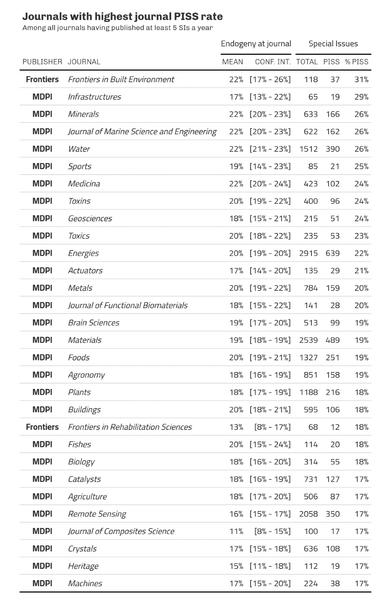
Most journals practice special issues fairly responsibly. But it's the worst offenders that contribute most of the PISS. ~90% of PISS in our data come from just 150/904 journals. And it's exactly who you think it is. #MDPI #Frontiers 13/n

#Peer_review is one of the key stones of trust in #SchollComm. This blogpost by a researcher about here experience being a reviewer for #MDPI is interesting for those considering publishing, reading or reviewing for such journals

https://deevybee.blogspot.com/2024/08/guest-post-my-experience-as-reviewer.html

My experience as a reviewer for MDPI

  Guest post by  René Aquarius, PhD Department of Neurosurgery Radboud University Medical Center, Nijmegen, The Ne...

I recently met somebody actually working for #MDPI and before figuring that out, I was tricked by their partner into insult #MDPIgarbage.
Long story short, I consoled them that at least they weren't working for #Elsevier.

But they seemed really nice and extremely unhappy to be stuck with a terrible employer due to economic circumstances.

#AcademicChatter #PhDLife #PostDocLife

„Bug in #springernature metadata may be causing ‘significant, systemic’ citation inflation“
Mit aktuellem Kommentar des CTO von #MDPI
#bibliometrics

via @sinensetin und @jagusch

https://retractionwatch.com/2025/11/11/bug-in-springer-nature-metadata-may-be-causing-significant-systemic-citation-inflation/

Bug in Springer Nature metadata may be causing ‘significant, systemic’ citation inflation

Millions of researchers could be affected by a “dramatic distortion of citation counts” likely caused by flaws in how the academic publishing giant Springer Nature handles article metadata, accordi…

Retraction Watch

🆕📖 "Chanting Ṣalawāt as a Form of Self-Cultivation" von Tuba Işık im von ihr herausgegebenen Special Issue "Islamic Practical Theology" (#MDPI)! 😊

Der Beitrag ist 🔓 Open Access verfügbar.

🔗 https://doi.org/10.3390/rel16091104

#Religion, #Praxis, #Gebet, #Sufismus, #Identität