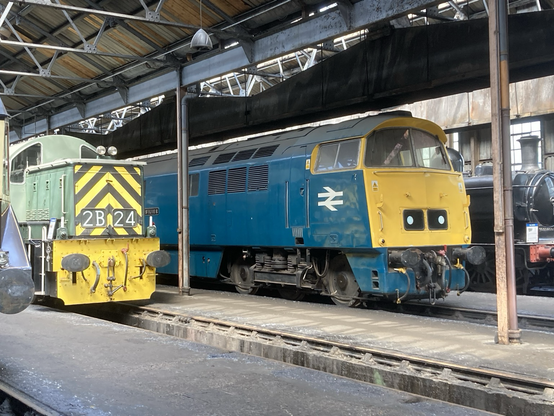
British Rail diesel-hydraulics at the Great Western Society, Didcot, UK
| #TMRGUK | |
| #MMRGUK |
British Rail diesel-hydraulics at the Great Western Society, Didcot, UK
I am running trains again 🎉
From: @making_tracks
https://makertube.net/w/hkdyBXXLJy493xjzvimBH7

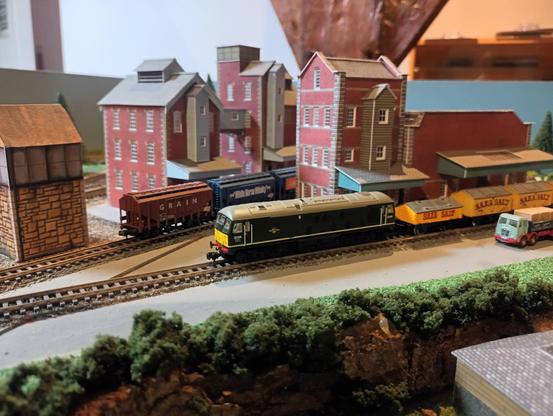
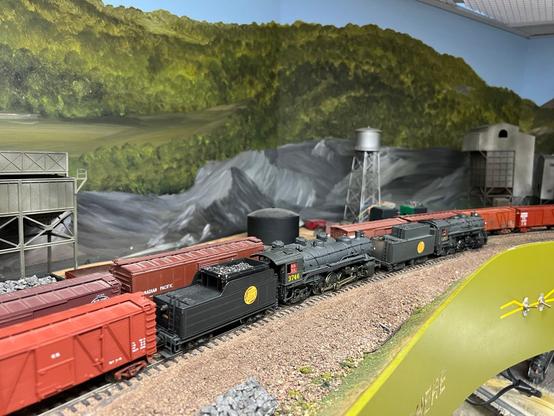
A BR Class 24 dliesel collects a short rake of salt wagons.
Loco is Graham Farish which is a beautifully smooth running model. The salt wagons are a mixture of Peco and Graham Farish.
It’s not all finished, but it is finished enough that I can run trains! Here’s a short clip of two trains going through the station area from opposite directions. There’s a Class 37 and a Class 411 EMU. Enjoy.
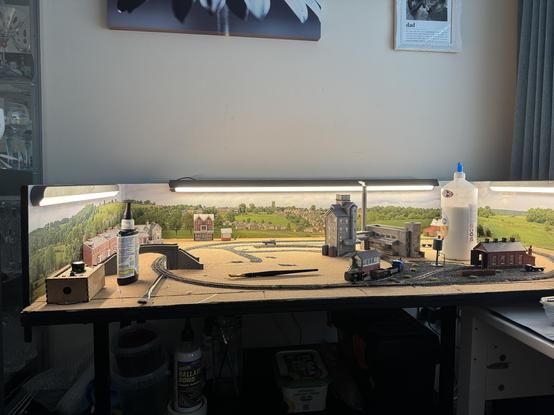
I have added some lights around the top of my layout. Pretty pleased with the light they offer in addition to the lights in the room. 💡
#trains #trainnerds #railway #modeltrain #modelrailway #railways #trainnerd #train #locomotive #loco
Realistic Layout Operation
My old friend Tony Thompson has started a mini series of blog posts on Realistic Layout Operation. As always, Tony is a thoughtful person, who probably has more model railroad operating experience than anyone I know. The first post in the series surprised me, but I’m not going to precis it; you should read it yourself.
Tony does, however, raise an interesting question: what makes layout operation realistic? And since, I have been thinking about realism and accuracy in railway modelling for a few years now, maybe it would be fun to see if my philosophy can apply to operations too. In a nutshell, my modelling philosophy comes down to this: accuracy is observed in details, while realism is the feeling we get from the spaces between those details.
It’s easy to see how we can make operations more accurate. We can follow the rule book the real railroad followed. we can increase the fidelity of the paperwork. We can use a throttle that looks like a real control stand or backhead. We can lock our switches. We can connect air lines and wait for reservoirs to fill. We can animate our water towers.
Those are all details, and the aficionados among us appreciate them. But I’m not sure they impart a feeling of reality.
I’ve only driven a real train once – on a steam experience before we left England. For a day, I supplemented the regular crew on a little 0-4-4 in Devon, alternately firing and driving. It was loud and hot, and you could barely see what was happening outside. To move the train, you and the fireman had to think ahead so there was enough steam at the moment it was required, and braking took a similar level of local knowledge and planning. Trains are heavy and changing their speed is hard!
It’s hard to imagine how that experience could scale down to make a realistic operating feeling for an engineer on our models. The closest I ever came was on Tom Hood’s layout before he converted to DCC. At that time, he had throttles where the brake was separate from the speed, and the locomotives were tuned beautifully to creep to a stop. It was the one time I felt that I couldn’t stop the engine if I needed to.
Boosting the momentum on our DCC systems could help with a similar feeling of mass. Proto:87 seems to help with a feeling of mass as well, as the models have no space to hunt for the rails, and are imperceptibly more purposeful as a result. I think springing could also assist with making our flyweight models behave like Foremans and Tysons as they roll over the variations in the track.
I don’t think, however, that it is possible to duplicate the heat and the noise of a real locomotive driving experience. Standing outside the model, the ability to see is perfect, so we may have to content ourselves with a feeling of mass.
Aside from engineer, the operating position I have the most familiarity with is dispatcher. Most of that experience has been in Timetable and Train Order layouts, which you would think would be as realistic as it can get. There you are, after all, in the dispatcher’s office with nothing before you but prototypical paperwork.
That may be so, but it feels more like a game than like reality, and the primary reason is driven by our tiny layouts and the volume of traffic we move on them. I have never dispatched a real railroad, but I suspect that OS reports don’t feel like a distributed denial of service attack on the poor guy who is trying to write a complicated helping order.
A real railroader once told me that if you wanted feel like a real engineer, you should go out at night when it’s 4 degrees Celsius and raining to try to read the car numbers on a cut of cars by lantern-light. I’ve heard other stories of railroaders who sat waiting for a signal for almost an entire shift. Another one told me about holding a brakeman’s hand as his life drained from his severed legs. Even after my steam experience day, I fell asleep before we got out of the car park.
Real railroad operation is heavy, exhausting, dangerous work interspersed with boredom. Model railroad operation is a social evening out to play a game with interesting rules and intricate game pieces. We can make those game pieces as accurate as we like, but realism is much more difficult to come by given the constraints of time and space in our game rooms. Perhaps that’s a good thing; I enjoy an evening out with like-minded friends, and I don’t want to have to hold any of their hands while they expire on the ballast. Perhaps “realistic” operations should not be the goal so much as “satisfying” operations.
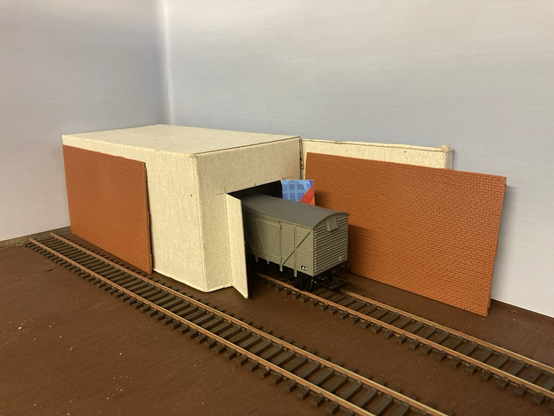
Modelling activities have slowed to a crawl recently, but tonight I mocked-up the #Cadburys warehouse. This was fun - slicing up, folding and stapling a cereal packet!
All structures for this layout will be mundane, single story warehouses and industrial units.
#MMRGUK #TMRGUK #ModelRailway #ModelRailroad #makershour #Trains
I had an epiphany today: Mastodon is my makerspace. I haven't been able to find a makerspace in this area since we moved here in '22, and that's been bugging me. But I scroll through Mastodon and see people's printing, woodworking, electronics, and welding projects, and I admire them, and sometimes I ask questions and learn new techniques. And when I post my own, people do the same.
That's a makerspace.
@3dprinting #MakerSpace #woodworking #fpga #electronics #DIY #3DPrinting #welding
Got there in the end! 😃
This puzzle has an odd choice of trains…
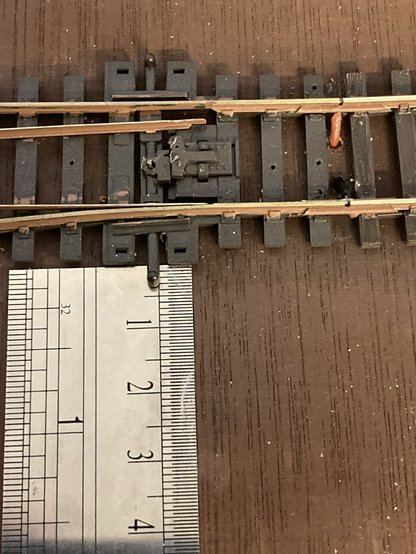
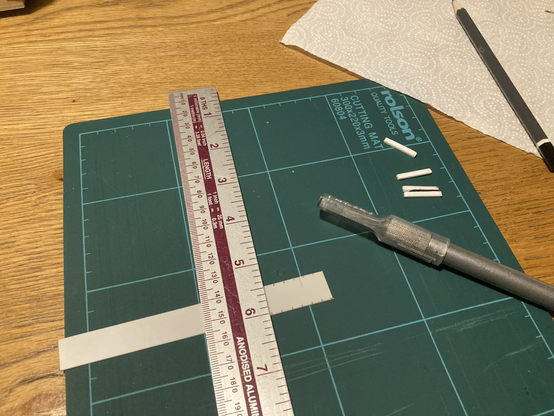
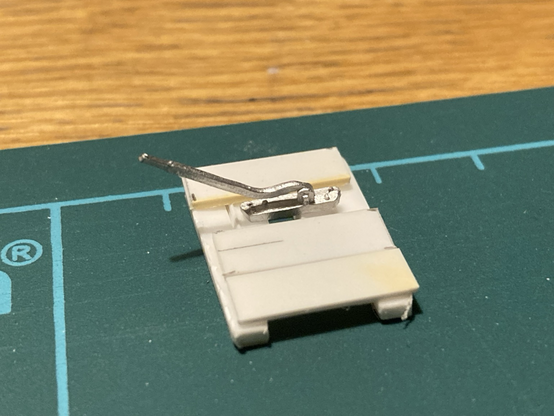
Tonight’s task: scratch-building some sleeper extensions and footboards for the point levers.
This is the first time I’ve actually tried anything like this in a long time. I’ve no dimensions to work from - just winging it a bit. Looks okay though.
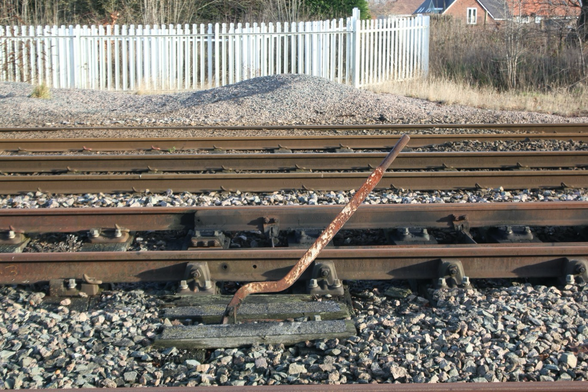
The real example is at Gobowen (off Wikipedia).
#Trains #ModelRailway #ModelRailroad #ScratchBuilding #OOscale
 (rainynight65) has moved
 Chris BULL
 Phil Haigh
 Rich On Rails
 Pembroke:87
 Kernel Bob