173 Followers
227 Following
271 Posts

Department of Technical Biochemistry
@Uni_Stuttgart@bawü.social

#NaturalProducts #ChemicalBiology #SynBio #NRPS #Enzymes

website @Uni_Stuttgarthttps://www.ibtb.uni-stuttgart.de/en/tb/
Google Scholar of the PIhttps://scholar.google.co.uk/citations?user=K9BxnUEAAAAJ&hl=de

Now in Chem Sci! 🎉
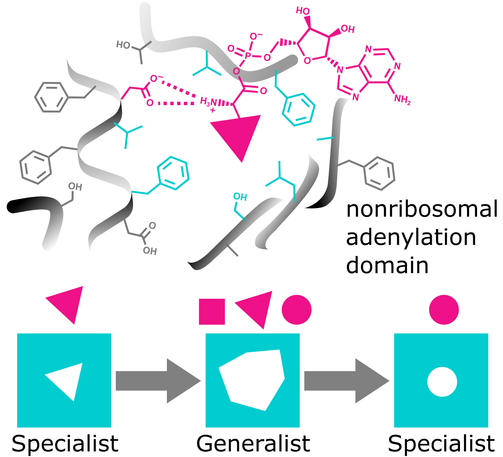
We investigated how #enzymes in the #nonribosomal #biosynthesis of life-saving #peptide #antibiotics can be engineered.
Assuming that #promiscuity serves as a springboard for #evolution, we measured the specificity profiles of hundreds of mutants. The results revealed remarkable shifts in substrate specificity in multiple directions, highlighting the evolutionary potential of these enzymes and leading the way for engineering antibiotic biosynthesis.

https://doi.org/10.1039/D6SC00250A

🏆 Thrilled to share fantastic news! 🎉 Honored with the "Goldene Kreide" Teaching Award in Chemistry by amazing students at the Faculty of Biology, Chemistry & Earth Sciences, Universität Bayreuth! 🧪📚

Thanks for the votes, Lena Glöckler, Fachschaft, for impeccable organization and Prof Frank Hahn for inviting me to this position. Teaching in Bayreuth was a joy! Special thanks to the OCI team Dr Thomas Schmalz, André Wetzel, and Silvia Kastner.

#GoldeneKreide #TeachingAward #Chemistry #Bayreuth

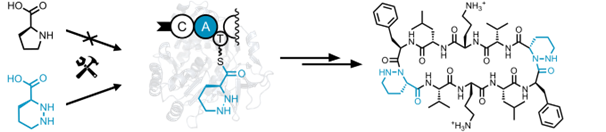
In a paper now out in Angewandte, we have applied directed evolution on the nonribosomal peptide synthetase (#NRPS) making the peptide #antibiotic gramicidin S. Just a few mutations were sufficient to make the NRPS incorporate the non-standard building block piperazic acid instead of proline into the peptide. Directed evolution of NRPSs is needed to adapt the structures of antibiotic peptides to help fight increasing #AntimicrobialResistance.

https://doi.org/10.1002/anie.202304843

@LeibnizHKI

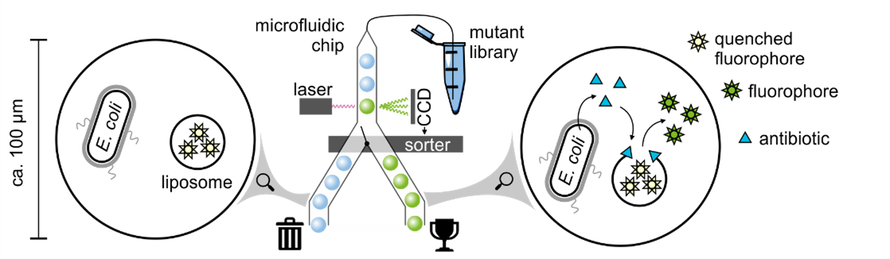
#DirectedEvolution is a powerful method but has not been easy to do with gigantic #nonribosomal biocatalysts that make important #antibiotics. We have developed a #microfluidics screen that uses liposomes as sensors for membrane active peptides. Bacteria are grown in tiny droplets. If they make gramicidin S, the sensor liposomes burst, liberate calcein, and generate fluorescence. This was tested for screening mutants and may become a useful tool for directed evolution. https://www.biorxiv.org/content/10.1101/2023.01.13.523969v1

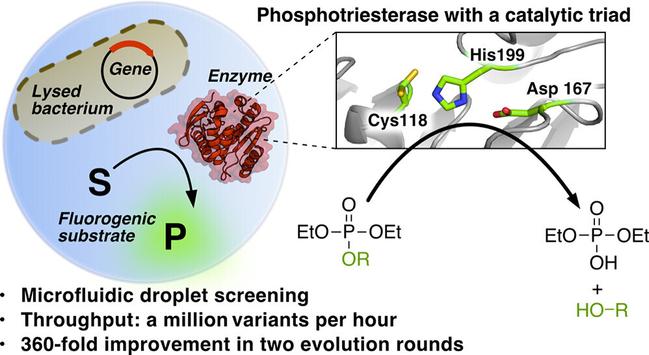
@davidschnettler and the Hollfelder-team have used #DirectedEvolution to breed new phosphotriesterases that could be useful for bioremediation or treatment of organophosphate intoxication. Active #enzyme variants were retrieved from large libraries packaged in tiny droplets on a #microfluidics platform.

Now in #jacs
https://pubs.acs.org/doi/full/10.1021/jacs.2c10673

We had a lot of fun celebrating our Christmas dinner at the #Fuchsturm restaurant in #Jena. We warmly welcome our new postdoc Dr. Kirti Sharma and master student Hannah Zeihe. We wish a happy holiday season to all our fellow scientists!