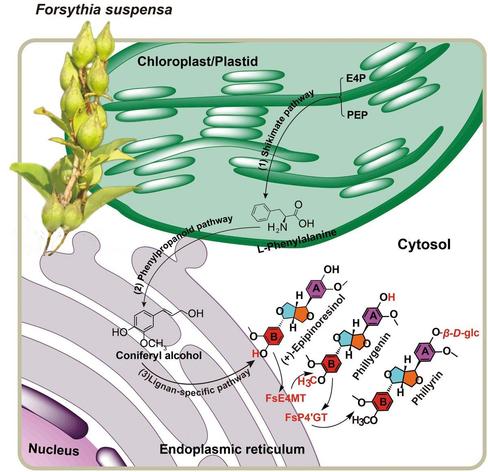
Wang et al. reveal key steps in its #biosynthesis, bringing us one step closer to a valuable #drug.
🔗https://doi.org/10.1111/jipb.70216
@WileyLifeSci
#PlantSci #JIPB #plant #medicine #botany
Now in Chem Sci! 🎉
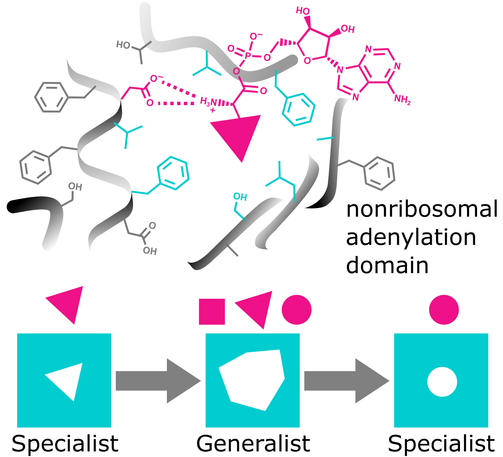
We investigated how #enzymes in the #nonribosomal #biosynthesis of life-saving #peptide #antibiotics can be engineered.
Assuming that #promiscuity serves as a springboard for #evolution, we measured the specificity profiles of hundreds of mutants. The results revealed remarkable shifts in substrate specificity in multiple directions, highlighting the evolutionary potential of these enzymes and leading the way for engineering antibiotic biosynthesis.

Abstract Data on the biological activity of nanoparticles of various natures—metallic (Ag, Cu, Zn, Ti), silicon (Si), and carbon nanomaterials—on plants are summarized. Their influence on the growth, development, and resistance of plants to biotic and abiotic stresses at the molecular, cellular, and organismal levels is considered. Special attention is paid to nanoparticles obtained by “green” synthesis, which are characterized by high bioactivity, biocompatibility, stability, and environmental safety. The physiological and biochemical effects of the action of nanoparticles are analyzed, in particular their influence on seed germination, photosynthetic activity, antioxidant system, expression of stress-induced genes, etc. It has been demonstrated that biosynthesized nanoparticles cause a positive effect without toxicity in most cases, while chemically synthesized analogues can cause significant negative changes in plants. The advantages of biosynthesized nanoparticles are emphasized: their high level of environmental safety, fungicidal, antibacterial, and antiviral activity. The need for further research to optimize dosage, methods of application, and assessment of long-term effects of nanomaterials, taking into account the balance between efficiency and environmental safety, is emphasized. The obtained results demonstrate the prospects for the use of nanomaterials in cell biology, physiology, and biotechnology of plants.

Gymnosperms are #economically valuable but lack the #root #anatomy and #physiology to survive #ClimateChange-induced waterlogging.
Yan et al. identify an ethylene #biosynthesis TF module that may help #PlantScience change that.
https://doi.org/10.1111/jipb.70100
@WileyLifeSci
#JIPB #tree #botany
🫖You can't beat a good cup of tea! ...how about some #PlantScience to go with it?
Liu et al. describe the #biosynthesis of acylated flavonoids in #tea plants and highlight CsHCT as a #genetic target for enhancing #cold resistance.
https://doi.org/10.1111/jipb.70055
@WileyLifeSci
#JIPB #botany
Need a little mid-week magic?🪄
🌱Well, we're #plant #scientists, so you're getting the "Magic #Methyl Effect."🧪
Li et al. explore key factors in the #biosynthesis of irregular terpenes--and more! Get a pre-pub sneak peek here! ⬇️
https://doi.org/10.1111/jipb.70048
@WileyLifeSci #botany
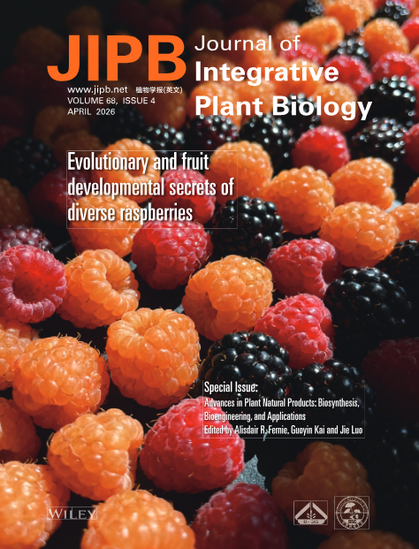
🎃 Have you picked your Halloween costume? 🎃 And more importantly, have you submitted your papers to our upcoming special issue on Advances in Plant Natural Products: #Biosynthesis, #Bioengineering, and Applications.
https://jipb.net/EN/news/news863.shtml
#PlantScience #medicine #food #beauty #agriculture #botany #SynBio
A mystery 30+ years in the making!
In this #OpenAccess Brief Report, Wu et al. describe a novel physiological function of the #Arabidopsis
PPRD1 in #brassinosteroid #biosynthesis, and new possibilities for alternative #steroid reductases involved in steroid #metabolism.