 Zack
Zack mcc
mccA thing that never stops being funny to me is that electoral reform is stymied by the fact there are separate camps who want instant-runoff voting, Condorcet ranked voting, and proportional representation, and they don't cooperate. Seriously one of the funniest things to happen in human history. First Past the Post has a plurality of support so it wins every engagement. First Past the Post wins by First Past the Post rules.
 ✧✦Catherine✦✧
 Fabio G.
@whitequark One of the most unpleasant people in the fediverse is (was?) an aggressive AV promoter
I don't know if this is what @mcc has in mind, but it sure doesn't help the AV camp
@magitweeter @whitequark I don't know what this is about and I don't think it would make me happier to find out.
My post was a little bit jokey. I was sort of making myself the butt of the joke by saying it is bad for alternative voting system proponents to infight and then doing what looks like infighting. Maybe that is too subtle to be a good joke.
 Avi Bryant
@mcc I maintain, unironically, that I’m fine with *any* of these systems but if I have to rank them, I would put approval voting first.
 AlgoCompSynth by znmeb 🇺🇦
 May Likes Toronto
@mcc This is why every reasonable electoral reform push is always for a citizen's assembly on electoral reform, and not just a standard government committee.
 Drew Scott Daniels
@mcc the bigger problem is a lack of understanding both now, and after a change. The current system is well understood despite its flaws.
I am discouraged by the disinformation and misinformation after a change causing a loss of confidence.
There are risks like unelected party appointees that come with mixed proportional representation. That problem more points to a need of reform for how parties choose candidates and is a bigger worry for all voting systems.
I am discouraged by the disinformation and misinformation after a change causing a loss of confidence.
There are risks like unelected party appointees that come with mixed proportional representation. That problem more points to a need of reform for how parties choose candidates and is a bigger worry for all voting systems.
@drewdaniels I know voting nerds hate IRV but one reason I like IRV is it's very easy to explain to someone.
"Your first vote wins unless that's not possible".
 bug // june
@mcc It's just silt stirring, this bullshit is neverending. They jam progress by this here too with filibuster, gerymandering, overcomplications, all the damn deceptive legalese, basically making it so nobody knows wtf to do because everyone is just fucking bickering instead of doing any ACTUAL work, meanwhile the warcrimes escalate and everyone is just there trying to follow the rules of a busted ass rigged system smh
 ⛅ w chance of bears
@mcc Considering that a majority government declined to simply legislate the ruling party's preferred variant after promising "the last election under FPTP", FPTP can *lose* under FPTP rules and still be inflicted upon us because even ignorable fragmentation kills electoral reform.
 Keenan Tims
@mcc Amusing take. The people have rarely, if ever, had the full question presented to them, though.
IRV is trash. It's just a different kind of broken. Maybe for a single winner election it is a reasonable compromise, but I won't just not work with pro-IRV people, I will actively oppose them when it comes to parliamentary representatives.
 Matthew Miller
 Ewen McNeill
@mcc here (Aotearoa, aka NZ) we eventually solved that logjam by having *two* first past the post votes: one for the proportional representation method to go to the second round, and a second as a first past the post runoff of the candidate from the first round and first past the post itself.
The chosen proportional representation (MMP — mixed member proportional) isn’t that good. But at least it’s better than raw first past the post.
 ViennaMike
@mcc That's why I support the Virginia initiatives for Ranked Choice voting: not perfect, but a marked improvement, and we're actually making progress on getting it more broadly adopted. It's instant runoff for single.positiom and Single Transferable Vote for multiple seats.
 ZephyrXero
@mcc I would want proportional representation to replace the district system for House members, and then ranked choice or equivalent for everything else
 Proto Himbo European
@mcc This is painful and hilarious. It raises the prospect of perhaps getting all these people together and forming a coalition of some kind, and pushing forward, getting commitments to push on reform while waiting until later to decide precisely which reform method gets advocated for. Like a primary process. Then when, IDK, Condorcet or Preference voting or whatever wins, everyone else can grit their teeth and support it, kind of like I did when Kamala got the nomination.
 World Basement Classic
@guyjantic @mcc What happens in practice is that's the exact point the coalition of support breaks down and the whole thing fails. See the Alternative Vote referendum in the UK for an example.
@diffrentcolours @mcc I think I might have some fairly Polyanna all-get-along illusions :(
 James T Monkey
@diffrentcolours @guyjantic @mcc Choosing AV as an alternative to FPTP was a deliberate move to see it fail.
I think the problem is appealing to the ‘one person one vote’ crowd. Approval voting makes sense in these terms (everyone says yes or no to each candidate), as does ranked voting (everyone lists their preferences in order), as does PR (if 10% of people want a party, that’s the proportion of seats they get) - all fair in layman’s terms.
But AV is weird, unintuitive, hard to explain.
@teamonkey @diffrentcolours @guyjantic I'm really confused by people using "AV" and sometimes it means "approval voting" and sometimes it means "alternative voting" which I think is what the British call instant runoff voting for some reason I don't understand. Why not call it instant runoff voting. Or just ask for "ranked voting" and decide later if you want IRV or some fancier math
@mcc @diffrentcolours @guyjantic True. I meant Alternative Vote (aka Instant Runoff Voting), which was commonly called ‘AV’ during the UK referendum.
@teamonkey @diffrentcolours @guyjantic Last week the NDP in Canada held a ranked vote with IRV and the way they explained it is they just didn't explain it. They said "rank the candidates in the order you prefer them" and stuffed the resolution mechanism on a side page. Everybody seemed happy with this.
@teamonkey @diffrentcolours @guyjantic Now, if Britain had a campaign where people tried to look at IRV closely and it confused them, maybe that means we should use Condorcet! (That's the "mathematically correct" way to do ranked voting). But what I'd ask is, was IRV confusing because it's confusing. Or was it confusing because an ad campaign by opponents tried to make it seem confusing. What if an ad campaign tries to make Condorcet sound confusing too. You have to make a matrix—is this simple?
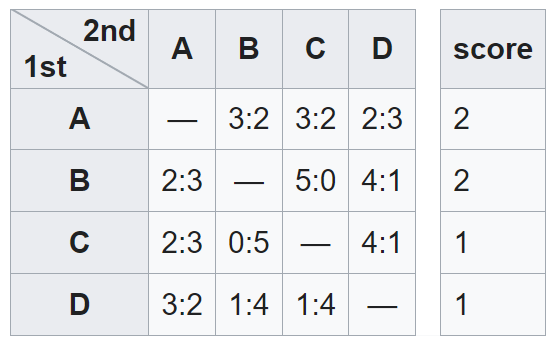
@teamonkey @diffrentcolours @guyjantic Usually the reason I prefer IRV over "the mathematically correct way" is most people aren't good at math, and I thought IRV was simpler to explain ("your first choice gets your vote, if they can't win it's your second choice"). But maybe that's because I have programmer brain and I find discrete algorithms intuitively easy to understand. I don't know!
@mcc @diffrentcolours @guyjantic My feeling is that ranking all the choices in order is simpler for people to understand, and more likely to seem fair. Everyone knows how to rank things in order. The math isn’t really important.
Approval Voting is another one that makes intuitive sense to people. Easy sell.
But having a vote, and then “having another vote if you lose” seems inherently unfair and open to misinformation, IRV encourages that, even if it’s more similar to the above than not.
@teamonkey @mcc @diffrentcolours The USA has a long history of runoff votes and the like. Many elections use them now. I think, as others have mentioned, there are multiple motivations under this. When it suits us, tens of millions of citizens spend hours learning some basics of immunology, international relations, tariff policy, etc. but usually to justify our own prejudices or help us fit in with our ingroups. I think a lot of the resistance to reforms like this is on that level.
@mcc @diffrentcolours @guyjantic I mean, UK has already successfully used STV for decades, e.g. Scottish elections, but crucially not for UK Parliament 🤷
At the time of the referendum, there was a coalition govt of Lib Dems who wanted full PR (eg STV) and Tories who wanted to keep FPTP. AV was chosen as a compromise but it was misinformised that AV benefited the Tories. Most people who didn’t want FPTP didn’t want Tories. People who didn’t understand saw it as an unfair system compared to FPTP.
@teamonkey @guyjantic @mcc Nah, AV is simple. You just list candidates in order of preference. Just like going out for a meal - "I'd like the lasagne" "Sorry, we're out of that" "Oh OK, I'll have the salad".
It was a pragmatic compromise in theory, because if was in Labour's manifesto. But they preferred to give the Lib Dems a bloody nose than eliminate the tactical voting they so often rely on.
@diffrentcolours @guyjantic @mcc Sure, but even back then there was a ton of misinformation. 2/3rds voted against AV over FPTP, so it’s not that easy.
You have to put your explanation up against “why is it fair that you get another vote if your first one loses” and I don’t think that’s easy to explain, but it’s very easy to campaign off.
https://www.bbc.co.uk/news/av/uk-politics-12934509
That plus the “FPTP protects us from extremists” angle which I still hear today despite everything suggesting the opposite is true.
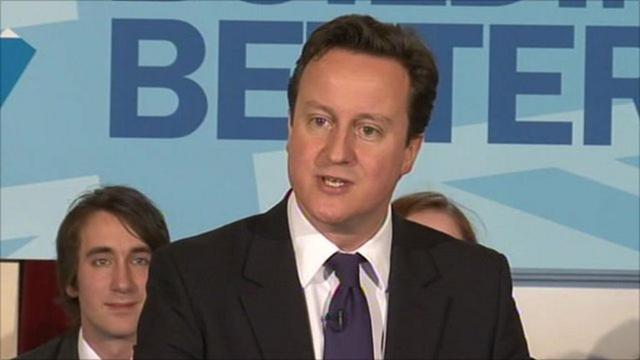
@teamonkey @guyjantic @mcc Yes, the pro-AV campaign, like the pro-EU campaign, was run by (mostly the same bunch of) wonks with no experience of grassroots campaigning or messaging sadly.
 Paul Martin
@[email protected] @[email protected] @[email protected] @[email protected] "messaging sadly" sounds too close to home.
@teamonkey @diffrentcolours @mcc You're mostly talking about UK/British (don't blast me for not understanding which labels to use) situations, but we get similar stuff here, except that it's rare for any voting reform idea to even make it to mainstream news at all. The objections are pretty much the same, then the people complaining about alternative voting systems end up endorsing the fucking electoral college and lowkey endorsing gerrymandering. I think that gives their game away. The EC is byzantine, patently unfair, and at least as complicated as any of those systems. The difference, I think, is that something like the EC leaves an option for powerful people to manipulate a small number of humans to get what they want, while an actually fair voting system cuts them out of the loop.
 Matthew Dockrey
@mcc I will always support any voting reform. No favorites, no factionalism. Taking whatever improvement you can get is the only possible rational response where it can be mathematically shown that while the status quo is very bad, none of the options can actually be perfect.
 Peter Drake
@mcc Same story with "never daylight saving" versus "permanent daylight saving".
 fluffy 💜
@peterdrake @mcc personally I don't care which one we get, just as long as we get ONE of them
(applied to both voting systems and DST abolishment/permanence)
 leastaction
@mcc The real question is: do we want proportional representation or not? The majority answer is yes. This is why Trudeau reneged on his promise to end FPTP.
 Sprocket The Clown
@mcc of these I've only heard of ranked choice voting.
 fraggle
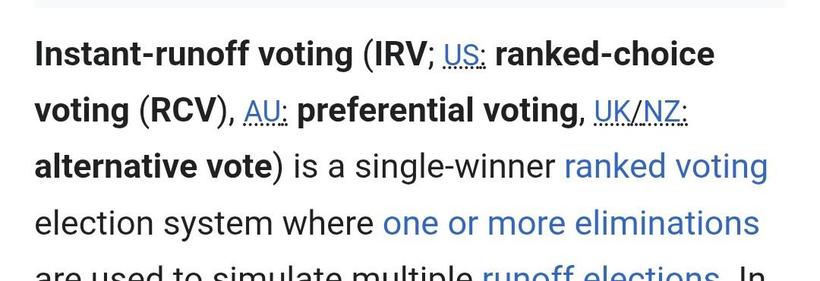
@mcc according to wikipedia, instant runoff is known by four different names. We can't even reach consensus on the basics
 Cassandrich
@mcc You forgot the one true solution that even overcomes Arrow's theorem: sortition.
 John Breen
@mcc I'm really enjoying the ranked-choice system in Maine. Sure, there is a delay, but who decided that a week or two is too long to wait, to conclude a months-long process with big impact ?
Because TV networks are impatient to announce the result ?
Because TV networks are impatient to announce the result ?
 kit
kit@mcc
At home (AoNZ) we had two referenda, the first to choose an alternative electoral mechanism, and the second to pick between the then current (FPtP) and the top alternative (MMP)
Of course, from time to time the Government of the day wants to go back, but even when they did get that to another referendum, the electorate said no.
 Tiota Sram
@mcc see, what I would like to see (short of an anarchist revolution) is not even in the imagined space:
1. From each district, top most-popular 5 candidates all go to the decision-making body.
2. During votes in that body, each representative casts a number of votes equal to the number of voters that voted for them in the election.
3. At any point representees can mail in a form to switch their vote to someone else (among the 5 from their district) or to withdraw it.
4. Enough withdrawals triggers a new election.
I mean obviously no politician would support such a move, and it's still a representative and therefore hierarchical system. It would have its own corruptions and perverse incentives. But for those who think reforming an electoral system is still possible, why not push for something like this that would actually shake up political power more seriously?