 🇪🇺 Yet Another Owl🕯️🕊️
 Radical Anthropology
Nice essay by #ManvirSingh on how #language shapes #thought
https://www.newyorker.com/magazine/2024/12/30/how-much-does-our-language-shape-our-thinking
Your personality changes when you speak another language, but that’s not always a bad thing / The Conversation
Un bell'aticolo sul Principio di Relatività Linguistica, formulato da Whorf negli anni '30.
Languages don’t just allow us to communicate – they also shape our perception of what surrounds us, and ourselves.
#Whorf #Sapir
#languages #linguistics #sociolinguistics #pragmatics #languageLearning
Nice essay by #ManvirSingh on how #language shapes #thought
https://www.newyorker.com/magazine/2024/12/30/how-much-does-our-language-shape-our-thinking
...come le facciamo noi..
Quando sentite dire "colpiremo gli interessi israeliani all'estero", sappiate decodificare quello che può volersi intendere in relazione alla lingua nella quale pensa la fonte del messaggio.
E no, questo mio non è un post di propaganda, come alcuni penseranno, ma è un post di linguistica: quella che ho studiato per nulla (ma tant'è, sono felice lo stesso), quella che mi guida nelle *mie* analisi della realtà (delle quali sono generalmente soddisfatto).
2/ Mein Lieblingslinguist Geoffrey Pullum hat schon in den 80ern darüber geschrieben, wo dieser Mythos herkommt. Die Kolumne ist auch in einem Buch mit dem gleichnamigen Titel erschienen: The great Eskimo vocabulary hoax.
Für alle, die sich irgendwie für Sprachwissenschaften oder auch Wissenschaft allgemein interessieren: #MustRead. Pullum ist der lustigste Linguist, den ich kenne.
https://press.uchicago.edu/ucp/books/book/chicago/G/bo3684610.html
Und verantwortlich für die Katastrophe ist ein gewisser Benjamin Lee #Whorf, Amateurlinguist: „What happened was that Benjamin Lee Whorf, Connecticut fire prevention inspector and weekend language-fancier, picked up Boas' example and used it, vaguely, in his 1940 amateur linguistics article 'Science and linguistics,' which was published in MIT's promotional magazine Technology Review (Whorf was an alumnus; he had done his B.S. in chemical engineering at MIT). Our word snow would seem too inclusive to an Eskimo, our man from the Hartford Fire Insurance Company confidently asserts.“
Hier kann man den Aufsatz einzeln runterladen:
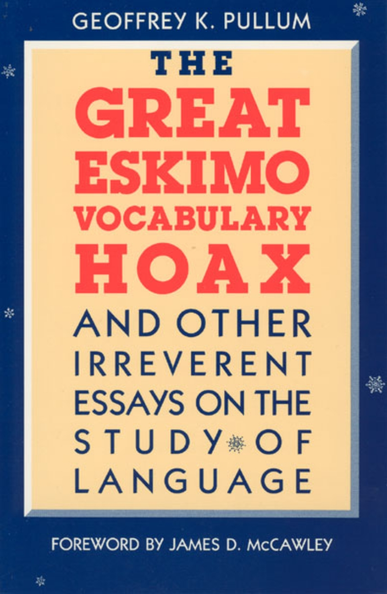

How reliable are all those stories about the number of Eskimo words for snow? How can lamps, flags, and parrots be libelous? How might Star Trek’s Commander Spock react to Noam Chomsky’s theories of language? These and many other odd questions are typical topics in this collection of essays that present an occasionally zany, often wry, but always fascinating look at language and the people who study it. Geoffrey K. Pullum’s writings began as columns in Natural Language and Linguistic Theory in 1983. For six years, in almost every issue, under the banner "TOPIC. . .COMMENT," he published a captivating mélange of commentary, criticism, satire, whimsy, and fiction. Those columns are reproduced here—almost exactly as his friends and colleagues originally warned him not to publish them—along with new material including a foreword by James D. McCawley, a prologue, and a new introduction to each of these clever pieces. Whether making a sneak attack on some sacred cow, delivering a tongue-in-cheek protest against current standards, or supplying a caustic review of some recent development, Pullum remains in touch with serious concerns about language and society. At the same time, he reminds the reader not to take linguistics too seriously all of the time. Pullum will take you on an excursion into the wild and untamed fringes of linguistics. Among the unusual encounters in store are a conversation between Star Trek’s Commander Spock and three real earth linguists, the strange tale of the author’s imprisonment for embezzling funds from the Campaign for Typographical Freedom, a harrowing account of a day in the research life of four unhappy grammarians, and the true story of how a monograph on syntax was suppressed because the examples were judged to be libelous. You will also find a volley of humorous broadsides aimed at dishonest attributional practices, meddlesome copy editors, mathematical incompetence, and "cracker-barrel philosophy of science." These learned and witty pieces will delight anyone who is fascinated by the quirks of language and linguists.
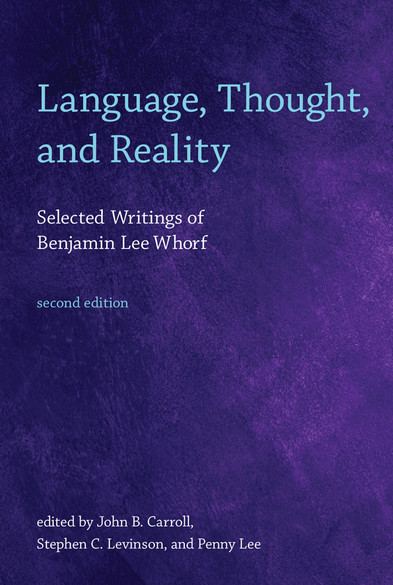
Language, Thought and Reality
Selected Writings of Benjamin Lee Whorf
The pioneering linguist Benjamin Whorf (1897–1941) grasped the relationship between human language and human thinking: how language can shape our innermost thoughts. His basic thesis is that our perception of the world and our ways of thinking about it are deeply influenced by the structure of the languages we speak.
The Whorf Hypothesis is a linguistic theory, particularly popular in America, claiming that the language you speak has a strong influence in the way you think.
I personally think that the theory is mostly bunk. On the other hand, I believe that being exposed early in life to _multiple_ languages _does_ affect the way you think. Namely, even your verbal knowledge and skills somehow become fairly language-independent.
🧵>
#Filmabend per #Watch2Gether & #StudioLink mit #Immanuel
03.09.21; #Arrival
#Sapir-#Whorf-#Hypothese: #Annahme der #Linguistik nach der #Sprache das #Denken formt; #Wechselseitigkeit der #Beeinflussung; #Zirkularität;
#Linguistik als #Perspektive auf den #akademischen #Habitus als #Bedingung der #Möglichkeit der #Reflexion von #Kommunikation im #Unterschied zur #Fortsetzung eines #Irrtums durch #Vermachtung.
Adherents of Toki Pona argue that, speaking this language, we discover the deep meaning of things hidden behind the intricate constructions of the ordinary language. Toki Pona can be learned in just four hours, but then it can not be forgotten for the rest of his life. Native speakers say that by learning it, they began to look at the world in a completely different way - more philosophically.
🐘
https://almanakh-labris.livejournal.com/106112.html
#Sapir #Whorf #hypothesis #janSapile #janWonpe #tana #TokiPona #sona
" Американские ученые, проанализировав статистику боев с японцами во Второй мировой войне, обнаружили, что войска США побеждали чаще. Причину нашли в длине слов английского и японского языков. В английском языке средняя длина слова составляет пять букв, а в японском - тринадцать. То есть пока…
[Toki Pona] follows the philosophy of "less is more", its goals include breaking up concepts into parts, eliminating unnecessary synonyms, setting for good, pleasing to the ear sound.
🐘
" Американские ученые, проанализировав статистику боев с японцами во Второй мировой войне, обнаружили, что войска США побеждали чаще. Причину нашли в длине слов английского и японского языков. В английском языке средняя длина слова составляет пять букв, а в японском - тринадцать. То есть пока…

 Steve James
 Stefan Müller
 earthling
 Jorge Stolfi
 Sozialwelten
 jansegers