Colleagues from the Dep. of Biology and Ecology in Ostrava (Czechia) are looking for a post-doc (1 year with possibility of extension):

🧬 💻 Postdoc in bioinformatics - bioinformatics analyses (genome, transcriptome, proteome) of Trypanosomatidae https://prf.osu.eu/job-opportunities/?kdepr=31&prace=2680

#bioinformatics #endobionts #parasitology #Trypanosomatida #trypanosoma #jobs #AcademicJobs #JobAlert #biology

Job Opportunities / Faculty of Science

Job Opportunities - Faculty of Science - Dare to Explore. The University of Ostrava is a young and rising university, ranked well among central European Universities. We offer Quality, Affordability and Hospitality in our English taught Bachelors, Masters and Doctoral degrees.

University of Ostrava
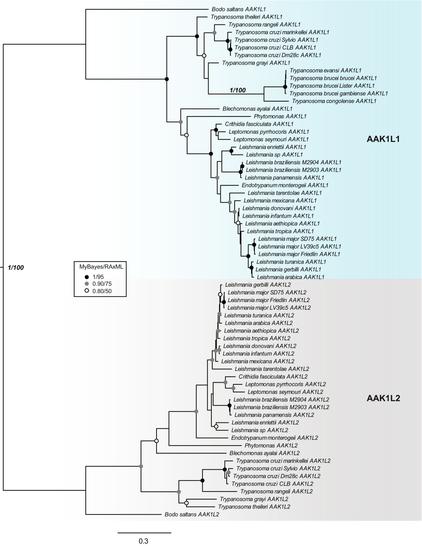
New #ISEPpapers! AAK1-like: A putative pseudokinase with potential roles in cargo uptake in bloodstream form #Trypanosoma brucei #parasites https://onlinelibrary.wiley.com/doi/full/10.1111/jeu.12994 #protists #microbes
Meningoencephalitis and brain abscess (ring-enhancing lesions) are common manifestation of #Trypanosoma cruzi reactivation in advanced #HIV patients #IDMastodon #MedMastodon #Chagas #IMPearls #MedEd
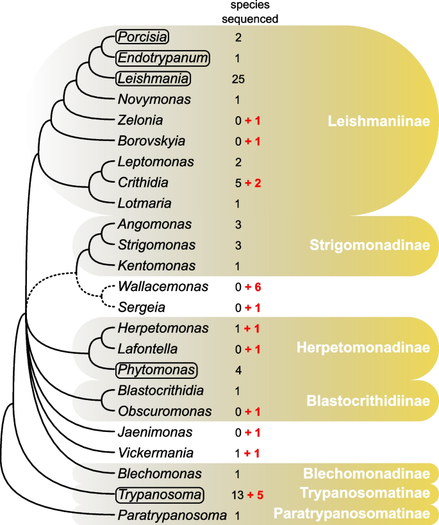
New #ISEPpapers! Shining the spotlight on the neglected: new high-quality #genome assemblies as a gateway to understanding the evolution of Trypanosomatidae https://bmcgenomics.biomedcentral.com/articles/10.1186/s12864-023-09591-z #protists #parasites #microbes #genomics #microbiology #genomes #science #trypanosoma by Amanda Albanaz et al.
Shining the spotlight on the neglected: new high-quality genome assemblies as a gateway to understanding the evolution of Trypanosomatidae - BMC Genomics

Background Protists of the family Trypanosomatidae (phylum Euglenozoa) have gained notoriety as parasites affecting humans, domestic animals, and agricultural plants. However, the true extent of the group's diversity spreads far beyond the medically and veterinary relevant species. We address several knowledge gaps in trypanosomatid research by undertaking sequencing, assembly, and analysis of genomes from previously overlooked representatives of this protistan group. Results We assembled genomes for twenty-one trypanosomatid species, with a primary focus on insect parasites and Trypanosoma spp. parasitizing non-human hosts. The assemblies exhibit sizes consistent with previously sequenced trypanosomatid genomes, ranging from approximately 18 Mb for Obscuromonas modryi to 35 Mb for Crithidia brevicula and Zelonia costaricensis. Despite being the smallest, the genome of O. modryi has the highest content of repetitive elements, contributing nearly half of its total size. Conversely, the highest proportion of unique DNA is found in the genomes of Wallacemonas spp., with repeats accounting for less than 8% of the assembly length. The majority of examined species exhibit varying degrees of aneuploidy, with trisomy being the most frequently observed condition after disomy. Conclusions The genome of Obscuromonas modryi represents a very unusual, if not unique, example of evolution driven by two antidromous forces: i) increasing dependence on the host leading to genomic shrinkage and ii) expansion of repeats causing genome enlargement. The observed variation in somy within and between trypanosomatid genera suggests that these flagellates are largely predisposed to aneuploidy and, apparently, exploit it to gain a fitness advantage. High heterogeneity in the genome size, repeat content, and variation in chromosome copy numbers in the newly-sequenced species highlight the remarkable genome plasticity exhibited by trypanosomatid flagellates. These new genome assemblies are a robust foundation for future research on the genetic basis of life cycle changes and adaptation to different hosts in the family Trypanosomatidae.

BioMed Central

African #trypanosomes mapped for the first time to understand evolution and potential treatments https://phys.org/news/2023-03-african-trypanosomes-evolution-potential-treatments.html

Genome-wide subcellular protein map for the flagellate parasite #Trypanosoma brucei: Karen Billington et al. https://www.nature.com/articles/s41564-022-01295-6 #protists #parasites

For the first time ever, scientists have developed a detailed "protein atlas" of a pathogen—a kind of biological map that locates proteins in cells.

African trypanosomes mapped for the first time to understand evolution and potential treatments

A parasite which has devastating impacts on agriculture and human health is the first pathogen to have its proteins located and mapped within its cells—providing clues to their function and helping to identify potential drug targets.

Phys.org

Now live at eLife: Structural screens identify candidate human homologs of insect chemoreceptors and cryptic Drosophila gustatory receptor-like proteins

https://elifesciences.org/articles/85537

The first part of a developing project looking into the enigmatic origins of insect Gustatory and Odorant receptors!

#olfaction #smell #taste #gustation #evolution #molecularevolution #phylogenetics #LECA #trypanosoma #drosophila #AlphaFold

Structural screens identify candidate human homologs of insect chemoreceptors and cryptic Drosophila gustatory receptor-like proteins

eLife
@PeerCommunityIn now published in Peer Community Journal, #Infections section: Whole blood transcriptome profiles of trypanotolerant and trypanosusceptible cattle highlight a differential modulation of metabolism and immune response during infection by #Trypanosoma congolense https://peercommunityjournal.org/articles/10.24072/pcjournal.239/ https://doi.org/10.24072/pcjournal.239
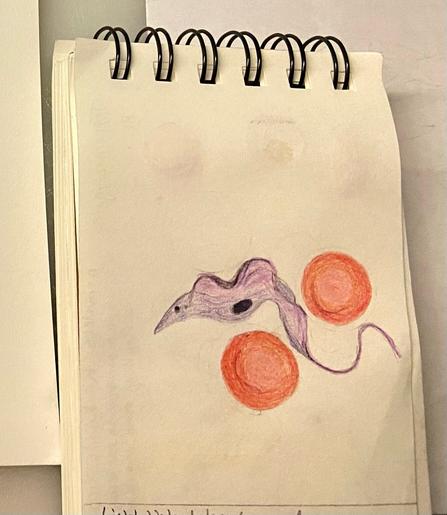
Preliminary sketch of Trypanosoma theileri. Trying to recreate lost micrograph of a specimen whipping a RBC with flagellum until it burst. #sciart #trypanosoma #vetmed
A new #preprint #OpenScience #PeerReview by #PCI_Infections: Peylhard M, Berthier D, Dayo G-K, Chantal I, Sylla S, Nidelet S, Dubois E, Martin G, Sempéré G, Flori L, Thévenon S (2022) Whole blood transcriptome profiles of trypanotolerant and trypanosusceptible cattle highlight a differential modulation of metabolism and immune response during infection by #Trypanosoma congolense. #bioRxiv. https://doi.org/10.1101/2022.06.10.495622