A Tale of Festive Facades and Fractured Foundations – How Societies Cling to Tradition While Grappling with Decline
Halloween 2025: Surviving Economic and Moral Crises in America and Europe | J&M Duna Press
Shadows of All Hallows: Navigating Halloween 2025 Amid Moral Shadows and Economic Storms in America and Europe
Autumn leaves fall like melancholic confetti, painting the streets in a reddish orange that echoes the impending twilight. It’s October 2025, and the air carries not only the scent of carved pumpkins and hidden candies, but also a palpable tension—a collective whisper of unease that intertwines with the laughter of costumed children. Halloween, this ancestral celebration of wandering souls and ephemeral disguises, returns as a distorted mirror of our own inner shadows. In America and Europe, where neon lights compete with jack-o’-lantern lanterns, the holiday promises to be an oasis of normality in a year marked by economic turbulences, ethical erosion, and an incessant bombardment of social distractions. But what really awaits us on this All Hallows’ Eve? A social and economic narrative that reveals not only the festive spectacle, but the human struggle to survive—and perhaps even thrive—amid the chaos.
Imagine a suburban street in New Jersey, USA, where families gather for “trick or treat.” Children dressed as superheroes inspired by the new 2025 Superman movie, with flowing capes and determined gazes, knock on doors. In the background, solar panels flicker faintly under the waxing moon, a subtle reminder of energy bills that have risen 15% in the last months due to renewed trade tariffs. In Berlin, Germany, a group of friends in “KPop Demon Hunters” outfits—a viral trend from a Netflix movie that mixes K-pop with supernatural hunts—dance to electronic beats at a street party, ignoring for a moment the headlines about Europe’s stagnant GDP growth at 0.9%. These scenes, full of color and camaraderie, mask a darker reality: a continent and hemisphere divided by moral, ethical, and economic bankruptcies that threaten to swallow the festive spirit. How will we survive all this? This is the question echoing in the minds of millions, from Wall Street to Westminster, as Halloween unfolds as a perfect metaphor—disguises that hide deep wounds, but also opportunities for rebirth.
Halloween 2025, according to predictions from designers and platforms like Pinterest, will be an eclectic fusion of nostalgia and sustainable innovation. Trends point to vintage decorations inspired by Netflix’s Wednesday, with Victorian gothic touches and natural elements like organic pumpkins and eco-friendly wax candles, reflecting a search for comfort in uncertain times. “Uncommon” costumes explode in popularity: from dollcore puppets with ethereal strings to ghostly insects like moon butterflies and ladybugs, symbolizing an escape to whimsy amid the mundane. In Europe, where the holiday blends with Celtic traditions like the Irish Samhain, expect a renaissance of community events—bonfires in Scottish villages and masked balls in Paris—that emphasize authentic connections, contrasting with the digital isolation plaguing the continent. Economically, Halloween drives billions: in the US, projected spending of $11 billion on candies and decorations, a 7% increase from 2024, despite persistent inflation. But this festive boom is fragile, a temporary balm for wounds that have been bleeding for years.
The social narrative of 2025 paints a picture of deep disconnection, exacerbated by distractions that erode the community fabric. In America, where Gallup reports that 50% of adults see moral values at a record decline—driven by gun violence, political polarization, and a drop in religiosity—Halloween offers a rare glimpse of unity. Families gather, neighbors share piles of treats, and for one night, the “other” becomes an ally in the game of disguise. However, studies like the one in Nature from 2023 reveal that this perception of moral decline is a cognitive illusion: persistent for 70 years in 60 nations, fueled by memory bias and selective exposure to negative news, but not anchored in objective evidence of increased immorality. In Europe, where Eurobarometer surveys indicate ethical erosion linked to corruption scandals and growing inequalities, the holiday echoes ancient pagan purification traditions—a collective catharsis against cynicism. A 2022 study on ResearchGate identifies causes like media influence and failures in religious education as roots of this “moral decay,” exacerbated by a materialistic society that prioritizes the immediate over the eternal.
These social distractions—social networks that devour 2.5 hours daily per user, according to Economist Impact—cost the American economy $650 billion annually in lost productivity, equivalent to $4,500 per worker. In Europe, where recovery time from digital interruptions reaches 127 hours per year, the impact is similar, fragmenting focus and amplifying stress. Think of Halloween parties: while teenagers scroll TikTok feeds for costume ideas, they lose valuable hours that could be spent on real conversations. This “digital malaise,” as described by the LSE Business Review, not only erodes interpersonal ethics—fostering toxic individualism—but also distracts from larger issues, like climate migration affecting 1 in 5 Europeans, per UN reports.
Economically, the fall of 2025 is a labyrinth of elongated shadows. In the US, the IMF projects global growth of 3.3%, but with downward revisions for America due to tariffs that raise inflation to 2.9% and slow GDP to 1.7%. Deloitte Insights warns of an “inflationary impulse” from tariffs, with 60% of costs passed to consumers, exacerbating inequalities in a country where 40% of families live paycheck to paycheck. In Europe, the European Commission forecasts stagnation at 1.1% for the EU, with inflation falling to 1.7%, but risks from trade tensions and natural disasters—like the floods in Germany that cost €40 billion—loom like ghosts. The McKinsey Global Institute highlights changes in trade policy as the biggest risk to growth, cited by 60% of survey respondents, surpassing even geopolitical instabilities. Amid this, Halloween injects vitality: retailers like Spirit Halloween predict spikes in sales of Fantastic Four-inspired costumes, a reminder that festive consumption can cushion economic shocks, boosting 0.5% of seasonal GDP in the US.
But how will we survive? The key lies in narratives of resilience, woven with threads of facts and human hope. First, combat the moral illusion with community action. Studies from Greater Good Magazine show that perceptions of decline are biased, but acts of kindness—like organizing local Halloween events—restore social bonds, reducing loneliness by 20%, per 2023 Cigna data. In America, where the HOW Institute reports that 95% see moral leadership as essential for long-term success, encourage business leaders to prioritize ethics in hiring, fostering empathetic cultures that mitigate stress. In Europe, integrate ethical education into curricula, as recommended by the 2022 study, to fill the void left by secularization.
Economically, survival strategies are pragmatic and proven. The Harvard Business Review analyzed past recessions and found that 9% of companies thrive by cutting non-essential costs and investing in innovation—a playbook for 2025. Start by assessing finances: reduce high-interest debts, which consume 20% of average American income, and build a 3-6 month emergency fund, per Newsweek advice. Diversify income: freelancers on platforms like Upwork reported 15% higher earnings during downturns, exploring skills in AI and sustainability—resilient sectors, according to the World Bank. For distractions, adopt “focus time”—90-minute blocks without notifications, recovering 127 lost hours annually, per Economist Impact. In Europe, upskilling policies like Germany’s Kurzarbeit have proven to reduce unemployment by 2% during crises.
At its core, Halloween 2025 invites us to drop the masks. In New York, a family father, indebted by tariffs that raised import costs, turns his garage into a community haunted maze, generating an extra $2,000 and reconnecting neighbors isolated by screens. In London, a group of European immigrants organizes a “Night of Lost Souls,” blending Halloween traditions with Balkan rituals, fostering solidarity amid migration tensions. These stories are not fiction; they are echoes of human resilience, anchored in data from the OECD Economic Outlook, which emphasizes that modest growth persists despite uncertainties, if nurtured by investments in human capital.
However, the path ahead is not without thorns. Moral polarization, fueled by media that amplifies the negative, threatens to turn celebrations into battlefields—think debates on “appropriative Halloween” dividing American communities. Economically, Morgan Stanley forecasts the slowest global growth since the pandemic, with government deficits swelling in Europe and the US to stimulate recovery. Distractions like social media addiction, costing €200 billion in European productivity annually, perpetuate a cycle of apathy, where the immediate—a viral bee costume reel (+754% in searches)—eclipses the urgent, like fiscal reforms.
Survival demands intentionality. Cultivate authentic networks: join communities like Oslo Meet, a global platform that connects entrepreneurs to “unite experiences and inspire solutions,” transforming isolation into innovation. Studies from the World Economic Forum show that collaborative ecosystems increase resilience by 30% during crises. Invest in financial education: apps like Mint helped 40% of American users navigate past recessions, per Forbes. And above all, embrace vulnerability—the Halloween teaches us that exposing fears can exorcise them.
As the midnight of October 31 approaches, remember: the disruptions of 2025 are not the end, but a dark interlude in a greater symphony. America and Europe, with their moral and economic bankruptcies, will emerge not despite the distractions, but through them—reconnecting in festive bonfires, innovating amid perceived decline, and surviving with human grace. The real trick? Turning trick-or-treat into triumph. And the treat? A more compassionate society, ready for the dawn.
Main References:
- Mastroianni, A. M., & Gilbert, D. T. (2023). The illusion of moral decline. Nature, 618(7965), 473–480. https://www.nature.com/articles/s41586-023-06137-x
- Alvi, S., et al. (2022). The Study Exploring the Causes of Moral Decay in Society: A Mixed Method Analysis. ResearchGate. https://www.researchgate.net/publication/367536893_The_Study_Exploring_the_Causes_of_Moral_Decay_in_Society_A_Mixed_Method_Analysis
- International Monetary Fund. (2025). World Economic Outlook Update, January 2025. https://www.imf.org/en/Publications/WEO/Issues/2025/01/17/world-economic-outlook-update-january-2025
- Deloitte Insights. (2025). US Economic Forecast Q3 2025. https://www.deloitte.com/us/en/insights/topics/economy/us-economic-forecast/united-states-outlook-analysis.html
- European Commission. (2025). Spring 2025 Economic Forecast. https://economy-finance.ec.europa.eu/economic-forecast-and-surveys/economic-forecasts/spring-2025-economic-forecast-moderate-growth-amid-global-economic-uncertainty_en
- Economist Impact. (2023). In Search of Lost Focus. https://impact.economist.com/new-globalisation/in-search-of-lost-focus-2023/
- Gulati, R., et al. (2019). How to Survive a Recession and Thrive Afterward. Harvard Business Review. https://hbr.org/2019/05/how-to-survive-a-recession-and-thrive-afterward
Share your thoughts in the comments, and explore more insights on our Journal and Magazine. Please consider becoming a subscriber, thank you: https://dunapress.org/subscriptions – Follow J&M Duna Press on social media. Join the Oslo Meet by connecting experiences and uniting solutions: https://oslomeet.org
#CriseEconomica #EconomicCrisis #Halloween2025 #ResilienciaSocial #SocialResilience
 WPS News
 Urbanism Now
 DoomsdaysCW
 Paulo Fernando de Barros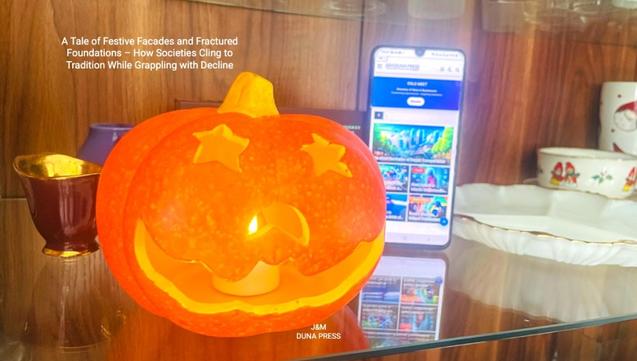
 CITO Greenhouse
 Newsramp
 Cluster ROOTS

 Dr. Simon Bunchuay-Peth

 Canadian Association For Food Studies