EFU: When We Stop Merely Measuring Reality and Start Learning Its Language
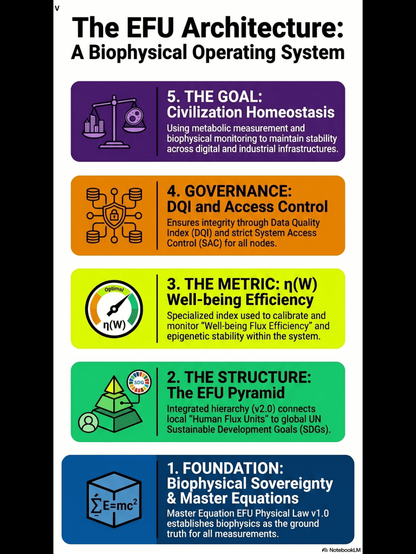
There are moments when a new unit of measurement seems, at first glance, like a technical detail. Later, it turns out to be something much more important: a change in how we think. I believe EFU may be exactly that kind of shift. It is not just another number. It is a new language for describing the flows that sustain human civilization — material, energetic, ecological, and social.
The real importance of EFU is not only what it measures, but what it reveals. It invites us to stop seeing the world as a collection of isolated data points and start seeing it as a connected system of flows. Water, energy, materials, waste, agriculture, transport, and environmental pressure are not separate stories. They are chapters of the same larger story. EFU helps make that story visible.
A New Unit, Not Just a New Label
The most interesting thing about EFU is not the number itself, but the way of thinking it encourages. When we begin to look at a problem through EFU, we no longer see only statistics. We see relationships. We see dependencies. We see thresholds, bottlenecks, imbalances, and patterns of stress that are otherwise easy to miss.
That is why EFU matters. It does not merely describe the present. It helps us ask whether a system is stable, whether it is being overburdened, and whether it can remain viable over time. In that sense, EFU is not only a measuring tool. It is a tool for understanding resilience.
Why This Could Matter More Than It First Appears
Every major historical era has had its own dominant way of measuring reality. The industrial age centered on mass, energy, and power. The digital age elevated information, data, and connectivity. The next era may well revolve around flows, pressures, limits, and ecological coherence.
EFU fits naturally into that future. It suggests that the question is not merely “how much is there?” but also:
- How does it move?
- What system is it part of?
- What does it cost?
- How long can it continue?
That is a much deeper way of thinking. It is not just accounting. It is civilizational self-awareness.
The Future Vision: When Measurement Becomes Thoughtful
What makes EFU especially exciting is that it points beyond itself. If some of the most advanced ideas in modern physics suggest that spacetime, locality, and even causality may not be fundamental, but rather emergent from a deeper layer of reality, then we are already living in a world where our old intuitions may not be enough.
EFU belongs to that broader intellectual horizon. It does not need to claim that it is “new physics.” But it can certainly be understood as a step toward a new kind of structured thinking: a way of measuring reality that is more aligned with systems, thresholds, and hidden dependencies.
In that future, artificial intelligence could become a particularly powerful partner. Not because it merely computes faster, but because it may detect patterns that are too complex for human intuition alone. If EFU is paired with AI-driven symbolic reasoning, we may not just analyze data more efficiently — we may discover new kinds of relationships:
- hidden ratios,
- tipping points,
- structural imbalances,
- and system-level laws that are difficult to express in ordinary terms.
The Intuitive Advantage
One of the strongest qualities of EFU may be its intuitive power. A good unit of measurement does not oversimplify reality. It organizes it. It makes complexity legible without distorting it.
That is especially valuable in areas like:
- water management,
- agriculture,
- energy systems,
- waste treatment,
- urban planning,
- and environmental policy.
In these fields, raw numbers often fail to communicate what is really happening. EFU can help bridge that gap. It can create a shared framework in which experts, decision-makers, and ordinary citizens can discuss the same problem in the same conceptual language.
That is a rare and valuable thing. A unit that improves understanding is more than a unit. It becomes a bridge.
A Small Concept With a Large Horizon
EFU may still be an emerging idea. It may need refinement, testing, and better formalization. That is not a weakness. In fact, it is often the mark of a genuinely important idea. The most transformative concepts rarely arrive in finished form. They begin as a direction, a hunch, an intuition that something essential is missing.
And perhaps that is what EFU is really pointing to: a civilization that no longer measures only what it extracts, consumes, or produces, but also what it sustains, balances, and preserves.
If that is true, then EFU is not a side project. It is a possible step toward a new intellectual culture — one that understands that the future will not be shaped only by growth, but by balance.
#aNewLanguageForMeasuringReality #abstractReality #AIAndScience #beyondNumbersUnderstandingSystemsThroughEFU #circularEconomy #conceptualShift #dimensionalAnalysis #ecologicalFlows #EFU #EFUAsAFrameworkForSustainability #emergentReality #emergentSpacetime #energyFlows #environmentalPressure #fromDataToMeaningInEnvironmentalSystems #futureOfScience #futureVision #hiddenStructures #howAICanHelpDiscoverSystemLevelLaws #HumanFluxUnit #humanCenteredMeasurement #interdisciplinaryFramework #materialFlows #measuringHumanCivilizationThroughFlows #newEpistemology #newUnitOfMeasurement #pregeometricReality #quantumGravity #resilience #resourceManagement #scientificParadigmShift #sustainability #symbolicReasoning #systemDynamics #SystemsThinking #theFutureOfMeasurementAndReality #waterManagement #whyEFUMattersForTheFuture Lieblingstypen

 U3dn
U3dn
 The Risks of Artificial Intelligence and Ways to Protect Ourselves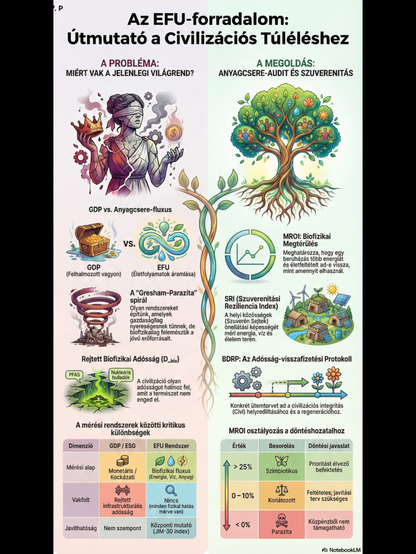
 Felhasználó
 mymedschool
 Daily Times - Latest Pakistan News, World, Business, Sports, Lifestyle [Unofficial]
 Firstyear