#Quantumcomputing was a big theme this week at #IBMThink, as #quantumadvantage now appears closer than ever, according to #IBM CEO Arvind Krishna. Early adopters such as Cleveland Clinic, Boeing and Allstate were on hand at the conference to talk about how they're using the technology.
My colleague Kathleen Casey covers it all comprehensively but digestibly here, including the implications for enterprise #AI:
https://www.techtarget.com/searchdatacenter/news/366642895/Quantum-moves-from-promise-to-practice-at-IBM-Think-2026

Quantum moves from promise to practice at IBM Think 2026
Quantum computing is becoming a reality at major companies, from Boeing to Allstate. Quantum -- especially when paired with AI -- promises better business outcomes.
youtube.com/watch?v=L8JD...
#QuantumAdvantage seems to be more or less dispelled, as classical algorithms - all of which involve transforms of notations - perform comparably without specialized
#qubit processors.
#Ewin_Tang the youngest of several mathematicians proving that.
Once again math>$.
Youngest Winner of Breakthroug... 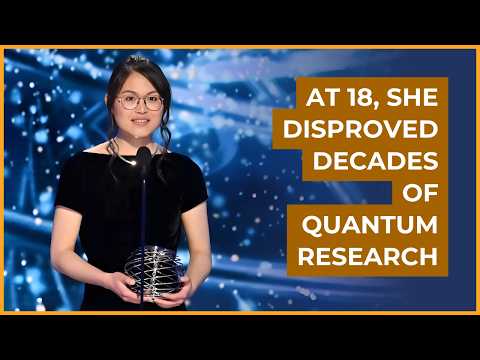
Youngest Winner of Breakthrough Prize in Mathematics
#Google claims a
#breakthrough in
#quantumcomputing, developing an algorithm that performed a task beyond the capabilities of conventional computers. The algorithm, which computed the structure of a molecule, demonstrates “
#quantumadvantage” but real-world applications are still years away. While impressive, the achievement focused on a narrow
#scientificproblem and fully fault-tolerant quantum computers are still some way off.
https://www.theguardian.com/technology/2025/oct/22/google-hails-breakthrough-as-quantum-computer-surpasses-ability-of-supercomputers?eicker.news #tech #media #news Google hails breakthrough as quantum computer surpasses ability of supercomputers
Algorithm performed task beyond capability of classical computers, although experts say real-world application still years away
The paper presents the Zuchongzhi 3.0 quantum processor, which sets a new benchmark in quantum computational advantage with its 105 qubits. The study looks well-designed, with consistent and reproducible results. The findings suggest that this processor represents a significant advancement in the field of quantum computing.
https://arxiv.org/abs/2412.11924
#QuantumComputing #QuantumProcessor #Zuchongzhi3 #QuantumAdvantage #QuantumPhysics #Benchmarking

Establishing a New Benchmark in Quantum Computational Advantage with 105-qubit Zuchongzhi 3.0 Processor
In the relentless pursuit of quantum computational advantage, we present a significant advancement with the development of Zuchongzhi 3.0. This superconducting quantum computer prototype, comprising 105 qubits, achieves high operational fidelities, with single-qubit gates, two-qubit gates, and readout fidelity at 99.90%, 99.62% and 99.18%, respectively. Our experiments with an 83-qubit, 32-cycle random circuit sampling on Zuchongzhi 3.0 highlight its superior performance, achieving one million samples in just a few hundred seconds. This task is estimated to be infeasible on the most powerful classical supercomputers, Frontier, which would require approximately $6.4\times 10^9$ years to replicate the task. This leap in processing power places the classical simulation cost six orders of magnitude beyond Google's SYC-67 and SYC-70 experiments [Nature 634, 328(2024)], firmly establishing a new benchmark in quantum computational advantage. Our work not only advances the frontiers of quantum computing but also lays the groundwork for a new era where quantum processors play an essential role in tackling sophisticated real-world challenges.
Independent verification of results is an important part of the #scientific process. However - in #physics at least - #replication and #verification studies rarely seem to be published. Despite this, I decided to attempt to verify the results of a groundbreaking Nature Physics paper from 2012, in which the authors describe the first dynamical #quantum #simulator. You can read the fruits of my labour in my #arxiv preprint: "Classical verification of a quantum simulator: local relaxation of a 1D Bose gas". I hope you find it interesting.
https://scirate.com/arxiv/2401.05301
#ScientificProcess #QuantumSimulator #QuantumSimulation #QuantumAdvantage #science #ClassicalVerification #ComputationalPhysics #ParallelComputing #HPC #HighPerfomanceComputing #supercomputer #TensorNetworks #MatrixProductStates #TEBD

Classical verification of a quantum simulator: local relaxation of a 1D Bose gas
In [Nat. Phys. 8, 325-330 (2012)], Trotzky et al. utilize ultracold atoms in an optical lattice to simulate the local relaxation dynamics of a strongly interacting Bose gas "for longer times than present classical algorithms can keep track of". Here, I classically verify the results of this analog quantum simulator by calculating the evolution of the same quasi-local observables up to the time at which they appear "fully relaxed". Using a parallel implementation of the time-evolving block decimation (TEBD) algorithm to simulate the system on a supercomputer, I show that local densities and currents can be calculated in a matter of days rather than weeks. The precision of these numerics allows me to observe deviations from the conjectured power-law decay and to determine the effects of the harmonic trapping potential. As well as providing a robust benchmark for future experimental, theoretical, and numerical methods, this work serves as an example of the independent verification process.

What is quantum utility? | IBM Research Blog
For the first time in history, quantum computers are demonstrating the ability to solve useful problems at a scale beyond brute force classical simulation.
 Beth Pariseau
 Hublai (charismatic megafauna)
 Winbuzzer
 Mathrubhumi English

 tech news ᳇ eicker.news
 WetHat💦
 Dr. P. M. Secular
 EURACTIV Technology
 guetto 🧑💻 🇪🇺