IBM ra mắt 2 bộ xử lý lượng tử mới, bao gồm một mẫu có khả năng tính toán lượng tử tolerent lỗi vào năm 2029 #LượngTử #QuantumComputing #IBM #TínhToánLượngTử #QuantumProcessor #CôngNghệMới #TechNews #TinCôngNghệ
Green light for Europe's first ion-trap-chip pilot line: Milestone for the stabilization and strengthening of quantum technology fabrication, bolstering Europe's technological sovereignty 👉 https://press.uni-mainz.de/green-light-for-europes-first-ion-trap-chip-pilot-line/ @bmftr_bund
#QuantumTechnology #QuantenComputer #IonTrap #QuantumProcessor #QuantumSensing #QuantumCommunication #QuantumComputing #IonTraps
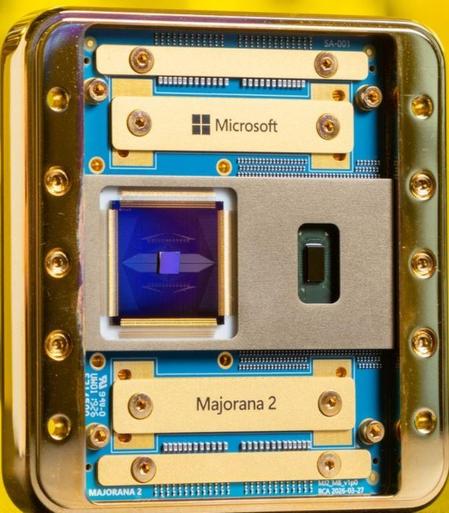
Microsoft Azure News: Built with a breakthrough class of materials called a topoconductor, Majorana 1 marks a transformative leap toward practical quantum computing. Quantum computers promise to transform science and society—but only after they achieve the scale that once seemed distant and...
The paper presents the Zuchongzhi 3.0 quantum processor, which sets a new benchmark in quantum computational advantage with its 105 qubits. The study looks well-designed, with consistent and reproducible results. The findings suggest that this processor represents a significant advancement in the field of quantum computing.
https://arxiv.org/abs/2412.11924
#QuantumComputing #QuantumProcessor #Zuchongzhi3 #QuantumAdvantage #QuantumPhysics #Benchmarking
In the relentless pursuit of quantum computational advantage, we present a significant advancement with the development of Zuchongzhi 3.0. This superconducting quantum computer prototype, comprising 105 qubits, achieves high operational fidelities, with single-qubit gates, two-qubit gates, and readout fidelity at 99.90%, 99.62% and 99.18%, respectively. Our experiments with an 83-qubit, 32-cycle random circuit sampling on Zuchongzhi 3.0 highlight its superior performance, achieving one million samples in just a few hundred seconds. This task is estimated to be infeasible on the most powerful classical supercomputers, Frontier, which would require approximately $6.4\times 10^9$ years to replicate the task. This leap in processing power places the classical simulation cost six orders of magnitude beyond Google's SYC-67 and SYC-70 experiments [Nature 634, 328(2024)], firmly establishing a new benchmark in quantum computational advantage. Our work not only advances the frontiers of quantum computing but also lays the groundwork for a new era where quantum processors play an essential role in tackling sophisticated real-world challenges.
Introducing the 98” Samsung QEC Series 450 nit 4K UHD Display: https://www.reviewspace.info/introducing-the-98-inches-samsung-qec-series-450-nit-4k-uhd-display
#Samsung #DisplayTechnology #BusinessSolutions #UHDDisplay #QuantumProcessor #DigitalSignage #Monitor #TechnologyNews
https://www.slashinsider.com/quantum-processor-high-fidelity-magic-state/
Scientists at the University of Science and Technology of China demonstrated a key advancement in fault-tolerant #quantumcomputing by successfully preparing high-fidelity logical magic states on a superconducting #quantumprocessor.
Scientists at the University of Science and Technology of China demonstrated a key advancement in fault-tolerant quantum computing by successfully preparing high-fidelity logical magic states on a superconducting quantum processor. Their approach, outlined in Physical Review Letters, could pave the way for scalable and robust quantum computers, overcoming challenges like noise and errors.
Intel Corporation is betting its money that quantum dot silicon chips will be part of the first commercial quantum computer and says the focus should be on building quantum computers that look like classical computers today.
It wants researchers to use its chip and work on software applications to go with it.
But is this announcement a big deal? Here's my @eveningstandard story, on what the future of quantum computing will look like, with analysis and views from the likes of: Anne Matsuura, Ravi Pillarisetty, Joe Fitzsimons of Horizon Quantum Computing, John Morton of Quantum Motion and Mark Mattingley-Scott of Quantum Brilliance:
https://www.standard.co.uk/tech/intel-quantum-silicon-chip-quantum-computer-b1088066.html
#quantumcomputing #intel #quantumtechnology #technologynews #quantumprocessor #mooreslaw
Referenced link: https://phys.org/news/2022-12-quantum-processor-reveals-bound-states.html
Discuss on https://discu.eu/q/https://phys.org/news/2022-12-quantum-processor-reveals-bound-states.html
Originally posted by Phys.org / @[email protected]: https://twitter.com/physorg_com/status/1600526060759576576#m
#Quantumprocessor reveals #boundstates of photons hold strong even in the midst of chaos @nature https://phys.org/news/2022-12-quantum-processor-reveals-bound-states.html
Researchers have used a quantum processor to make microwave photons uncharacteristically sticky. They coaxed them to clump together into bound states, then found that these photon clusters survived in a regime where they were expected to dissolve into their usual, solitary states. The discovery was first made on a quantum processor, marking the growing role that these platforms are playing in studying quantum dynamics.