TET enzymes remove
#DNAmethylation markers; This study shows that these enzymes are required for
#photoreceptor cells to initiate the genetic program to become rods instead of cones, & for maturation of the
#retina @PLOSBiology https://plos.io/3UaVBfl
Novel photoreceptor sheds light on how cyanobacteria 'see' color
Scientists from Tokyo Metropolitan University have identified a new photoreceptor in cyanobacteria with a modification in part of its structure which makes it sensitive to green/teal light. The photoreceptor belongs to a family usually sensitive to red/green light in the environment.
Retinal
#photoreceptor cells are maintained through a complex
#ProteinTrafficking network. @RobichauxLab use quant super-res microscopy to reveal trafficking of the visual pigment
#rhodopsin in the inner segment region of rod photoreceptors
#PLOSBiology https://plos.io/3RPJPVW
Super-resolution mapping in rod photoreceptors identifies rhodopsin trafficking through the inner segment plasma membrane as an essential subcellular pathway
Photoreceptor cells of the retina are maintained through a complex protein trafficking network. This study uses quantitative super-resolution microscopy to reveal the trafficking of the essential visual pigment rhodopsin in the inner segment region of rod photoreceptors.
Ciliated
#photoreceptor cells have been well studied re
#RetinalDegeneration, but what about
#PrimaryCilia in other ocular cell types? Study shows that
#PrimaryCilium in RPE is essential for development & function; loss results in degeneration
#PLOSBiology https://plos.io/3t2PwaG
Deletion of IFT20 exclusively in the RPE ablates primary cilia and leads to retinal degeneration
Most research on retinal degeneration has focused on the ciliated photoreceptor cells, but the role of primary cilia in other ocular cell types has largely been ignored. This study shows that the primary cilium in the retinal pigment epithelium is essential for development and for the proper functioning of this tissue; its absence results in retinal degeneration.
Our new review on "Photobehaviours guided by simple photoreceptor systems" has been published (as author accepted manuscript version).
A synthesis, classification and hopefully a valuable resource, together with Emelie Brodrick.
Also with practical guidelines on how to measure photobehaviour.
https://zenodo.org/record/8225165 #neuroscience #photoreceptor #evolution #science
Photobehaviours guided by simple photoreceptor systems
Light provides a widely abundant energy source and valuable sensory cue in nature. Most animals exposed to light have photoreceptor cells and in addition to eyes, there are many extraocular strategies for light sensing. Here, we review how these simpler forms of detecting light can mediate rapid behavioural responses in animals. Examples of these behaviours include photophobic (light avoidance) or scotophobic (shadow) responses, photokinesis, phototaxis and wavelength discrimination. We review the cells and response mechanisms in these forms of elementary light detection, focusing on aquatic invertebrates with some protist and terrestrial examples to illustrate the general principles. Light cues can be used very efficiently by these simple photosensitive systems to effectively guide animal behaviours without investment in complex and energetically expensive visual structures.

Promising stem cell approach to correct photoreceptor cell degeneration, which causes visual decline and blindness
A preclinical study using stem cells to produce progenitor photoreceptor cells—light-detecting cells found in the eye—and then transplanting these into experimental models of damaged retinas has resulted in significant vision recovery. This finding, by scientists at Duke-NUS Medical School, the Singapore Eye Research Institute and the Karolinska Institute in Sweden, marks a first step toward potentially restoring vision in eye diseases characterized by photoreceptor loss. The research is published in the journal Molecular Therapy.
Investigating both the
#genetic information and structure of the
#photoreceptor #rhodopsin, responsible for detecting dim light, of
#whale #sharks to investigate how they can see in the dim light at extreme depths.
#MarineBiology #sflorghttps://www.sflorg.com/2023/03/mb03292301.html
How whale shark rhodopsin evolved to see, in the deep blue sea!
the photoreceptor rhodopsin of whale sharks


new role for neuronal Synaptobrevin
The post-Golgi trafficking in Drosophila photoreceptors, in particular that of rhodopsin 1 (Rh1) to photoreceptive rhabdomeres at the plasma membrane, has been proven a useful model system to study the secretory pathway; this has been shown to require Rab11, a marker of recycling endosomes, but the exact mechanisms remain unknown. Akiko K. Satoh and colleagues recently found that Synaptobrevin (Syb), the orthologue of the human SNARE VAMP3 and another recycling endosome marker, localises to the trans-side of the Golgi stack, and in this work (Yamashita et al., 2022), they now address the role of the neuronal isoform nSyb in Rh1 transport. The authors show first that nSyb is essential for post-Golgi Rh1 transport, and, moreover, that nSyb also localises to post-Golgi vesicles at the base of rhabdomeres, identifying this factor for the first time as the SNARE involved in post-Golgi transport in photoreceptors, in addition to its well-described function in synaptic vesicle fusion. Furthermore, results obtained from nSyb-null photoreceptors of dark-reared flies suggest that nSyb also has a role in recycling of Rh1 via light-induced endocytosis, in addition to orchestrating the exocytosis of the newly synthesised protein. Taken together, the work presented here thus describes a new and unexpected role for nSyb in regulating rhodopsin distribution in Drosophila photoreceptors.
 PLOS Biology
 CellBioNews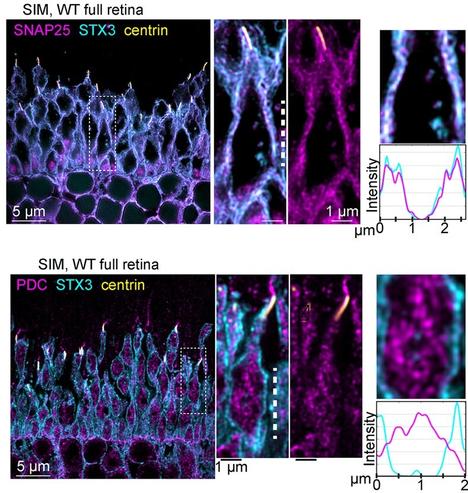

 Gaspar Jekely
 Phys.org
 Scientific Frontline
 Journal of Cell Science