RE: https://mastodon.green/@plazi_species/116022519007902519

Beetles of the genus #Cheironitis (#Scarabaeinae) are characterized by a strikingly #robust #morphology in the #adults, while the larvae usually resemble cockchafer grubs. These are #dungbeetles that exhibit #broodcare. They are widespread in #arid regions of the #Palearctic and #Afrotropical regions. YuHeng Wang et al. (2025) described, i.a., the new species C. #aiweiae from #ShirenGou (Xinjiang Uygur). #Biodiversityresearch © this text #StefanFWirth

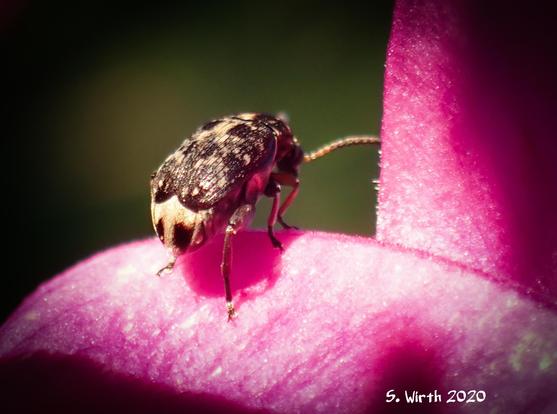
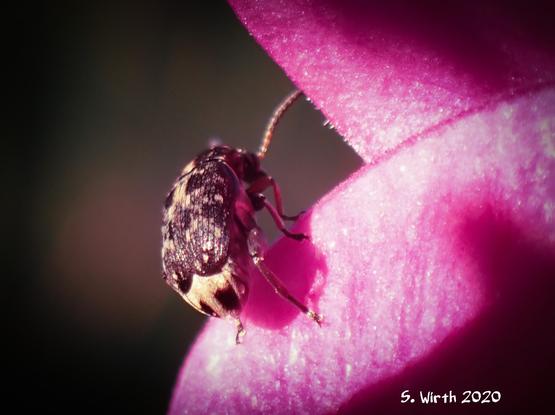
The #beetle #Bruchus #affinis (#Bruchinae) is widespread in the western #Palearctic and common in #Europe. The larvae develop in the seeds of sweet peas (#Lathyrus). The #adults can be found from April to August. K. Sláma & M.-S. Coquillaud (1992) investigated the "programmed, #nervouscontrol of #respiratory #metabolism" in diapausing adults.

© #StefanFWirth #Berlin Blankenfelde 2020/2025

Ref
https://doi.org/10.1016/0022-1910(92)90031-8

#Photos
© S.F. Wirth

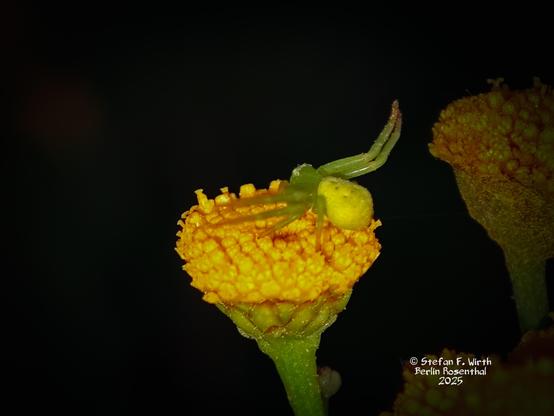
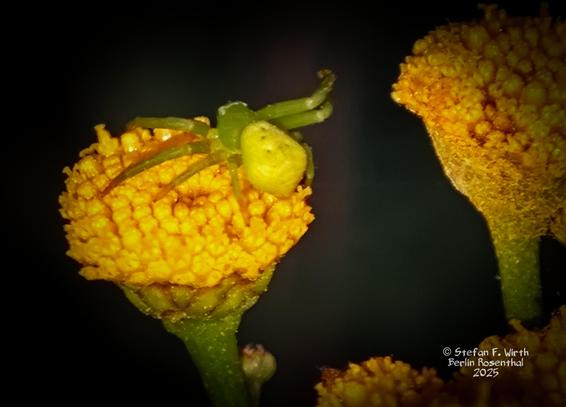
The #crabspider #Ebrechtella #tricuspidata has a #palearctic native range and is widely distributed, but in Europe appears more often in the East and South. In Germany it is considered not very abundant, but common. It prefers warmth exposed moist areas. H. Guo et al. (2025) found that #femalechoice is focused on the #malesize only, while #male'choice (when #mating experienced) is towards #virginfemales.

© #StefanFWirth #Berlin 2025

Ref

https://doi.org/10.1093/cz/zoae059

#Photos
© S F. Wirth

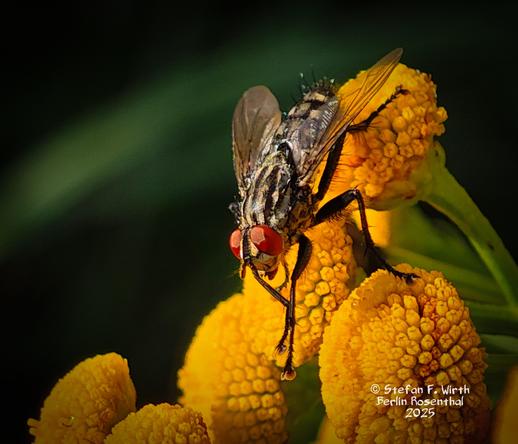
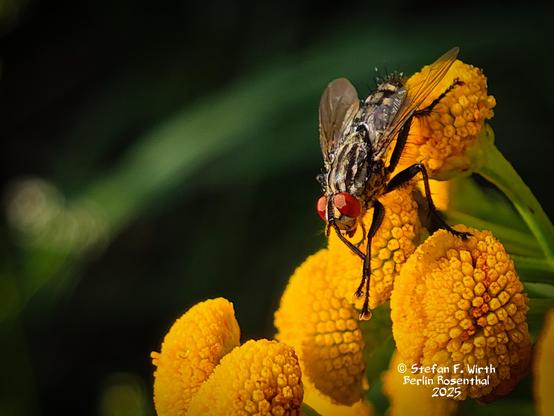
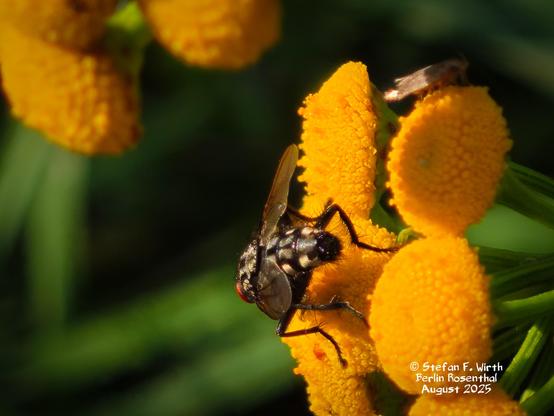
Shown is a #fly of the #genus #Sarcophaga, not being determined on a #specieslevel. It belongs to the #cryptic S. carnaria-#speciesgroup S. #carnaria itself is distributed throughout the #Palearctic region and is a #parasitoid of earthworms. H. E. Moore et al. (2021) used #cuticularhydrocarbon (CHC) profiles to differentiate 11 Sarcophaga species (including S. carnaria) from each other
© #StefanFWirth #Berlin 2025

Ref
https://doi.org/10.1038/s41598-021-87221-y

#Photos
© S. F. Wirth

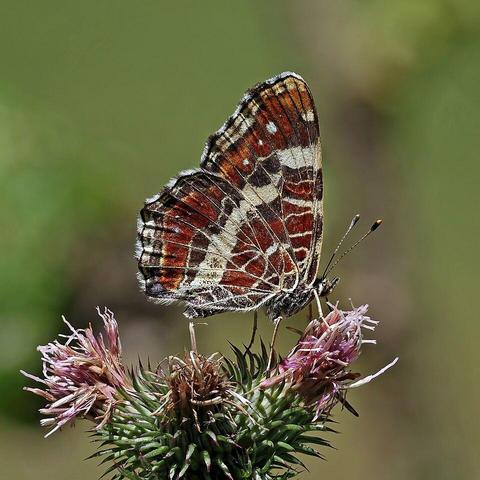
𝗪𝗜𝗞𝗜𝗣𝗘𝗗𝗜𝗔 𝗣𝗜𝗖𝗧𝗨𝗥𝗘 𝗢𝗙 𝗧𝗛𝗘 𝗗𝗔𝗬

✧ map ✧

The map (Araschnia levana) is a butterfly of the family Nymphalidae. It is found from Spain through Europe and east through the Palearctic to Central Asia and the Russian Far East to Korea and Japan. The map exhibits seasonal dimorphism which means it has two different forms, depending on whether its larva grows in the summer or the winter. The su...

#CentralAsia #Japan #Spain #Europe #Palearctic #Wikipedia
https://en.wikipedia.org/wiki/Map_(butterfly)

The #duskyant, #Formica #fusca (#Myrmicinae), is a ground-dwelling #ant with #earthnests in warmer habitats, widespread in #CentralEurope and extending across the western #Palearctic. The nests are #polygynous (severely active #queens). Like many ant species, this one also carries #phoretic organisms on its body, e.g., #mites of the #Histiostomatidae. #biodiversity #insects #Hymenoptera

© #StefanFWirth, #Berlin May 2025

Artistic Photo:

#Worker of F. fusca Berlin, May 2025, © S.F. Wirth

The #firebug #Pyrrhocoris apterus is widespread throughout much of #Palearctic. Adults and the five nymphal stages tend to #aggregate. They are #soildwellers and feed on plant #seeds, occasionally also on insect eggs. Some mite species can be on the bugs, with the #parasitic #mite #Hemipteroseius adleri being particularly specialized for it.

© #StefanFWirth #Berlin 2025

in my #YouTube video about a tree (2025)
https://youtu.be/wZqDuEFu8Nk?si=0HLyBsc4VjzGKvok

#Photo

P. apterus Bln, 2020, new edit 2025 © S. F. Wirth

European hornbeam and its many macro and micro habitats

YouTube