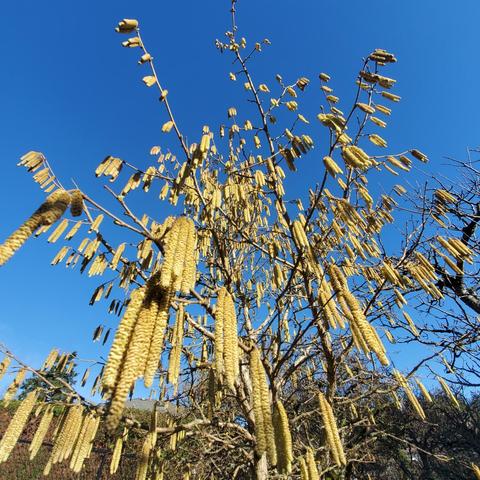
#Wikipedia - #HazelTrees! Another tree that is found in many locations in the Northern Hemisphere!
Excerpt: "Corylus has around 14–18 species. The circumscription of species in eastern Asia is disputed, with World Flora Online and the Flora of China differing in which taxa are accepted, within this region. WFO accepts 17 species while Flora of China accepts 20 species (including Corylus mandshurica).
Only those taxa accepted by both sources are listed below.
The species are grouped as follows:
Nut surrounded by a soft, leafy involucre, multiple-stemmed, suckering shrubs to 12 m tall
Involucre short, about the same length as the nut
- Corylus americana – American hazel, eastern North America
- Corylus avellana – Common hazel, Europe and western Asia
- Corylus heterophylla – Asian hazel, Asia
- Corylus yunnanensis – Yunnan hazel, central and southern China
Involucre long, twice the length of the nut or more, forming a 'beak'
- Corylus colchica – Colchican filbert, Caucasus
- Corylus cornuta – Beaked hazel, North America
- Corylus maxima – Filbert, southeastern Europe and southwest Asia
- Corylus sieboldiana – Asian beaked hazel, northeastern Asia and Japan (syn. C. mandshurica)
Nut surrounded by a stiff, spiny involucre, single-stemmed trees to 20–35 m tall
Involucre moderately spiny and also with glandular hairs
- Corylus chinensis – Chinese hazel, western China
- Corylus colurna – Turkish hazel, southeastern Europe and Asia Minor
- Corylus fargesii – Farges' hazel, western China
- Corylus jacquemontii – Jacquemont's hazel, Himalaya
- Corylus wangii – Wang's hazel, southwest China
Involucre densely spiny, resembling a chestnut burr
- Corylus ferox – Himalayan hazel, Himalaya, Tibet and southwest China (syn. C. tibetica).
"Several hybrids exist, and they can occur between species in different sections of the genus, e.g. Corylus × colurnoides (C. avellana × C. colurna). The oldest confirmed hazel species is Corylus johnsonii found as fossils in the Ypresian-age rocks of Ferry County, Washington.
"Chilean hazel (Gevuina avellana), despite its name, is not related to this genus.
Ecology
"At least 21 species of #fungus have a #mutualistic relationship with hazel. Lactarius pyrogalus grows almost exclusively on hazel, and hazel is one of two kinds of host for the rare Hypocreopsis rhododendri. Several rare species of Graphidion lichen depend on hazel trees. In the UK, five species of moth are specialised to feed on hazel including Parornix devoniella. Animals which eat hazelnuts include #RedDeer, #dormouse and #RedSquirrel.
Uses
"The nuts of all hazels are edible. The common hazel is the species most extensively grown for its nuts, followed in importance by the #filbert. Nuts are also harvested from the other species, but apart from the filbert, none is of significant commercial importance.
"A number of cultivars of the common hazel and filbert are grown as ornamental plants in gardens, including forms with contorted stems (C. avellana 'Contorta', popularly known as "Corkscrew hazel" or "Harry Lauder's walking stick" from its gnarled appearance); with weeping branches (C. avellana 'Pendula'); and with purple leaves (C. maxima 'Purpurea').
"Hazel is a traditional material used for making #wattle, withy #fencing, #baskets, and the frames of #Coracleboats. The tree can be coppiced, and regenerating shoots allow for harvests every few years. There is a seven-year cycle (cut and grow) for hurdle (fence) making.
"Hazels are used as food plants by the larvae of various species of #Lepidoptera including Eriocrania chrysolepidella.
Culture
"The #Celts believed hazelnuts gave one wisdom and inspiration. There are numerous variations on an ancient tale that nine hazel trees grew around a sacred pool, dropping into the water nuts that were eaten by salmon (a fish sacred to #Druids), which absorbed the wisdom. A Druid teacher, in his bid to become omniscient, caught one of these special salmon and asked a student to cook the fish, but not to eat it. While he was cooking it, a blister formed and the pupil used his thumb to burst it, which he naturally sucked to cool, thereby absorbing the fish's wisdom. This boy was called #FionnMacCumhail (Fin McCool) and went on to become one of the most heroic leaders in Gaelic mythology.
" 'The #HazelBranch' from #Grimms' Fairy Tales claims that hazel branches offer the greatest protection from snakes and other things that creep on the earth. In the Grimm tale '#Cinderella', a hazel branch is planted by the protagonist at her mother's grave and grows into a tree that is the site where the girl's wishes are granted by birds."
Learn more:
https://en.wikipedia.org/wiki/Hazel
#SolarPunkSunday #Hazelnuts #HazelTrees #CelticMythology #NutTrees #Trees
 Ms. Que Banh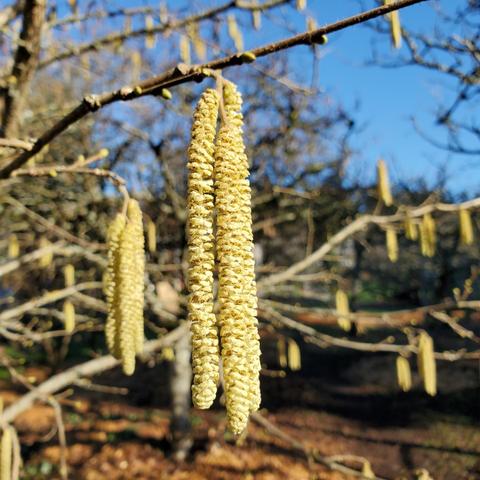
 DoomsdaysCW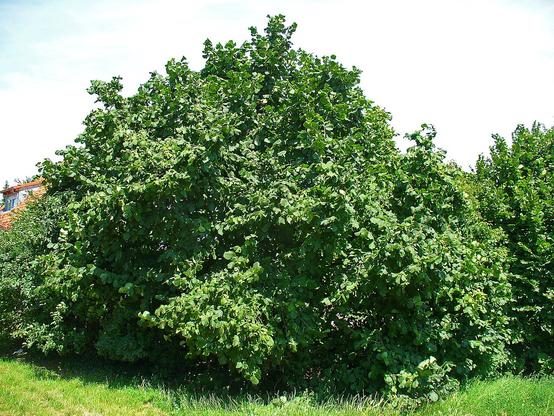


 Homestead Culture