 Dr Mircea Zloteanu 🌺🌞🍃
#statstab #555 To Be FAIR: Theory Specification Needs an Update
Thoughts: what's the use of better stats if our theories are nonsense?
#statstab #555 To Be FAIR: Theory Specification Needs an Update
Thoughts: what's the use of better stats if our theories are nonsense?
Roundup of some recent (and not so recent) #metascience news:
Contained Experiments, Reproducibility Crisis?, Six Types of Metascience, and Personal Predictions
https://open.substack.com/pub/markrubin/p/contained-experiments-reproducibility
Right, enough complaining about academia, let's make things better! A small step, but my colleagues and I are organising the Second Workshop on Replication in the Language Sciences (WoReLa 2) in July 2027 in Cologne: https://sites.google.com/view/worela2.
The call for abstract is now open (deadline 15 August). Linguists of all walks of life, we hope that many of you will want to join us for a two-day gathering of interesting people with fresh ideas on #replication, #reproducibility, #OpenScience, #metascience, and much more in all subdisciplines of #linguistics!
Fellow linguists, please boost and tell your friends, colleagues, and students! 🔃
"The Six Camps of Metascience", by Caleb Watney and Jenn Gustetic
https://www.macroscience.org/p/the-six-camps-of-metascience
I haven't seen #OpenScience classified as a branch of #Metascience yet, but it makes sense.

Welcome to Maastricht University! Are you an ambitious post-doctoral researcher with an Open Science mindset who seeks to unravel the threads of visibility and invisibility of staff across research projects? For an Open Science NL funded research project “Inv…
#statstab #545 Dynamic Meta-analysis: When Transparency Meets Multiplicity
Thoughts: Seems like hard work but makes perfect sense. Combine this with live meta-analyses.
#metascience #metaanalysis #evidence #multiverse
https://drmattg.github.io/Uncertain_Ecologist/Dynamic_Meta_analysis.html
👀 Seminar: Questioning Some Metascience Assumptions, with Mark Rubin
https://events.humanitix.com/questioning-some-metascience-assumptions-with-mark-rubin
August 14th at 4pm (GMT + 10). A very reasonable 7am in the UK
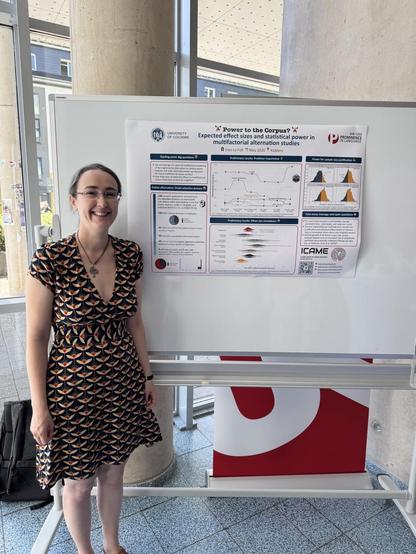
I submitted a poster abstract to the #ICAME47 because I thought this would be the most low-key format to present work-in-progress, but then there were only four posters and we each got a four minutes after today‘s plenary in the large auditorium 😱Definitely more attention than I had envisaged, but I think it went well. I was done at 3‘59! ⏱️ Lots of encouraging feedback and interesting follow-up ideas! ☺️
Poster and abstract: https://linktr.ee/elefoll.
#CorpusLinguistics #linguistics #metascience
@corpuslinguistics
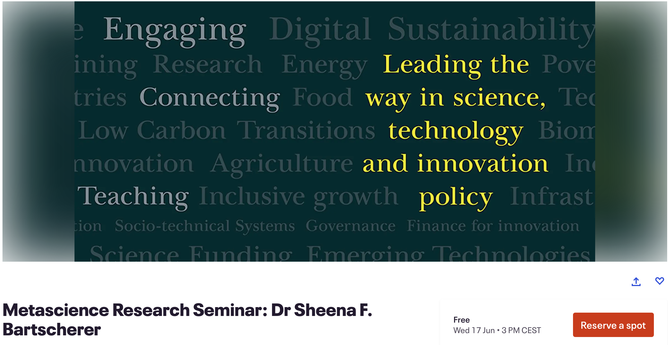
On 17 June, Sheena Bartscherer will be reporting online on her new project, “Reforming Science”.
The project is looking to investigate the different actors who are currently, but also historically advocating for science reforms, how they discuss these matters publicly, how critiques are interacted with, and how they organise themselves.
Further information and registration details can be found here: https://www.eventbrite.co.uk/e/metascience-research-seminar-dr-sheena-f-bartscherer-tickets-1989914011375
#Metascience #ScienceReform #NetworkAnalysis #SocualMediaAnalysis #LIS
 Mark Rubin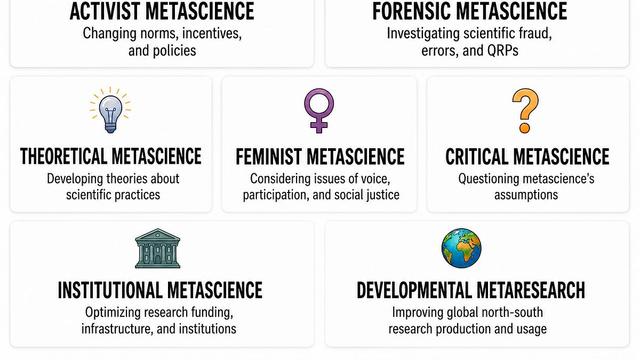
 Elen Le Foll 🇫🇷 🇬🇧 🇩🇪
 Konrad Hinsen
 Bart Penders
 ISiS Radboud
 Tom Stafford
 IBI HU Berlin