Karolína Vaníčková, Meritxell Alberich-Jorda et al
https://www.embopress.org/doi/full/10.15252/embj.2023113527
The disease severity of COVID-19 varies considerably from asymptomatic to serious, with fatal complications associated with dysregulation of innate and adaptive immunity. Lymphoid depletion in lymphoid tissues and lymphocytopenia have both been associated with poor disease outcomes in COVID-19 patients, but the mechanisms involved remain elusive. In this study, hACE2 transgenic mouse models susceptible to SARS-CoV-2 infection were used to investigate the characteristics and determinants of lethality associated with the lymphoid depletion observed in SARS-CoV-2 infection.
A particular focus is #lymphoid tissues that produce, store and carry #Tcells that fight infection, and #antibody-making #Bcells.
The coronavirus may also be hiding out in long-lived #nerve cells and #heart muscle, where it may drive chest #pain, brain fog, #fatigue and other long-Covid symptoms, said Diane Griffin, a virologist at the Johns Hopkins Bloomberg School of Public Health in Baltimore who has studied the body’s response to viral infections for more than 50 years.
“We have pretty good information from acute #RNA #virus infections that RNA does persist and that it does have consequences,” said Griffin, who is vice president of the US National Academy of Sciences. “Basically, it’s hard to get rid of viruses.”
Proving that persistent viral #infection causes long Covid will be difficult, Griffin said. Viruses in stealth mode suppress replication to avoid harming their host cells.
Despite extensive distribution of coronavirus RNA throughout patients’ bodies, Chertow’s team saw little evidence of inflammation or that the immune system had tried to destroy infected cells outside the respiratory tract.
(4/n)
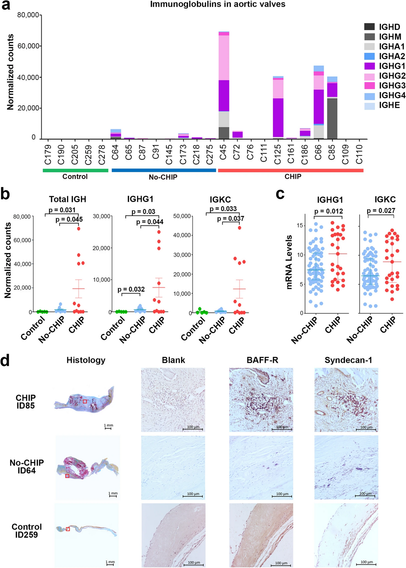
Clonal hematopoiesis of indeterminate potential (CHIP) is characterized by the presence of clones of mutated blood cells without overt blood diseases. In the last few years, it has emerged that CHIP is associated with atherosclerosis and coronary calcification and that it is an independent determinant of cardiovascular mortality. Recently, CHIP has been found to occur frequently in patients with calcific aortic valve disease (CAVD) and it is associated with a poor prognosis after valve replacement. We assessed the frequency of CHIP by DNA sequencing in the blood cells of 168 CAVD patients undergoing surgical aortic valve replacement or transcatheter aortic valve implantation and investigated the effect of CHIP on 12 months survival. To investigate the pathological process of CAVD in CHIP carriers, we compared by RNA-Seq the aortic valve transcriptome of patients with or without CHIP and non-calcific controls. Transcriptomics data were validated by immunohistochemistry on formalin-embedded aortic valve samples. We confirm that CHIP is common in CAVD patients and that its presence is associated with higher mortality following valve replacement. Additionally, we show, for the first time, that CHIP is often accompanied by a broad cellular and humoral immune response in the explanted aortic valve. Our results suggest that an excessive inflammatory response in CHIP patients may be related to the onset and/or progression of CAVD and point to B cells as possible new effectors of CHIP-induced inflammation.