 Glennn
 Geekoo
New cosmic twist: magnetar flares may be responsible for creating gold, platinum, and other heavy elements in the universe. #Magnetars #CosmicAlchemy #HeavyElements
https://geekoo.news/magnetar-flares-may-forge-the-universes-heaviest-elements/

 Steve Dustcircle 🌹
#NeutronStars Collide, Forging #HeavyElements in a #Cosmic Inferno
https://scitechdaily.com/neutron-stars-collide-forging-heavy-elements-in-a-cosmic-inferno/
 Jazzynupe
Can We Create New Elements Beyond the Periodic Table? - YouTube
https://www.youtube.com/watch?v=MwMwzGIt5ek
#PBSSpaceTime #Elements #HeavyElements #Chemistry #Radioactive #NewElements #PerodicTable
https://www.youtube.com/watch?v=MwMwzGIt5ek
#PBSSpaceTime #Elements #HeavyElements #Chemistry #Radioactive #NewElements #PerodicTable

Can We Create New Elements Beyond the Periodic Table?
 Matt Willemsen
Brightest Gamma-Ray Burst of All Time Challenges Element Formation Theories
https://scitechdaily.com/brightest-gamma-ray-burst-of-all-time-challenges-element-formation-theories/ #Astronomy #Astrophysics #JWST #nucleogenesis #GammaRayBurst #HeavyElements #BOAT #gold #platinum
https://scitechdaily.com/brightest-gamma-ray-burst-of-all-time-challenges-element-formation-theories/ #Astronomy #Astrophysics #JWST #nucleogenesis #GammaRayBurst #HeavyElements #BOAT #gold #platinum

Brightest Gamma-Ray Burst of All Time Challenges Element Formation Theories
James Webb Space Telescope observations show no sign of heavy elements. In October 2022, an international team of researchers, including Northwestern University astrophysicists, observed the brightest gamma-ray burst (GRB) ever recorded, GRB 221009A. Now, a Northwestern-led team has confirmed th
AI-Powered Astrophysics: Unveiling the Cosmic Origins of Heavy Elements
https://scitechdaily.com/ai-powered-astrophysics-unveiling-the-cosmic-origins-of-heavy-elements/
#AI—Powered #Astrophysics #Cosmic #Origins #nucleosynesis #HeavyElements #RapidNeutron—Capture
https://scitechdaily.com/ai-powered-astrophysics-unveiling-the-cosmic-origins-of-heavy-elements/
#AI—Powered #Astrophysics #Cosmic #Origins #nucleosynesis #HeavyElements #RapidNeutron—Capture

AI-Powered Astrophysics: Unveiling the Cosmic Origins of Heavy Elements
Machine learning predictions successfully model atomic masses of nuclide chart. The origin of heavy elements in our universe is theorized to be the result of neutron star collisions, which produce conditions hot and dense enough for free neutrons to merge with atomic nuclei and form new elements in
 Corrado
#AI for #astrophysics: #Algorithms help chart the origins of #heavyelements

AI for astrophysics: Algorithms help chart the origins of heavy elements
The origin of heavy elements in our universe is theorized to be the result of neutron star collisions, which produce conditions hot and dense enough for free neutrons to merge with atomic nuclei and form new elements in a split-second window of time. Testing this theory and answering other astrophysical questions requires predictions for a vast range of masses of atomic nuclei.
 Daniel Pomarède
in the #arXiv
Do we Owe our Existence to Gravitational Waves?
by John Ellis and co-authors
https://arxiv.org/abs/2402.03593
#GravitationalWaves #humanbiology #humanbiochemistry #human #biology #biochemistry #chemistry #iodine #rprocess #neutron #capture #neutroncapture #nuclear #physics #nuclearphysics #kilonovae #lunar #regolith #lunarregolith #neutron #stars #neutronstars #binary #systems #bromine #heavyelements #life #astronomy #astrophysics #astrodon #space #science #research #LIGO #VIRGO
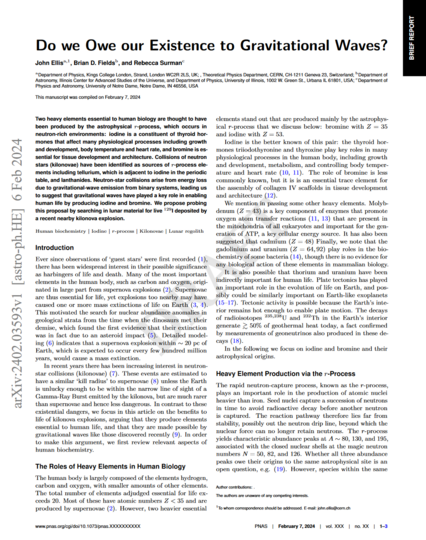

Do we Owe our Existence to Gravitational Waves?
Two heavy elements essential to human biology are thought to have been produced by the astrophysical $r$-process, which occurs in neutron-rich environments: iodine is a constituent of thyroid hormones that affect many physiological processes including growth and development, body temperature and heart rate, and bromine is essential for tissue development and architecture. Collisions of neutron stars (kilonovae) have been identified as sources of $r$-process elements including tellurium, which is adjacent to iodine in the periodic table, and lanthanides. Neutron-star collisions arise from energy loss due to gravitational-wave emission from binary systems, leading us to suggest that gravitational waves have played a key role in enabling human life by producing iodine and bromine. We propose probing this proposal by searching in lunar material for live $^{129}$I deposited by a recent nearby kilonova explosion.
#Ancientstars made extraordinarily #heavyelements, #researchers find

Ancient stars made extraordinarily heavy elements, researchers find
How heavy can an element be? An international team of researchers has found that ancient stars were capable of producing elements with atomic masses greater than 260, heavier than any element on the periodic table found naturally on Earth. The finding deepens our understanding of element formation in stars.
#JWST Confirms the Formation of #HeavyElements in a #Kilonova
https://www.universetoday.com/163921/jwst-confirms-the-formation-of-heavy-elements-in-a-kilonova/

JWST Confirms the Formation of Heavy Elements in a Kilonova
A recent study published in Nature investigates recent observations from NASA’s James Webb Space Telescope (JWST) and ground-based telescopes of heavy elements within the ejected material of a recent gamma-ray burst (GRB), classified as GRB 230307A, that was likely produced by a kilonova with GRB 230307A being designated as the second-brightest GRB ever detected. The … Continue reading "JWST Confirms the Formation of Heavy Elements in a Kilonova"