 NASA [Unofficial]
NASA’s Fermi Glimpses Power Source of Supercharged Supernovae
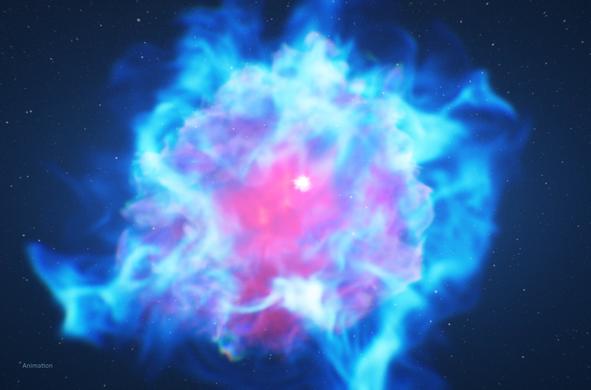
NASA’s Fermi Glimpses Power Source of Supercharged Supernovae
Weekly Update from the Open Journal of Astrophysics – 16/05/2026
It’s Saturday once again, so time for another update of activity at the Open Journal of Astrophysics. Since the last update we have published a further five papers, bringing the number in Volume 9 (2026) to 104 and the total so far published by OJAp up to 552. It took us until late July to pass 100 last year.
I will continue to include the posts made on our Mastodon account (on Fediscience) to encourage you to visit it. Mastodon is a really excellent service, and a more than adequate replacement for X/Twitter (which nobody should be using); these announcements also show the DOI for each paper.
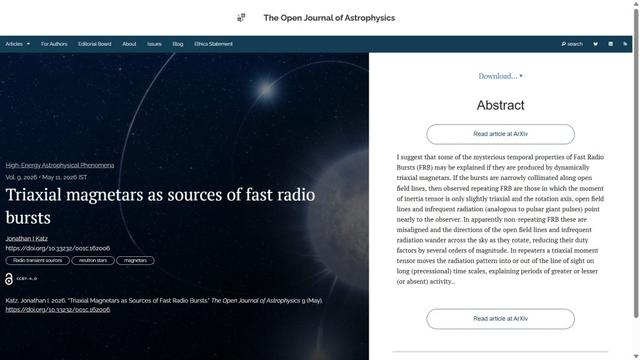
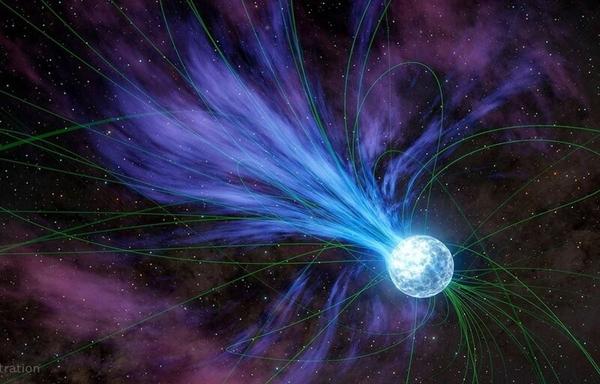
The first paper to report this week, published on Monday 11th May in the folder High-Energy Astrophysical Phenomena is “Triaxial magnetars as sources of fast radio bursts” by Jonathan I Katz (Washington University, USA). This paper suggests that the mysterious properties of Fast Radio Bursts (FRB) could be explained by triaxial magnetars, with their activity levels influenced by precessional time scales.
The overlay for this paper is here
You can find the officially accepted version on arXiv here and the announcement on Fediverse here:
https://fediscience.org/@OJ_Astro/116554775791392800
The second paper for this week, published on Tuesday 12th May in the folder Astrophysics of Galaxies, is “The Abundance of Thin Dwarf Galaxies: a Challenge for Cosmological Simulations” by Jose Benavides & Laura V. Sales (UC Riverside, USA), Julio F. Navarro (U. Victoria, Canada), Simon D. M. White (MPA Garching, Germany), and Carlos S. Frenk, Kyle A. Oman & Shaun Cole (U. Durham, UK). Depending on mass up to 40% of galaxies are intrinsically flat, a fraction that numerical models of galaxy formation struggle to reproduce suggesting the models are incomplete.
The overlay for this one is here:
The official version of the paper can be found on arXiv here and the Fediverse announcement here:
https://fediscience.org/@OJ_Astro/116560106342500157
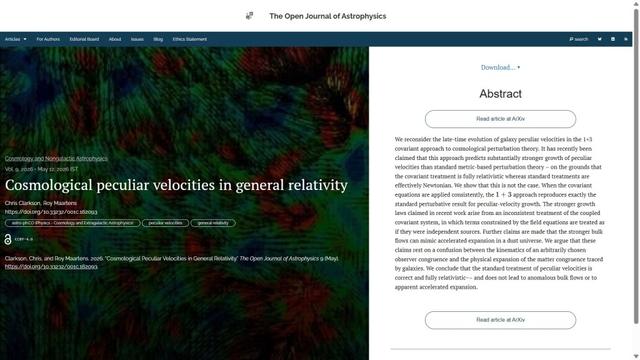
Next one up, the third paper of the week, also published on Tuesday 12th May but in the folder Cosmology and Nongalactic Astrophysics is “Cosmological peculiar velocities in general relativity” by Chris Clarkson (Queen Mary, University of London, UK) and Roy Maartens (U. Western Cape, South Africa). This paper refutes claims that the 1+3 covariant approach to cosmological perturbation theory predicts stronger growth of galaxy peculiar velocities, arguing that standard treatments are correct and fully relativistic.
The overlay for this one is here:
The final, accepted version can be found on arXiv here and the Mastodon announcement is here:
https://fediscience.org/@OJ_Astro/116560224426499932
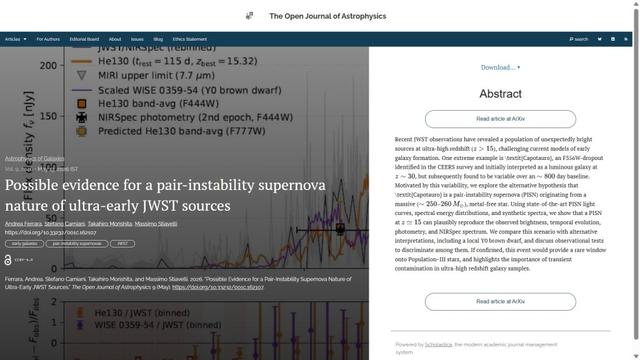
The fourth paper this week, published on Wednesday May 13th “Possible evidence for a pair-instability supernova nature of ultra-early JWST sources” by Andrea Ferrara & Stefano Carniani (Scuola Normale Superiore, Pisa, Italy), Takahiro Morishita (California Institute of Technology, USA), and Massimo Stiavelli (Space Telescope Science Institute, USA). Published in the section Astrophysics of Galaxies. This paper argues that recent observations challenge early galaxy formation models, suggesting that the bright source, Capotauro, could be a supernova from a massive, metal-free star, not a luminous galaxy as initially thought.
The overlay is here:
The officially accepted version can be found on arXiv here and here is the Mastodon announcement:
https://fediscience.org/@OJ_Astro/116566147448743997
The fifth and final article of this week was also published on Wednesday 13th May but in the folder Cosmology and Nongalactic Astrophysics. The title is “Evolving and interacting dark energy: photometric and spectroscopic synergy with DES Y3 and DESI DR2” and it is by Maria Tsedrik and Benjamin Bose (University of Edinburgh, UK). The study investigates the Dark Scattering interacting dark energy scenario, using data from various sources. Results show no evidence of dark-sector interaction and a preference for the Chevallier-Polarski-Linder parametrisation.
The overlay is here:
You can find the authorized version of this paper on arXiv here and the Fediverse announcement is here:
https://fediscience.org/@OJ_Astro/116566165139100860
And that concludes this week’s update. I’ll do another next Saturday.
#arXiv251211035v3 #arXiv260104953v3 #arXiv260107374v3 #arXiv260314511v2 #AstrophysicsOfGalaxies #Capotauro #ChevallierPolarskiLinder #cosmicShear #cosmologicalSimulations #CosmologyAndNonGalacticAstrophysics #DarkEnergy #DarkEnergySpectroscopicInstrument #DarkEnergySurvey #DarkScattering #DiamondOpenAccess #DiamondOpenAccessPublishing #dwarfGalaxies #fastRadioBursts #galaxyFormation #generalRelativity #HighEnergyAstrophysicalPhenomena #JWST #Magnetars #OpenAccess #OpenAccessPublishing #peculiarVelocities #supernova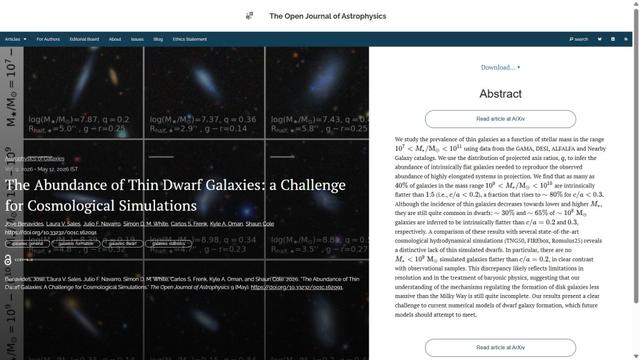
Object That Wobbled Space Time Just Solved Two Mysteries in Astronomy - YouTube
https://www.youtube.com/watch?v=eT5INRJYzwA

Weekly Update from the Open Journal of Astrophysics – 01/11/2025
It’s time once again for the usual Saturday update of the week’s new papers at the Open Journal of Astrophysics (although a bit later in the day than usual). Since the last update we have published another two papers, which brings the number in Volume 8 (2025) up to 163, and the total so far published by OJAp up to 398.
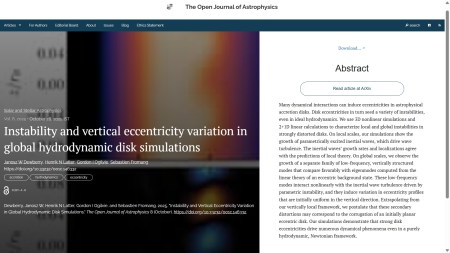
The first paper this week is “Instability and vertical eccentricity variation in global hydrodynamic disk simulations” by Janosz W Dewberry (U. Mass. Amherst, USA), Henrik N. Latter and Gordon I. Ogilvie (U. Cambridge, UK) and Sebastien Fromang (U. Paris Saclay, France). This article was published in the folder Solar and Stellar Astrophysics on Tuesday 28th October 2025; it discusses the instabilities and eccentricity variations generated in numerical hydrodynamic simulations of accretion disks.
The overlay is here:
You can find the officially accepted version on arXiv here.
The Fediverse announcement is here:
Open Journal of Astrophysics
New Publication at the Open Journal of Astrophysics: "Instability and vertical eccentricity variation in global hydrodynamic disk simulations" by Janosz W Dewberry (U. Mass. Amherst, USA), Henrik N Latter and Gordon I Ogilvie (U. Cambridge, UK) & Sebastien Fromang (U. Paris Saclay, France)
https://doi.org/10.33232/001c.146332
October 28, 2025, 9:43 am 2 boosts 0 favoritesThe second (and last) paper of the week is “Fast X-ray Transient Detection with AXIS: application to Magnetar Giant Flares” by Michela Negro (Louisiana State University, USA) and 8 others based in the USA and Canada. This one was also published on Tuesday 28th October, but in the folder High-Energy Astrophysical Phenomena. It presents a feasibility study of detecting Magnetar Giant Flares with the Advanced X-ray Imaging Satellite (AXIS). The overlay is here:
You can find the official version of this one on arXiv here. The announcement on Mastodon is here:
Open Journal of Astrophysics
New Publication at the Open Journal of Astrophysics: "Fast X-ray Transient Detection with AXIS: application to Magnetar Giant Flares" by Michela Negro (Louisiana State University, USA) and 8 others based in the USA and Canada
https://doi.org/10.33232/001c.146360
October 28, 2025, 10:02 am 1 boosts 1 favoritesIt being a relatively slow week we didn’t reach the 400 mark as I thought we might, but we will probably get there next week. After 10 months of the year 2025, in which we have published 163 papers, a rough projection for the 2025 total is 195. We do have some extra papers up our sleeve, however, so we might well reach 200 for the year. We will find out soon enough!
#accretionDisks #AdvancedXRayImagingSatelliteAXIS_ #arXiv250903763v2 #arXiv251022381v1 #DiamondOpenAccessPublishing #HighEnergyAstrophysicalPhenomena #Magnetars #OpenAccessPublishing #OpenJournalOfAstrophysics #SolarAndStellarAstrophysics #TheOpenJournalOfAstrophysics #XRayAstronomy
#TheMetalDogArticleList
#BraveWords
HELL IN THE CLUB Announce Studio Album Joker In The Pack; “Magnetars” Single Streaming
#HELLINTHECLUB #AnnounceStudioAlbumJokerInThePack #Magnetars #heavymetal #album #newrelease #single #video #announcement #vocalist #streaming #BraveWords

𝗡𝗲𝘄 𝘁𝗶𝗺𝗶𝗻𝗴 𝘀𝗼𝗹𝘂𝘁𝗶𝗼𝗻 𝗳𝗼𝗿 𝗔𝗦𝗞𝗔𝗣 𝗝𝟭𝟴𝟯𝟮-𝟬𝟵𝟭𝟭
P = 2652 s (44 min) & Pdot ≈ 1.9×10⁻⁷
Implies B ≈ 2×10¹⁶ G—far above the slow-magnetar branch
20 radio + 27 NICER bursts, χ²ᵣ = 0.9
Paper & TOA table here ▶️ https://zenodo.org/records/15848242/files/J1832_paper.pdf?download=1
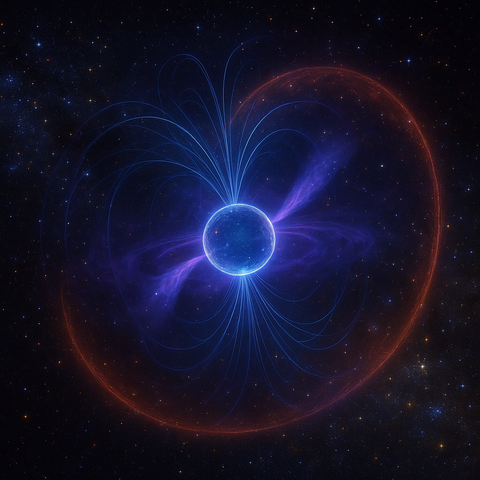

What happens when the universe's most magnetic object shines with the power of 1000 suns in a matter of seconds? Thanks to NASA's IXPE (Imaging X‑ray Polarimetry Explorer), a mission in collaboration with ASI (Italian Space Agency), scientists are one step closer to understanding this extreme event.
New cosmic twist: magnetar flares may be responsible for creating gold, platinum, and other heavy elements in the universe. #Magnetars #CosmicAlchemy #HeavyElements
https://geekoo.news/magnetar-flares-may-forge-the-universes-heaviest-elements/
Neue #Goldquelle in alten Daten entdeckt.
Ein Ausbruch eines #Magnetars, aufgezeichnet vor 20 Jahren, beinhaltete ein Signal, das nun als #Nukleosynthese verstanden wird. Dabei entstehen schwere Elemente wie #Gold und #Platin.
Ein Forschungsteam aus den USA konnte den r-Prozess, der bereits vor 70 Jahren zumindest theoretisiert wurde, in einem aufgezeichneten Ausbruch eines Magnetars nachweisen.
https://www.golem.de/news/magnetare-neue-goldquelle-in-alten-daten-entdeckt-2505-195925.html
(01 May) The Universe’s Gold May Come From a Totally Unexpected Kind of Star
A forgotten flare from a dead star could explain how the early cosmos got its bling.
https://s.faithcollapsing.com/ke1ex
Archive: ais: https://archive.md/wip/WVYTU ia: https://s.faithcollapsing.com/c970z
#magnetars #nasa #neutron-stars #space-&-spaceflight
 In the Dark
 Miro Collas
 🤘 The Metal Dog 🤘
 MHS
MHS Bob 🇨🇦🇲🇽🇺🇦
 Geekoo

 Steven Saus [he/him]