Attending the #RichEarthSummit at the moment, on #nutrient recovery from human #excreta and #SustainableSanitation.

https://www.richearthsummit.org

Yesterday, people discussed how this work matters to #environmentalJustice (notably excretory and sanitation justice, https://blogfromthebelly.com/2024/03/07/dealing-with-our-crap-who-does-who-doesnt-and-why-a-talk-on-excretory-justice-and-the-toilet).

These new sanitation methods and valorisation of excreta in agriculture can really make a difference for the 17 sustainable development goals (#SGDs).

Today is about current implementations all over the world.

Home / | Rich Earth Summit

Rich Earth Summit

@Angle

@wikipedia really has everything πŸ˜‹

Even an elaborate article on #humanure & its uses!!! πŸ’©πŸ’©πŸ’©

https://en.wikipedia.org/wiki/Reuse_of_human_excreta

Bonus link for "Humanure" πŸ˜‚
https://en.wikipedia.org/wiki/Compost#Human_excreta

#wiki #wikipedia #article #human #excreta #poo #pee #manure #farming #gardening

Reuse of human excreta - Wikipedia

πŸ“
The #EAWAG just published a report on "Mainstreaming Decentralised Urban Water Management Solutions for Sustainable Cities" where they talk about sustainable water and sanitation solutions at different scales.

Read more here: https://www.eawag.ch/en/info/portal/news/news-detail/innovative-water-solutions-for-sustainable-cities/

Some of our work in the OCAPI program is also mentioned in there πŸ˜‰

#water #wastewater #sanitation #sustainability #cities #urbanism #excreta

Innovative water solutions for sustainable cities

Cities need to become more sustainable and use their water resources more efficiently. Managing water in small-scale cycles is one possible solution. A new white paper shows how this can be achieved.

Word Search Puzzle 129

Word List : #ommiades #batiks #janitrix #tlakluit #excreta #epodic #insculp #dunny #striate #hatchers #isoplere #blimpish #lordy #histioid #abaue #cable #soapsuds #carberry

Kara Finance

New year, new publication! πŸ’©

"Fate of #nitrogen in French human #excreta: current waste and agronomic opportunities for the future" with T. Starck and F. Esculier.

Available for free here: https://hal.science/hal-04232722

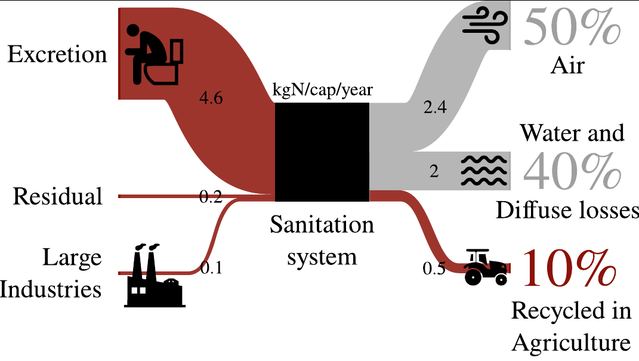
We analyze the French sanitation system and the associated flows of nitrogen: 50% of the nitrogen stays reactive in the #environment but only 10% is recycled as agricultural #fertilizer, the rest only pollutes soils and rivers.

1/3

#agriculture #food #urine #feces #sustainability

Fate of nitrogen in French human excreta: current waste and agronomic opportunities for the future

Nitrogen (N) is essential for plant growth and protein synthesis but global reactive N losses, mainly from food systems, induce strong environmental impacts. N losses after human excretion are often overlooked because, in Western societies, they partly occur as inert N2, following denitrification in wastewater treatment plants (WWTP), and losses in waters are often small compared to diffuse agricultural emissions. Yet N from human excretions could be used for crop fertilization, potentially with very high recycling rates via source separation. In this study we use unique operational data from the ∼20,000 French WWTPs to produce a N mass-balance of excretions in the French sanitation system. Even though 75 % of WWTPs' sludge is spread on crops, only 10 % of the excreted N is recycled and 50 % of N is lost to the atmosphere, mainly through WWTP nitrification-denitrification. The remaining 40 % ends up in water or in diffuse losses in the ground, of which about half is lost outside of the WWTPs' discharge system, through sewers storm water and individual autonomous systems. While WWTPs removal efficiency increased in the 2000s, it has been followed by a decade of stagnation, reaching 70 % at the national level. This national average hides regional discrepancies, from 60 to 85 % in the 6 French water agencies basins. These differences closely correlate with the classification as β€œN sensitive areas” and is mainly due to large WWTPs which handle most of the N load. Recycling all N in excretions could supply 10 % of domestic protein consumption in the current French food system, and up to 30 % if it is prioritized towards crop production for human consumption. Redesigning the food system (decrease of nutrient losses, more plant-based diets) could further increase this contribution.

Following up my previous posts ⬆️
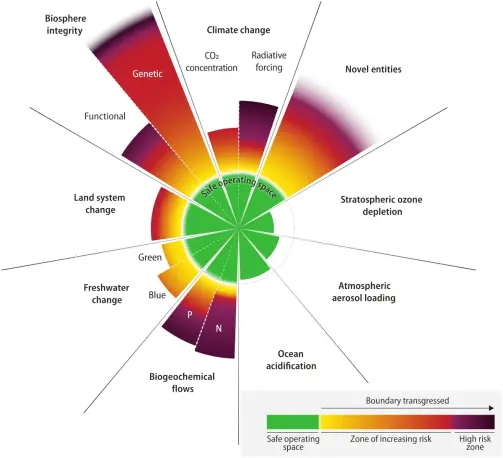
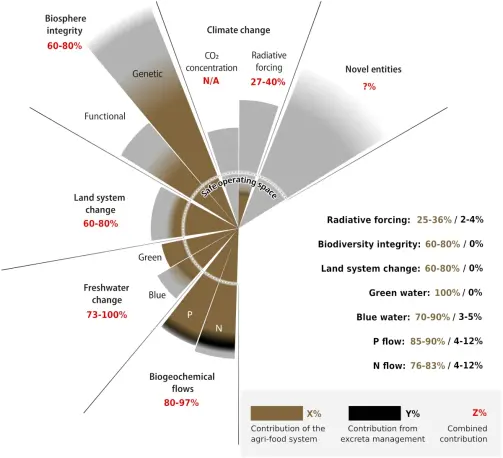
I wanted to show how the agri-#food and #excreta management systems contribute to bringing us beyond the Earth planetary boundaries.
I did not find anything to draw "blurry" graphs to show uncertainties, so I ended up doing it manually via #inkscape, with radial gradients ;)

Here is the final result, using mostly data from:

* https://www.science.org/doi/10.1126/sciadv.adh2458
* https://www.jstor.org/stable/26798991
* the IEA

1/2

#planetaryBoundaries #sustainability #agriculture #sanitation

The #Shit Conference: all you ever wanted to know about #poop, #feces... you name it!

https://www.geocities.ws/shitology

October 21st and 22nd, 2023.

It's an interdisciplinary conference, so you'll be able to learn about many things like the social and historical implications of #excreta management, as well as their potential benefits for #agriculture.

"MERDE ALORS!" - SOAS Shit Conference - 21-22 October 2023 - #shitologyconference

Let's talk about important stuff again: #urine.
In my 1st thread [1], I ended with several questions regarding the challenges of human #excreta management for #sustainable #agriculture.

Since I'm lazy, I'll start with the easy ones πŸ˜‰
So starting with "are alternative urine management methods a potential source of #health hazard?"

[1]: https://scicomm.xyz/@tfardet/109370756100378256

1/N

Tanguy Fardet (@[email protected])

Time for a thread about my new research topic: #nutrient flows! I started looking at #nutrients and #agriculture a while ago and was appalled by the current situation of our agri-food system: from a mathematical standpoint, if you want #sustainability, you need to bring back the same quantity of nutrients you extracted during harvest, right? To grow food it's a little more subtle than that, but broadly, you want a circular system. Do you know how far from circularity our food system is? 1/N

A community for scientists and science communicators.