 Bryan King
Spectral Filth: Clean Up Your Signal or Shut it Down
1,563 words, 8 minutes read time.
The spectrum is a finite piece of territory, and right now, you’re squatting on it like a man who doesn’t know how to clean his own house. Amateur radio used to be the domain of builders—men who understood that every watt of power was a responsibility. Now, the bands are crawling with appliance operators who treat their rigs like smartphones. They buy a cheap, unbranded box from overseas, hook it up to a sub-par antenna, and start spraying RF across the band like a broken sewer pipe. This isn’t just a technical oversight; it’s a failure of discipline. If your transmitter is throwing spurious emissions, you aren’t a radio operator. You’re a source of pollution. You are the high-frequency equivalent of a neighbor who lets his trash blow into everyone else’s yard. It’s time to stop making excuses, stop blaming the ionosphere for your lack of reach, and start looking at the cold, hard physics of what is actually coming out of your feedline.
THE GUTLESS REALITY OF NON-LINEAR TRASH
When you push a signal through an amplifier, you’re engaging in a fight with physics. If that amplifier isn’t biased correctly—if you’re driving it into saturation because you’re obsessed with the “100W” glowing on your meter—you are creating harmonics. These are the bastard children of your fundamental frequency. You think you’re sitting pretty on 7.150 MHz, but because your hardware is junk or your settings are sloppy, you’re also screaming on 14.300 MHz and 21.450 MHz. This is non-linear distortion, and it is the mark of a man who hasn’t mastered his tools. A real operator knows that the “final” in his radio is a delicate balance of current and voltage. When you push it too hard, the peaks flatten out, the sine wave turns into a jagged mess, and the resulting spectral splatter is an embarrassment. You aren’t just taking up more space than you’re entitled to; you’re stepping on the weak-signal guys three states over who are actually trying to do something meaningful with their license. If you can’t run a clean signal at full power, back the gain off. Mastery isn’t about being the loudest voice in the room; it’s about being the most precise.
SHIELDING, STRAY INDUCTANCE, AND THE COST OF LAZINESS
RF is a restless beast. It doesn’t want to stay on the copper traces of your PCB. It wants to radiate from every unshielded wire, every loose screw, and every poorly grounded chassis. If your hardware looks like a bird’s nest inside, you have already lost the war. Spurious emissions aren’t always harmonics; sometimes they’re parasitic oscillations—high-frequency ghosts born from the stray inductance of long lead wires and the lack of proper bypassing. When you skimp on the build quality, or when you use a switching power supply that hasn’t been filtered for common-mode noise, you are inviting filth into your signal. You wouldn’t drive a car with a leaking fuel line, so why are you operating a radio that leaks RF from its own casing? Every milliwatt that doesn’t go out the antenna port as a clean fundamental frequency is a milliwatt that is working against you. It creates RFI in your own shack, it trips your GFCI breakers, and it makes you a nuisance to your neighbors. You need to understand the mechanics of shielding. A chassis isn’t just a box to hold the components; it’s a Faraday cage. If you’ve compromised that cage because you were too lazy to tighten the bolts or use proper EMI gaskets, you are the problem.
THE GATEKEEPERS: BUYING VS. BUILDING YOUR DEFENSES
If you’re running a high-power station—pushing a kilowatt or more—you don’t play games with homebrew experiments unless you have the lab equipment to back it up. At those levels, the heat and reactive power in a filter are enough to turn cheap components into shrapnel. You buy a commercial Low-Pass Filter (LPF) from the outfits that build them like tanks—Bencher, Barker & Williamson, or DX Engineering. You’re looking for a heavy-duty, shielded enclosure that guarantees at least 50dB to 60dB of attenuation at the second harmonic. This is your “Master Gatekeeper.” It’s the insurance policy that keeps your high-power harmonics from bleeding into every television and radio in a three-block radius. Buying a filter isn’t an admission of defeat; it’s a strategic decision to use a tested, calibrated tool to protect the integrity of the bands. However, if you want to call yourself a master of this craft, you eventually have to build. For low-power rigs or specialized band-pass needs, building your own filter is where the theory becomes reality. You don’t use junk-box parts. You use precision-wound toroids—T50-2 or T60-6 powdered iron—and high-voltage Silver Mica or NP0 capacitors. If you use cheap ceramic discs, your filter’s cutoff frequency will drift as soon as the components get warm, and you’ll watch your SWR climb while your signal turns back into trash. Building a Chebyshev or Elliptic filter forces you to understand the relationship between inductance and capacitance. It’s a rite of passage. But remember: you never put a homebrew filter on the air without verification. You use a Vector Network Analyzer (VNA) to sweep that circuit and prove it’s doing its job. You verify the insertion loss and you confirm the stopband. If you can’t prove it’s clean on the bench, it doesn’t touch the antenna.
Whether you buy it or build it, the responsibility for what leaves your shack stops with you. You wouldn’t drive a truck with no mufflers through a quiet neighborhood at 3 AM, so don’t be the operator who thinks it’s okay to spray wide-band noise across the spectrum because you were too lazy to install a filter. A clean signal is the signature of a disciplined man. It shows you respect the physics of the medium and the rights of every other operator on the air. If you’re too cheap to buy a filter and too lazy to build one, do the world a favor and stay off the mic. The airwaves are a shared resource, not your personal dumping ground. Every time you key up, your reputation is on the line. Are you a technical asset, or are you just more noise? Real operators don’t guess; they measure. They don’t hope; they verify. Master your hardware, tighten your shielding, and for the sake of the hobby, clean up your signal. If you can’t operate with technical integrity, you shouldn’t be operating at all. Solder the solution or shut it down.
SECURE THE SPECTRUM: LOCK DOWN YOUR SIGNAL INTEGRITY NOW
Stop being a spectator in your own shack. If you’ve spent more time looking at the price tag of your rig than the spectral purity of its output, you’re part of the problem. Your license isn’t a trophy; it’s a mandate to maintain technical excellence. If you aren’t checking your footprint, you’re just another lid adding to the noise floor.
Here is your mission:
- Audit your signal: Stop trusting the factory sticker. Put your rig on a dummy load, grab a VNA or a spectrum analyzer, and prove to yourself that your second and third harmonics aren’t bleeding into territory where they don’t belong.
- Kill the noise: If you find filth, fix it. Solder a low-pass filter, choke your lines with real ferrites, and tighten every screw on your chassis until that Faraday cage is airtight.
- Educate the soft: When you hear an operator splashing across the band with a dirty signal, don’t just complain about it on a forum. Direct him to the physics. Demand better from your local club.
The grid is fragile and the noise floor is rising. We need operators who are assets, not liabilities. Clean up your signal today, or pull the plug. The airwaves don’t owe you a thing—you owe them your discipline. Own your frequency or get off it.
SUPPORTSUBSCRIBECONTACT MED. Bryan King
Sources
- FCC Part 97 Amateur Radio Service Rules
- ARRL Handbook for Radio Communications
- ARRL Technical Information Service: Spurious Emissions
- Low Pass Filter Basics for Radio Transmitters
- Design of Low Pass Filters for Amateur Radio
- Microwaves101: Spurious Emissions Encyclopedia
- RF Biasing for Linear Power Amplifiers
- Analog Devices: Understanding and Eliminating Spurious Emissions
- Rohde & Schwarz: Measuring Spurious Emissions Application Note
- Keysight: Spectrum Analysis Basics
- Mini-Circuits: Intro to RF Filters
- W8JI: RF Amplifier Design and Testing
- Understanding Intermodulation Distortion (IMD)
- RF Cafe: Harmonic Distortion and Suppression
- HamRadio.me: Harmonics and Effective Radiated Power
- DX Engineering: Low Pass Filter Technical Specs
- W8JI: Station Grounding and RF Interference
- ARRL: FCC Part 97 Section 307 – Emission Standards
- VK6YSF: 7-Pole Chebyshev Low Pass Filter Design
- Nuts & Volts: Understanding RF Filter Design
- TinySA Wiki: Measuring Harmonics and Spurious Signals
- VNA for Everyone: Testing RF Filters
- OnAllBands: Low Pass Filters and TVI Defense
- G3LSW: Practical Filter Construction for Hams
- ARRL: Clean Up Your Signal – Reducing RFI
- METAS: High Precision VNA Measurements
- RF Design Guide: Intermodulation and Harmonics
- Collins Radio: Historical Amateur Engineering Manuals
- ITU-R SM.329: Unwanted Emissions in the Spurious Domain
- Amateur Radio Wiki: Low Pass Filter Theory
Disclaimer:
The views and opinions expressed in this post are solely those of the author. The information provided is based on personal research, experience, and understanding of the subject matter at the time of writing. Readers should consult relevant experts or authorities for specific guidance related to their unique situations.
Related Posts
#AmateurRadio #AmateurRadioTechnical #AmplifierBiasing #BandPassFilter #ChebyshevFilter #CommonModeCurrent #electromagneticInterference #EllipticFilter #Elmering #EMI #FaradayCage #FCCRegulations #FerriteChokes #hamRadio #HarmonicDistortion #HighPowerRF #IMD #IntermodulationDistortion #LinearElectronics #LowPassFilter #LPF #NonLinearAmplification #ParasiticOscillation #Part97Compliance #QRP #RadioHardware #radioSpectrumManagement #RadioStationAudit #RadioTransmitterMaintenance #RFEngineering #RFFeedback #RFFilterDesign #RFGrounding #RFPowerAmplifier #RFShielding #RFI #signalIntegrity #SignalPurity #SilverMicaCapacitors #SpectralFootprint #SpectralSplatter #SpectrumAnalysis #SpuriousEmissions #TechnicalDiscipline #TinySA #ToroidWinding #VectorNetworkAnalyzer #VNATesting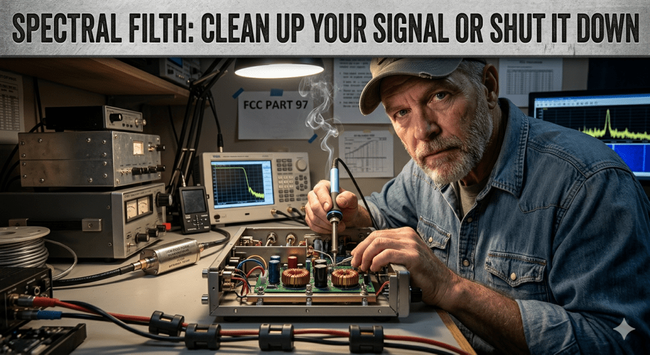
 Mathias Magdowski
 mofosyne
 Phys.org
 hackaday unofficial