 Bryan King
The Physics of the Airwaves: Why Your Factory Antenna is Failing You
1,605 words, 8 minutes read time.
The average handheld radio on the market today is a solid, capable piece of engineering. You don’t need to drop four thousand dollars on public-safety-grade infrastructure to put a clear, professional signal on the air. But whether your rig cost fifty dollars or five hundred, you are likely sabotaging your own performance the moment you screw on that factory-provided “rubber duck.” These antennas are triumphs of portability, not physics; they are roughly 10 centimeters of coiled copper buried in plastic, designed to slide easily into a pocket rather than radiate into the ether. They function less like an antenna and more like a dummy load. When you key that mic, you aren’t just transmitting; you are forcing a perfectly functional transceiver to dump its power into a high-resistance coil. The majority of your five watts never leaves the radio as an electromagnetic wave—it stays inside the device, turning into thermal energy that warms up the casing while your signal dies just a few blocks away. You are paying for a radio, but you are only getting the performance of a signal generator. It’s time to stop confusing convenience with capability.
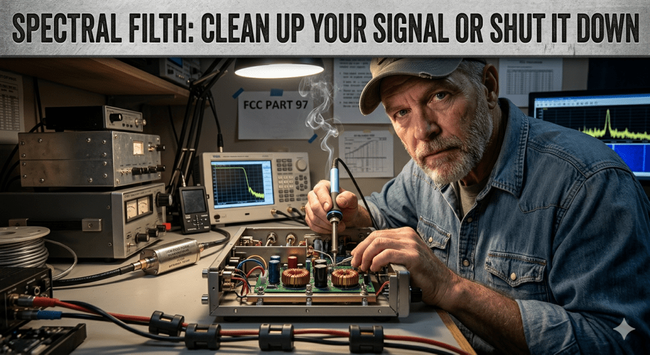
Before you even worry about the antenna, look at the radio itself. Avoid the bottom-of-the-barrel, “mystery brand” junk flooding online marketplaces. A legitimate, engineered radio carries an FCC ID—check the chassis or under the battery. That alphanumeric string is your assurance that the device has been tested for spectral purity and harmonic suppression, as required by 47 CFR Part 97.307(e). This regulation mandates that transmitter spurious emissions must be suppressed by a specific amount relative to the mean power of the fundamental. Cheap, non-compliant radios often fail these tests, resulting in “splatter” that can cause harmful interference to other services, which is a direct violation of 47 CFR Part 97.101(d). A radio without that ID is not a tool; it is a liability that invites enforcement action.
The Precision Transducer: Why Your Antenna Defines Your Station
An antenna is not a generic accessory you treat as an afterthought; it is a precision transducer—the most vital component in your entire station. Think of it as the mechanical lever of the electromagnetic world, providing the leverage necessary to transform electrical current from your final amplifier into a propagating electromagnetic wave. To resonate efficiently on the 146 MHz (2-meter) and 440 MHz (70-centimeter) bands, the laws of physics dictate specific resonant lengths. A quarter-wave antenna for 2-meters requires roughly 50 centimeters, while for 70-centimeters, it requires about 17 centimeters.
When you rely on a single, 10-centimeter “rubber duck” to cover both, you are forcing the antenna to work against its own nature. It is an electrically short, high-Q helix that is inherently narrowband and fundamentally inefficient. You are driving RF energy into a tight, constricted coil, where the vast majority of that energy is dissipated as resistive heat within the antenna structure itself. The helical design is a compromise of geometry, not a triumph of engineering; it forces the electromagnetic field to “bunch up” in a tiny volume of copper, making the antenna act more like a resistor than a radiator.
You aren’t just losing decibels—you are failing to provide the proper aperture for the signal to transition from your feedline into free space. An antenna’s aperture is directly related to its physical size; when you shrink that size, you shrink the antenna’s ability to “catch” or “throw” waves. You are left with a fundamental engineering mismatch where your feedline expects to see a specific impedance, but your antenna is presenting a complex, highly reactive load that varies wildly with the slightest environmental change. No amount of transmit power—no matter how many watts you pump into that coil—will overcome the basic reality that your system is not resonant. You are fighting the immutable laws of electromagnetics, and the physics will win every single time. Your radio is not “weak”; your radiator is simply incapable of doing the work it was designed for.
The Counterpoise Myth and the Reality of Impedance
A radio does not just need a radiator; it requires a complete electrical circuit to push current into the atmosphere. Think of your antenna like a mirror in an optical system—if you only have one side of the mirror, you have no reflection. A radio needs a ground plane to function as that second half of the circuit. Without a dedicated ground plane or a properly calculated counterpoise, your antenna system is fundamentally incomplete. You are not operating a radio station; you are operating a “half-circuit” that is desperately hunting for a return path. In that void, your own hand, your forearm, and the mass of your torso become the unwilling, erratic, and highly inefficient counterpoise.
Because your body is now part of the antenna circuit, you are the most variable component in the entire signal path. Every time you shift your grip, move your arm, or even change your stance relative to the radio, you are drastically altering the capacitance and the local impedance of the antenna system. When that SWR swings, your transceiver’s internal protection circuitry is forced to work in overdrive. It detects that reflected energy and immediately throttles your transmitter. This is called power fold-back, and it is the death of your signal.
Practical Steps to Immediate Efficiency
If you are tired of being a “weak signal” operator, stop buying more power and start building a better system. Here is how you fix your signal today:
- Ditch the Rubber Duck: This is the single highest-return investment you can make. Purchase a high-quality, dual-band telescopic or whip antenna. A half-wave antenna is “end-fed” and does not rely on your body or the radio chassis as a ground plane, making it instantly more stable and efficient than the stock antenna.
- Implement a “Tiger Tail”: If you must use a shorter antenna, connect a “tiger tail”—a flexible piece of wire cut to a quarter-wave length (approx. 49 cm for 2m) attached to the ground side of your SMA connector. This acts as a decoupled counterpoise, moving the RF return path away from your hand and into the wire, significantly reducing SWR fluctuations.
- Leverage an Antenna Analyzer: Stop trusting your radio’s internal SWR meter; it is a blunt instrument. Use a NanoVNA to map the SWR across the band. You will be shocked to see how often your “good” antenna is actually operating with an SWR of 3:1 or higher at your favorite repeater frequency.
- The Coax-to-Radio Bridge: If you use a remote antenna, use a “pigtail” adapter made of high-quality, flexible cable (like RG-316 or LMR-240) rather than a rigid SMA-to-PL259 adapter. A rigid adapter puts immense mechanical stress on the radio’s SMA connector, which can cause the internal solder joints to fracture over time—a classic cause of intermittent transmission failures.
- Ground Plane Maximization: If you are operating from a vehicle or a desk, use a magnetic mount on a large metal surface. A metal roof or a cookie sheet acting as a ground plane can improve your gain by 3 dB or more compared to a vertical antenna held in your hand.
Engineering Efficiency: The Path to a True Link Budget
You hold an amateur license, which serves as a legal mandate that you possess the technical competence to be a steward of the RF spectrum. Yet, many operators treat their station as a black box, oblivious to the cumulative decibel losses (dB) that turn a potential 5-watt signal into less than 1 watt of effective radiated power (ERP). When the environment shifts—when the signal-to-noise ratio (SNR) degrades due to atmospheric noise or local interference—those margins you ignored suddenly become the difference between a successful link and total communication failure.
Stop accepting “convenience” as an engineering parameter. If your station requires you to stand in a specific posture or hold the radio at a precise angle to open the squelch, your system is not a station; it is a failure of basic RF design. When you minimize your SWR to as close to 1:1 as possible, you maximize the power transfer efficiency and stop wasting energy on reflected waves. You have the technical authority to operate; now demonstrate the discipline to build a system that respects the physics of the medium. Clean up your feedline, tune your radiator, and ensure that your signal is defined by its efficiency, not its compromises.
Call to Action
Stop being a passenger to your own hardware. The manufacturing industry thrives on keeping you in the “convenience trap,” where they sell you a high-performance radio bundled with a “rubber duck” antenna designed for the box, not for the airwaves. They want you to believe that your signal issues are a lack of power—that the solution to your poor performance is simply buying their next, slightly more expensive model. They are betting on you to stay a consumer, not an operator.
The difference between a reliable link and a failed transmission isn’t in your radio’s menu settings or the wattage displayed on your screen; it’s in the physical reality of the antenna you choose and the way you integrate it into your station. You have the license to operate, but now you need the discipline to engineer.
Take a critical look at your gear today. Reject the “factory standard” that serves their margins rather than your signal. Replace the inefficient stock antenna, stabilize your ground plane, and stop wasting your power as heat. Build a system that actually speaks the language of the ionosphere rather than fighting against it. Test, tune, and verify your results with an analyzer—don’t just hope for a signal, build one that commands the airwaves. The science of radio is right in front of you; put it to work and take back control of your station.
SUPPORTSUBSCRIBECONTACT MED. Bryan King
Sources
- FCC Amateur Radio Service
- ARRL Antenna Basics
- ARRL: The Antenna-Radio Interface
- 47 CFR Part 97: Amateur Radio Service
- ARRL: Understanding SWR
- ARRL: Antenna Modeling
- Electronics Notes: Quarter Wave Vertical Antenna
- Electronics Notes: Electrically Short Antennas
- RF Cafe: Helical Antenna Theory
- NanoVNA Project Site
- ARRL: Handheld Antenna Performance
- FCC Equipment Authorization (FCC ID Search)
- eHam: Practical Antenna Troubleshooting
- HamRadioSchool: The Importance of Ground Planes
- QSL.net: Ground Plane Fundamentals
- ARRL: Counterpoise and Grounding
- Electronics Tutorials: Understanding Power Efficiency
- ARRL: Transmission Lines and Loss
- The ARRL Antenna Book (Reference)
- FCC Enforcement and Interference Rules
- W8JI: Mobile Antenna Efficiency
- HamUniverse: Antenna Impedance Basics
- ARRL Summary of Amateur Radio Rules
- 47 CFR Part 97.307(e): Spurious Emissions
- ARRL Enforcement News regarding Non-Compliant Radios
Disclaimer:
The views and opinions expressed in this post are solely those of the author. The information provided is based on personal research, experience, and understanding of the subject matter at the time of writing. Readers should consult relevant experts or authorities for specific guidance related to their unique situations.
Related Posts
Rate this:
#AmateurRadio #amateurRadioLicense #antennaAnalyzer #antennaBasics #antennaDesign #antennaEfficiency #antennaGain #antennaGroundPlane #antennaImpedance #antennaResonance #antennaTheory #antennaTuning #coaxialCableLoss #communicationReliability #Counterpoise #FCCCompliance #FCCPart97 #hamRadio #hamRadioAntenna #hamRadioEducation #hamRadioTips #handheldRadio #handheldRadioUpgrades #HTAntenna #NanoVNA #portableAntenna #radioBestPractices #radioCommunication #radioEquipment #RadioHardware #radioHobbyist #radioInterference #radioLinkBudget #radioPerformance #radioSignalQuality #radioStationSetup #radioTransmission #radioTroubleshooting #RFEngineering #RFPropagation #RFSpectrum #rubberDuckAntenna #signalStrength #SpuriousEmissions #StandingWaveRatio #SWR #technicalRadioOperations #tigerTailAntenna #transceiverEfficiency