 Bryan King
Spectrum Stewardship: Why “Everything is NOT Fine.”
2,667 words, 14 minutes read time.
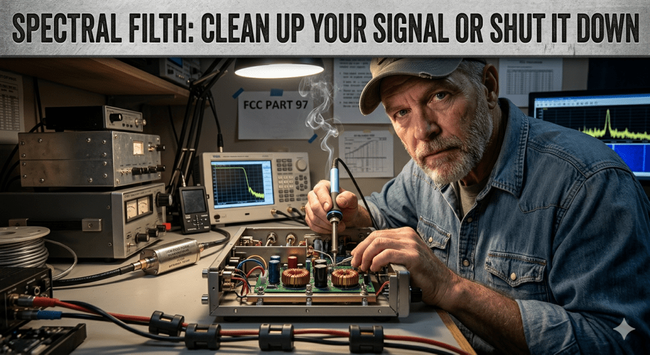
Amateur radio is bleeding out from a thousand self-inflicted technical cuts, and the patient is too deluded by the “everything is fine” mantra to notice the arterial spray. For decades, we have let the standards slide, trading the disciplined engineering of the mid-century for the cheap, plug-and-play convenience of imported junk and “appliance operator” apathy. We’ve grown soft. We’ve started treating the radio spectrum like a public park where anyone can dump their trash, forgetting that we are licensed stewards of a finite and increasingly hostile RF environment.
I have been in this hobby for nearly 16 years now, and to be honest, I have seen the enforcement and knowledge level drop firsthand. I know that by sounding the alarm, I am risking being labeled a “grumpy old ham”—the kind who complains just for the sake of it. But that couldn’t be further from the truth. I’m not here to gatekeep; I’m here to act as a scout. I see a new generation of younger hams who are anxious and excited to get on the bands, and I want them to stay there. My goal is to prevent these new operators from unknowingly walking into a buzzsaw of federal fines and license revocations because they weren’t warned about the gear they were using.
In my previous post, I laid out the blunt reality of spectral filth. Since then, it has become apparent that a dangerous sentiment is taking root in our ranks: the idea that technical decay is an “imagined” problem or a mere obsession of a few “curmudgeons.” This dismissal is a luxury we can no longer afford. I’m not speaking from a throne of perfection—I’ve been there. I have stood at the transmitter, keyed up a cheap Baofeng, and broadcasted without the slightest understanding of what splatter or out-of-band emissions actually were. I was part of the noise. I didn’t realize that my “affordable” entry into the hobby was actually a weaponized piece of interference that threatened the integrity of the bands I wanted to enjoy.
But ignorance is only an excuse until you know better. Recently, I have seen a renewed effort to increase technical literacy and get crappy equipment off the air. We are finally realizing that helping the next generation doesn’t mean lowering the bar—it means giving them the tools to clear it safely. Once you understand the physics, continuing to transmit a dirty signal isn’t a mistake; it’s a choice.
The FCC has Grown Teeth: Beyond the “Mean Letter”
For years, the Amateur community grew complacent, fueled by the myth that the FCC didn’t have the budget or the interest to police the ham bands. That era of benign neglect is over. The Commission has stopped sending “mean letters” that get tucked away in a desk drawer and has started wielding the hammer of Forfeiture Orders and Field Seizures. With the adoption of the FCC 26-28 Framework in April 2026, the Enforcement Bureau has been revitalized with automated remote monitoring sites and a mandate for “Proactive Spectrum Integrity.” They aren’t waiting for a interference complaint from your neighbor anymore; they are using wide-area software-defined sensors to flag “dirty” signatures in real-time. If you are splattering or radiating harmonics, you aren’t just an annoyance—you are a blip on a federal radar that now has the teeth to bite back.
The Ghost of CB Past and the Seven Signs of Failure
We have seen this movie before, and we know exactly how it ends. In 1983, when the FCC abandoned CB licensing, the band didn’t just “open up”—it spiraled into a technical graveyard. By removing the requirement for a license, the FCC essentially removed the requirement for accountability. Almost overnight, 27 MHz was transformed from a vital short-range communication tool into a wasteland of over-modulated noise and “private broadcasters.” These were operators who decided that the rules of physics didn’t apply to them, using illegal linear amplifiers to pump spectral filth across the spectrum just to be the loudest voice in an empty room.
The technical discipline of the “Community of Substance” was drowned out by roger beeps, echo mics, and massive splatter that made adjacent channels unusable. Amateur radio is currently teetering on that same precipice. When you dismiss spectral purity as “gatekeeping” or “elitism,” you are actively advocating for the CB-ification of our bands. You are arguing for a world where ego-driven broadcasting replaces disciplined engineering. Once a band becomes a high-noise floor landfill, the serious operators leave, the emergency services look elsewhere, and the “private broadcasters” are left shouting into a void of their own creation.
The consequences of this “everything is fine” apathy are visible in the wreckage of these seven recent enforcement actions:
- The Pittsburgh EMS Crisis (March 25, 2026): Technician Class licensee David J. Miller (KD3ASC) utilized a modified BTech UV-Pro handheld as an unauthorized, uncoordinated simplex repeater. Because the device was “unlocked” and operated outside of its intended design parameters without any output filtering, it generated massive out-of-band emissions. These spurious signals landed directly on the Allegheny County EMS primary dispatch frequency, “desensing” their receivers and blocking critical emergency traffic for over two hours. The FCC Enforcement Bureau utilized its new high-resolution direction-finding network to triangulate the source to Miller’s residence within minutes. The operation resulted in an immediate federal equipment seizure, a proposed forfeiture of $18,500, and the permanent revocation of his license. This case stands as a brutal reminder: when your technical “short-cuts” delay an ambulance, the “hobbyist” excuse carries zero weight in a court of law.
- The Boeing 787 Transponder Blindness (April 2026): Under Docket No. FAA-2025-0924, federal investigators confirmed that high-altitude “CW interference” effectively blinded the Integrated Surveillance System (ISSPU) on Boeing 787s, causing them to drop off radar at 1030 MHz and 1090 MHz. While the FAA’s $8 million hardware mandate protects the planes, the FCC’s hunt for the “terrestrial sources” revealed a split reality of accountability. The largest sources were traced back to aging industrial heating arrays and legacy military-contractor radar test sites in the Midwest. These corporate violators are currently shielded behind the redacted “administrative correction” process—fixing their leaky hardware in private to avoid public scandal. However, the same investigation snagged several Amateur stations near flight paths whose unsuppressed 2nd and 3rd harmonics were contributing to the L-band noise floor. Unlike the corporations, these operators don’t have a shield; they face public Cease and Desist orders and the immediate suspension of their operating privileges. It’s a stark lesson: the government might let a factory fix its mistakes in the dark, but if you’re a licensed hobbyist leaking filth into a protected aviation band, your “spectral negligence” will be handled in the bright light of a public enforcement action.
- The Illinois $25,000 Forfeiture and Revocation (June 2025): The FCC issued a massive fine against General Class licensee Thomas J. Sandman (KC9SDR) for transmitting high-power, broadband “indecipherable noise” that effectively paralyzed a wide swath of the spectrum. This wasn’t just a case of poor audio; it was a total failure of technical discipline, where his station was pumping out a signal so wide and so dirty that it masked legitimate traveler assistance frequencies. When the Enforcement Bureau issued a Notice of Interference, Sandman chose to ignore it, likely believing the old myth that the Commission has no “boots on the ground.” He was wrong. The FCC didn’t just stop at the $25,000 penalty—they moved to permanently revoke his license, ruling that his willful technical negligence and refusal to cooperate proved he lacked the basic character qualifications to be a federal licensee. This is the new reality: if you treat the airwaves like a private jammer, the government won’t just fine you; they will evict you from the hobby entirely.
- The Idaho Wildfire Interference (January 2025): Extra Class licensee Jason Frawley (WA7CQ) was slapped with a record-breaking $34,000 fine for intentional interference with U.S. Forest Service radio communications during the “Johnson Fire.” Frawley used his own amateur gear to transmit eight times on a government frequency (151.145 MHz), identifying himself only as “comm tech” while advising aircraft of hazards. This “vigilante dispatching” forced a fire operations chief to leave the fire line to physically track Frawley down at a local airstrip. Despite Frawley’s plea that he was “just trying to help,” the FCC issued the maximum possible forfeiture and moved to permanently revoke his license. This remains the ultimate “don’t be this guy” example: having “good intentions” is not a legal defense for hijacking a public safety frequency during an active emergency.
- The 10-Meter Business Band Leak (Late 2025): General Class licensee Robert L. Vance (N8XRT) was hit with a $7,500 fine after his “bargain-basement” amplifier setup crippled a local logistics network. Vance was operating on the 10-meter band (28.400 MHz), but because he was using a poorly shielded, non-compliant HF amplifier, his station was radiating a massive 2nd harmonic directly onto 56.800 MHz—a frequency used by a regional freight-dispatching service. The “leaked” signal was so powerful it completely desensitized the logistics company’s base station, halting truck movements for an entire afternoon. After ignoring a “Good Neighbor” request from the company to check his equipment, the FCC Field Office intervened. Along with the $7,500 forfeiture, Vance was issued a Mandatory Silence Order on the 10-meter band until his station could be independently certified as meeting Part 97.307(d) spectral purity standards. It’s a $7,500 lesson in why “good enough for the ham bands” isn’t good enough when your harmonics start bleeding into the commercial world.
- The Maryland Modified-Gear Raid (February 2026): Technician Class licensee Kevin M. Thorne (KC3VLB) faced a coordinated home station raid by FCC agents and local law enforcement. The center of the investigation was a Baofeng UV-5R that Thorne had “unlocked” via a hardware and software modification to transmit on the 700/800 MHz public safety bands. Because these entry-level radios utilize a “System-on-a-Chip” (SoC) design with filtering strictly tuned for amateur frequencies, forcing the device to transmit out-of-band bypassed its internal safeguards. The resulting spurious emissions and harmonic images crippled the local Prince George’s County digital trunking system, corrupting data packets and blocking emergency dispatches. Thorne’s refusal to heed warnings led to the seizure of all his equipment, a $15,000 fine, and the permanent revocation of his license. It’s a stark warning to the “unlocked gear” community: when you strip the filters off a cheap radio to play on forbidden frequencies, you aren’t just an intruder—you are a public safety hazard.
Dangerous Waters: The “Fast-Track” Audit and the Modding Trap
If you think you can fly under the radar because you’re a “small station,” you are operating on a 1995 understanding of federal enforcement. The April 2026 rollout of the Proactive Spectrum Integrity (PSI) framework has fundamentally changed the game. The FCC has shifted from a “wait-and-see” reactive stance to an aggressive, automated audit system.
The Rise of the Remote Monitoring Grid
The Enforcement Bureau is now utilizing a nationwide grid of Remote Monitoring Stations (RMS). These aren’t just listening posts; they are high-resolution software-defined arrays that scan the bands 24/7, flagging “spectral signatures” that deviate from Part 97 standards.
- The “Fast-Track” Audit: When the RMS grid detects a signal with harmonics less than 43 dB below the fundamental, or excessive bandwidth splatter, it automatically logs the timestamp, frequency, and signal strength.
- The Individual Liability: In the landmark Report and Order (specifically FCC 26-28, adopted April 30, 2026), the FCC clarified that “The manufacturer won’t pay the fine—you will.” If you choose to put a “dirty” import radio or a non-certified, poorly shielded amplifier on the air, you are assuming 100% of the legal and financial risk. The Commission is no longer entertaining the “I didn’t know the radio was bad” defense. As a licensed operator, it is your job to know.
The Lethal Cost of “Unlocking” Gear
We have seen a surge in field seizures lately targeting “unlocked” or “modded” radios—specifically entry-level SoC (System-on-a-Chip) devices like the Baofeng UV-5R or the BTech UV-Pro.
The temptation to perform a “MARC/CAP mod” to transmit on frequencies you aren’t licensed for is high, but the technical cost is often a total loss of spectral filtering. These radios are built with narrow-band filters designed for the ham bands; when you force them to transmit on 700/800 MHz or EMS frequencies, you aren’t just “opening up” the radio—you are stripping off its mask and letting out a torrent of harmonic filth and spurious images.
As the cases of Kevin M. Thorne (KC3VLB) and David J. Miller (KD3ASC) prove, once that filth hits a public safety channel, the FCC doesn’t just send a letter. They send agents, they seize your entire shack, and they hand you a bill that costs more than a used car.
The Command to Discipline: Hardening the Shack
The history of cheap, imported radios is a history of “compliance in name only.” You are the control operator. If you buy a $25 splatterbox and hook it up to a high-gain antenna, the legal liability stops with you. Everything is not fine because we have stopped policing our own stations. Technical mastery is the price of admission for our spectrum.
If your radio is dirty, fix it or take it off the air. Every station should be running a high-quality Low-Pass Filter (LPF) on the output to suppress harmonics before they hit the antenna. You must employ Ferrite Chokes (Type 31 or 43) on every cable to kill common-mode current that turns your shack wiring into an accidental radiator. Finally, verify your station bonding—not just for safety, but to ensure your equipment isn’t leaking RF into every piece of consumer electronics in the neighborhood.
The choice is yours: be a person of substance who respects the physics of the medium, or be the reason the next generation loses their privileges entirely. Stop the “private broadcaster” mindset. Solder the connections, filter the output, and prove you’re worth the frequency you’re occupying.
— 73 —
W8DBK
Call to Action
Don’t take my word for it—prove me wrong. Take your primary rig to the next club meeting, put it on a calibrated spectrum analyzer, and see what you’re actually dumping into the air. If you’re clean, carry on. If you’re radiating filth, fix it before the automated grid sends you a bill.
What’s your station’s harmonic suppression look like? Drop your results or your filtering setup in the comments below.
SUPPORTSUBSCRIBECONTACT MED. Bryan King
Sources
- FCC Enforcement Bureau: Recent Forfeiture Orders and NALs
- FCC Equipment Authorization: Trusted Lab Initiative (ET Docket 24-136)
- FCC Case Study: WA7CQ Idaho Wildfire Interference Forfeiture
- 47 CFR § 97.307 – Emission Standards (The 43 dB Requirement)
- 47 CFR § 97.103 – Station Licensee Responsibilities (The Control Operator Mandate)
- ARRL News: Recent License Revocations for Technical Negligence
- NTIA Spectrum Management: Federal Frequencies and Protection Zones
- FAA Order: Interference with Aviation Navigation and Communication
- Public Safety Communications: Understanding Desensing and Interference
- ITU Radio Regulations: International Spectral Purity Standards
- NIST: Calibrating Frequency and Spectral Measurements
- NIST Electromagnetics: Spurious Emission Measurement Frameworks
- FCC Knowledge Database: SDoC vs. Certification Requirements
- FCC Guide: Operating a Station in the Amateur Radio Service
- APCO International: Public Safety Spectrum Defense
- FCC Consumer Guide: Tracking and Defining Sources of Interference
- Engineering Ethics: The Physics of Out-of-Band Emissions
- RF Cafe: Technical Breakdown of Amateur Radio Part 97 Rules
- Microwave Journal: Risks of Harmonic Distortion in RF Systems
- IEEE Standards: The Critical Role of Station Shielding and Bonding
- FCC Document: Modernizing Equipment Authorization (The “Bad Lab” Pivot)
- Government Publishing Office: 2026 Title 47 CFR Annual Update
- FEMA: The Impact of Amateur Interference on Emergency Alert Systems
- CISA: SAFECOM Resources for Emergency Communications Spectrum
- FCC Enforcement: Archive of Amateur Radio Field Seizures
Disclaimer:
The views and opinions expressed in this post are solely those of the author. The information provided is based on personal research, experience, and understanding of the subject matter at the time of writing. Readers should consult relevant experts or authorities for specific guidance related to their unique situations.
#10MeterBandHarmonics #accidentalRadiator #AmateurRadioEnforcement2026 #amateurRadioEquipmentSeizure #amateurRadioTechnicalDiscipline #applianceOperatorApathy #aviationBandInterference #BaofengUV5RMods #Boeing787TransponderBlindness #BTechUVProUnlocked #CBIficationOfAmateurRadio #commonModeCurrent #directionFindingNetwork #EMSRadioInterference #equipmentAuthorizationProcess #FCC2628Framework #FCCForfeitureOrders #FCCNALLetters #ferriteChokesType31 #ferriteChokesType43 #fieldSeizures2026 #grumpyOldHam #hamRadioLicenseRevocation #hamRadioMentor #harmonicSuppression #individualLiabilityHamRadio #lowPassFilterForHamRadio #outOfBandEmissions #overModulation #Part97307Compliance #Part97307D #ProactiveSpectrumIntegrity #PSIFramework #publicSafetyInterference #radioFrequencyEngineering #radioPhysicsForHams #radioShackHardening #RemoteMonitoringStations #RFInterferenceSolutions #RMSGrid #SDRMonitoringGrid #signalSplatter #spectralFilth #spectralPurityStandards #spectralSignatureTracking #spectrumStewardship #SpuriousEmissions #stationBondingAndGrounding #technicalLiteracyInHamRadio #trustedLabInitiative #W8DBKFieldReport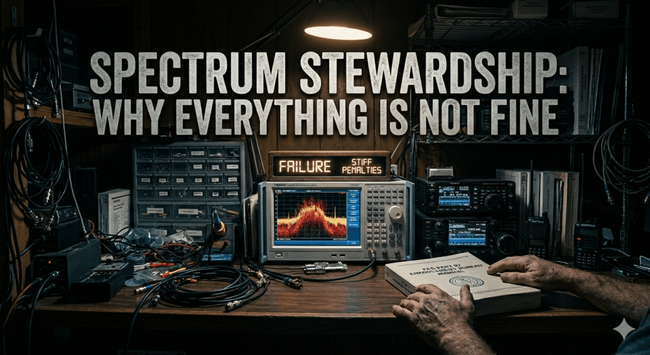
 KI7CFO