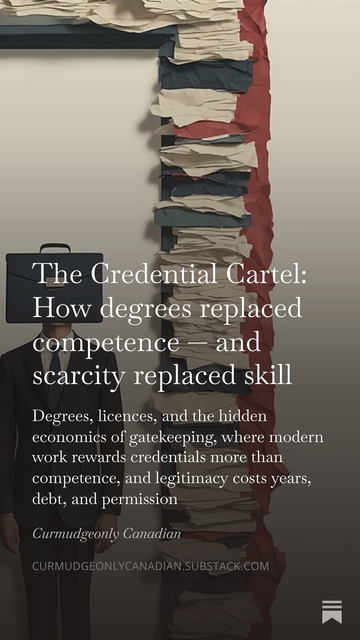
University: "You need our stamp to prove you're educated."
Also university: Teaches 19th-century economics while collecting payment in fiat currency that proves the curriculum is fiction.
The irony writes itself.
University: "You need our stamp to prove you're educated."
Also university: Teaches 19th-century economics while collecting payment in fiat currency that proves the curriculum is fiction.
The irony writes itself.
Real expertise: "Here's how this mechanism actually functions."
Phantom expertise: "I have credentials (unspecified), institutional validation (from those I defend), and sophisticated language (that pathologises your recognition)."
The second sounds more credible.
The first is actually useful.
Learn to tell the difference.
#Expertise #Credentialism #CriticalThinking #AppealToAuthority
A higher seat at the table of an unjust system, an illusory diversity among the ruling class, is not progress, it is a bribe!
― Muirén Ní Sídach
Chris Hedges and Catherine Liu, author of “Virtue Hoarders: The Case against the Professional Managerial Class” discuss the rejection of liberalism, and the credentialed managerial class war against the working class.
#CatherineLiu & #ChrisHedges
#Culture #Economics #Politics #ClassWarfare #Neoliberal #HyperIndividualist #Credentialism
https://www.youtube.com/watch?v=PuIb4j_hxSw
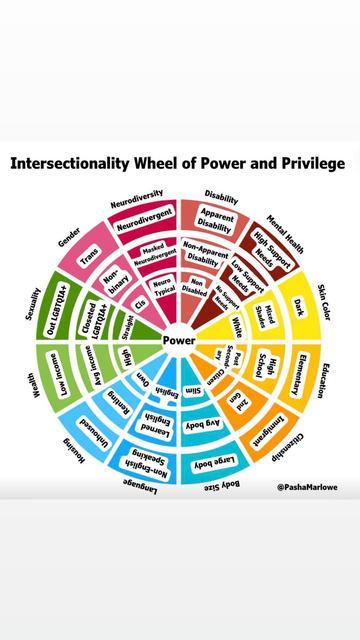
Please feel free to share this visual representation of how various aspects of identity contribute to #power and #privilege in our society.
Highlighting the complexity of social experiences & the disadvantages for those without power should help those with power to understand how they attained it without any effort.
#Ableism #Classism #Credentialism
#Discrimination #Homophobia #Intersectional #Linguicism #MentalHealthStigma #NeurodivergentDiscrimination #Racism #Sexism #Sizeism #Transphobia
#Credentialism and #Meritocracy in the United States of America
> Reducing reliance on credentials is also more likely to increase diversity, even when it’s not a stated objective.
"I don't expect anybody with no musical background to get it. I took classical piano for fifteen fucking years, theory, composition, the whole thing, and I'm getting so fucking tired of people saying, 'Oh, it's a rock 'n' roll guy fucking around with electronic music.' That's bullshit. One of these days I'm gonna pull my degrees out and say, 'Does that make me legitimate?' But I don't wanna do that because that's horseshit too."—Lou Reed
#Credentialism is excessive reliance on credentials, especially academic degrees. The term originally was applied to over-reliance on credentials in hiring, but its use has broadened.
Credentials are third-party acknowledgments that the holder possesses the requisite knowledge and clearance relating to a specific field of knowledge. Most are educational in nature, usually a diploma indicating the completion of a specific course of study.
#RationalWiki
https://rationalwiki.org/wiki/Credentialism
@schrisomalis fascinating!
It looks like what we're seeing is a spike in this particular collocation rather than a drop in others — there must be a #DigitalHumanities paper on the evolution of #credentialism there
A TLS, GUARDIAN AND NEW STATESMAN BOOK OF THE YEAR 2020 The new bestseller from the acclaimed author of Justice and one of the world's most popular philosophers "Astute, insightful, and empathetic...A crucial book for this moment" Tara Westover, author of Educated These are dangerous times for democracy. We live in an age of winners and losers, where the odds are stacked in favour of the already fortunate. Stalled social mobility and entrenched inequality give the lie to the promise that "you can make it if you try". And the consequence is a brew of anger and frustration that has fuelled populist protest, with the triumph of Brexit and election of Donald Trump. Michael J. Sandel argues that to overcome the polarized politics of our time, we must rethink the attitudes toward success and failure that have accompanied globalisation and rising inequality. Sandel highlights the hubris a meritocracy generates among the winners and the harsh judgement it imposes on those left behind. He offers an alternative way of thinking about success - more attentive to the role of luck in human affairs, more conducive to an ethic of humility, and more hospitable to a politics of the common good.