The great cities of Mesopotamia ("the land between two rivers") developed prior to the late 4th millennium BCE along two rivers – the Tigris and Euphrates – and were fully established by the Early Dynastic period (circa 2900 to circa 2350/2334 BCE). #History #Uruk #Ur #Nineveh #Mesopotamia #Mari #Eridu #Babylon #Ashur #Akkad #Kish #Lagash #Nippur #Sippar #HistoryFact https://whe.to/ci/2-2900-en/
12 Great Cities of Ancient Mesopotamia: The Rise and Fall of the Earliest Cities in the World

The great cities of Mesopotamia ("the land between two rivers") developed prior to the late 4th millennium BCE along two rivers – the Tigris and Euphrates – and were fully established by the Early Dynastic...

World History Encyclopedia
Ashur (also known as Assur) was an Assyrian city located on a plateau above the Tigris River in Mesopotamia (today known as Qal'at Sherqat, al-Shirqat District, northern Iraq). #History #Tukulti-NinurtaI #Assyria #Assur #AshurnasirpalII #Ashur #UNESCO #HistoryFact https://whe.to/ci/1-148-en/

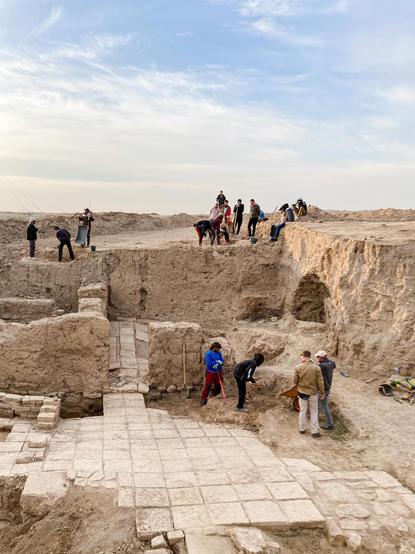
A team of archaeologists has announced the discovery of a monumental stone relief in Iraq depicting King Ashurbanipal, along with Ishtar, Ashur, and other religious figures. “This find is a rare and invaluable window into the spiritual and political world of one of history’s most powerful empires.”

https://wildhunt.org/2025/05/ancient-nineveh-yields-another-spectacular-discovery-a-relief-of-ishtar-and-assur.html

#archaeology #assyrian #Nineveh #ishtar #pagan #ashur #shamash #science

Ancient Nineveh Yields another Spectacular Discovery: A relief of Ishtar and Assur

A team of archaeologists has announced the discovery of a monumental stone relief in Iraq depicting King Ashurbanipal, along with Ishtar, Ashur, and other religious figures. “This find is a rare and invaluable window into the spiritual and political world of one of history’s most powerful empires.”

The Wild Hunt

Ninive, dallo scavo riemerge un inedito bassorilievo assiro con il re Assurbanipal e le divinità Ashur e Ishtar

Elena Percivaldi

Importante scoperta archeologica nella città di Ninive, che sorgeva nei pressi della moderna Mosul, in Iraq. Dallo scavo in corso è riemerso un imponente bassorilievo raffigurante – ed è per la prima volta – le divinità principali del pantheon assiro, scolpite su una lastra di pietra di 5,5 metri di lunghezza, 3 metri di altezza e ben 12 tonnellate di peso.

A rivelarlo è il team dell’Università di Heidelberg, guidato da Aaron Schmitt, che dal 2022 lavora nel cuore del Palazzo Nord di Ninive, costruito dal re Assurbanipal, l’ultimo grande sovrano dell’impero assiro. “Tra le immagini in rilievo ad oggi note nei palazzi assiri non vi sono raffigurazioni di divinità principali. Ecco perché secondo noi la scoperta è straordinaria”, spiega Schmitt.

Una scena sacra scolpita nella pietra

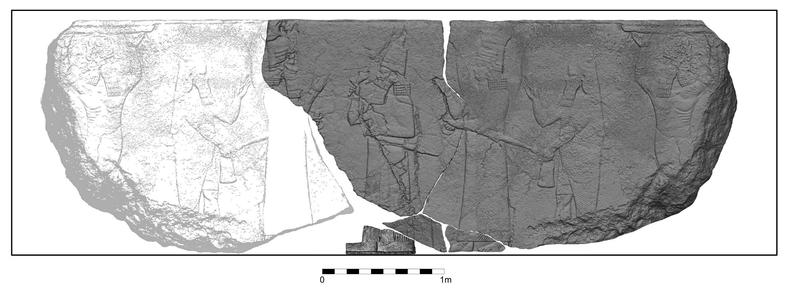
Il bassorilievo, probabilmente collocato in origine davanti all’ingresso principale della sala del trono, rappresenta una scena di forte significato religioso e politico: il re Assurbanipal in posizione centrale, accompagnato da Ashur, il dio supremo degli Assiri, e da Ishtar, dea della guerra e dell’amore, protettrice di Ninive.

Dietro di loro, un genio pesce, figura apotropaica spesso legata alla saggezza e alla protezione, e una figura con le braccia sollevate che potrebbe essere interpretata come un uomo-scorpione, ulteriore elemento mitologico a completare la narrazione sacra. I segni sulla pietra suggeriscono che in origine la composizione fosse sormontata da un grande disco solare alato, simbolo della divinità e del potere regale.

Leggi anche

https://storiearcheostorie.com/2025/03/26/a-udine-la-copia-di-un-bassorilievo-assiro/

Il bassorilievo assiro, un tesoro sepolto da oltre duemila anni

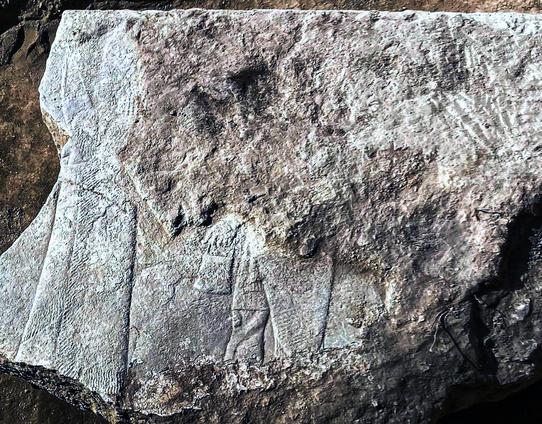
Il rilievo è stato rinvenuto in frammenti all’interno di una fossa colmata di terra, dietro la nicchia dove in origine era collocato. Secondo gli studiosi, fu probabilmente rimosso e interrato durante il periodo ellenistico, nel III o II secolo a.C.

Frammento del rilievo (foto credit: Aaron Schmitt)

Questo spiegherebbe perché gli archeologi britannici, attivi nella zona già nel XIX secolo, non lo avessero mai individuato, nonostante le importanti scoperte fatte in altri ambienti del palazzo e oggi conservate al British Museum.

Un progetto internazionale per la valorizzazione

La scoperta è frutto del progetto “Heidelberg Nineveh”, avviato nel 2018 sotto la direzione di Stefan Maul del Dipartimento di Lingue e Culture del Vicino Oriente dell’Università di Heidelberg. In collaborazione con lo Iraqi State Board of Antiquities and Heritage, l’obiettivo a medio termine è ricollocare il bassorilievo nel suo contesto originario e aprirlo al pubblico, trasformando la scoperta in un punto di riferimento per la valorizzazione del patrimonio mesopotamico.

Verso una nuova interpretazione dell’arte assira?

Nei prossimi mesi, il team tedesco analizzerà nel dettaglio il rilievo e il suo contesto, con l’intento di pubblicare uno studio approfondito su rivista scientifica. Le dimensioni e la qualità dell’opera, unite alla rarità del soggetto, promettono di fornire nuovi, importanti elementi per la comprensione dell’iconografia imperiale assira.

Immagine in apertura: Modello 3D del rilievo: i reperti sono evidenziati in grigio scuro, la parte in grigio chiaro rappresenta una ricostruzione basata sui reperti. Il re Assurbanipal è raffigurato al centro. (credit: Michael Rummel)

#archeologia #archeologiaMesopotamia #arteAssira #Ashur #Assurbanipal #bassorilievo #bassorilievoAssiro #Irak #Iraq #Ishtar #Mesopotamia #Ninive #notizie #palazzoNordNinive #patrimonioIracheno #reAssurbanipal #scavi #scaviArcheologici #scoperte #scoperteArcheologiche #UniversitàDiHeidelberg

Prof. Dr. Aaron Schmitt

Das Institut für Ur- und Frühgeschichte und Vorderasiatische Archäologie in Heidelberg

Spectacular Find in the Ancient City of Nineveh

Hach was genial. Die Besetzung zum #Spartacus SpinOff #HouseOfAshur wird immer genialer. Jetzt zwei meiner liebsten Darsteller dazu gekommen #GrahamMcTavish & #ClaudiaBlack 🥰

Auch wenn ich wenig begeistert bin, dass die
#Ashur für das #Spinoff wieder auferstehen lassen, bin ich voller Vorfreude bez. der Serie.

https://www.fernsehserien.de/news/spartacus-spin-off-engagiert-graham-mctavish-outlander-und-claudia-black-farscape

#Serien #Serienzeug #Serienjunkie
„Spartacus“-Spin-Off engagiert Graham McTavish („Outlander“) und Claudia Black („Farscape“)

Ashur übernimmt Nachfolge von Batiatus

fernsehserien.de
Ashurnasirpal II

Ashurnasirpal II (r. 884-859 BCE) was the third king of the Neo-Assyrian Empire. His father was Tukulti-Ninurta II (r. 891-884 BCE) whose military campaigns throughout the region provided his son with...

World History Encyclopedia
Assyria began as a small trading community centered at the ancient city of Ashur and grew to become the greatest empire in the ancient world prior to the conquests of Alexander the Great and, after him, the Roman Empire. https://www.worldhistory.org/Assyrian_Warfare/ #History #AdadNirariI #Ashur #Ashurbanipal
Assyrian Warfare

Assyria began as a small trading community centered at the ancient city of Ashur and grew to become the greatest empire in the ancient world prior to the conquests of Alexander the Great and, after...

World History Encyclopedia
The foundation of the Assyrian dynasty can be traced to Zulilu, who is said to have lived after Bel-kap-kapu (c. https://www.worldhistory.org/article/106/history-of-assyria/ #History #Ashur #Ashurbanipal #AshurnasirpalII
History of Assyria

The foundation of the Assyrian dynasty can be traced to Zulilu, who is said to have lived after Bel-kap-kapu (c. 1900 BCE), the ancestor of Shalmaneser I. The city-state of Ashur rose to prominence...

World History Encyclopedia
The Marduk Prophecy is an Assyrian document dating to between 713-612 BCE found in a building known as The House of the Exorcist adjacent to a temple in the city of Ashur. https://www.worldhistory.org/article/990/the-marduk-prophecy/ #History #Ashur #Babylon #Esarhaddon
The Marduk Prophecy

The Marduk Prophecy is an Assyrian document dating to between 713-612 BCE found in a building known as The House of the Exorcist adjacent to a temple in the city of Ashur. It relates the travels of...

World History Encyclopedia