Albane Imbert, Head of Making Lab at The Crick institute in London, is recruiting:

"We are seeking an experienced engineer to join the Making Lab team at Senior (SLRS) or Principal (PLRS) level. This is a hands-on technically demanding role focused on leading the development of robotics, automation and integrated hardware-software systems for biomedical research."

https://crick.wd3.myworkdayjobs.com/External/job/London/Principal-Laboratory-Research-Scientist_R2483-1

#PhDJobs #TheCrick

Senior/Principal Laboratory Research Scientist

Salary for this Role: SLRS: From £45,700 per annum with benefits, subject to skills and experience PLRS: From £55,555 per annum with benefits, subject to skills and experience Job Title: Senior/Principal Laboratory Research Scientist Reports to: Albane Imbert Closing Date: 13/Mar/2026 23.59 GMT Job Description: Senior/Principal Laboratory Research Scientist – Making Lab Science Technology Platform Reporting to: Head of Making Lab STP Contract term: This is a full-time permanent position on Crick terms and conditions of employment. Salary for this Role: Senior Laboratory Research Scientist: From £45,700 with benefits, subject to skills and experience Principal Laboratory Research Scientist: From £55,555 with benefits, subject to skills and experience About us The Francis Crick Institute is Europe’s largest biomedical research institute under one roof. Our world-class scientists and staff collaborate on vital research to help prevent, diagnose and treat illnesses such as cancer, heart disease, infectious diseases and neurodegenerative conditions. The Crick is a place for collaboration, innovation and exploration across many disciplines. A space where the brightest minds can pursue big and bold ideas and discover answers to crucial scientific questions. We support them in a dynamic environment which fosters excellence with state-of-the-art infrastructure, cutting-edge facilities, and a creative and curious culture. We’ve removed traditional boundaries of departments, divisions and disciplines and instead have an open approach that supports every researcher. This gives us the freedom to take risks and carry out high-quality, pioneering research. Creating a space for discovery without boundaries helps us to turn our science into benefits for human health and the economy. About the Making Lab The Making Lab is a Science Technology Platform (STP) operating at the interface of engineering and biology. We accelerate biomedical discovery by designing and delivering advanced engineering solutions to complex scientific challenges. We collaborate across Neuroscience, Structural Biology, Cancer, Immunology and Bioengineering. Our expertise lies in Systems Engineering and Microfluidics & Tissue Engineering. We build robotics, automation platforms, sensing systems and integrated hardware-software tools that power cutting-edge research. As part of the global Making in Research movement, we champion open hardware, rapid prototyping and reproducible system design to drive innovation in science. About the role We are seeking an experienced engineer to join the Making Lab team at Senior (SLRS) or Principal (PLRS) level. This is a hands-on technically demanding role focused on leading the development of robotics, automation and integrated hardware-software systems for biomedical research. You will take ownership of the full project lifecycle, from initial technical scoping and system architecture through electronic hardware integration, embedded and software development, testing, validation and final deployment. Projects span bespoke instrumentation and complex real-time experimental platforms, delivered in close collaboration with neurophysiology groups and teams developing advanced automated lab systems. You will operate within state-of-the-art facilities, including dedicated electronics and integration spaces alongside a workshop for digital and conventional manufacturing (CNC, laser machining, additive manufacturing). At Principal level, you will also contribute to management and long-term technical strategy, infrastructure development and platform planning for the Systems Engineering activity. Click here to read more about the STP See the full job description here For more details on the type of projects developed at the lab: OptoPi: An open source flexible platform for the analysis of small animal behaviour Functional specialisation of multisensory temporal integration in the mouse superior colliculus VISIBLE: An imaging-driven system for sampling, biofabrication, and manipulation of complex biological models Chronobot: Deep learning guided time-resolved cryo-EM captures molecular choreography of RecA in homology search What you will be doing You will be responsible for: Leading end-to-end development of bespoke hardware-software systems. Designing and integrating control systems, robotics platforms and data acquisition interfaces. Developing microcontroller-based systems, PCBs and sensor integrations. Applying structured systems engineering methods. Using version control, testing frameworks and clear documentation standards. Providing expert input on experimental design, feasibility and system architecture. Mentoring engineers and deliver hands-on technical training to researchers. Contributing to publications and disseminating technical resources. At principal level, contributing to platform strategy, infrastructure planning and capital investment. About you You will have: (Minimum criteria for SLRS & PLRS*) (Minimum criteria for PLRS**) Essential: Degree, PhD or equivalent experience in Engineering, Robotics, Electronics, Mechatronics or related field.* Significant hands-on experience in system design and hardware-software integration.* Strong programming skills in Python and C ++ within Linux environments.* Experience developing control systems, automation platforms or experimental instrumentation.* Expertise in microcontrollers, PCB design and sensor integration.* Strong understanding of testing, reproducibility and structured engineering workflows.* Comfortable leading multidisciplinary technical projects.** Skilled communicator with the ability to convey technical concepts clearly to diverse scientific audiences.** Desirable: Experience at the engineering-biology interface. Knowledge of signal processing, imaging systems or biomedical instrumentation. Experience with digital fabrication, including CNC machining, 3D printing or laser cutting. About Working at the Crick Our values Everyone who works at the Crick has a valuable role to play in advancing the Crick’s mission and shaping our culture! We are bold. We make space for creative, dynamic and imaginative ideas and approaches. We’re not afraid to do things differently. We are open. We’re highly collaborative and interactive, and make sure our activities are visible to the outside world. We are collegial. We show respect for one another, work cooperatively and support the wider community. At the Francis Crick Institute, we believe that diversity and inclusion are essential to driving innovation and scientific discovery. We are committed to creating a workplace where everyone feels valued, respected, and empowered to succeed, regardless of their background, identity, or personal circumstances. We actively encourage applications from individuals of all genders, ethnicities, abilities, and experiences. We are a Disability Confident: Committed employer and want to ensure that everyone can apply and be part of our recruitment processes and so we'll make reasonable adjustments if you need them - just let us know when you apply. If you need assistance with applying (i.e., would like to apply by phone or post) please email: [email protected]. Find out more about life at the Crick. What will you receive? At the Francis Crick Institute, we value our team members and are proud to offer an extensive range of benefits to support their well-being and development: Visas: Applicants for this role will be eligible for sponsorship to work in the UK Generous Leave: 28 days of annual leave, plus three additional days over Christmas and bank holidays. Pension Scheme: Defined contribution pension with employer contributions of up to 16%. Health & Well-being: 24/7 GP consultation services. Occupational health services and mental health support programs. Eye care vouchers and discounted healthcare plans. Work-Life Balance: Back-up care for dependents. Childcare support allowance. Annual leave purchase options. Crick Networks offering diverse groups’ support, community and inclusive social events. Perks: Discounted gym memberships, bike-to-work scheme, and shopping discounts. Subsidised on-site restaurant and social spaces for team interaction. Career support: A Post-doc to PI programme and other career development activities Please note you must meet the essential criteria listed within the Role Profile, to have your application reviewed. We reserve the right to withdraw this advert at any given time due to the number of applications received. The Francis Crick Institute is a biomedical discovery institute researching the biology underlying human health. At the Crick, scientists and staff collaborate to stretch the very limits of what we know about how life works. Our work is helping to understand why disease develops and to translate discoveries into new ways to prevent, diagnose and treat illnesses such as cancer, heart disease, stroke, infections and neurodegenerative diseases. The Francis Crick Institute is a charity, founded by the Medical Research Council, Cancer Research UK, Wellcome, UCL (University College London), Imperial College London and King’s College London.

How do animals sense depth? 👀

Work from the Znamenskiy group #TheCrick reveals 3D depth-selective responses in the primary visual cortex. #preprint

Check out the excellent #preLight from Wing Gee Shum & Phoebe Reynolds ⬇️

https://prelights.biologists.com/highlights/a-depth-map-of-visual-space-in-the-primary-visual-cortex/

#biology #behaviour #cognition #neuroscience

A depth map of visual space in the primary visual cortex - preLights

How do animals sense depth? Work from Znamenskiy group (@petrznam) reveals 3D depth-selective responses in the primary visual cortex.

preLights

It's #RareDiseaseDay so check out our brand new #RareDisease Special Issue that will continue to grow over the next few months!

So far we have:
🔬Cutting-edge research papers
👩‍🔬An interview with Prof Veronica Kinsler from #TheCrick who pieces together the mosaic of rare skin diseases
📢 #PatientVoice interviews with rare disease #PatientAdvocates

Follow this space for even more rare disease research, reviews & interviews:
https://journals.biologists.com/dmm/issue/17/6

Disease Models & Mechanisms

The Company of Biologists

Postdoc position at the lab of Michael Winding at #TheCrick in London:

https://crick.wd3.myworkdayjobs.com/External/job/London/Postdoctoral-Fellow---M-Winding-Social-Circuits-and-Connectomics-Laboratory_R1447-1

... on neuronal circuits that drive social interactions between animals.

#neuroscience #connectomics #Drosophila #vEM #FIBSEM

Postdoctoral Fellow – M. Winding Social Circuits and Connectomics Laboratory

Salary for this Role: From £41,935 with benefits, subject to skills and experience. Job Title: Postdoctoral Fellow – M. Winding Social Circuits and Connectomics Laboratory Reports to: Michael Winding Closing Date: 23.59 GMT Job Description: Postdoctoral Fellow – M. Winding Social Circuits and Connectomics Laboratory Reporting to: Michael Winding, Group Leader Contact term: This is a full-time, fixed term (4 years) position on Crick terms and conditions of employment. Please note there is no closing date for this role and applicants will be considered on a rolling basis. We encourage you to apply as soon as possible if you are interested in the role. The Research Group The postdoctoral position will be in Dr. Michael Winding’s laboratory. The Social Circuits and Connectomics Lab investigates how neuronal circuits in the brain drive social interactions between animals. To make this problem tractable, the lab focuses on cooperative foraging between fruit fly larvae. In this behaviour, individual animals come together and synchronise their movements to dig deeper into the food substrate and feed more efficiently. We have previously mapped the entire brain of this animal with synapse resolution (Winding, Pedigo et al. Science 2023), and will experimentally test the functional and behavioural roles of individual circuit elements in the connectome using linked genetic driver lines. These rich datasets are ripe for computational analysis and modelling, allowing for mechanistic understanding of circuit function and social behaviour. Overview of the lab’s research vision can be found at: https://www.crick.ac.uk/research/labs/michael-winding Research techniques in the laboratory include: electron microscopy imaging by enhanced FIBSEM, automated reconstruction using machine learning pipelines, comparative connectomics and network analysis, functional imaging, behavioural opto/thermogenetics, 3D printing and design, building Raspberry Pi-based behavioural rigs. The Project The postdoctoral fellow will be part of a comparative connectomics project in the lab. We have identified environmental and genetic manipulations that disrupt normal social interactions in fruit fly larvae. The project involves investigating the circuitry changes in the brain that causes these deficits in social behaviour. We will use volume electron microscopy (EM) to image with synapse-resolution the entire brains of animals with social deficits, in collaboration with Lucy Collinson at the Crick’s EM STP. The postdoctoral fellow will help map the circuitry from EM using a combination of automated reconstruction and proofreading, followed by modelling and network analysis in collaboration with Carey Priebe at John Hopkins University. The goal is to determine how brain miswiring disrupts social behaviours. This will be a group effort; the postdoctoral fellow will work alongside a PhD student and with the other members of the lab. The applicant should therefore work well in a team. After circuitry changes are identified, the fellow will model the possible functional and behavioural effects of these changes and collaborate with lab members to test predictions experimentally. To accomplish these tasks, the applicant should have a strong computational background. The postholder will have the following responsibilities: Help establish an automated reconstruction pipeline with the Crick’s AI team Proofread the segmented neurons across the brain as needed Comparative network analysis between control and experimental connectomes Computationally model the activity of neurons, constrained by the identified circuitry Postdoctoral Fellows will lead their own project, contribute to other projects on a collaborative basis (both in the lab and with external collaborators) and may guide PhD students in their research. The ability to work in a team is essential. Key experience and competencies The post holder should embody and demonstrate our core Crick values: Bold; Open; Collegial Essential PhD (or in the final stages of PhD submission) in Computational Neuroscience, Quantitative Fields, or any Biomedical Field if the project involved a significant computational component. Good knowledge and experience in python. Ability to communicate effectively with experimentalists, work together to refine models. Track record of impactful paper(s) or preprint(s). Evidence of data presentation at scientific meetings. Desirable Experience in machine learning/PyTorch Experience in network analysis Previous work in connectomics Experience in research with model biological system About Us At the Crick, we conduct research at the forefront of biomedical research. We combine rigour with an open and collaborative culture, and are outward-looking, reflecting our status as a partnership of six organisations aiming to pool knowledge, ideas and resources. We have a wide research portfolio with no divisions or departments, bringing biomedical researchers together with clinicians, physical scientists and applied scientists from our pharmaceutical partners. We aim to attract the most talented researchers and support them to tackle innovative research questions. Our Science Technology Platforms (STPs) provide our researchers with access to state-of-the-art technology and expertise. In this project, the postdoctoral fellow will minimally collaborate with the Software Engineering & AI STP and the Electron Microscopy STP. We provide an excellent learning environment with dedicated education programmes in public engagement with science, education and personal development, and a postdoc training programme that prepares scientists for leadership roles in science. If you are interested in applying for this role, please apply via our website. All offers of employment are subject to successful security screening and continuous eligibility to work in the United Kingdom. If you require a visa to work in the UK we will help support your application should you be successful. Find out what benefits the Crick has to offer: For more information on our great pay and benefits package please click here: https://www.crick.ac.uk/careers-and-study/life-at-the-crick/pay-and-benefits Equality, Diversity & Inclusion: We welcome applications from all backgrounds. We are committed to providing equal employment opportunities, regardless of ethnicity, nationality, gender, sexual orientation, gender identity, religion, pregnancy, age, disability, or civil partnership, marital or family status. We particularly welcome applications from people who are Minority Ethnic as they are currently underrepresented in the Crick at this level. Diversity is essential to excellence in scientific endeavour. It increases breadth and perspective, leading to more innovation and creativity. We want the Crick to be a place where everyone feels valued and where diversity is celebrated and seen as part of the foundation for our Institute’s success. The Crick is committed to creating equality of opportunity and promoting diversity and inclusivity. We all share in the responsibility to actively promote dignity, respect, inclusivity and equal treatment and it is our aim to ensure that these principles are reflected and implemented in all strategies, policies and practices. Read more on our website: https://www.crick.ac.uk/careers-and-study/life-at-the-crick/equality-diversity-and-inclusion The Francis Crick Institute is a biomedical discovery institute researching the biology underlying human health. At the Crick, scientists and staff collaborate to stretch the very limits of what we know about how life works. Our work is helping to understand why disease develops and to translate discoveries into new ways to prevent, diagnose and treat illnesses such as cancer, heart disease, stroke, infections and neurodegenerative diseases. The Francis Crick Institute is a charity, founded by the Medical Research Council, Cancer Research UK, Wellcome, UCL (University College London), Imperial College London and King’s College London.

Open position for a PhD student in the lab of Michael Winding at #TheCrick in London, UK.

The project:

"The role of autism-related genes in brain wiring and social behaviour"

Apply by October 5th.

https://www.crick.ac.uk/careers-study/vacancies/2023-09-01-the-role-of-autism-related-genes-in-brain-wiring-and-social-behaviour

#neuroscience #DevBio #connectomics #Drosophila

The role of autism-related genes in brain wiring and social behaviour

Crick

New group leader at #TheCrick, Michael Winding, is hiring a staff scientist:

"Interested in a research career, but don't want to worry about funding or job stability? We are hiring a staff scientist! Help us uncover how social behaviours work and how social isolation disrupts brain wiring and function. Apply by 30 June."

https://crick.wd3.myworkdayjobs.com/External/job/London/XMLNAME--Senior--Laboratory-Research-Scientist_R1162-2

"Salary for this Role: LRS, from £31,675 to £35,900. SLRS, from £39,950 to £45,275 with benefits, subject to skills and experience, and opportunities for advancement."

#neuroscience #jobs #academia #Drosophila

(Senior) Laboratory Research Scientist

Salary for this Role: From £31,675 subject to skills and experience Job Title: (Senior) Laboratory Research Scientist Reports to: Michael Winding Closing Date: 30/Jun/2023 23.59 GMT Job Description: Job title: Laboratory Research Scientist (LRS) or Senior Laboratory Research Scientist (SLRS) Reporting to: Michael Winding, Group Leader Contract term: This is a full-time, permanent position on Crick terms and conditions of employment. Appointment to LRS or SLRS depends on experience and qualifications. Salary for this Role: LRS, from £31,675 to £35,900. SLRS, from £39,950 to £45,275 with benefits, subject to skills and experience, and opportunities for advancement. The Role The role of a (Senior) Laboratory Research Scientist in the Crick is diverse and rewarding. The role allows one to pursue science without the stress of acquiring funding or worrying about temporary contracts. The role involves leading or supporting one or more scientific projects or programmes. The role covers a wide range of different functions and allows for continuity of lab operations. Typical activities include: • Assisting and collaborating with other lab members on their research projects. • Providing experimental or technical support to lab members. • Undertaking own research project, designing, and executing experiments with strategic direction from the group leader. • Managing long-term investigations and collaborations with other researchers. • Participating in academic activities, including group meetings and journal clubs, seminars, and scientific meetings. • Writing up findings for publication and completing revisions. • Occasional organisation and management of the laboratory, including maintaining laboratory databases, ordering of laboratory supplies, monitoring budgets, and routine maintenance of laboratory equipment. • Training and supervising other lab members in key techniques and protocols, lab operations, and equipment use. • Liaising with Science Operations and attending key quadrant meetings. • Writing risk assessments and SOPs and providing safety guidance to lab members. The Research Group The position will be in Dr. Michael Winding’s laboratory, which opened in April 2023. The Social Circuits and Connectomics Lab investigates how neuronal circuits in the brain drive social interactions between animals. To make this problem tractable, the lab focuses on cooperative foraging between fruit fly larvae (Drosophila melanogaster). The LRS/SLRS will assist the Group Leader in establishing the lab from the ground up, including testing and prototyping equipment, helping train PhD students and postdocs, and establishing a welcoming and vibrant lab culture. In collaboration with the Crick Scientific Technology Platforms (STPs), the lab is developing behavioural rigs to track the behaviour of individual animals, enhanced focused-ion beam SEM (eFIBSEM) to acquire new connectomics datasets, and two-photon functional imaging of individual neurons during behaviour. The LRS/SLRS will report to the Group Leader. Key responsibilities These include but are not limited to: Setting up/testing equipment (behavioural rigs, eFIBSEM, 2P microscopes, etc.) Generating, proofreading, and analysing new connectomes Maintain working knowledge of laboratory equipment and techniques Leading an independent research project Assisting in training and mentoring lab members Assisting in the projects of other lab members Experience and Competencies The ideal candidate will have a mixture of computational and experimental skills. A working knowledge of a programming language (preferrable python) is essential, as well as experience with microscopy (ideally two-photon) and/or behavioural experiments. An important requirement is a candidate with a very strong drive to learn new techniques and maintain this knowledge within the group, allowing smooth transitions between new and departing lab members. Part of this role will therefore involve training new lab members and collaborating with them on their projects when needed. The LRS/SLRS will also pursue their own research project, including long-term projects with strategic direction from the Group Leader. These projects could methodologically involve genetic behavioural screens, generating and proofreading connectomics datasets, scRNA-seq, and/or functional imaging with tracking two-photon microscopes. A proven track record of strong publications is desirable. LRS: Applies specific technical or practical skills and has a well-developed working knowledge of technical or scientific practices and procedures acquired through on-the-job, vocational or academic training. Work will involve the application of skills and knowledge to provide a range of technical support activities. SLRS: Applies an in-depth knowledge of research, technical or other scientific practices, methods and procedures gained through either experience and/or formal academic qualifications and applies this knowledge to provide a range of specialist activities. The post holder should embody and demonstrate our core Crick values: Bold; Open; Collegial Essential Ability and desire to learn new skills Working knowledge of a programming language Experimental background (microscopy, behavioural/genetic experiments, etc.) Ability to work collaboratively Ability to communicate and present data Desirable PhD in a relevant discipline, such as neuroscience, biosciences, or quantitative fields, or equivalent experience Experience with python Experience with light microscopy (two-photon ideally) Excellent organisational skills Experience in training/mentoring others Experience facilitating collaborations About Us At the Crick, we conduct research at the forefront of biomedical research. We combine rigour with an open and collaborative culture, and are outward-looking, reflecting our status as a partnership of six organisations aiming to pool knowledge, ideas and resources. We have a wide research portfolio with no divisions or departments, bringing biomedical researchers together with clinicians, physical scientists and applied scientists from our pharmaceutical partners. We aim to attract the most talented researchers and support them to tackle innovative research questions. Our science technology platforms provide our researchers with access to state-of-the-art technology and expertise. We provide an excellent learning environment with dedicated education programmes in public engagement with science, education and personal development, and a postdoc training programme that prepares scientists for leadership roles in science. If you are interested in applying for this role, please apply via our website. All offers of employment are subject to successful security screening and continuous eligibility to work in the United Kingdom. If you require a visa to work in the UK we will help support your application should you be successful Equality, Diversity & Inclusion We welcome applications from all backgrounds. We are committed to providing equal employment opportunities, regardless of ethnicity, nationality, gender, sexual orientation, gender identity, religion, pregnancy, age, disability, or civil partnership, marital or family status. We particularly welcome applications from people who are Minority Ethnic as they are currently underrepresented in the Crick at this level. Diversity is essential to excellence in scientific endeavour. It increases breadth and perspective, leading to more innovation and creativity. We want the Crick to be a place where everyone feels valued and where diversity is celebrated and seen as part of the foundation for our Institute’s success. The Crick is committed to creating equality of opportunity and promoting diversity and inclusivity. We all share in the responsibility to actively promote dignity, respect, inclusivity and equal treatment and it is our aim to ensure that these principles are reflected and implemented in all strategies, policies and practices. Read more on our website: https://www.crick.ac.uk/careers-and-study/life-at-the-crick/equality-diversity-and-inclusion For more information on our great pay and benefits you can read more here: https://www.crick.ac.uk/careers-and-study/life-at-the-crick/pay-and-benefits Find out what benefits the Crick has to offer: For more information on our great pay and benefits package please click here: https://www.crick.ac.uk/careers-and-study/life-at-the-crick/pay-and-benefits Equality, Diversity & Inclusion: We welcome applications from all backgrounds. We are committed to providing equal employment opportunities, regardless of ethnicity, nationality, gender, sexual orientation, gender identity, religion, pregnancy, age, disability, or civil partnership, marital or family status. We particularly welcome applications from people who are Minority Ethnic as they are currently underrepresented in the Crick at this level. Diversity is essential to excellence in scientific endeavour. It increases breadth and perspective, leading to more innovation and creativity. We want the Crick to be a place where everyone feels valued and where diversity is celebrated and seen as part of the foundation for our Institute’s success. The Crick is committed to creating equality of opportunity and promoting diversity and inclusivity. We all share in the responsibility to actively promote dignity, respect, inclusivity and equal treatment and it is our aim to ensure that these principles are reflected and implemented in all strategies, policies and practices. Read more on our website: https://www.crick.ac.uk/careers-and-study/life-at-the-crick/equality-diversity-and-inclusion The Francis Crick Institute is a biomedical discovery institute researching the biology underlying human health. At the Crick, scientists and staff collaborate to stretch the very limits of what we know about how life works. Our work is helping to understand why disease develops and to translate discoveries into new ways to prevent, diagnose and treat illnesses such as cancer, heart disease, stroke, infections and neurodegenerative diseases. The Francis Crick Institute is a charity, founded by the Medical Research Council, Cancer Research UK, Wellcome, UCL (University College London), Imperial College London and King’s College London.

For all electron microscopists out there:

"Crosshair, semi-automated targeting for electron microscopy with a motorised ultramicrotome"

Kimberly Meechan et al. 2022 @eLife from Yannick Schwab's lab at EMBL in collaboration with The Crick institute. https://elifesciences.org/articles/80899

Presents a new method for reliably and "selectively targeting small regions of interest in a resin block by trimming with an ultramicrotome", powered by "user-friendly software to convert X-ray images of resin-embedded samples into angles and cutting depths for the ultramicrotome."

Reviewed by three outstanding electron microscopists: Christel Genaud, Song Pang, and Michaela Wilsch-Bräuninger.

#electronmicroscopy #microCT #Platynereis #science #methods #EMBL #TheCrick

Crosshair, semi-automated targeting for electron microscopy with a motorised ultramicrotome

A new method using a motorised ultramicrotome and open-source software allows semi-automatic targeting of regions of interest for electron microscopy.

eLife

When you're chairing a session and your stylist is a strong-willed 5-year old fashionista obsessed with ties. #scientistMom

Razi Karapinar and I look forward to another day full of exciting #science at #TheCrick!

#Introduction
I have a longstanding interest in identifying which genes the #malaria parasite needs to survive, and why. During my PhD I was involved in early genome-scale screens in #Plasmodium. Now, I'm delving into more detail on gene function at scale by building approaches for automated culture at #TheCrick.

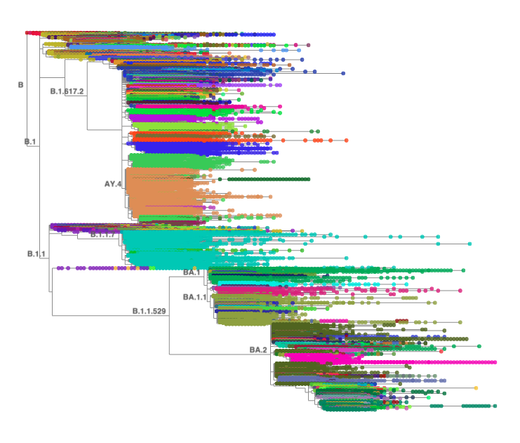
Since the pandemic I have also got into #GenomicEpidemiology in a big way. I created https://taxonium.org, a tool for exploring million-sequence trees, amongst other things.

Taxonium

Interactive exploration of large phylogenetic trees