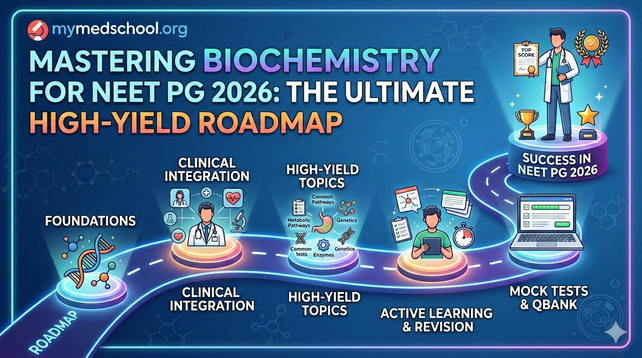
Mastering Biochemistry for NEET PG 2026: The Ultimate High-Yield Roadmap

Master high-yield Biochemistry for NEET PG 2026. Learn clinical correlation strategies, rate-limiting enzyme matrices, and interactive exam tools to boost your score on mymedschool.org.

mymedschool.org
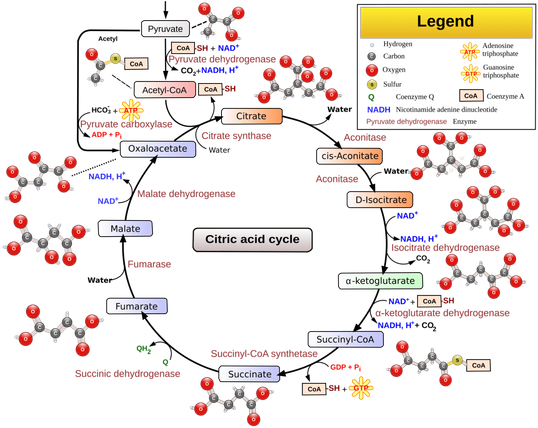
U01.01.101 TCA Cycle: Krebs Cycle Steps, Enzymes, and Energy Yield

Master the Tricarboxylic Acid (TCA) Cycle with our U01.01.101 guide. Learn the sequence of reactions, key enzymes like Isocitrate Dehydrogenase, and the total yield of NADH, FADH2, and GTP. Understand how the cycle is regulated by energy charge and its role in aerobic respiration. Essential USMLE Step 1 biochemistry available on mymedschool.org.

mymedschool.org
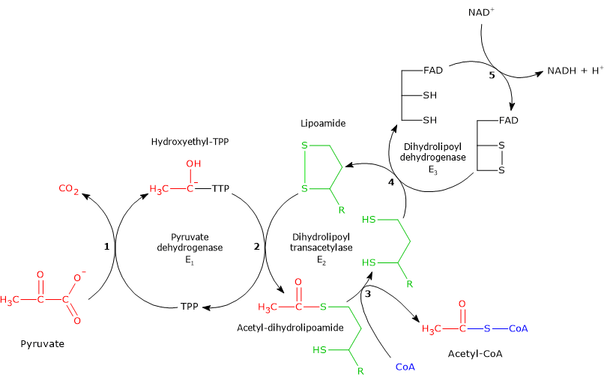
U01.01.098 Pyruvate Dehydrogenase Complex: The Bridge to the TCA Cycle

Master the Pyruvate Dehydrogenase (PDH) complex with our U01.01.098 guide. Explore the three enzymes (E1, E2, E3), the five essential cofactors (B1, B2, B3, B5, Lipoic Acid), and the clinical consequences of PDH deficiency. Learn how arsenic poisoning and thiamine deficiency disrupt this critical metabolic link. Essential USMLE Step 1 biochemistry available on mymedschool.org.

mymedschool.org
U01.01.098 Pyruvate Dehydrogenase Complex: The Bridge to the TCA Cycle

Master the Pyruvate Dehydrogenase (PDH) complex with our U01.01.098 guide. Explore the three enzymes (E1, E2, E3), the five essential cofactors (B1, B2, B3, B5, Lipoic Acid), and the clinical consequences of PDH deficiency. Learn how arsenic poisoning and thiamine deficiency disrupt this critical metabolic link. Essential USMLE Step 1 biochemistry available on mymedschool.org.

mymedschool.org
U01.01.075 Vitamin B2 MCQs: Riboflavin, FAD/FMN & Redox Reactions Quiz

Master the biochemistry and clinical pathology of Riboflavin with our U01.01.075 Vitamin B2 question set. This practice collection covers high-yield medical topics including FAD and FMN as essential cofactors for the TCA cycle, Succinate Dehydrogenase, and the Electron Transport Chain. Learn to identify the classic clinical "2 Cs" of deficiency: Cheilosis and Corneal vascularization. Designed for medical students, these free medical questions on mymedschool.org provide essential preparation for USMLE Step 1 and clinical nutrition exams.

mymedschool.org

The Tricarboxylic Acid Cycle

#AcetylCoA, #CitricAcidCycle, #Glycolysis, #KrebsCycle, #TCACycle #Biochemistry There are several metabolic pathways have been identified, those are used to liberate energy from food components. In the glycolytic…. Medical Microbiology & Recombinant DNA Technology (RDT) Labs | Read More -

https://micrordt.wordpress.com/2024/04/27/the-tricarboxylic-acid-cycle/

The Tricarboxylic Acid Cycle

#AcetylCoA, #CitricAcidCycle, #Glycolysis, #KrebsCycle, #TCACycle #Biochemistry There are several metabolic pathways have been identified, those are used to liberate energy from food components. In…

Medical Microbiology & RDT Labs

Here are some studies I've read today. For others to read. Today's topic is metabolomics.

https://pubmed.ncbi.nlm.nih.gov/34685558/
Finally got some leads on lipids and porphyria. Like squeezing blood from a rock I tell ya, no one studies this shit

https://www.mdpi.com/1422-0067/23/6/3219
Some neat info on energy metabolism. Also where I realized with horror that I am actually going to have to memorize the krebs cycle for my work

anyways, there are ways around the pay walls but I am legally not allowed to say in case future employers see this

#lipidomics #lipids #porphyria #hepatology #liver #TCAcycle #science #research #disease #metabolism

Profiling of Serum Metabolites of Acute Intermittent Porphyria and Asymptomatic HMBS Mutation Carriers - PubMed

This study aims to present the serum metabolite profiles of patients with acute intermittent porphyria (AIP) and identify specific metabolites that could potentially discriminate between AIP, asymptomatic HMBS mutation carriers, and healthy individuals. The study cohort included 46 female participan …

PubMed
Increase in biomass due to changes in F1-hybrid metabolite

Heterosis is a phenomenon in which F1 hybrids, generated by crossing different species or strains, exhibit more vigorous growth than their parents. F1 hybrids are grown for many crops on the market today. However, although heterosis has been known for more than 100 years, its mechanism has not yet been completely understood.

Phys.org