📢 Neu in RADAR: GitLab-Import!
Neben #GitHub unterstützt RADAR nun auch den Import von Inhalten aus #GitLab-Repositorys!
✔️ Forschende können Quellcode, Datensätze oder Dokus direkt und komfortabel nach RADAR übertragen – ganz ohne manuelles Hochladen.
✔️ Ermöglicht DOI-Vergabe, macht Softwareversionen eindeutig zitierbar + referenzierbar und sorgt für deren langfristige Verfügbarkeit.
Alle Details: https://bit.ly/4hlO9bT

#introductions I'm Stephan, originally an English Philologist and Linguist, now a #SoftwareEngineering researcher at the German Aerospace Center's (https://social.bund.de/@dlr) Institute of Software Technology in #Berlin.
I'm a 2018 Fellow of the Software Sustainability Institute (https://mastodon.social/@SoftwareSaved), founder and lead of the #CitationFileFormat (https://citation-file-format.github.io/) and co-founder of de-RSE (https://mastodon.social/@de_rse).
I work on #ResearchSoftware, #SoftwareCitation, #SoftwarePublication, #SoftwareIntelligence, #SoftwareSustainability, #EmpiricalSoftwareEngineering.
554 Posts, 154 Following, 4.89K Followers · Wir sind das Deutsche Zentrum für Luft- und Raumfahrt (DLR) und lieben unsere Themen Luftfahrt, Raumfahrt, Energie, Verkehr, Digitalisierung & Sicherheit! Web: https://www.dlr.de/de Impressum: https://www.dlr.de/de/service/impressum Datenschutz: https://www.dlr.de/de/service/datenschutz Netiquette: https://www.dlr.de/de/aktuelles/social-media/netiquette
Huh, I must've missed the announcement.
@swheritage is now providing citation metadata to download as #BibTeX and use via #BibLaTeX (biblatex-software) for archived software with a CITATION.cff file or codemeta.json in the root directory! 🎉
Very cool!
#CitationFileFormat #SoftwareHeritage #ResearchSoftware #SoftwareCitation
Thanks to #CURIOSS members, Collin Capano and William Gearty at the Syracuse University #OSPO, for sharing this fascinating talk from @adam42smith on the #citationstylelanguage
#academicOSS #academicOSPOs #citation #opensource #opensourcesoftware #openscience #openresearch #softwarecitation
A new paper about @joss
"The Journal of Open Source Software (JOSS): Bringing Open-Source Software Practices to the Scholarly Publishing Community for Authors, Reviewers, Editors, and Publishers"
https://doi.org/10.31274/jlsc.18285
#Publishing #ScientificPublishing #SoftwareCitation #OpenSource #Software #RSEng #ResearchSoftware #SoftwareEngineering
Introduction: Open-source software (OSS) is a critical component of open science, but contributions to the OSS ecosystem are systematically undervalued in the current academic system. The Journal of Open Source Software (JOSS) contributes to addressing this by providing a venue (that is itself free, diamond open access, and all open-source, built in a layered structure using widely available elements/services of the scholarly publishing ecosystem) for publishing OSS, run in the style of OSS itself. A particularly distinctive element of JOSS is that it uses open peer review in a collaborative, iterative format, unlike most publishers. Additionally, all the components of the process—from the reviews to the papers to the software that is the subject of the papers to the software that the journal runs—are open. Background: We describe JOSS’s history and its peer review process using an editorial bot, and we present statistics gathered from JOSS’s public review history on GitHub showing an increasing number of peer reviewed papers each year. We discuss the new JOSSCast and use it as a data source to understand reasons why interviewed authors decided to publish in JOSS. Discussion and Outlook: JOSS’s process differs significantly from traditional journals, which has impeded JOSS’s inclusion in indexing services such as Web of Science. In turn, this discourages researchers within certain academic systems, such as Italy’s, which emphasize the importance of Web of Science and/or Scopus indexing for grant applications and promotions. JOSS is a fully diamond open-access journal with a cost of around US$5 per paper for the 401 papers published in 2023. The scalability of running JOSS with volunteers and financing JOSS with grants and donations is discussed.
Do you publish your #ResearchSoftware to support #Reproducibility and enable #SoftwareCitation?
If you don't yet, or want to automate the process, join me at @helmholtz_hmc #hmc_fairfriday this Friday, where I'll talk about these things and #HERMES, a workflow we develop in @helmholtz to automate software publication with rich metadata.
Join our next HMC FAIR Friday seminar event with Stephan Druskat from DLR! The lecture will take place on 15th November 2024 at 10 am CET in Zoom. abstract: Research software powers research across disciplines, and enables us to work with ever larger and more complex research data. Without long-term access to the specific versions of the software that have been used in research, we are unable to reproduce the research that has been done. The deposit of software metadata and artifacts in...
"How do official software citation formats evolve over time? A longitudinal analysis of R programming language packages"
by Yuzhuo Wang and @nalsi
in Scientometrics
https://doi.org/10.1007/s11192-024-05064-6
(unfortunately not open access, but there's a preprint at https://arxiv.org/abs/2307.09390)
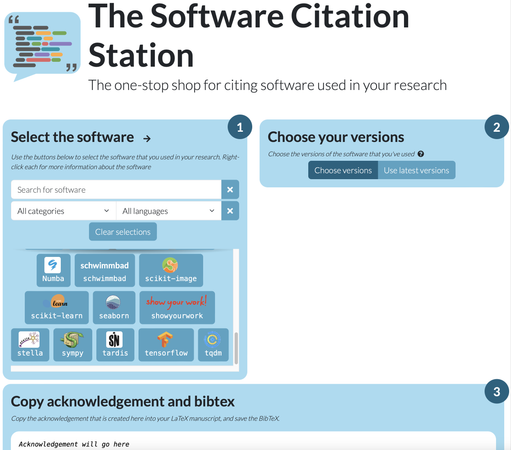
An interesting new tool to promote #SoftwareCitation and credit in #astronomy:
The Software Citation Station: a website for making citing software used in your research quick and easy
by Tom Wagg & Floor Broekgaarden
https://www.tomwagg.com/software-citation-station/
(and a paper about this, now on GitHub, soon to be on arXiv: https://github.com/TomWagg/software-citation-station/blob/main/paper.pdf)