Digital Independence Day / Dia da Independência Digital
Rizoma, domingo, 5 de julho às 13:00 GMT+1
EN:
Our workshop series in which we liberate us from the shitty big tech monopolies.
You want to move away from Windows, Google, Apple, Instagram, Bluesky, Twitter, Whatsapp or any of the other big tech monopolies, but you are unsure how and what are the alternatives?
Or you know that already, but you rather want to make that step with others instead of alone?
You just want to discuss in depth what is the coolest of the many alternatives to a service?
Or you are already very deep into the topic and you just want to help others in making the change?
Come around, together we boycott big tech bit by bit.
We meet every first Sunday of the month and every time we replace one more app with a privacy respecting alternative.
Our next workshop starts
📅 on July 5th
🕐 at 13:00
📍 in the CCS room @ Rizoma, Rua José Estêvão 4, 1150-202 Lisboa.
🆓 Admission is free.
👷 Agenda
13:00 Introduction, open discussion, help for early birds
13:45 - 14:00 short focus presentation on Email Encryption and RSS feeds with Thunderbird.
In the rest of the workshop we just discuss whatever comes up and help each other with technical difficulties.
🧰🎒 What to bring
🐧 For people who want to change to Linux:
Bring a computer on which you want to install Linux.
Bring the appertaining charger with you.
Bring a big external storage device with a backup of your data. (We recommend to make the backup beforehand).
Besides your laptop, if possible also bring an empty USB flash drive with at least 4 GB.
Bring your passwords. (So that you can set up your e-mail, etc. ...)
Allow at least 2 hours for installation and setup.
---------------------------------------------------------------------------------------------------------
PT:
A nossa série de workshops em que nos libertamos dos monopólios dos big tech.
Quer afastar-se do Windows, Google, Apple, Instagram, Bluesky, Twitter, Whatsapp ou qualquer outro dos grandes monopólios tecnológicos, mas não sabe como e quais são as alternativas?
Ou já sabe, mas prefere dar esse passo com outras pessoas em vez de sozinho?
Quer apenas discutir em profundidade qual é a melhor das muitas alternativas a um serviço?
Ou já está muito envolvido no assunto e só quer ajudar outras pessoas a fazer a mudança?
Junte-se a nós, juntos vamos boicotar os big tech, pouco a pouco.
Encontrarmos todos os primeiros domingos do mês e, a cada vez, substituirmos mais uma aplicação por uma alternativa que respeite a privacidade.
A proxima workshop começa
📅 no dia 5 de jujho
🕐 às 13h
📍 na sala CCS @ Rizoma, Rua José Estêvão 4, 1150-202 Lisboa.
🆓 Entrada Livre.
👷 Agenda
13h00: Introdução, discussão aberta, ajuda para os madrugadores
13h45 - 14h00: breve apresentação sobre Criptografia de e-mails e feeds RSS com o Thunderbird.
No restante do workshop, discutiremos o que surgir e ajudaremos uns aos outros com dificuldades técnicas.
🧰🎒 O que trazer
🐧 Para quem deseja mudar para o Linux:
Traga um computador no qual deseja instalar o Linux.
Traga o carregador correspondente.
Traga um dispositivo de armazenamento externo grande com uma cópia de segurança dos seus dados. (Recomendamos fazer a cópia de segurança com antecedência).
Além do seu computador portátil, se possível, traga também uma pen USB vazia com pelo menos 4 GB.
Traga as suas palavras-passe. (Para que possa configurar o seu e-mail, etc.)
Reserve pelo menos 2 horas para a instalação e configuração.
https://eventos.coletivos.org/event/digital-independence-day-dia-da-independencia-digital-5
 Marcel SIneM(S)US
 eventos.coletivos.org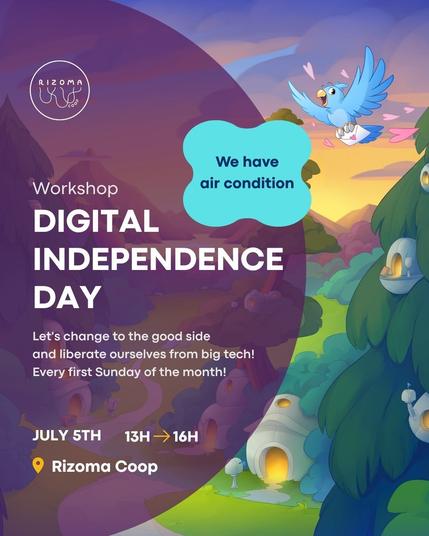
 OpenUK
 Analyst207

 Linux Association of Canada

 Sync-in
 N-gated Hacker News
 Yorgos Saslis