Decibels Decoded: The Brutal Logic of the Logarithmic Scale

2,208 words, 12 minutes read time.

The electromagnetic spectrum is a violent, unforgiving landscape where signals die in the dirt or soar across the vacuum of space based on the math you choose to ignore. Most people live their lives in a comfortable, linear world where two plus two equals four and an inch is always an inch, but the moment you key a mic, that world burns down. In the realm of Amateur Radio, we deal with power levels that don’t just fluctuate; they explode and collapse across a scale so vast it would make a standard accountant’s head spin. We are forced to use the decibel not because it is elegant or academic, but because it is the only weapon sharp enough to cut through the astronomical differences between a whisper of thermal noise and the roar of a kilowatt amplifier. If you tried to track the gain and loss of a signal using standard linear multiplication, you would be buried under a mountain of zeros before you even reached the feedline. The decibel is our survival kit, a logarithmic shorthand that tames the chaotic physics of RF into something a man can actually use to build a station that works.

The Linear Trap and the Death of Scalability

When you look at a signal traveling from a transceiver through a length of coax, out an antenna, and across a thousand miles of ionosphere, you aren’t just looking at a slight change in voltage. You are witnessing a total transformation of energy that spans twelve orders of magnitude, a range that renders linear numbers completely useless for anyone trying to get a job done. If we measured signal strength in watts alone, we would be forced to compare 0.000000000001 watts of received signal against 1,500 watts of transmitted power, a mental exercise that serves no one but the masochist. The linear scale is a trap for the small-minded because it fails to account for how energy actually behaves in the physical world, where losses don’t subtract—they divide. By shifting our perspective to the logarithmic scale of the decibel, we turn these impossible multiplications into simple addition and subtraction, allowing an operator to see the truth of their system without getting lost in the weeds of scientific notation. It is about stripping away the fluff and looking at the ratio, the raw relationship between what you have and what you started with, which is the only thing that matters when the skip is in.

Biology and the Weber-Fechner Reality

The reason the decibel feels “unnatural” to the uninitiated is that it mirrors the harsh reality of our own senses rather than the artificial tidiness of a ruler. Humans don’t perceive the world linearly; we are wired by evolution to detect changes in intensity based on ratios, a phenomenon known in the cold halls of science as the Weber-Fechner Law. If you are standing in a dark room and someone lights a single candle, the change is massive, but if you are standing under the midday sun and they light that same candle, you won’t see a damn thing. Our ears and eyes work on a logarithmic curve to keep us from being overwhelmed by the environment, and radio waves follow that same brutal logic as they propagate through space. By using decibels, we are finally aligning our technical measurements with the physical way the universe handles energy and the way our biological hardware interprets it. It is a recognition that a 3dB increase—a doubling of power—is the smallest change that actually moves the needle in a meaningful way for the human ear or a sensitive receiver.

The Physics of Propagation and the Inverse Square Law

The universe does not hand out signal strength for free, and it certainly does not surrender it in a straight line. As a radio wave leaves your antenna and expands into the void, it spreads its energy across the surface of an ever-growing sphere, a physical reality dictated by the Inverse Square Law. This means that if you double the distance between your station and the receiver, you aren’t just losing half your strength; you are spreading that same power over four times the area, effectively gutting your signal. Trying to track this degradation using linear percentages is a fool’s errand that leads to incomprehensible decimals and failed links. The logarithmic nature of the decibel allows us to visualize this geometric expansion as a steady, manageable rate of decline, turning the terrifying physics of spherical spreading into a simple subtraction problem. When you understand that every 6dB of loss represents a doubling of distance in free space, you stop guessing and start operating with the cold precision of someone who knows exactly where their signal is going to die.

Mastering the Rule of Threes and Tens

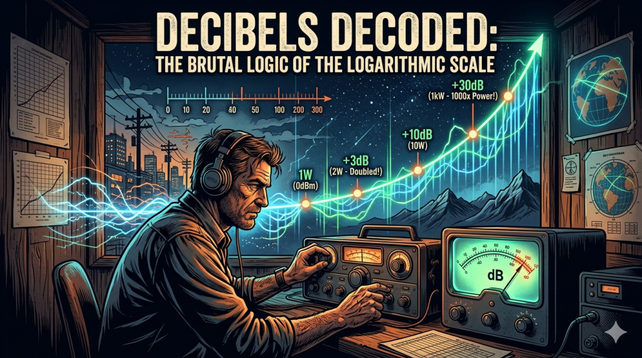
In the field, you don’t have time to pull out a scientific calculator and solve for base-10 logarithms while the band is opening and the pileup is screaming. You need a mental shorthand that works as fast as you do, and that is where the “Rule of 3s and 10s” becomes the ultimate field manual for the radio operator. It is a simple, visceral truth: a 3dB change is a doubling or halving of power, and a 10dB change is a ten-fold increase or decrease. If you add an amplifier that gives you 13dB of gain, you aren’t just guessing at the output; you know instantly that you’ve increased your power by ten times and then doubled it again, a total twenty-fold jump in raw force. This isn’t just math for the sake of math; it is the ability to look at a piece of coax with a 3dB loss rating and know exactly that half of your hard-earned power is being bled off as heat before it ever touches the air. Mastering these ratios allows you to see through the marketing lies of “high-gain” antennas and understand exactly what is happening to every milliwatt in your signal chain.

The Reference Point and the War for Ground Truth

A decibel on its own is a ghost—a ratio with no home and no meaning until you tie it to a concrete reference point. This is where the amateurs are separated from the experts, in the understanding of the suffixes that give the decibel its teeth and its utility in the real world. When we talk about dBm, we are tethering that ratio to a single milliwatt, creating an absolute scale that allows us to measure everything from the noise floor of a receiver to the output of a handheld. Without that “m,” you’re just talking about a change; with it, you’re talking about power you can feel. The same lethal precision applies to antenna gain, where dBi measures against an ideal isotropic radiator in free space, while dBd measures against a real-world dipole. If you don’t know which one you’re looking at, you’re flying blind and likely overestimating your station’s performance by 2.15dB. It is about demanding a ground truth in a world of relative numbers, ensuring that when you say your signal is “up 2 S-units,” you actually know the physical reality of the power hitting the other guy’s front end.

The S-Unit and the Lie of the Meter

Every operator has stared at an S-meter, watching that needle bounce as if it were a direct line to the truth, but most wouldn’t recognize the logarithmic violence happening behind the glass. In a properly calibrated receiver, a single S-unit represents a 6dB change in signal strength, which is a four-fold increase in power. When you tell a DX station they have gone from an S-7 to an S-9, you aren’t just giving them a polite compliment; you are telling them their signal power at your antenna has surged by a factor of sixteen. This is the logarithmic scale in its most practical, everyday application, yet it is where most people lose the thread of reality. The “S-9 plus 20” report isn’t just a bigger number—it is a staggering hundred-fold increase over the baseline S-9 signal. If you don’t respect the decibel, you don’t respect the massive energy required to punch through the noise floor when the ionosphere decides to stop cooperating. The meter is a logarithmic gatekeeper, and if you can’t read the code, you’re just looking at a moving needle without a clue of the raw wattage it represents.

Signal-to-Noise: The Only Metric That Survives

At the end of the day, raw power is a vanity metric if you can’t manage the ratio between your signal and the chaotic roar of the universe. This is the Signal-to-Noise Ratio (SNR), and it is the final battlefield where the decibel proves its worth as a tactical tool. In a world of linear numbers, trying to calculate how much “clearer” a signal is when you reduce the noise floor by 3dB would be a nightmare of tiny fractions. In the logarithmic world, it is a simple subtraction that tells you exactly how much breathing room you’ve bought for your data or your voice. You don’t need a thousand watts if you have a clean 10dB SNR; you just need enough distance from the floor to be heard. This is why we obsess over low-noise amplifiers and high-gain Yagis—not for the sake of the numbers themselves, but because the logarithmic scale tells us exactly how much of a fighting chance we have against the static. It is the cold, hard math of survival in a medium that wants to swallow your signal whole.

The Technician’s Final Reckoning

Mastering the decibel is not a suggestion for the amateur radio operator; it is the fundamental requirement for anyone who wants to stop being a “black box” appliance operator and start being an engineer of the airwaves. The logarithmic scale is the only language that accurately describes the way energy moves, bleeds, and conquers the vacuum of space. It strips away the comfort of linear thinking and replaces it with a visceral understanding of ratios, forces, and the physical limits of our hardware. When you stop fearing the log and start using it to dissect your feedline loss, your antenna gain, and your receiver sensitivity, the entire hobby shifts from a series of mysteries into a calculated game of precision. You begin to see the spectrum for what it really is: a vast, logarithmic expanse where every 3dB is a hard-won victory and every 10dB is a total transformation of your reach. If you want to own the frequency, you have to own the math that defines it.

Call to Action

The electromagnetic spectrum doesn’t care about your feelings, and it certainly doesn’t care about your inability to do the math. You can keep twisting dials and hoping for the best, or you can finally weaponize the decibel to build a station that actually commands the airwaves. Every milliwatt you lose to a bad connector or a mismatched feedline is a failure of discipline, a surrender to the noise that separates the hobbyists from the elite operators.

It is time to take a cold, hard look at your signal chain and audit every inch of it with logarithmic precision. Get your hands on a quality SWR bridge, calculate your real-world line loss, and stop relying on the “black box” to save you. The skip is opening, the noise floor is rising, and the only thing standing between you and a successful contact is the math you choose to master. Gear up, run the numbers, and earn your place on the waterfall.

SUPPORTSUBSCRIBECONTACT ME

D. Bryan King

Sources

Disclaimer:

The views and opinions expressed in this post are solely those of the author. The information provided is based on personal research, experience, and understanding of the subject matter at the time of writing. Readers should consult relevant experts or authorities for specific guidance related to their unique situations.

#10dBRule #3dBRule #AmateurRadio #amateurRadioTechnician #antennaGain #BelScale #coaxAttenuation #currentGain #dBScale #dBiVsDBd #dBmVsDBW #decibelConversion #decibels #dipoleGain #doublingPower #DXCommunication #electromagneticSpectrum #feedlineLoss #hamRadioMath #hamRadioTechnical #inverseSquareLaw #isotropicRadiator #logarithmicScale #logarithmicUnits #NoiseFloor #powerMeasurement #powerRatios #RadioElectronics #radioPropagationLoss #RadioWavePhysics #receiverSensitivity #RFEngineering #RFFieldStrength #RFGain #RFHarmonics #RFLinkBudget #RFPower #SMeterCalibration #SUnits #signalDegradation #signalPropagation #signalStrength #signalToNoiseRatio #SNR #stationOptimization #transmitterOutput #voltageGain #waveIntensity #WeberFechnerLaw
The Silent Siege: Defending the Radio Spectrum in an Age of Noise

3,286 words, 17 minutes read time.

The electromagnetic spectrum is currently facing an unprecedented siege from commercial expansion, environmental noise pollution, and regulatory encroachment, threatening the viability of independent communication. This conflict involves a diverse cast of actors ranging from multinational telecommunications conglomerates and unsuspecting homeowners to a dedicated community of radio operators who stand as the last line of defense for this invisible public resource. While the general public remains largely unaware of the radio waves passing through them, a fierce battle is being waged for control of these frequencies, occurring in corporate boardrooms, legislative chambers, and the backyards of suburban neighborhoods. The stakes are considerably higher than mere hobbyist chatter; at risk is the ability to maintain decentralized, resilient communication infrastructures independent of the fragile commercial grid. As the demand for wireless data explodes and the noise floor rises, the preservation of the spectrum requires a concerted response from informed men willing to understand the physics, the policy, and the practical application of radio technology.

The Commercial Encroachment on Finite Resources

The most immediate and powerful threat to the radio spectrum comes from the insatiable commercial appetite for bandwidth. As modern society transitions into an era defined by the Internet of Things and 5G connectivity, corporate entities are aggressively lobbying for access to every available slice of the radio frequency pie. This creates a direct conflict with existing services, including the bands historically allocated for amateur and emergency use. The spectrum is a finite physical resource; unlike fiber optic cables where more strands can be laid, there is only one electromagnetic spectrum. When a frequency band is auctioned off to the highest bidder for billions of dollars, it is often lost to the public domain forever. This commoditization of the airwaves treats a law of nature as a piece of real estate to be fenced off and monetized.

The pressure is particularly intense because the specific frequencies that are most desirable for long-range communication or high-penetration data signals are the very same frequencies that have been cultivated by amateur operators for decades. Telecommunications giants view these bands as underutilized assets waiting to be exploited for profit. The concept of “use it or lose it” has never been more relevant. If a community of capable operators does not actively occupy and defend these frequencies through demonstrated utility and public service, regulators face immense pressure to reallocate them to commercial interests. This reality turns every licensed operator into a stakeholder in a global resource management crisis. The defense against this encroachment is not just about complaining to regulators; it involves demonstrating the unique value of non-commercial spectrum access, particularly its role in disaster recovery when profit-driven networks fail.

The Rising Tide of the Noise Floor

While commercial reallocation attempts to steal the spectrum from above, a more insidious threat is rising from below: Radio Frequency Interference (RFI). This phenomenon is often referred to as the rising “noise floor.” In the past, turning on a radio receiver resulted in a quiet hiss of static, out of which a voice or signal would clearly emerge. Today, that quiet background is increasingly replaced by an angry roar of electronic smog. This pollution is generated by millions of poorly shielded consumer electronic devices. LED light bulbs, variable speed pool pumps, cheap switching power supplies, and solar panel inverters spew stray radio frequency energy into the environment. To a casual observer, these devices are harmless conveniences; to a radio operator, they are jammers that blind receivers and render communication impossible.

This environmental degradation of the electromagnetic spectrum creates a scenario where even if the frequencies are legally protected, they become practically useless. It is akin to owning a plot of land that has been flooded by toxic waste; you may hold the deed, but you cannot build on it. The physics of radio reception rely on the signal-to-noise ratio. As the noise floor rises, stronger and stronger signals are required to break through, effectively shrinking the range of communication systems. A handheld radio that could once talk to a station thirty miles away might now struggle to reach three miles across a noisy city. This threat is largely unregulated at the consumer level, as the enforcement of interference standards has lagged behind the proliferation of cheap electronics imported from manufacturers who cut corners on shielding.

Community Response and Technical Stewardship

The response to these threats has catalyzed a sophisticated movement within the radio community focused on stewardship and technical innovation. This is not a passive group; it consists of technically minded individuals who view the spectrum as a public trust. The primary weapon in this response is education and technical adaptation. Operators are developing new digital transmission modes designed specifically to function in high-noise environments. These modes use advanced signal processing and error correction to decode messages that are buried deep beneath the electronic smog, effectively reclaiming territory that was thought to be lost. This demonstrates a resilience and ingenuity that defines the spirit of the radio community. Rather than surrendering to the noise, they engineer their way through it.

Furthermore, the community response involves active monitoring and “fox hunting”—the practice of locating sources of interference. When a rogue signal or a malfunctioning device disrupts communications, operators use directional antennas and triangulation techniques to physically track down the source. This can lead to diplomatic engagements with utility companies to fix arcing power lines or helping a neighbor replace a noisy power supply. It is a form of neighborhood watch, but for the electromagnetic environment. This hands-on approach requires a deep understanding of wave propagation and electronics, skills that are honed through the pursuit of licensure and regular practice. It reinforces the idea that the spectrum is a shared backyard, and it is the responsibility of the residents to keep it clean.

The Regulatory Battlefield and Property Rights

Beyond the technical challenges, a significant battle is being fought on the regulatory front involving Homeowners Associations (HOAs) and private land covenants. These restrictions often prohibit the installation of external antennas, effectively locking millions of potential operators out of the spectrum. The “CC&Rs” (Covenants, Conditions, and Restrictions) that govern many modern housing developments prioritize aesthetic uniformity over functional resilience. This creates a paradox where a resident may legally hold a federal license to operate a radio station for emergency communications but is contractually banned from erecting the antenna necessary to use it. This represents a clash between private contract law and the public interest in maintaining a dispersed, capable civil defense network.

The community response to this has been a mix of legislative lobbying and stealth engineering. Legislation like the Amateur Radio Parity Act has been introduced in various forms to try and force a compromise, arguing that reasonable accommodation for antennas is a matter of national safety. On the ground, operators have become masters of stealth, deploying “invisible” antennas disguised as flagpoles, hidden in attics, or woven into landscaping. This ingenuity allows men to remain active and capable despite the restrictions, maintaining their readiness and their connection to the airwaves. It is a quiet act of rebellion, asserting the right to communicate and the duty to be prepared, regardless of arbitrary rules set by a housing board.

Strategic Implications of Spectrum Dominance

The importance of this subject extends into the realm of national security and strategic independence. In an era of cyber warfare and potential infrastructure attacks, reliance on centralized communication networks—like cell towers and the internet—is a vulnerability. These systems are fragile; they depend on the power grid, fiber backbones, and complex software stacks that can be hacked or jammed. The radio spectrum, accessed through decentralized amateur equipment, offers a fallback layer that is robust because of its simplicity and distribution. There is no central switch to turn off the ionosphere. There is no server farm to bomb that will silence point-to-point radio communication.

Understanding the spectrum allows an individual to step outside the “matrix” of commercial dependency. When the cellular networks are congested during a crisis, or when internet service providers suffer outages, the radio operator remains connected. This capability is not just about personal safety; it is a community asset. The response to spectrum threats is fundamentally about preserving this capability for the greater good. It aligns with a masculine ethos of protection and provision—ensuring that when the primary systems fail, a secondary, hardened system is ready to take over. This requires a workforce of licensed operators who are not just hobbyists, but disciplined communicators who understand the strategic value of the frequencies they guard.

Historical Context of Spectrum Allocation

To fully appreciate the current threats, one must understand the history of how the spectrum was tamed. In the early days of radio, the airwaves were a chaotic frontier, much like the Wild West. There were no lanes, no rules, and constant interference. The catalyst for order was the sinking of the Titanic in 1912. The tragedy highlighted the deadly consequences of unregulated communication, where distress calls could be missed or jammed by irrelevant chatter. This led to the Radio Act of 1912, which established the principle that the spectrum is a public resource to be managed by the government for the public good. It established the licensing structure that exists today, creating a hierarchy of users and prioritizing safety of life.

Over the last century, this allocation has evolved into a complex map of frequency blocks assigned to military, aviation, maritime, commercial, and amateur users. The amateur allocation was not a gift; it was carved out by pioneers who proved that the “useless” shortwave frequencies could actually span the globe. Today’s operators are the inheritors of that legacy. They occupy the bands that their predecessors explored and charted. The threat of losing these bands is a threat to erase that history and the public’s right to access the airwaves directly. The historical perspective reinforces why the community is so defensive of its privileges; they know that once a frequency is surrendered to commercial interests, it is never returned.

The Human Element of the Network

Technology and policy are critical, but the most vital component of spectrum defense is the human operator. A radio is merely a collection of capacitors and transistors until it is powered by a human intent on communicating. The decline in the number of active, knowledgeable operators is perhaps the greatest threat of all. A spectrum that is silent is a spectrum that is vulnerable to reallocation. The community needs fresh blood—men who are willing to learn the code, understand the electronics, and join the network. This is not about nostalgia for old technology; it is about maintaining a vital skill set in the modern world.

The culture of the radio community is one of mentorship and rigor. It welcomes those who are willing to put in the work to understand the medium. When a man decides to study the spectrum, he is not just preparing for a test; he is learning the language of the universe. He learns how the sun’s cycles affect communication, how the terrain shapes a signal, and how to build systems that survive when others fail. This human element is the ultimate check against the threats of noise and encroachment. An educated, active populace is the strongest argument for the continued preservation of the amateur bands.

Technological Adaptation and the Future

Looking forward, the defense of the spectrum will rely heavily on software-defined radio (SDR) and cognitive radio technologies. These advancements allow radios to be smarter, sensing the environment and finding clear frequencies automatically. The community is at the forefront of experimenting with these tools. By pushing the boundaries of what is possible with limited power and bandwidth, amateur operators often innovate solutions that are later adopted by the commercial and military sectors. The fight against spectrum pollution is driving the development of better filters and more robust digital protocols.

This technological evolution transforms the operator from a passive user into an active researcher. It makes the pursuit of a license an entry point into a world of high-tech experimentation. The threats facing the spectrum are forcing the community to up its game, resulting in a renaissance of technical learning. Men who engage with this subject find themselves gaining proficiency in computer networking, antenna physics, and signal processing—skills that are highly transferrable and economically valuable in the modern marketplace. The defense of the hobby thus becomes a pathway to professional development and technical mastery.

The Role of Organized Advocacy

No individual can fight the telecommunications lobby or the tide of electronic noise alone. The response is coordinated through national and international bodies that represent the interests of the non-commercial user. Organizations act as the shield, employing legal experts and engineers to testify before government commissions and international bodies like the International Telecommunication Union (ITU). They monitor legislative proposals, file comments on rule-making proceedings, and alert the membership when immediate action is required.

Supporting these organizations is a key part of the community response. It involves a recognition that rights must be defended collectively. The effectiveness of this advocacy depends on the size and engagement of the membership. A large, active body of licensed operators commands respect in Washington and Geneva. It signals to regulators that this is a voting block and a skilled workforce that cannot be ignored. The political aspect of spectrum defense is dry and often bureaucratic, but it is the trench warfare that keeps the frequencies open for the operator to use.

Natural Threats and Solar Cycles

The spectrum is also subject to threats that are entirely natural and beyond human control. The sun, the ultimate source of all radio propagation on Earth, goes through eleven-year cycles of activity. During the peak of these cycles, solar flares and coronal mass ejections can cause radio blackouts, wiping out communication across entire hemispheres. While this is not a “threat” in the sense of a malicious actor, it is a challenge that requires a deep understanding of space weather. The operator must know how to read the solar indices and adjust their strategies accordingly.

This connection to the cosmos adds a profound dimension to the spectrum. It reminds the operator that they are dealing with forces of nature. The community response to solar weather involves building networks of automated beacons that monitor propagation in real-time, providing data that is used not just by hams, but by scientific institutions. It turns the operator into a citizen scientist, contributing to our understanding of the sun-earth connection. This resilience in the face of natural variation is part of what makes radio operators so valuable during earthly disasters; they are accustomed to adapting to changing conditions.

The Economic Reality of Spectrum Auctions

It is impossible to discuss spectrum threats without addressing the sheer scale of the money involved. Governments view spectrum auctions as a painless way to raise revenue. Billions of dollars are exchanged for the exclusive rights to transmit on specific frequencies. This creates a David and Goliath dynamic. The amateur community cannot buy the spectrum; they can only argue for its value based on public service and educational merit. This is a difficult argument to make in a capitalist system that prioritizes immediate revenue over long-term resilience.

However, the economic argument is shifting. As infrastructure becomes more vulnerable to cyber-attacks, the “insurance policy” value of a trained volunteer radio corps is being reassessed. The cost of a total communications blackout during a hurricane or terrorist attack is astronomical. The community argues that the spectrum they occupy is a down payment on national safety. By maintaining these frequencies for public use, the government avoids the cost of building and maintaining a redundant emergency network of their own. It is a symbiotic relationship, but one that requires constant reminder and defense against the lure of quick auction cash.

Cybersecurity and the Radio Spectrum

The convergence of radio and computing has introduced cyber threats into the spectrum domain. Modern radios are often computers with antennas, and like any computer, they can be vulnerable. Malicious actors can exploit software vulnerabilities to jam networks, spoof signals, or inject false data. The “spectrum threat” now includes the possibility of hostile state actors using electronic warfare techniques to disrupt civil society.

The community response has been to embrace cybersecurity best practices. This includes verifying signal integrity, using digital signatures, and developing “air-gapped” systems that can operate without connection to the public internet. The modern operator must be part hacker, part engineer. This evolution appeals to men who are interested in information security and systems architecture. It frames the license not just as a permit to talk, but as a credential in the field of information assurance.

The Imperative of Self-Reliance

Ultimately, the drive to understand and defend the spectrum is rooted in the imperative of self-reliance. In a world where systems are increasingly interconnected and interdependent, the failure of one component can lead to cascading collapse. The man who holds a radio license and understands the spectrum possesses a tool of independence. He is not reliant on a monthly subscription or a functioning cell tower to ensure the safety of his family or community.

This self-reliance is the core motivation that drives the community response. It is why they build their own antennas, why they fight the HOAs, and why they study for the exams. It is a refusal to be helpless. The spectrum is the medium through which this independence is exercised. Protecting it is protecting the ability to act when others are paralyzed by a loss of connectivity. It is a masculine pursuit of competence and readiness in an unpredictable world.

Conclusion: The Future of the Frequency

The future of the radio spectrum is far from guaranteed. It stands at a crossroads between total commercialization and a balanced model that preserves public access. The threats of noise, regulation, and encroachment are unrelenting. However, the response from the community has been equally persistent. Through technical innovation, political advocacy, and a commitment to service, the guardians of the airwaves are holding the line.

For the man looking from the outside, this struggle represents an opportunity. It is a chance to join a fraternity of capable individuals who are not content to be passive consumers of technology. By engaging with the subject, understanding the physics, and eventually stepping up to earn the credentials, one becomes part of the solution. The spectrum is a heritage and a responsibility. It requires vigilant defense to ensure that when the world goes silent, there is still a signal in the noise, clear and strong, ready to carry the message.

Call to Action

If this breakdown helped you think a little clearer about the threats out there, don’t just click away. Subscribe for more no-nonsense security insights, drop a comment with your thoughts or questions, or reach out if there’s a topic you want me to tackle next. Stay sharp out there.

D. Bryan King

Sources

Disclaimer:

The views and opinions expressed in this post are solely those of the author. The information provided is based on personal research, experience, and understanding of the subject matter at the time of writing. Readers should consult relevant experts or authorities for specific guidance related to their unique situations.

#5GExpansion #AirGappedSystems #Airwaves #AmateurRadio #AntennaParity #antennaTheory #BandwidthScarcity #CivilDefense #CognitiveRadio #CommercialEncroachment #CommunicationBlackout #CoronalMassEjections #cyberSecurity #DecentralizedNetworks #digitalModes #DigitalSignatures #DirectionFinding #DisasterRecovery #electromagneticSpectrum #ElectronicSmog #ElectronicWarfare #ElectronicsHobby #emergencyCommunications #errorCorrection #FCCRegulations #FoxHunting #FrequencyAllocation #frequencyCoordination #FrequencyGuard #FutureOfRadio #GridDown #hamRadio #HFBands #HOARestrictions #IndependentInfrastructure #InformationAssurance #InterferenceHunting #IonosphericSkip #ITUStandards #LicensedOperator #MensHobbies #MicrowaveFrequencies #MonitoringStations #NationalSecurity #NeighborhoodWatch #NetworkResilience #NoiseFloor #OffGridComms #Preparedness #PropertyRights #PublicResource #publicSafety #RadioAct #radioBlackout #RadioEngineering #RadioFrequencyInterference #RadioLicensing #RadioPhysics #radioReceiver #RadioSilence #radioSpectrum #ResilientSystems #RFI #SDRTechnology #SecureComms #SelfReliance #shortwaveRadio #signalProcessing #signalStrength #SignalToNoiseRatio #softwareDefinedRadio #SolarCycles #SpaceWeather #SpectrumAnalyzer #SpectrumAuctions #SpectrumDefense #SpectrumManagement #SpectrumThreats #StealthAntennas #STEMSkills #StrategicIndependence #TacticalRadio #TechnicalMastery #TechnicalStewardship #TelecommunicationsLobby #TitanicRadioHistory #transceiver #VHFUHF #VolunteerCorps #WavePropagation #WirelessPolicy #WirelessTelegraphy

The Gentleman’s Guide to Ham Radio: Unwritten Rules for Modern Operators

1,301 words, 7 minutes read time.

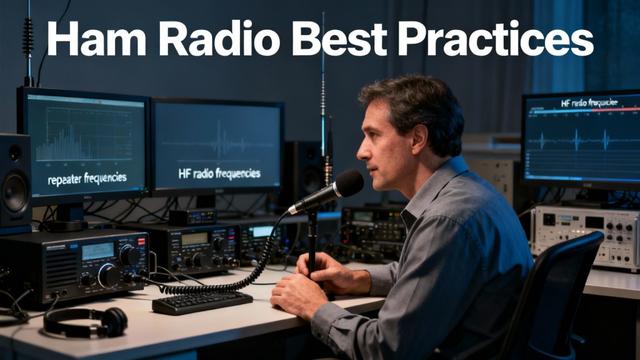
Amateur radio, or ham radio, is a unique hobby that combines technical skill, communication expertise, and community interaction. Success on the airwaves requires more than just a license—it demands understanding both regulations and the unwritten conventions that keep the hobby enjoyable and efficient for everyone. Operating responsibly ensures clear transmissions, prevents interference, and helps operators avoid being labeled a “lid,” a term for someone who makes avoidable mistakes on the air. This article explores the core practices that define effective ham radio operation.

Understanding Ham Radio Regulations

Every amateur radio operator is bound by regulations set forth by licensing authorities, and compliance is the first step in responsible operation. In the United States, for example, the Federal Communications Commission (FCC) enforces rules that prohibit broadcasting music, transmitting encrypted messages, or conducting commercial activities over amateur frequencies. Operators must also perform station identification at the start of a transmission, every ten minutes during prolonged contacts, and at the end of a conversation. These regulations are not merely formalities; they protect the integrity of the amateur radio spectrum and ensure that operators can communicate openly without interference from unauthorized sources.

Knowing the law is only the foundation. Equally important is understanding how to transmit responsibly. Operators must choose the correct calling frequency for their band, whether on VHF, UHF, or HF. For instance, in VHF operation, 146.52 MHz serves as the standard calling frequency in the Americas. HF operators must also be aware of band segments, using the upper portion for voice modes and the lower portion for data. Ignoring these guidelines and transmitting randomly can disrupt ongoing contacts and frustrate other operators. Listening before transmitting is critical; it prevents unintentional interference and helps operators gauge whether a frequency is active or clear.

Proper Repeater Etiquette and Communication Practices

Once you understand the rules, the next step is learning effective communication techniques, especially when using repeaters. Repeaters are shared resources, and using them incorrectly can annoy fellow operators or even create safety hazards during emergency communications. One of the most common mistakes for new operators is “chunking” the repeater—pressing the push-to-talk button without speaking. This generates unnecessary noise on the frequency and signals inexperience. If such an accident occurs, it should be acknowledged promptly to avoid being labeled a lid.

Operators should also avoid using the term “broadcast” to describe amateur transmissions. Amateur radio is inherently a two-way communication system. It is designed for interaction and connection, not one-way transmission of information. Similarly, operators should become familiar with repeater personalities. Some repeaters are formal and structured, with strict conversation protocols, while others are informal or casual. Observing the repeater’s tone and conventions before transmitting allows new operators to integrate seamlessly, reducing the risk of conflicts or misunderstandings. Listening, patience, and proper identification are key components of this stage of operation.

Calling Frequencies, Codes, and Phonetics

Another critical aspect of ham radio best practices is understanding how to make effective contact on a frequency. Calling frequencies are designated portions of a band where operators can announce their presence, such as calling “CQ” to signal availability for a conversation. On VHF repeaters, it is unnecessary to use traditional CQ calls. Instead, a simple identification or request for contact is sufficient. On HF, the situation is different. Operators may use CQ calls to reach others across longer distances, but even then, care must be taken to ensure the frequency is clear. Listening for a few moments, announcing presence, and waiting for responses prevents interference and shows respect for fellow operators.

Operators should also understand the proper use of codes. Common codes, such as QSL for confirmation of receipt or QTH for location, are derived from Morse code practices and are widely accepted. Other codes like QRZ (who is calling) and QSY (change frequency) serve specific functions. In addition, the phonetic alphabet is essential for clear identification, particularly on HF or during contests, where signal clarity is critical. On VHF repeaters, however, phonetics may be unnecessary unless the call sign is difficult to discern. Using codes and phonetics appropriately ensures that communications are efficient and understandable, maintaining professionalism on the air.

Advanced Best Practices for HF and Data Modes

HF operations introduce additional technical considerations, such as antenna tuning and signal management. Operators should never tune an antenna over an active conversation, as the tuning noise can disrupt ongoing contacts. Instead, move a few kilohertz away from an active frequency before initiating tuning procedures. Similarly, when engaging in data modes using software like FL Digi, operators should be aware of RSID tones and mode identification to prevent confusion for others receiving the signal.

Calling CQ on HF requires attentiveness and timing. Operators should first confirm that a frequency is free, announce their presence, and then issue a CQ call in a measured manner. Ragchewing, or extended conversational contact, requires awareness of the other operator’s signal strength and readability. Signal reports, often expressed using the RST system—Readability, Signal Strength, and Tone—allow operators to determine whether a conversation is feasible. Providing or interpreting an accurate RST ensures that communication remains clear and efficient, and prevents frustration caused by attempting contacts under suboptimal conditions.

Effective Interaction During Nets and Group Communications

Net operations, where one operator serves as a controller for a structured group conversation, demand disciplined communication. Operators should not transmit until called upon and must follow the net control protocol. Interrupting ongoing conversations is acceptable only under certain circumstances, such as emergencies or brief interjections. Understanding how to enter and participate in group discussions without dominating the channel is an advanced skill that reinforces professionalism.

Equally important is leaving adequate pauses between transmissions. Allowing time for other operators to respond or interject ensures that conversations remain orderly and inclusive. Misusing the seven-three shorthand, or incorrectly referencing handheld transceivers, may mark an operator as inexperienced. Observing these subtle conventions distinguishes proficient operators from novices and reinforces the culture of respect that underpins amateur radio.

Conclusion: Mastering Ham Radio Conduct

Operating a ham radio effectively requires a balance of technical knowledge, regulatory compliance, and interpersonal skill. By understanding regulations, respecting calling frequencies and repeaters, and mastering proper communication techniques, operators can avoid common mistakes and participate fully in the amateur radio community. Listening attentively, using codes and phonetics appropriately, and maintaining awareness of other operators on the frequency ensures clarity, efficiency, and respect.

Ham radio is as much about community and shared experience as it is about technology. Following best practices allows operators to make meaningful contacts, expand their skills, and enjoy the hobby without causing interference or frustration. Mastery of these principles ensures that every transmission contributes positively to the amateur radio environment, fostering both technical competence and professional conduct.

Call to Action

If this story caught your attention, don’t just scroll past. Join the community—men sharing skills, stories, and experiences. Subscribe for more posts like this, drop a comment about your projects or lessons learned, or reach out and tell me what you’re building or experimenting with. Let’s grow together.

D. Bryan King

Sources

Disclaimer:

The views and opinions expressed in this post are solely those of the author. The information provided is based on personal research, experience, and understanding of the subject matter at the time of writing. Readers should consult relevant experts or authorities for specific guidance related to their unique situations.

#amateurOperator #amateurRadio #amateurRadioAdvice #amateurRadioCommunity #amateurRadioEquipment #amateurRadioHobby #amateurRadioInstruction #amateurRadioKnowledge #amateurRadioNetwork #amateurRadioRules #amateurRadioSafety #amateurRadioSignals #amateurRadioStation #amateurRadioTraining #antennaTuning #callingFrequencies #communicationProtocol #contestOperation #cqCalls #cw #dataModes #digitalModes #effectiveRadioCommunication #emergencyCommunication #fccRegulations #flDigi #hamRadio #hamRadioBeginner #hamRadioBestPractices #hamRadioCommunity #hamRadioEtiquette #hamRadioGuide #hamRadioLicense #hamRadioOperations #hamRadioTips #handheldTransceiver #hfContacts #hfRadio #ht #morseCode #netControl #phoneticAlphabet #properCommunication #psk31 #pushToTalk #qCodes #qrz #qsl #qsy #qth #radioBestPractices #radioCallSigns #radioCheck #radioClarity #radioCodes #radioCommunicationSkills #radioContact #radioConversation #radioConversationEtiquette #radioEngagement #radioEtiquette #radioFrequency #radioGuidelines #radioHobbyist #radioInterference #radioLearning #radioLicense #radioListener #radioListening #radioMonitoring #radioOperation #radioOperationGuide #radioOperationTips #radioOperatorGuide #radioOperatorTips #radioSetup #radioSignal #radioTerminology #radioTransmission #ragchew #readability #repeaterCommunication #repeaterEtiquette #repeaters #rsidTone #rstReport #rtty #sevenThree #signalReport #signalStrength #toneReport #uhfCommunication #uhfContacts #vhfCommunication #vhfContacts

Simple trick to increase coverage: Lying to users about signal strength | Nick vs Networking

Stuck in a signal dead zone during emergencies? 🆘 WayFi ensures your call never drops. Learn how we boost signals in the toughest spots! #SignalStrength #EmergencyPreparedness https://wayfiwireless.com/preparing-for-emergencies-reliable-cellular-coverage
Understanding Signal Boosting Technology: Enhancing Cellular Coverage in Challenging Areas | WayFi Wireless

Discuss the critical role of reliable cellular coverage in emergency situations and how Wayfi Wireless ensures uninterrupted communication during crises.

WayFi Wireless