 Bryan King
Decibels Decoded: The Brutal Logic of the Logarithmic Scale
2,208 words, 12 minutes read time.
The electromagnetic spectrum is a violent, unforgiving landscape where signals die in the dirt or soar across the vacuum of space based on the math you choose to ignore. Most people live their lives in a comfortable, linear world where two plus two equals four and an inch is always an inch, but the moment you key a mic, that world burns down. In the realm of Amateur Radio, we deal with power levels that don’t just fluctuate; they explode and collapse across a scale so vast it would make a standard accountant’s head spin. We are forced to use the decibel not because it is elegant or academic, but because it is the only weapon sharp enough to cut through the astronomical differences between a whisper of thermal noise and the roar of a kilowatt amplifier. If you tried to track the gain and loss of a signal using standard linear multiplication, you would be buried under a mountain of zeros before you even reached the feedline. The decibel is our survival kit, a logarithmic shorthand that tames the chaotic physics of RF into something a man can actually use to build a station that works.
The Linear Trap and the Death of Scalability
When you look at a signal traveling from a transceiver through a length of coax, out an antenna, and across a thousand miles of ionosphere, you aren’t just looking at a slight change in voltage. You are witnessing a total transformation of energy that spans twelve orders of magnitude, a range that renders linear numbers completely useless for anyone trying to get a job done. If we measured signal strength in watts alone, we would be forced to compare 0.000000000001 watts of received signal against 1,500 watts of transmitted power, a mental exercise that serves no one but the masochist. The linear scale is a trap for the small-minded because it fails to account for how energy actually behaves in the physical world, where losses don’t subtract—they divide. By shifting our perspective to the logarithmic scale of the decibel, we turn these impossible multiplications into simple addition and subtraction, allowing an operator to see the truth of their system without getting lost in the weeds of scientific notation. It is about stripping away the fluff and looking at the ratio, the raw relationship between what you have and what you started with, which is the only thing that matters when the skip is in.
Biology and the Weber-Fechner Reality
The reason the decibel feels “unnatural” to the uninitiated is that it mirrors the harsh reality of our own senses rather than the artificial tidiness of a ruler. Humans don’t perceive the world linearly; we are wired by evolution to detect changes in intensity based on ratios, a phenomenon known in the cold halls of science as the Weber-Fechner Law. If you are standing in a dark room and someone lights a single candle, the change is massive, but if you are standing under the midday sun and they light that same candle, you won’t see a damn thing. Our ears and eyes work on a logarithmic curve to keep us from being overwhelmed by the environment, and radio waves follow that same brutal logic as they propagate through space. By using decibels, we are finally aligning our technical measurements with the physical way the universe handles energy and the way our biological hardware interprets it. It is a recognition that a 3dB increase—a doubling of power—is the smallest change that actually moves the needle in a meaningful way for the human ear or a sensitive receiver.
The Physics of Propagation and the Inverse Square Law
The universe does not hand out signal strength for free, and it certainly does not surrender it in a straight line. As a radio wave leaves your antenna and expands into the void, it spreads its energy across the surface of an ever-growing sphere, a physical reality dictated by the Inverse Square Law. This means that if you double the distance between your station and the receiver, you aren’t just losing half your strength; you are spreading that same power over four times the area, effectively gutting your signal. Trying to track this degradation using linear percentages is a fool’s errand that leads to incomprehensible decimals and failed links. The logarithmic nature of the decibel allows us to visualize this geometric expansion as a steady, manageable rate of decline, turning the terrifying physics of spherical spreading into a simple subtraction problem. When you understand that every 6dB of loss represents a doubling of distance in free space, you stop guessing and start operating with the cold precision of someone who knows exactly where their signal is going to die.
Mastering the Rule of Threes and Tens
In the field, you don’t have time to pull out a scientific calculator and solve for base-10 logarithms while the band is opening and the pileup is screaming. You need a mental shorthand that works as fast as you do, and that is where the “Rule of 3s and 10s” becomes the ultimate field manual for the radio operator. It is a simple, visceral truth: a 3dB change is a doubling or halving of power, and a 10dB change is a ten-fold increase or decrease. If you add an amplifier that gives you 13dB of gain, you aren’t just guessing at the output; you know instantly that you’ve increased your power by ten times and then doubled it again, a total twenty-fold jump in raw force. This isn’t just math for the sake of math; it is the ability to look at a piece of coax with a 3dB loss rating and know exactly that half of your hard-earned power is being bled off as heat before it ever touches the air. Mastering these ratios allows you to see through the marketing lies of “high-gain” antennas and understand exactly what is happening to every milliwatt in your signal chain.
The Reference Point and the War for Ground Truth
A decibel on its own is a ghost—a ratio with no home and no meaning until you tie it to a concrete reference point. This is where the amateurs are separated from the experts, in the understanding of the suffixes that give the decibel its teeth and its utility in the real world. When we talk about dBm, we are tethering that ratio to a single milliwatt, creating an absolute scale that allows us to measure everything from the noise floor of a receiver to the output of a handheld. Without that “m,” you’re just talking about a change; with it, you’re talking about power you can feel. The same lethal precision applies to antenna gain, where dBi measures against an ideal isotropic radiator in free space, while dBd measures against a real-world dipole. If you don’t know which one you’re looking at, you’re flying blind and likely overestimating your station’s performance by 2.15dB. It is about demanding a ground truth in a world of relative numbers, ensuring that when you say your signal is “up 2 S-units,” you actually know the physical reality of the power hitting the other guy’s front end.
The S-Unit and the Lie of the Meter
Every operator has stared at an S-meter, watching that needle bounce as if it were a direct line to the truth, but most wouldn’t recognize the logarithmic violence happening behind the glass. In a properly calibrated receiver, a single S-unit represents a 6dB change in signal strength, which is a four-fold increase in power. When you tell a DX station they have gone from an S-7 to an S-9, you aren’t just giving them a polite compliment; you are telling them their signal power at your antenna has surged by a factor of sixteen. This is the logarithmic scale in its most practical, everyday application, yet it is where most people lose the thread of reality. The “S-9 plus 20” report isn’t just a bigger number—it is a staggering hundred-fold increase over the baseline S-9 signal. If you don’t respect the decibel, you don’t respect the massive energy required to punch through the noise floor when the ionosphere decides to stop cooperating. The meter is a logarithmic gatekeeper, and if you can’t read the code, you’re just looking at a moving needle without a clue of the raw wattage it represents.
Signal-to-Noise: The Only Metric That Survives
At the end of the day, raw power is a vanity metric if you can’t manage the ratio between your signal and the chaotic roar of the universe. This is the Signal-to-Noise Ratio (SNR), and it is the final battlefield where the decibel proves its worth as a tactical tool. In a world of linear numbers, trying to calculate how much “clearer” a signal is when you reduce the noise floor by 3dB would be a nightmare of tiny fractions. In the logarithmic world, it is a simple subtraction that tells you exactly how much breathing room you’ve bought for your data or your voice. You don’t need a thousand watts if you have a clean 10dB SNR; you just need enough distance from the floor to be heard. This is why we obsess over low-noise amplifiers and high-gain Yagis—not for the sake of the numbers themselves, but because the logarithmic scale tells us exactly how much of a fighting chance we have against the static. It is the cold, hard math of survival in a medium that wants to swallow your signal whole.
The Technician’s Final Reckoning
Mastering the decibel is not a suggestion for the amateur radio operator; it is the fundamental requirement for anyone who wants to stop being a “black box” appliance operator and start being an engineer of the airwaves. The logarithmic scale is the only language that accurately describes the way energy moves, bleeds, and conquers the vacuum of space. It strips away the comfort of linear thinking and replaces it with a visceral understanding of ratios, forces, and the physical limits of our hardware. When you stop fearing the log and start using it to dissect your feedline loss, your antenna gain, and your receiver sensitivity, the entire hobby shifts from a series of mysteries into a calculated game of precision. You begin to see the spectrum for what it really is: a vast, logarithmic expanse where every 3dB is a hard-won victory and every 10dB is a total transformation of your reach. If you want to own the frequency, you have to own the math that defines it.
Call to Action
The electromagnetic spectrum doesn’t care about your feelings, and it certainly doesn’t care about your inability to do the math. You can keep twisting dials and hoping for the best, or you can finally weaponize the decibel to build a station that actually commands the airwaves. Every milliwatt you lose to a bad connector or a mismatched feedline is a failure of discipline, a surrender to the noise that separates the hobbyists from the elite operators.
It is time to take a cold, hard look at your signal chain and audit every inch of it with logarithmic precision. Get your hands on a quality SWR bridge, calculate your real-world line loss, and stop relying on the “black box” to save you. The skip is opening, the noise floor is rising, and the only thing standing between you and a successful contact is the math you choose to master. Gear up, run the numbers, and earn your place on the waterfall.
SUPPORTSUBSCRIBECONTACT MED. Bryan King
Sources
- The Decibel – American Radio Relay League (ARRL)
- NIST: SI Units and the Decibel
- ITU-R V.574: Use of the decibel and the neper in telecommunications
- FCC: Radio Frequency Safety and Power Calculations
- Microwaves101: The Decibel Encyclopedia
- Rohde & Schwarz: dB or not dB? (Application Note)
- NWS: Logarithmic Signal Processing in Radar Systems
- Analog Devices: Understanding dB, dBm, and dBW
- CISA: Emergency Communications System Lifecycle and RF Planning
- Electronics Notes: RF Logarithmic Units and Tables
- Keysight Technologies: Fundamentals of RF and Microwave Power Measurements
- RF Cafe: Decibel (dB) Reference and Equations
- Maxim Integrated: Glossary Definition of the Decibel
- ScienceDirect: Logarithmic Scales in Signal Processing
- AMSAT-UK: Understanding the Decibel Scale in Satellite Communications
- University of Toronto: Physics of the Decibel and Human Hearing
- Electronics Tutorials: Logarithms for Decibels in Electronics
- EE Times: The Decibel – The Handy Logarithm
- Repeater Builder: Engineering Guide to the Decibel
- Skyworks: RF Fundamentals and Logarithmic Power Control
- Anritsu: Difference Between dB and dBm
- Amphenol Procom: The Decibel in Radio Communication Systems
- Everything RF: Understanding dBm and Power Levels
- TAPR: Understanding dB, dBm, dBd, and dBi for Digital Radio
- Vias.org: Mathematical Definition of the Bel and Decibel
- Math Is Fun: Decibel Concepts Explained Simply
- All About Circuits: Decibels in AC Theory
- Mini-Circuits: Application Note on Signal Gain and Loss
- RF Design Guide: The Decibel Scale in RF Engineering
- METAS: Standard Logarithmic Units in Measurement
Disclaimer:
The views and opinions expressed in this post are solely those of the author. The information provided is based on personal research, experience, and understanding of the subject matter at the time of writing. Readers should consult relevant experts or authorities for specific guidance related to their unique situations.
#10dBRule #3dBRule #AmateurRadio #amateurRadioTechnician #antennaGain #BelScale #coaxAttenuation #currentGain #dBScale #dBiVsDBd #dBmVsDBW #decibelConversion #decibels #dipoleGain #doublingPower #DXCommunication #electromagneticSpectrum #feedlineLoss #hamRadioMath #hamRadioTechnical #inverseSquareLaw #isotropicRadiator #logarithmicScale #logarithmicUnits #NoiseFloor #powerMeasurement #powerRatios #RadioElectronics #radioPropagationLoss #RadioWavePhysics #receiverSensitivity #RFEngineering #RFFieldStrength #RFGain #RFHarmonics #RFLinkBudget #RFPower #SMeterCalibration #SUnits #signalDegradation #signalPropagation #signalStrength #signalToNoiseRatio #SNR #stationOptimization #transmitterOutput #voltageGain #waveIntensity #WeberFechnerLaw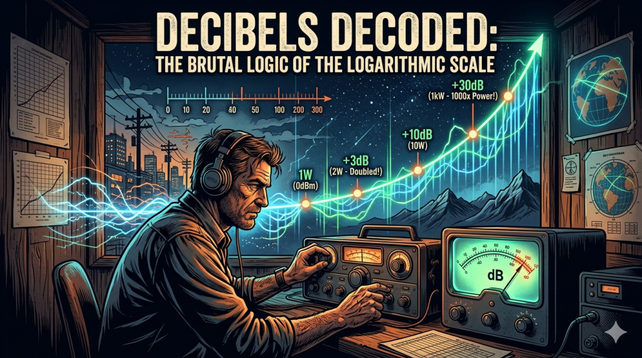
 Stephen Hayes
 Cecelia
 petapixel (unofficial)



 diyphotography (unofficial)

 DrMast
 रञ्जित (Ranjit Mathew)