 AltAndPaper EN|Satire News
Neighborhood Watch Plays 'Suspicious Person' to Save Crime App
Trench-coated patrols filed 70% of the alerts themselves.
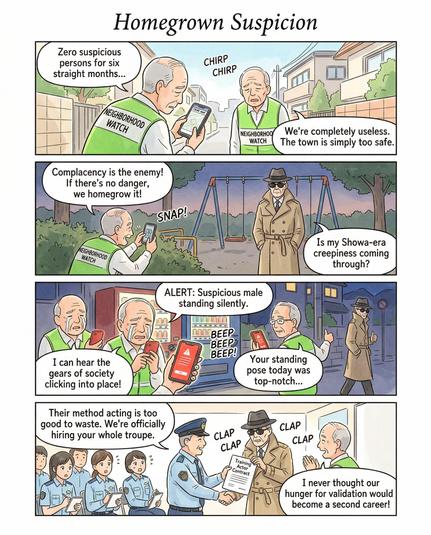
Neighborhood Watch Plays 'Suspicious Person' to Save Crime App
Trench-coated patrols filed 70% of the alerts themselves.
Pre-print: The curious case of lower reported racial discrimination in healthcare #healthcare #discrimination #survey #evidence #quantitative #racism #selfreport #migration
https://www.medrxiv.org/content/10.64898/2026.02.27.26347279v1

Objective: Explore self-reported racial discrimination in healthcare. Methods: Representative population sample, Switzerland, repeated cross-sectional data 2016 to 2024 (N=15,525). Results: Contrary to expectation, respondents from the migration-related population (foreign citizens, foreign born, migration background, first/second generation) report less racial discrimination than members of the majority population. Over time, we see an increase in the non migration-related population reporting (racial) discrimination in healthcare, while the share for the migration-related population is constant. The validity of the instrument is demonstrated with reported discrimination at work and in housing and the results are reliable across specifications and statistical controls. Conclusion: We speculate that in some cases, reported racial discrimination may express unmet expectations in healthcare more generally. ### Competing Interest Statement The authors have declared no competing interest. ### Funding Statement This research was supported by the Swiss National Science Foundation project grant 200939, with additional support from the NCCR on the move (grant 51NF40_205605). ### Author Declarations I confirm all relevant ethical guidelines have been followed, and any necessary IRB and/or ethics committee approvals have been obtained. Yes The details of the IRB/oversight body that provided approval or exemption for the research described are given below: Secondary analysis of anonymous data available from the Swiss Federal Statistical Office (https://www.bfs.admin.ch/bfs/en/home/statistics/population/surveys/zids.html) as described and cited in the manuscript. I confirm that all necessary patient/participant consent has been obtained and the appropriate institutional forms have been archived, and that any patient/participant/sample identifiers included were not known to anyone (e.g., hospital staff, patients or participants themselves) outside the research group so cannot be used to identify individuals. Yes I understand that all clinical trials and any other prospective interventional studies must be registered with an ICMJE-approved registry, such as ClinicalTrials.gov. I confirm that any such study reported in the manuscript has been registered and the trial registration ID is provided (note: if posting a prospective study registered retrospectively, please provide a statement in the trial ID field explaining why the study was not registered in advance). Yes I have followed all appropriate research reporting guidelines, such as any relevant EQUATOR Network research reporting checklist(s) and other pertinent material, if applicable. Yes The data used are available upon reasonable request from the Swiss Federal Statistical Office (https://www.bfs.admin.ch/bfs/en/home/statistics/population/surveys/zids.html).
Are you in #academia? And have you written anything negative about the #TrumpCultureWars? There is a great new website where you can #SelfReport!
♻️
In the age of #CircularEconomy asking #FoodIndustry to #SelfReport #FoodWaste is such a waste of time and energy TBH. Especially if nobody checks them afterwards whether the reported figures are accurate.
The focus should be on a #ZeroWaste #IndustrialPolicy, especially in the #UK where government committed to #ZeroWasteEconomy.
Self-reporting is extremely flawed and unreliable. Also, allowing any waste in industry is way past its expiry date, it is time to move on.
The #ThousandsStandingAround has an exciting new announcement for those who enjoy being treated like #criminal suspects just for travelling by air.
Now, you can use the tools of the #RepressiveStateAppartus to #SelfReport yourself to an agency that fails to detect >90% of weapons.
I'm sure this will improve their detecting numbers.
They LITERALLY cannot get worse (95-98% of weapons tested by the FBI, under two-rounds of dumbing down when the failure rates were ~%100)
Enjoy your experience in the #SurveillanceState at #HarryReid International #airport
😬 Not only can poor reasoners be more prone to overestimate their reasoning ability (a la Kruger & Dunning), but self-reported reasoning habits can be alarmingly unrelated to behavioral tests of those habits!
Some evidence + take-aways: https://www.psychologytoday.com/us/blog/upon-reflection/202107/can-we-estimate-our-own-ability-reason
#CriticalThinking #DunningKruger #DecisionScience #CognitiveScience #Personality #SelfReport
The emotion trajectory of self-selected jazz music with lyrics: A psychophysiological perspective
Have you ever wondered how music can affect your emotions and physiological responses? This groundbreaking study delves into the relationship between lyrics, participant-selected music, and emotion trajectory on self-reported emotional responses and physiological responses.
A new study shows that music with lyrics can elicit stronger emotional responses, and that the order of emotions in a playlist (emotion trajectory) matters for how we feel. The research has important implications for understanding musical emotions and their role in mental health support.
So, next time you listen to music, consider how the lyrics and emotion trajectory may be influencing your emotional and physiological responses.
https://doi.org/10.1177/03057356211024336
#musictherapy #lyrics #emotion #emotional #response #emotions #happiness #sadness #arousal #valence #heartrate #instrumentalmusic #lyrics #trajectory #jazzmusic #musicianship #preferredmusic #vectoringeffect #music #jazz #music #valence #heartrate #respiration #instrumental #musicianship #physiology #selfreport #moodregulation #mood
Can we trust self-report data?
John Shaver, Martin Lang & colleagues went to the trouble of benchmarking self-reported religious service attendance against measured attendance in remote Fiji.
TL; DR: there is measurement error. In the villages studied, people overstate religious service attendance.
John isn’t here yet, but you can follow Martin at @martinlangcz
Link:
https://journals.plos.org/plosone/article?id=10.1371/journal.pone.0257160
#selfreport #survey #psychology #measurement #anthropology #quantmethods

Social desirability reporting leads to over estimations of church attendance. To date, researchers have treated over-reporting of church attendance as a general phenomenon, and have been unable to determine the demographic correlates of inaccuracy in these self-reports. By comparing over eight months of observational data on church attendance (n = 48 services) to self-report in a rural Fijian village, we find that 1) self-report does not reliably predict observed attendance, 2) women with two or more children (≥ 2) are more likely to over-report their attendance than women with fewer children (≤ 1), and 3) self-report of religiosity more reliably predicts observed church attendance than does self-report of church attendance. Further, we find that third-party judgements of church attendance by fellow villagers are more reliably associated with observed church attendance than self-report. Our findings suggest that researchers interested in estimating behavioral variation, particularly in domains susceptible to social desirability effects, should consider developing and employing third-party methods to mitigate biases inherent to self-report.
 Didier Ruedin
 Mark Wieczorek
 Tünde Nagy-Bántó
 🇺🇦PhotoSniperFox🇺🇦
 Nick Byrd, Ph.D.
 personally
 Joseph Bulbulia