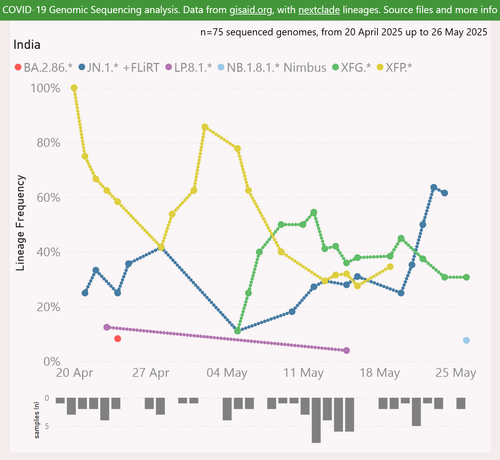
I’ve added a couple of pages to my main SARS-CoV-2 variant analysis dataviz, digging into the data for International Travellers.
The first page shows the Lineage L2 trends across all the International Traveller samples. This is probably a more randomised sample than the "Global" aggregate of all samples submitted to GISAID, as those are dominated by the US and Canada
These samples are mainly collected from arrivals into the US and Japan, and while the data is unstructured, they often record the country of origin. This can give some insight into under-sampled countries.
Vielleicht wird #LongCoVID ernster genommen, wenn wir es #BioBlackout nennen? Das Mem "Mitochondrien sind Kraftwerke der Zelle" dürfte ja bei Vielen schon verankert sein.
> Novel biomarkers of #mitochondrialdysfunction in Long #COVID patients
> … prolonged disruptions[of] cellular energy metabolism
> -- https://link.springer.com/article/10.1007/s11357-024-01398-4
#Blackout #SarsCoV2 #SARS_COV_2 #CoVIDisNotOver #dieMasteBleibtAuf #BrainFog #Hirnnebel #KraftwerkederZelle
Coronavirus disease 2019 (COVID-19) can lead to severe acute respiratory syndrome, and while most individuals recover within weeks, approximately 30–40% experience persistent symptoms collectively known as Long COVID, post-COVID-19 syndrome, or post-acute sequelae of severe acute respiratory syndrome coronavirus 2 (SARS-CoV-2) infection (PASC). These enduring symptoms, including fatigue, respiratory difficulties, body pain, short-term memory loss, concentration issues, and sleep disturbances, can persist for months. According to recent studies, SARS-CoV-2 infection causes prolonged disruptions in mitochondrial function, significantly altering cellular energy metabolism. Our research employed transmission electron microscopy to reveal distinct mitochondrial structural abnormalities in Long COVID patients, notably including significant swelling, disrupted cristae, and an overall irregular morphology, which collectively indicates severe mitochondrial distress. We noted increased levels of superoxide dismutase 1 which signals oxidative stress and elevated autophagy-related 4B cysteine peptidase levels, indicating disruptions in mitophagy. Importantly, our analysis also identified reduced levels of circulating cell-free mitochondrial DNA (ccf-mtDNA) in these patients, serving as a novel biomarker for the condition. These findings underscore the crucial role of persistent mitochondrial dysfunction in the pathogenesis of Long COVID. Further exploration of the cellular and molecular mechanisms underlying post-viral mitochondrial dysfunction is critical, particularly to understand the roles of autoimmune reactions and the reactivation of latent viruses in perpetuating these conditions. This comprehensive understanding could pave the way for targeted therapeutic interventions designed to alleviate the chronic impacts of Long COVID. By utilizing circulating ccf-mtDNA and other novel mitochondrial biomarkers, we can enhance our diagnostic capabilities and improve the management of this complex syndrome.
🎶🎶
Ich bin wieder hier, in meinem Revier,
war niemals wirklich weg
🎶🎶
Liebe #Covid Bubble , könnt Ihr Tests empfehlen, die auch RSV und Influenza anzeigen?