 Happy Heritic
“Finally, they labor everywhere for the union and agreement of the democratic parties of all countries.
The communists disdain to conceal their views and aims.
They openly declare that their ends can be attained only by the forcible overthrow of all existing social conditions.
Let the ruling classes tremble at a communistic revolution.
The #proletarians have nothing to lose but their chains.
They have a world to win.
WORKINGMEN OF ALL COUNTRIES, UNITE!”
 Sofia Florina
This picture is a Soviet propaganda poster for International Workers' Day in 1963.
#sofiaflorina #ソフィアフロリナ #internationalworkersday #workersday #internationallabourday #internationallaborday #labourday #laborday #mayday #1may #may1 #1stmay #may1st #poster #posters #propaganda #propagandaposter #propagandaposters #sovietposter #sovietposters #sovietpropaganda #sovietpropagandaposter #workers #worker #workersoftheworldunite #proletarian #proletarians #proletariat #socialism
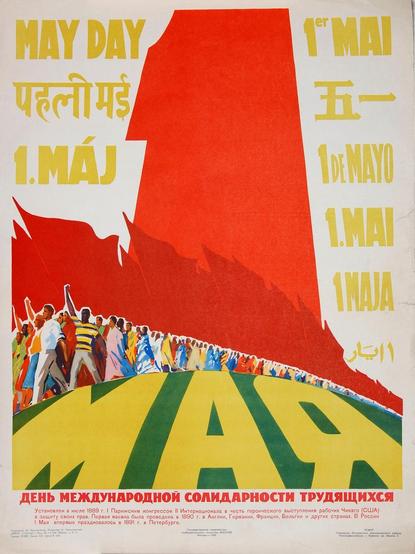
Happy International Workers' Day, 1 May, 2026! Workers of the world, unite!☭☭☭
#sofiaflorina #ソフィアフロリナ #internationalworkersday #workersday #internationallabourday #internationallaborday #labourday #laborday #workers #worker #workersoftheworldunite #proletarian #proletarians #proletariat #socialism
 Peter Riley
#Capitalism #disabilitysupportworkers #LabourMovement #NDIS #Organize #Proletarians #Solidarity #unions

The proletarianisation of disability support work: workers’ perspectives on the NDIS - Overland literary journal
Support workers, rather than creating objects, create a caring relationship. The scrupulous observance of organisational policies and ‘best practice’ codes is not sufficient to create such a relationship. This can only be created when workers take the time to understand their clients and build trusting, authentic, equal relationships with them.
 Miguel Afonso Caetano
"If the Assad regime’s management of rent was shaped by a local context, the appropriation of the state by armed gangs is no cultural anomaly. It has emerged both as a condition and a limit of bourgeois revolution in the region. Today it is inscribed in the very restructuring of capitalist relations under the pressure of the global crisis of valorization and the shortage of surplus value.
In Syria, the profitable sectors from the point of view of capitalist investments can be counted on one hand: construction, extraction, transportation of commodities (and protection), drug trafficking, and the trade of militia loyalties to foreign powers.6 None belong to the “productive” sphere; all have a rentier dimension. These markets are dependent on state-linked positions—not as an instance of regulation, but as a distributor of monopolies. Competition between capitalists in such a configuration is decided by brute force and alliances with other brute forces. Within this structure, the line between proletarian and henchman grows increasingly blurred.
The fall of the Syrian regime coincided with a global crisis in which the scramble for rent markets has gone hand in hand with the spectacular erosion of the state-form oriented toward regulating inter-capitalist competition. The state “distinct from particular capitalists” (a never achieved ideal) has given way to a state increasingly captured by particular capitalist groups, competing for extractivist, land-based, and speculative markets under the constant threat of armed violence. This “state of barbarism” tends to prevail at the global level—not as an archaic form, but as the paradigm of a crisis of surplus-value seeking salvation in profits structured around rent positions."
https://brooklynrail.org/2025/10/field-notes/the-syrian-state-and-the-specter-of-the-proletariat/
#Syria #Assad #Capitalism #ClassWarfare #Proletarians #Marxism

The Syrian State and the Specter of the Proletariat | The Brooklyn Rail
In 2009, I lived for three months in the Tadamon neighborhood, in the suburbs of Damascus. In this suburb, regime control was less visible—a “periphery,” as sociologists call it, always careful to stay on the right side of the line. In 2011, gatherings began to form.
 sunkawitko
/ CLASS WAR / This May 8, 2025, large sections of the bourgeois class are celebrating the eightieth “anniversary” of the end of the Second World War, this gigantic bloodbath that left over sixty million human beings, proletarians, dead on the altar of profit and nationalism. Yesterday, today and tomorrow, it’s in the name of anti-fascism (for some) or #fascism (for others), in the name of #democracy, #freedom, “the country in danger”, religion, peace, that these massacres are perpetuated.
Capitalism seems to have reached the end of a cycle: too much devalorization, too many accumulated commodities, too many machines, too many #proletarians, not enough profitable markets… The contradictions between the different national sectors of one and the same global bloodthirsty being, which feeds on the exploitation of our bodies, our flesh, our energy, our lives, our prospects, these contradictions take warlike forms, and warmongering blocs are beginning to re-form to carry out the enterprise of destroying the living, so necessary to the revitalization of this empire of death, i.e. the #capitalist mode of production.
Today, rearmament is the order of the day, and billions of dollars and euros are being invested in the most advanced technologies for this morbid task of wiping out surplus proletarians and means of production. The army is in the limelight, patriotic flags (whatever they may be) are flying in the wind of the destructive fury of our class enemies, radio and TV programs, the press of the powers that be (and those to come), all the propaganda of these lackeys of the capitalist order are roaring with one voice: full speed ahead toward war!
Capitalism lives from #war, capitalism is war: commercial war, #military war, permanent war between different values in their search for more profits, etc. War is in the DNA of capitalism! “Money is the nerve of war”, as the saying goes, but the opposite is just as true, if not more dialectical: war is the nerve of money! And faced with this reality, our only response as proletarians, in tragic times of war as in times of (social) peace, is the class strike and war, sabotage of the economy, revolutionary #defeatism, insurrection, #revolution…
It’s on this occasion that we republish here a text by the Internationalist #Communist Group (#ICG), which dates back thirty years and which, at the time, was written on the same anniversary of the end of the Second World War, to remind us that capitalism needs war, and that on its altars of death, it’s always our class brothers and sisters who are sacrificed.
Fascist or anti-fascist, the dictatorship of Capital is democracy, its peace and its war!
CW – May 8, 2025.
https://www.autistici.org/tridnivalka/gci-icg-beyond-the-celebration-anniversary-may-8-1945-2025/
Happy International Workers' Day, 1 May, 2025! Workers of the world, unite! ☭☭☭
#sofiaflorina #ソフィアフロリナ #internationalworkersday #workersday #internationallabourday #internationallaborday #labourday #laborday #workers #worker #workersoftheworldunite #proletarian #proletarians #proletariat #socialism
 rotenotes
"The #Communists disdain to conceal their views and aims. They openly declare that their ends can be attained only by the forcible overthrow of all existing social conditions. Let the ruling classes tremble at a Communistic #revolution. The #proletarians have nothing to lose but their #chains. They have a world to win. Working men of all countries, #unite."
—Karl #Marx and Friedrich #Engels, #Manifesto of the #Communist Party, English edition of 1888
 Окна РОСТа
@rf
#плакат #интернационал #Брискин #вектор #poster #international #proletarians #socialism #antiimperialism #USSR #vector
Плакат "Пролетарский интернационализм!...".
Худ. Брискин Вениамин Маркович. 1976 г.
вектор AI + SVG
https://t.me/okna_rosta/136
https://codeberg.org/oknaros...
https://disk.yandex.ru/d/zCo...
#плакат #интернационал #Брискин #вектор #poster #international #proletarians #socialism #antiimperialism #USSR #vector
Плакат "Пролетарский интернационализм!...".
Худ. Брискин Вениамин Маркович. 1976 г.
вектор AI + SVG
https://t.me/okna_rosta/136
https://codeberg.org/oknaros...
https://disk.yandex.ru/d/zCo...