【🎉Latest accepted article】
Tetraploids of an invasive clonal shrub, Lantana camara, present greater invasiveness than diploids
#Polyploidy | #ClonalGrowth | #GeneticDiversity | #PhenotypicPlasticity | #InvasionSuccess
【🎉Latest accepted article】
Tetraploids of an invasive clonal shrub, Lantana camara, present greater invasiveness than diploids
#Polyploidy | #ClonalGrowth | #GeneticDiversity | #PhenotypicPlasticity | #InvasionSuccess
Abstract Tubulin plays a key role in the functioning of cytoskeletal systems that regulate such fundamental processes as cell division and growth. Correct identification of isotypes and determination of the orthology of tubulin genes in plants is a nontrivial task that requires the involvement of a complex of bioinformatics approaches. In the present study, a genome-wide search and identification of tubulin genes was carried out in diploid representatives of the genus Camelina, in particular in the C. neglecta, C. laxa, and C. hispida species, which allowed the authors to identify complete sets of α-, β-, and γ-tubulin genes as well as their pseudogenes. Phylogenetic analysis and a series of genome-wide comparisons allowed for establishing the orthology of the tubulin genes, determining isotype identity of the encoded tubulins, and tracing evolutionary changes in tubulin gene sets during species divergence and the emergence of allohexaploid C. sativa species. Genotyping of the accessions of different Camelina species using TBP-, cTBP-, and γTBP-markers allowed effective differentiation of species based on the assessment of polymorphisms of intronic regions of the β- and γ-tubulin genes. The obtained results lay a strong groundwork for further studies of the isotype and functional diversity of tubulins in Cruciferae and other groups of flowering plants and will also contribute to the development and implementation of new, highly efficient molecular marker systems for DNA-barcoding and marker-assisted breeding of plant species, including such promising oilseed crops as C. sativa.
Early-career researchers
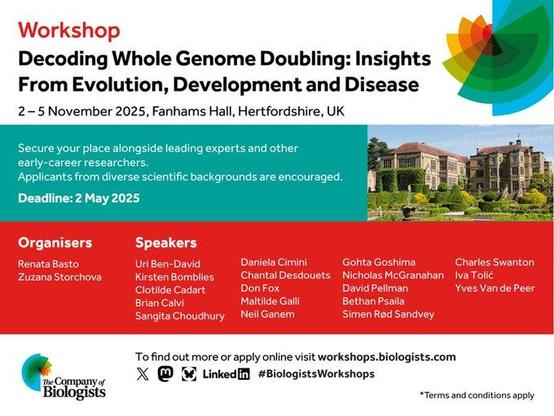
Apply by Friday 2 May for a funded place at our Workshop 'Decoding whole genome doubling: Insights from evolution, development and disease' organised by Renata Basto and Zuzana Storchova.
https://www.biologists.com/workshops/decoding-nov-2025/
#Workshop #Biology #Research #Collaboration #Connections #Networking #Genome #Evolution #Development #Disease #Polyploidy
Decoding whole genome doubling: Insights from evolution, development and disease Whole genome doubling (WGD) leading to physiological polyploidy, which is the presence of more than two copies of the whole chromosome set, is a common phenomenon observed in plants and animals. This natural occurrence serves various purposes in different organisms. For example, certain cells within[...] Read More
Coppage et al. identify four ancient polyploidy events with unusually high duplicate gene retention. Elevated gene conversion and delayed diploidization suggest a distinct class of paleopolyploid genomes.
Solving the #evolutionary puzzle of #polyploidy: How #genome duplication shapes #adaptation
https://phys.org/news/2025-01-evolutionary-puzzle-polyploidy-genome-duplication.html
Evolution is the basis of biological diversity, driven by mechanisms that allow organisms to adapt and survive. One such mechanism is polyploidy, where organisms carry extra copies of their genomes. While polyploidy provides genetic redundancy by allowing mutations without affecting survival, it can also slow evolutionary progress by diluting beneficial mutations.
#Evolutionary biologists investigate how #plant cold specialists can #adapt to the environment.
#climate_change #genomics #polyploidy #Cochlearia
https://phys.org/news/2024-07-evolutionary-biologists-cold-specialists-environment.html
Plant cold specialists like the spoonworts have adapted well to the cold climates of the Ice Ages. As cold and warm periods alternated, they developed a number of species that also resulted in a proliferation of the genome.
Interesting paper. They see different DNA repair strategies in postmitotic neurons and induction of cell cycle genes in neurons with Cas9 induced DSBs. This is consistent with our work that DNA damage may influence cell cycle gene expression and #polyploidy in the 🪰brain. (Nandakumar et al 2020). Still so much to be worked out. Neuronal DNA repair reveals strategies to influence CRISPR editing outcomes | bioRxiv
#Job #phd #Evolution #Genomics #Cancer #TransCan #MarBiol #Polyploidy #France
Here is an offer for a PhD (ERC HYPERCAN project) on the evolution of a transmissible cancer, with a focus on hyperploidy variations:
https://euraxess.ec.europa.eu/jobs/230401
Please boost
Transmissible cancers are fascinating biological entities that spread from one animal to another by the direct transfer of cancer cells, behaving in this way like parasitic life forms.