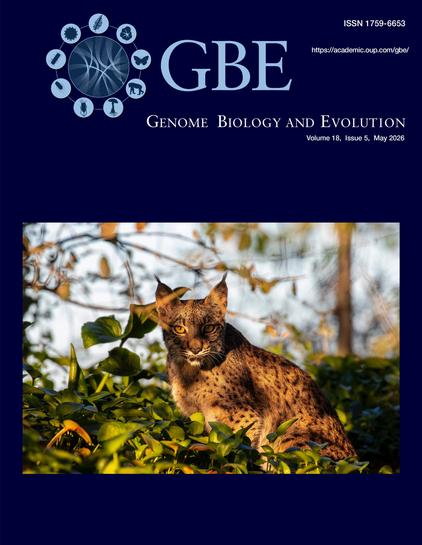
Bastian, Enard & Lartillot (@lbbe-lyon.bsky.social) tested predictions of the nearly-neutral theory of molecular evolution across time scales, confirming the role of effective population size in tuning selection efficacy in placental mammals.

🖌️ Léa Backory (Instagram: @lea_faitdesvagues)

🔗 https://doi.org/10.1093/gbe/evag030

This article is the focus of April's GBE Highlight, written by SMBE Fellow Haoran Cai:

🔗 https://doi.org/10.1093/gbe/evag074

#genome #evolution

Stephens, Kulczyk & Bhattacharya suggest that dark genes (those with no ascribable biological function) in stony corals originated via bursts of lineage-specific duplication, often from genes with known functions.

🔗 https://doi.org/10.1093/gbe/evag072

📷 Erin Chille / Debashish Bhattacharya

#genome #evolution #corals

Kälin et al. determined the genome sequences of 68 European Aphanomyces euteiche strains, finding evidence that the southern group is a separate species; virulence-related gene families evolving differently in the Aphanomyces genus were identified.

🔗 https://doi.org/10.1093/gbe/evag066

#genome #evolution

The mapping of the human #genome promises to change medicine and touch every person on earth. The federal gov't played an indispensable role in this great breakthrough. What was that role? What did it ask in return? You may be delighted by the answers. http://www.fromthegovt.com/human-genome-project/
Human Genome Project, From the Government

Steve Jobs, a founder of Apple Computer, gave what many consider the greatest college commencement speech ever at Stanford University in 2005.

From the Government

Herzig, Magwira & Lovell investigate protein structural constraint in SARS-CoV-2 evolution, suggesting that despite its rapid rate of mutation, the SARS-CoV-2 spike protein exhibited limited genomic plasticity following zoonotic transmission into the human population.

🔗 https://doi.org/10.1093/gbe/evag049

#genome #evolution #sarscov2

The April 2026 issue of Genome Biology and Evolution is now live, with our recent article on the genomics of Svalbard reindeer by Dussex et al. on the cover.

🔗 https://academic.oup.com/gbe/issue/18/4

📷 Brage B. Hansen

This study is featured in GBE's new virtual collection on “Conservation Genomics”:

🔗 https://academic.oup.com/gbe/pages/conservation-genomics

#genome #evolution #congen #conservation

Walt et al. leverage newly available cartilaginous fish genomes to investigate globin gene family evolution, revealing both similar and contrasting patterns of globin gene evolution between cartilaginous and bony vertebrates.

🔗 https://doi.org/10.1093/gbe/evag058

🖌️ Amber E. McDonald

#genome #evolution

Precision medicine integrates whole #genome sequencing into routine clinical care to analyze an individual's complete genetic code, enabling the accurate diagnosis of complex and rare diseases.
#Genomics #Genetics #Bioinformatics #MolecularMedicine #sflorg
https://www.sflorg.com/2026/03/geno03302601.html
Precision medicine helps more patients receive a genetic diagnosis

Many patients with suspected rare diseases, receiving a genetic diagnosis is highly significant.

de Mattos et al. present the first chromosome-scale assembly from the orchid Epidendrum, and identify two events of population expansion and retraction in E. fulgens demographic history.

🔗 https://doi.org/10.1093/gbe/evag057

📷 Fábio Pinheiro

#genome #evolution

Petr Heneberg publishes a new Letter urging caution on the interpretation of evidence linking regulatory processes to eusocial traits in bees.

🔗 https://doi.org/10.1093/gbe/evag032

We also publish a response by Dova Brenman-Suttner & Amro Zayed, arguing that there is value in discussing the possible connection between these regulatory mechanisms and social phenotypes.

🔗 https://doi.org/10.1093/gbe/evag054

#genome #evolution

Caution in Interpreting Regulatory RNA Associations With Eusocial Evolution in Bees

Abstract. Recent advances in transcriptomics and regulatory genomics have expanded interest in the potential roles of alternative splicing and noncoding RN

OUP Academic