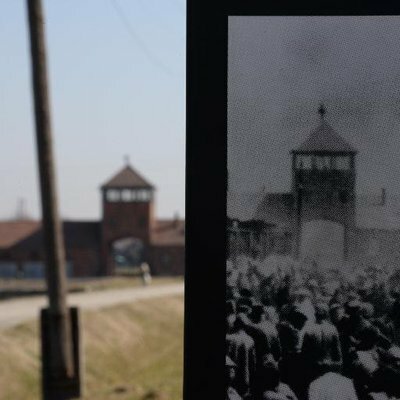
This episode of our #OnAuschwitz podcast is dedicated to father Maximilian Kolbe who was murdered in #Auschwitz on 14 August 1941. Listen about his arrest, incarceration, sacrifice of life and death. https://podcasters.spotify.com/pod/show/auschwitz-memorial/episodes/On-Auschwitz-23-the-sacrifice-and-death-of-father-Maximilian-Kolbe-e1mfh8m/a-a8cl79r
"On Auschwitz" (23): the sacrifice and death of father Maximilian Kolbe by On Auschwitz

At the end of July 1941 the camp commander Karl Fritzch selected 10 hostages from among the prisoners in Block 14 in retaliation for the escape of a prisoner. He condemned them to death by starvation in the bunker of Block 11. During the selection, a Polish prisoner who was a Franciscan monk and missionary, Maksymilian Kolbe (no. 16670), stepped out of link and asked the camp commander to take him instead of a desperate selected prisoner Franciszek Gajowniczek (np. 5659). After a brief dispute with Father Kolbe, Fritzch agreed to the substitution, especially when he found out that Kolbe is a Catholic priest. The 10 selected prisoners were led off to Block 11. In the Bunker Register the admission of them is noted without listing names, numbers, day of admission or day of death. Franciszek Gajowniczek survived the war and died in 1995. Maksymilian Kolbe was murdered with a poisonous injection on 14 August 1941. He was canonized by the pope John Paul II in October 1982. Teresa Wontor Cichy from the Auschwitz Memorial Research Center talk about Father Maksymilian Kolbe. The Germans incarcerated at least 464 priests, seminarians & monks as well as 35 nuns in #Auschwitz. Learn about the fate of Christian clergy and religious life in the camp: http://lekcja.auschwitz.org/en_18_duchowienstwo/

Spotify for Podcasters

@coffeegeek
😢 Follow @auschwitzmuseum and share it with your friends, so the remembrance is kept alive and all of those people did NOT suffer and die in vain.

Stand still by the shared photographs and story of those who got tortured, those who got killed.

Listen to their podcast #OnAuschwitz to be aware on how they had to work, live and die in the camp, and do everything possible to avoid that history repeats itself.
1 thing you can do: be aware for who you vote for, every single time!

"On Auschwitz" (11): Sport and sportspeople in Auschwitz by On Auschwitz

The term "sport" in KL Auschwitz was distorted by using it to refer to the exhausting exercises combined with the drill and singing applied on a mass scale. This form of sport, referred to after the war as pseudo-sport, was usually a way of enforcing discipline and punishing prisoners. However, among people deported by the Germans to Auschwitz, there were pre-war sportsmen and sportswomen: Olympians and national champions. Some prisoners had also the opportunity to practice some sports in the camp. These included wrestling and boxing, as well as games such as soccer, volleyball, and basketball. Mind sports were also popular among prisoners, particularly chess, but also card games. Renata Koszyk, an educator at the Auschwitz Memorial and curator of the exhibition dedicated to this topic, talks about sport and sportspeople in Auschwitz.

Anchor
"On Auschwitz" (10): Living and sanitary conditions as well as camp clothing at Auschwitz by On Auschwitz

The horrible living conditions created by the SS authorities in the block and barracks in all parts of the Auschwitz complex as well as the appalling sanitary conditions contributed to the exhaustion and death of many prisoners. The clothing which was completely inadequate for the weather conditions also had negative effect on the condition and health of the prisoners. Dr. Jacek Lachendro of the Auschwitz Memorial Research Center talks about the living and sanitary conditions and types of camp clothing.

Anchor
On Auschwitz • A podcast on Anchor

The official podcast of the Auschwitz Memorial. The history of Auschwitz is exceptionally complex. It combined two functions: a concentration camp and an extermination center. Nazi Germany persecuted various groups of people there, and the camp complex continually expanded and transformed itself. In the podcast "On Auschwitz," we discuss the details of the history of the camp as well as our contemporary memory of this important and special place. We kindly ask you to support our mission and share our podcast in social media. Online lessons: http://lesson.auschwitz.org

Anchor

The new episode of our "On Auschwitz" podcast is dedicated to the fate of Poles deported to Auschwitz during the ethnic cleansing operation the Germans organized in the Zamość region of occupied Poland.

🔊 https://anchor.fm/auschwitz-memorial/episodes/On-Auschwitz-26-Deportations-of-Poles-from-the-Zamo-region-to-Auschwitz-e1sov31

A total of 1,301 people, including at least 162 children were deported to Auschwitz in three transports in 1942 and 1943.

#Auschwitz #history #podcast #OnAuschwitz #Poland #Nazis #Germany #Zamość #memory #ww2 #education @histodons @museum

"On Auschwitz" (26): Deportations of Poles from the Zamość region to Auschwitz by On Auschwitz

After Germany attacked the Soviet Union in June 1941. Heinrich Himmler gave the order to create a "German settlement area" around the occupied Polish town of Zamość. The population of that region was to be expelled and replaced by German settlers. The area was chosen for its agricultural character. It consisted of five towns and 696 villages. The displaced population was sent to transit camps, where they were subjected to racial screening. Those who, according to German criteria, were not "racially valuable" were planned to be deported to concentration camps. A total 1,301 people, including at least 162 children were deported to Auschwitz in three transports Dr Wanda Witek-Malicka of the Auschwitz Memorial Research Centre talks about the ethnic cleansing carried out by the Germans in the Zamość region and the fate of the inhabitants of this region deported to Auschwitz. — In the picture: a family photo of Jan and Aniela Malec (Jan - the younger man sitting in the middle). Their children were taken away from them in the Zamość camp. Jan and Aniela were deported to Auschwitz, where they both died in a short time (Jan in March and Aniela in April 1943), orphaning four daughters aged 4-13. The girls were deported from the Zamość camp to Siedlce, where they survived the war. See also our online lesson about this topic: https://lekcja.auschwitz.org/dep_zam_PL/

Anchor

It might seem that we already know everything about the history of places such as Auschwitz. However, this is not true.

We are constantly learning new facts.

In our "On Auschwitz" podcast Dr. Piotr Setkiewicz, who is the head of our Research Center, talks about new research on the history of Auschwitz.

Listen here: https://anchor.fm/auschwitz-memorial/episodes/On-Auschwitz-24-New-Research-on-the-History-of-Auschwitz-e1nt1o7

#Auschwitz #Birkenau #history #podcast #research #facts #Holocaust #Shoah #ww2 #konwledge #genocide #Remember #Memorial #OnAuschwitz @histodons

"On Auschwitz" (24): New Research on the History of Auschwitz by On Auschwitz

It might seem that we already know everything about the history of places such as Auschwitz, because several decades have passed since the events and we have access to a great many documents and thousands of testimonies. However, this is not true. We are constantly learning new facts about the history of the camp, as Dr. Piotr Setkiewicz, the head of the Memorial Research Centre, explains in our podcast.

Anchor

#introduction For over 15 years I have worked at @auschwitzmuseum where I am a guide and a Press Officer responsible for the social media activity.

I am also the editor-in-chief of the monthly online magazine #Memoria (http://memoria.auschwitz.org) and a co-autor of the #OnAuschwitz podcast (http://podcast.auschwitz.org).

Former radio #journalist. Sometime a #photographer. Always an #optimist.

LANGUAGE

@WendyMsGator @histodons
Destruction of camp documentation is also part of the history of Auschwitz we need to talk about, as it reflects the perspective of perpetrators to the crimes they committed.

We dedicated two episodes of our podcast to the Archives and documents:

This one talks about the Archives in general: https://anchor.fm/auschwitz-memorial/episodes/On-Auschwitz-22-The-Archives-of-the-Auschwitz-Memorial-e1l4rgk

This one about the registration images: https://anchor.fm/auschwitz-memorial/episodes/On-Auschwitz-19-registration-photographs-of-Auschwitz-prisoners-e1gqmg0

#Auschwitz #documents #Archives #sources #podcast #OnAuschwitz #history #museum @museum

"On Auschwitz" (22): The Archives of the Auschwitz Memorial by On Auschwitz

The Archives of the Auschwitz Memorial collect, preserve, and provide access to documents and materials connected mainly with the history of the Auschwitz camp. The collection includes original German camp records, copies of documents obtained from other institutions in Poland and abroad, source material of postwar provenance (memoirs, accounts by survivors, material from the trials of Nazi war criminals, etc.), photographs, microfilms, negatives, documentary films, scholarly studies, reviews, lectures, exhibition scenarios, film scripts, and research results. Dr. Wojciech Płosa, the head of the Archives, talks about the activity of this part of the Museum. The document in the picture is one of the first plans of the main Auschwitz camp from mid-1940.

Anchor

@museum The horrible conditions in blocks & barracks in all parts of the Auschwitz complex as well as the appalling sanitary conditions contributed to the exhaustion and death of many prisoners.

Listen to our podcast about living & sanitary conditions in the camp. https://anchor.fm/auschwitz-memorial/episodes/On-Auschwitz-10-Living-and-sanitary-conditions-as-well-as-camp-clothing-at-Auschwitz-e18dcik

#Auschwitz #Birkenau #OnAuschwitz #podcast #education #history #memory #NeverForget #Birkenau #conditions #listen

"On Auschwitz" (10): Living and sanitary conditions as well as camp clothing at Auschwitz by On Auschwitz

The horrible living conditions created by the SS authorities in the block and barracks in all parts of the Auschwitz complex as well as the appalling sanitary conditions contributed to the exhaustion and death of many prisoners. The clothing which was completely inadequate for the weather conditions also had negative effect on the condition and health of the prisoners. Dr. Jacek Lachendro of the Auschwitz Memorial Research Center talks about the living and sanitary conditions and types of camp clothing.

Anchor