The #NEST Conference 2026 (https://nest-simulator.org/conference) has just started! I’m looking forward to two days of talks and discussions on #NeuralNetworks and the latest advances in the #NESTSimulator ✌️
Btw: We’re using #GatherTown again and I love creating these #8bit-like avatars there 👾
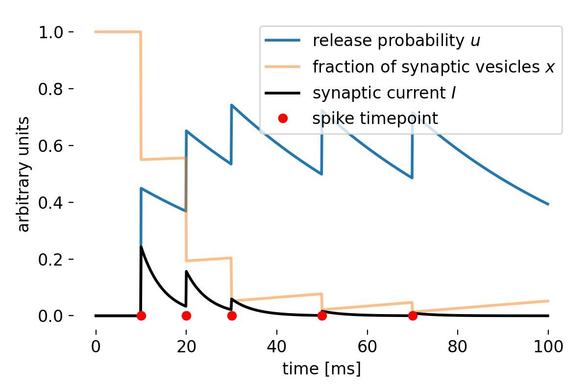
Short-term #synaptic #plasticity (#STP) transiently modulates synaptic strength based on recent activity. #ShortTermDepression #STD reduces efficacy during repeated activity, while #ShortTermFacilitation #STF can enhance responses to closely spaced #spikes. These dynamics shape #NeuralProcessing, #filtering, and synaptic #homeostasis. Here's a short #Python implementation and simulation in #NESTSimulator:
🌍 https://www.fabriziomusacchio.com/blog/2026-05-25-std_and_stf/
#CompNeuro #Neuroscience #NeuralDynamics #TsodyksMarkramModel
The Urbanczik-Senn plasticity model is a powerful framework for understanding synaptic #plasticity in #NeuralNetworks. It integrates dendritic prediction errors to unify supervised, unsupervised, and #ReinforcementLearning under a single rule. Its predictive coding mechanism and robust learning dynamics make it valuable for simulating neural processing and exploring plasticity. Here’s a short simulation using the #NESTsimulator:
🌍 https://www.fabriziomusacchio.com/blog/2026-02-22-urbanczik_senn_plasticity/
#CompNeuro #Neuroscience
Incorporating structural #plasticity in #SpikingNeuralNetworks (#SNN) enables dynamic #synaptic connectivity, reflecting the #brain's adaptability. By modeling synaptic growth and pruning based on #calcium concentration, we can simulate processes such as #learning and #MemoryFormation. In this post, I reproduce the #NESTSimulator tutorial on structural plasticity, demonstrating its impact on network stability and #homeostasis:
🌍 https://www.fabriziomusacchio.com/blog/2026-02-01-structural_plasticity/
#CompNeuro #Neuroscience #NeuralNetworks
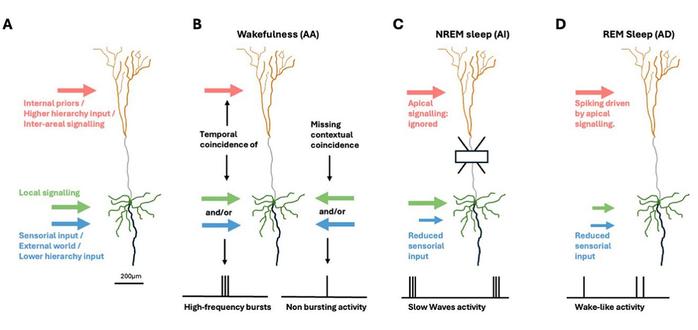
🧠 Pastorelli et al. (2025) present a "simplified two-compartment #neuron with #CalciumDynamics capturing #brain-state-specific apical-amplification, -isolation and -drive". This Ca-#AdEx model replicates distinct #dendritic mechanisms across wakefulness, #NREM & #REM sleep using a compact ThetaPlanes transfer function. Cool implementation using the #NESTsimulator 💻!
🌍 https://doi.org/10.3389/fncom.2025.1566196
#Neuroscience #CompNeuro
I recently played around with #RateModels using #NESTsimulator. Compared to #SNN, RM focus on average firing rates of #NeuronPopulations, simplifying analysis of large networks. They effectively capture collective dynamics like #oscillations and #synchronization, though they miss precise spike timing details. Thus, both approaches have their merits. Here is a brief overview:
🌍 https://www.fabriziomusacchio.com/blog/2025-08-28-rate_models/
#CompNeuro #Neuroscience #Python #PythonTutorial #SpikingNeuralNetwork
Here is a direct follow-up on this, now showing how to implement #GapJunctions in a network of #spiking #neurons (#SNN) using the #NESTsimulator. We simulate a network of 500 inhibitory neurons with gap junctions and analyze the effects on #synchrony and #oscillations. The code is also available on GitHub. Feel free to modify and expand upon it 🤗
🌍 https://www.fabriziomusacchio.com/blog/2025-09-17-gap_junctions_network_example/
#CompNeuro #Neuroscience https://sigmoid.social/@pixeltracker/115044925455984072
📝 New blog post: #GapJunctions (#ElectricalSynapses) enable direct electrical and chemical communication between #neurons, synchronizing activity and supporting rapid signal propagation. Their #modeling is crucial for understanding #NeuralNetworkDynamics, #oscillations, and #brain 🧠 function. Here is a brief summary including a small #PythonTutorial using the #NESTsimulator.
🌍 https://www.fabriziomusacchio.com/blog/2025-08-15-gap_junctions/
#CompNeuro #Neuroscience #Python #OpenSource
In 2000, Nicolas Brunel presented a framework for studying sparsely connected #SpikingNeuralNetworks (#SNN) with random connectivity & varied excitation-inhibition balance. The model, characterized by high sparseness & low firing rates, captures diverse neural dynamics such as synchronized regular and asynchronous irregular activity and global oscillations. Here is a brief summary of these concepts & a #PythonTuroial using the #NESTsimulator.
🌍 https://www.fabriziomusacchio.com/blog/2024-07-21-brunel_network/
#CompNeuro #Neuroscience


Brunel network: A comprehensive framework for studying neural network dynamics
In his work from 2000, Nicolas Brunel introduced a comprehensive framework for studying the dynamics of sparsely connected networks. The network is based on spiking neurons with random connectivity and differently balanced excitation and inhibition. It is characterized by a high level of sparseness and a low level of firing rates. The model is able to reproduce a wide range of neural dynamics, including both synchronized regular and asynchronous irregular activity as well as global oscillations. In this post, we summarize the essential concepts of that network and replicate the main results using the NEST simulator.

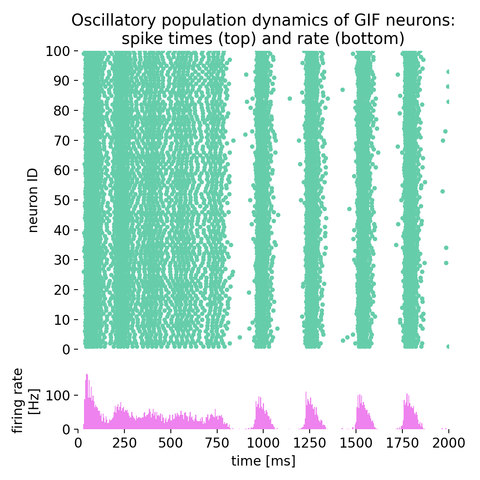
Oscillatory population dynamics of GIF neurons simulated with NEST
In this tutorial, we will explore the oscillatory population dynamics of generalized integrate-and-fire (GIF) neurons simulated with NEST. The GIF neuron model is a biophysically detailed model that captures the essential features of spiking neurons, including spike-frequency adaptation and dynamic threshold behavior. By simulating such a population of neurons, we can observe how these neurons interact and generate oscillatory firing patterns.
 Fabrizio Musacchio


 Fabrizio Musacchio