🧠 New paper from our neighboring Gründemann Lab @dzne 👋

Chloé Maëlle Benoit and colleagues show that #axon initial segments in #mPFC #neurons undergo #learning-dependent #StructuralPlasticity during fear extinction, linking #AIS dynamics to #MemoryFormation in vivo. A very cool study that extends the concept of learning-related #plasticity beyond #synapses to intrinsic neuronal compartments.

🌍 https://doi.org/10.1038/s41593-025-02152-5

#Neuroscience #DZNE

Before you continue to YouTube

Scientists discover babies form memories, even if they can't recall them later! 🤱‍🧠 New brain scans reveal the hippocampus encodes early experiences, but they remain inaccessible in adulthood 📚💭 #InfantMemories #BrainDevelopment #MemoryFormation #newz

https://www.npr.org/sections/shots-health-news/2025/03/20/nx-s1-5332387/baby-brain-scans-new-clues-infant-memories

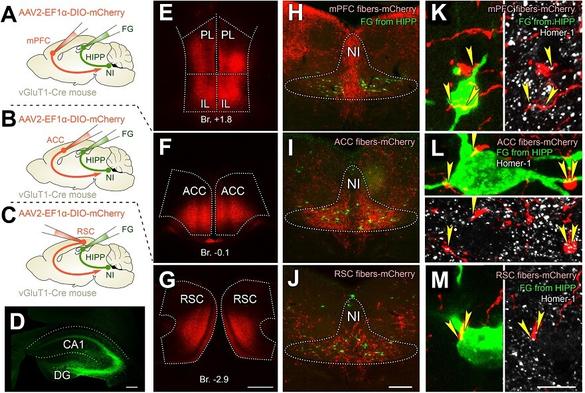
New insights into how hippocampal #MemoryFormation & recall is controlled by a disinhibition-based mechanism, supported by #hippocampal #somatostatin interneurons & their pontine #brainstem inputs from the #NucleusIncertus #PLOSBiology https://plos.io/3NkleaD
Fear memory recall involves hippocampal somatostatin interneurons

This study provides new insights into how hippocampal memory formation and recall is controlled by a disinhibition-based memory mechanism, supported by hippocampal somatostatin interneurons and their pontine brainstem inputs from the nucleus incertus.

Researchers decode neural mechanism for alternating memory formation and retrieval in humans

Generating new memories and remembering are two sides of the same coin, although sometimes they can appear as separate mechanisms. These mechanisms which seem to be distanced from each other are actually interconnected and are part of the same neural assemblies, according to a study now published in the journal Current Biology, which reveals the first scientific evidence on humans' memory dynamics.

Medical Xpress
The ability to rapidly relearn memories after forgetting has been ascribed to long-term #MemoryFormation. @AlkisMH &co show that rapid #relearning instead arises from fast new learning of short-term temporally-volatile memory #PLOSBiology https://plos.io/44bikeP
A double dissociation between savings and long-term memory in motor learning

Memories are easier to relearn than learn from scratch. This advantage, known as savings, has been widely assumed to result from the reemergence of stable long-term memories. In fact, the presence of savings has often been used as a marker for whether a memory has been consolidated. However, recent findings have demonstrated that motor learning rates can be systematically controlled, providing a mechanistic alternative to the reemergence of a stable long-term memory. Moreover, recent work has reported conflicting results about whether implicit contributions to savings in motor learning are present, absent, or inverted, suggesting a limited understanding of the underlying mechanisms. To elucidate these mechanisms, we investigate the relationship between savings and long-term memory by experimentally dissecting the underlying memories based on short-term (60-s) temporal persistence. Components of motor memory that are temporally-persistent at 60 s might go on to contribute to stable, consolidated long-term memory, whereas temporally-volatile components that have already decayed away by 60 s cannot. Surprisingly, we find that temporally-volatile implicit learning leads to savings, whereas temporally-persistent learning does not, but that temporally-persistent learning leads to long-term memory at 24 h, whereas temporally-volatile learning does not. This double dissociation between the mechanisms for savings and long-term memory formation challenges widespread assumptions about the connection between savings and memory consolidation. Moreover, we find that temporally-persistent implicit learning not only fails to contribute to savings, but also that it produces an opposite, anti-savings effect, and that the interplay between this temporally-persistent anti-savings and temporally-volatile savings provides an explanation for several seemingly conflicting recent reports about whether implicit contributions to savings are present, absent, or inverted. Finally, the learning curves we observed for the acquisition of temporally-volatile and temporally-persistent implicit memories demonstrate the coexistence of implicit memories with distinct time courses, challenging the assertion that models of context-based learning and estimation should supplant models of adaptive processes with different learning rates. Together, these findings provide new insight into the mechanisms for savings and long-term memory formation.

The ability to rapidly relearn memories after forgetting has been ascribed to long-term #MemoryFormation. @AlkisMH &co show that rapid #relearning instead arises from fast new learning of short-term temporally-volatile memory #PLOSBiology https://plos.io/44bikeP
A double dissociation between savings and long-term memory in motor learning

Memories are easier to relearn than learn from scratch. This advantage, known as savings, has been widely assumed to result from the reemergence of stable long-term memories. In fact, the presence of savings has often been used as a marker for whether a memory has been consolidated. However, recent findings have demonstrated that motor learning rates can be systematically controlled, providing a mechanistic alternative to the reemergence of a stable long-term memory. Moreover, recent work has reported conflicting results about whether implicit contributions to savings in motor learning are present, absent, or inverted, suggesting a limited understanding of the underlying mechanisms. To elucidate these mechanisms, we investigate the relationship between savings and long-term memory by experimentally dissecting the underlying memories based on short-term (60-s) temporal persistence. Components of motor memory that are temporally-persistent at 60 s might go on to contribute to stable, consolidated long-term memory, whereas temporally-volatile components that have already decayed away by 60 s cannot. Surprisingly, we find that temporally-volatile implicit learning leads to savings, whereas temporally-persistent learning does not, but that temporally-persistent learning leads to long-term memory at 24 h, whereas temporally-volatile learning does not. This double dissociation between the mechanisms for savings and long-term memory formation challenges widespread assumptions about the connection between savings and memory consolidation. Moreover, we find that temporally-persistent implicit learning not only fails to contribute to savings, but also that it produces an opposite, anti-savings effect, and that the interplay between this temporally-persistent anti-savings and temporally-volatile savings provides an explanation for several seemingly conflicting recent reports about whether implicit contributions to savings are present, absent, or inverted. Finally, the learning curves we observed for the acquisition of temporally-volatile and temporally-persistent implicit memories demonstrate the coexistence of implicit memories with distinct time courses, challenging the assertion that models of context-based learning and estimation should supplant models of adaptive processes with different learning rates. Together, these findings provide new insight into the mechanisms for savings and long-term memory formation.

The ability to rapidly relearn memories after forgetting has been ascribed to long-term #MemoryFormation. @AlkisMH &co show that rapid #relearning instead arises from fast new learning of short-term temporally-volatile memory #PLOSBiology https://plos.io/44bikeP
A double dissociation between savings and long-term memory in motor learning

Memories are easier to relearn than learn from scratch. This advantage, known as savings, has been widely assumed to result from the reemergence of stable long-term memories. In fact, the presence of savings has often been used as a marker for whether a memory has been consolidated. However, recent findings have demonstrated that motor learning rates can be systematically controlled, providing a mechanistic alternative to the reemergence of a stable long-term memory. Moreover, recent work has reported conflicting results about whether implicit contributions to savings in motor learning are present, absent, or inverted, suggesting a limited understanding of the underlying mechanisms. To elucidate these mechanisms, we investigate the relationship between savings and long-term memory by experimentally dissecting the underlying memories based on short-term (60-s) temporal persistence. Components of motor memory that are temporally-persistent at 60 s might go on to contribute to stable, consolidated long-term memory, whereas temporally-volatile components that have already decayed away by 60 s cannot. Surprisingly, we find that temporally-volatile implicit learning leads to savings, whereas temporally-persistent learning does not, but that temporally-persistent learning leads to long-term memory at 24 h, whereas temporally-volatile learning does not. This double dissociation between the mechanisms for savings and long-term memory formation challenges widespread assumptions about the connection between savings and memory consolidation. Moreover, we find that temporally-persistent implicit learning not only fails to contribute to savings, but also that it produces an opposite, anti-savings effect, and that the interplay between this temporally-persistent anti-savings and temporally-volatile savings provides an explanation for several seemingly conflicting recent reports about whether implicit contributions to savings are present, absent, or inverted. Finally, the learning curves we observed for the acquisition of temporally-volatile and temporally-persistent implicit memories demonstrate the coexistence of implicit memories with distinct time courses, challenging the assertion that models of context-based learning and estimation should supplant models of adaptive processes with different learning rates. Together, these findings provide new insight into the mechanisms for savings and long-term memory formation.