Breaking the code: Multi-stage 'code of conduct' phishing campaign leads to AiTM token compromise

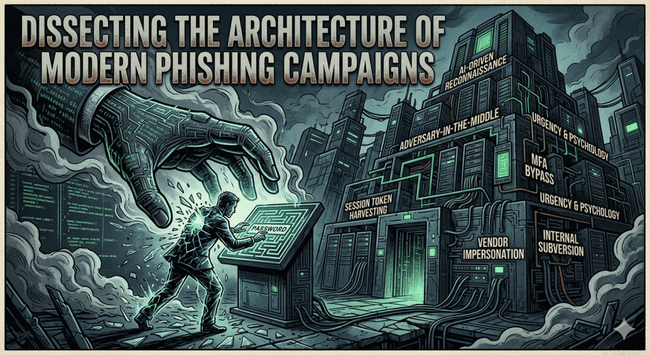
A sophisticated large-scale credential theft campaign targeted over 35,000 users across 13,000 organizations, primarily in the United States, between April 14-16, 2026. Attackers distributed fully authenticated emails from legitimate services using code of conduct-themed lures with polished HTML templates. The multi-stage attack chain included PDF attachments with embedded links, multiple CAPTCHA challenges, and intermediate staging pages designed to appear legitimate while filtering automated defenses. Recipients were directed through several layers ultimately leading to an adversary-in-the-middle phishing flow that proxied authentication sessions and captured tokens, bypassing non-phishing-resistant multifactor authentication. The campaign broadly impacted Healthcare, Financial services, Professional services, and Technology industries, using social engineering techniques that created urgency through time-bound prompts and concerning accusations.

Pulse ID: 69f8f1230f0bda494499b941
Pulse Link: https://otx.alienvault.com/pulse/69f8f1230f0bda494499b941
Pulse Author: AlienVault
Created: 2026-05-04 19:18:59

Be advised, this data is unverified and should be considered preliminary. Always do further verification.

#AdversaryInTheMiddle #AitM #CAPTCHA #CyberSecurity #Email #HTML #Healthcare #InfoSec #MultiFactorAuthentication #OTX #OpenThreatExchange #PDF #Phishing #SocialEngineering #UnitedStates #bot #AlienVault

LevelBlue - Open Threat Exchange

Learn about the latest cyber threats. Research, collaborate, and share threat intelligence in real time. Protect yourself and the community against today's emerging threats.

LevelBlue Open Threat Exchange

Is Your Bank Really Texting You? 3 Red Flags of a Phishing Message.

2,483 words, 13 minutes read time.

The Psychological Architecture of the Smishing Epidemic

The mobile phone is the most intimate piece of hardware in the modern world, a device that lives in our pockets and demands our immediate attention with every haptic buzz and notification chime. This proximity creates a dangerous psychological feedback loop where the user is conditioned to respond to SMS messages with a level of trust that they would never afford an unsolicited email. While email has decades of junk mail filters and visible header data to warn us of danger, the SMS interface is deceptively clean and stripped of context. When a text arrives claiming to be from a major financial institution, it enters a high-trust environment where the barrier between a legitimate service alert and a criminally organized credential harvest is virtually non-existent. Analyzing the current threat landscape, it is clear that the surge in smishing is not merely a technical failure of our telecommunications infrastructure, but a masterful exploitation of human neurobiology. Attackers understand that by bypassing the corporate firewall and landing directly on a victim’s personal device, they are catching the user in a state of cognitive vulnerability, often while they are distracted, tired, or multi-tasking.

The sheer volume of these attacks indicates a shift toward the industrialization of mobile deception. According to recent data, bank impersonation via text message has skyrocketed to become one of the most reported scams, primarily because the return on investment is staggering compared to traditional phishing. It costs almost nothing for an adversary to blast out thousands of messages using automated scripts and cheap gateway services, yet the potential payoff is total access to a victim’s financial life. This is not a hobbyist’s game; it is a highly refined business model that relies on the trusted screen effect. We have been trained to view our phone numbers as a secure second factor for authentication, which ironically makes us more susceptible to the very messages that seek to undermine that security. Consequently, the first step in defending against these attacks is to dismantle the inherent trust we place in the SMS protocol, recognizing that the medium itself is fundamentally insecure and easily manipulated by anyone with a malicious intent and a basic understanding of social engineering.

Red Flag #1: The False Sense of Urgency and Emotional Manipulation

The most potent weapon in a smisher’s arsenal is not a sophisticated zero-day exploit, but the manufactured crisis. Every successful bank-themed phishing message is designed to trigger a physiological response that prioritizes immediate action over rational analysis. When you receive a text stating that your account has been suspended due to suspicious activity or that a large transfer is pending your approval, the attacker is forcing you into a high-stakes decision window. They know that a panicked user is unlikely to look for the subtle technical flaws in the message because their primary focus is on resolving the perceived threat to their financial stability. This artificial urgency is a deliberate tactic to bypass the critical thinking filters that would otherwise identify the message as fraudulent. In the world of social engineering, time is the enemy of the victim and the best friend of the predator. By imposing a deadline, the adversary effectively shuts down the user’s ability to verify the claim through official channels.

Furthermore, these messages often utilize a push-pull dynamic of fear and relief. The initial fear of a compromised account is immediately followed by the perceived relief of a simple solution provided in the form of a link. This emotional roller coaster is a hallmark of sophisticated phishing kits where the goal is to drive the victim toward a pre-built landing page that mimics the bank’s actual login portal. I see this pattern repeated across thousands of observed samples: the language is always direct, the consequence is always severe, and the solution is always a single click away. Professionals must understand that a legitimate financial institution will never use a medium as volatile and insecure as SMS to demand immediate, high-stakes action involving sensitive credentials. If a message makes your heart rate spike before you’ve even finished reading the first sentence, that is not a customer service alert; it is a psychological exploit in progress. The grit of the situation is that these attackers are betting on your human instinct to protect what is yours, and they are winning because our biological hardware hasn’t evolved as fast as their social engineering software.

Red Flag #2: Deconstructing the Malicious URL and Domain Spoofing

The technical linchpin of a bank impersonation scam is the hyperlink, a digital trapdoor designed to look like a bridge to safety. In a legitimate banking environment, URLs are predictable, branded, and hosted on top-level domains that the institution has spent millions of dollars securing. However, attackers rely on the fact that the average mobile user rarely inspects the full string of a URL on a five-inch screen. To obscure their intent, they leverage URL shorteners or link-in-bio services that strip away the destination’s identity, replacing a recognizable bank domain with a sanitized, high-trust string of characters. When you see a link that begins with a generic shortening service, you are looking at a deliberate attempt to hide a malicious redirection chain. This infrastructure is often backed by sophisticated Phishing-as-a-Service platforms which generate unique, one-time-use links for every target. This makes it significantly harder for automated security filters to flag the domain as malicious because the URL effectively dies after it has been clicked by the intended victim, leaving no trail for threat researchers to follow in real-time.

Beyond simple shortening, more advanced adversaries utilize typosquatting or punycode attacks to create a visual illusion of legitimacy. They might register a domain that replaces a lowercase letter with a similarly shaped number, or they use international character sets that look identical to the English alphabet but lead to an entirely different server in a jurisdiction where law enforcement is non-existent. These spoofed domains are often hosted on legitimate cloud infrastructure, which allows them to bypass reputation-based filters that only look for bad neighborhoods on the internet. Once you click that link, you aren’t just visiting a website; you are entering a controlled environment where every pixel has been engineered to mirror your bank’s actual interface. The gritty reality is that by the time you realize the URL in the address bar is off by a single character, your keystrokes have already been captured by a headless browser or an Adversary-in-the-Middle proxy. Analyzing these landing pages reveals a level of craft that includes working help links and legitimate-looking privacy policies, all designed to keep you in the trust zone just long enough to hand over your credentials.

Red Flag #3: Inconsistencies in Delivery Architecture and Metadata

If you want to spot a fraudster, you have to look at the plumbing of the message itself. Legitimate financial institutions invest heavily in Short Code registries—those five or six-digit numbers that are strictly regulated and vetted by telecommunications carriers. When a bank sends an automated alert, it almost always originates from one of these verified short codes because they allow for high-throughput, reliable delivery that is difficult for scammers to spoof at scale. In contrast, most smishing attacks originate from standard ten-digit Long Codes or, increasingly, from email addresses masquerading as phone numbers via the SMS gateway. If a message claiming to be from a multi-billion dollar global bank arrives from a random area code in a different state or a Gmail address, the architecture of the delivery is screaming that it is a fraud. These long codes are essentially burner numbers, bought in bulk through VoIP providers or generated via automated botnets of compromised mobile devices. The disconnect between the supposed sender and the technical origin of the message is a massive red flag that is hiding in plain sight.

Furthermore, the metadata and lack of personalization provide critical clues to the message’s illegitimacy. A real bank notification is tied to a specific account and a specific customer profile; it will often include a partial account number or use a specific format that matches previous interactions you have had with that institution. Smishing messages, however, are designed for the spray and pray method. They use generic salutations like “Dear Customer” or “Valued Member” because the attacker doesn’t actually know who you are; they only know that your phone number was part of a massive data leak from a social media breach or a compromised e-commerce database. These messages are sent to thousands of people simultaneously, betting on the statistical probability that a certain percentage will actually have an account with the bank being impersonated. This lack of specificity is a hallmark of industrial-scale social engineering. When you receive a text that feels like a form letter with an artificial sense of emergency, it is a clear sign that you are being targeted by an automated script rather than a legitimate service department. The absence of your name or specific account details isn’t just a lapse in customer service; it is a fundamental technical indicator of a malicious campaign.

The Failure of Traditional MFA against Modern Smishing

The most dangerous misconception in modern personal security is the belief that Multi-Factor Authentication (MFA) via SMS is an impenetrable shield. While having any MFA is better than none, the grit of the current threat landscape is that smishing has evolved to bypass these secondary layers with ease. Modern phishing kits are no longer static pages that just steal a password; they are dynamic proxies that facilitate Adversary-in-the-Middle (AiTM) attacks. When a victim enters their credentials into a fraudulent bank portal, the attacker’s server passes those credentials to the real bank’s login page in real-time. The bank then sends a legitimate MFA code to the victim’s phone. The victim, thinking they are on the real site, enters that code into the attacker’s portal. The attacker then intercepts that code and uses it to complete the login on the real site, effectively hijacking the session. Within seconds, the adversary has bypassed the very security measure designed to stop them, proving that SMS-based codes are a liability in a world of proxied attacks.

This technical reality necessitates a shift toward more robust authentication standards. Analyzing the successful breaches of the last few years, it is evident that the only reliable defense against smishing-induced MFA bypass is the implementation of hardware-backed security keys or FIDO2/WebAuthn standards. These methods use public-key cryptography to ensure that the authentication attempt is tied to the specific, legitimate domain of the service provider. If an attacker directs a victim to a spoofed domain, the security key will simply refuse to authenticate because the domain signature doesn’t match. Consequently, relying on “text-to-verify” is essentially building a house of cards in a hurricane. We must move toward a zero-trust model for mobile interactions where no incoming text message is considered valid until it is verified through a separate, trusted out-of-band channel, such as calling the official number on the back of your physical debit card or using the bank’s official, sandboxed mobile application.

Hardening the Human and Technical Perimeter

Defeating the smishing threat requires more than just a sharp eye for typos; it requires a fundamental change in how we interact with our mobile devices. The first line of defense is a technical one: treat every unsolicited message as a potential payload. This means never clicking a link in an SMS, regardless of how legitimate it looks or how much pressure the message applies. Instead, the standard operating procedure should be to close the messaging app and navigate directly to the bank’s official website by typing the address into the browser yourself, or by opening the official app. This simple act of “breaking the chain” completely neutralizes the attacker’s redirection infrastructure. Furthermore, users should take advantage of mobile threat defense (MTD) tools and carrier-level spam reporting features. By forwarding suspicious messages to the “7726” (SPAM) short code used by most major carriers, you are contributing to a global database that helps telecommunications providers block these malicious origin points before they reach the next victim.

Ultimately, we have to accept that the SMS protocol was never designed with security in mind; it was designed for convenience. In a professional context, this means that organizations must stop using SMS for sensitive customer communications and move toward encrypted, authenticated in-app messaging. For the individual, it means adopting a mindset of aggressive skepticism. If your bank really needs to reach you, they will use a secure channel or a verified notification system that doesn’t rely on a fragile, easily spoofed text message. The gritty truth is that as long as people keep clicking, criminals will keep texting. By identifying these red flags—the manufactured urgency, the mangled URLs,

Call to Action

The digital battlefield is no longer confined to server rooms and encrypted tunnels; it is in the palm of your hand, vibrating in your pocket every time a predator decides to test your defenses. You can no longer afford to treat an SMS as a “simple text.” In an era where organized crime syndicates use automated botnets to exploit human fear, your only real firewall is a shift in mindset. You have the technical red flags—the artificial urgency, the mangled URLs, and the broken delivery architecture. Now, you have to use them.

Don’t wait until your balance hits zero to start taking mobile security seriously. Audit your accounts today. If you’re still relying on SMS-based two-factor authentication for your primary banking, you are leaving the door unlocked for any adversary with a proxy kit. Switch to a hardware-backed security key or an authenticator app immediately. The next time you receive a “critical alert” from your bank, don’t click. Don’t reply. Delete the message, open your browser, and go to the source yourself. The criminals are betting that you’ll be too distracted to notice the trap; prove them wrong by staying relentlessly skeptical. Your data is your responsibility—defend it like it.

SUPPORTSUBSCRIBECONTACT ME

D. Bryan King

Sources

Disclaimer:

The views and opinions expressed in this post are solely those of the author. The information provided is based on personal research, experience, and understanding of the subject matter at the time of writing. Readers should consult relevant experts or authorities for specific guidance related to their unique situations.

#accountSuspensionScam #adversaryInTheMiddle #AiTMAttacks #amygdalaHijack #bankTextScams #botnets #caffeinePhishing #CISAGuidelines #credentialHarvesting #cyberHygiene #cybercrimeSyndicates #cybersecurity #dataBreach #digitalForensics #domainSpoofing #endpointProtection #EvilProxy #fakeBankNotifications #FCCRegulations #FIDO2 #financialFraud #fraudAlerts #fraudPrevention #hardwareSecurityKeys #identityTheft #longCodes #maliciousURLs #MFABypass #mobileSecurity #mobileThreatDefense #mobileVulnerabilities #MTD #multiFactorAuthentication #networkSecurity #NISTCybersecurity #onlineBankingSecurity #PhaaS #phishingKits #phishingRedFlags #phishingAsAService #psychologicalTriggers #robotexts #scamAlerts #shortCodes #smishing #SMSGateway #SMSPhishing #socialEngineering #socialEngineeringTactics #technicalAnalysis #threatIntelligence #typosquatting #unauthorizedAccess #urgentAlerts #urlShorteners #VerizonDBIR #WebAuthn #zeroTrust
Clearwater, Florida, library disruption leads to felony charge against former employee

A former Clearwater library employee faces a felony charge after public computers at three branches were disrupted in February.

DysruptionHub

The $5,000 Text: How to Spot a “Package Delivery” Scam Before You Click.

2,534 words, 13 minutes read time.

The Anatomy of a $5,000 Digital Shakedown

The notification vibrates against your thigh with the same rhythmic insistence as a legitimate update from a tech giant, and in that split second, the trap is set. We live in an era of instant gratification and logistical transparency where the expectation of a cardboard box arriving at our doorstep has become a baseline psychological state. Scammers understand this better than you do, and they have weaponized the supply chain to turn your smartphone into a liability. A “Package Delivery” scam is not some low-effort prank executed by a bored teenager in a basement; it is a high-consequence, precision-engineered social engineering operation designed to exploit the cognitive friction between your digital life and your physical reality. When you receive a text claiming your “shipment is on hold due to an incomplete address,” you aren’t just looking at a message; you are looking at the entry point of a sophisticated redirect chain that aims to liquidate your checking account before the screen even times out.

Analyzing the mechanics of these attacks reveals a terrifyingly efficient conversion funnel that begins with the “Failed Delivery” hook. This specific lure is chosen because it creates immediate, low-level anxiety that demands a resolution, bypassing the logical filters we usually apply to suspicious emails. Unlike a random “you won a lottery” text which triggers immediate skepticism, the package delivery notification feels plausible because, in 2026, everyone is always waiting for something. This sense of urgency is the fuel for the fire, pushing the target to act before they think. The goal is to move the user from the secure environment of their encrypted messaging app to a controlled, malicious web environment where the predator dictates the rules of engagement. By the time you realize the URL looks slightly “off,” the site has already fingerprinting your browser, logged your IP address, and presented you with a pixel-perfect imitation of a major carrier’s tracking portal.

The Velocity of Vulnerability: Why Smishing is More Lethal than Email Phishing

The hard reality that most men fail to grasp until their identity is compromised is that the mobile device is a far more dangerous environment than the desktop. We have been trained for decades to look for red flags in emails—checking the sender’s full address, hovering over links, and noting poor grammar—but that defensive muscle memory disappears when we are holding a five-inch piece of glass. There is a documented “Mobile Trust Gap” where users are statistically much more likely to click a link sent via SMS (smishing) than one sent via email. This is partly due to the intimacy of the medium; text messaging is traditionally reserved for family, friends, and trusted services, leading to a lowered guard. Furthermore, the UI of mobile browsers often hides the very indicators we need to stay safe, such as the full URL path, making it nearly impossible to distinguish a legitimate domain from a “typosquatted” imitation at a glance.

Beyond the psychological comfort of the medium, the sheer velocity of a smishing attack makes it a superior weapon for the modern criminal. In a traditional phishing campaign, an email might sit in a spam folder or be filtered out by enterprise-grade gateways before it ever reaches the human eye. In contrast, an SMS bypasses most traditional security stacks and lands directly in the user’s pocket, often accompanied by a haptic buzz that triggers a compulsive “check” response. Industry data from the Verizon Data Breach Investigations Report suggests that the click-through rate on mobile-based social engineering is significantly higher than its desktop counterparts. This is not because the targets are unintelligent; it is because the environment is optimized for rapid, impulsive interaction. When you are walking through a parking lot or sitting in a meeting, you aren’t performing a forensic analysis of a link—you are trying to clear a notification, and that split-second lapse is all a threat actor needs to initiate a $5,000 drawdown.

Deconstructing the Payload: From a 160-Character Text to a Drained Bank Account

The journey from a simple SMS notification to a catastrophic financial loss is a masterclass in psychological manipulation and technical misdirection. Once a target clicks that “Update Address” or “Pay Redelivery Fee” link, they are rarely sent directly to a data-harvesting form; instead, they are bounced through a series of rapid redirects designed to bypass automated security scanners and “sandboxes” used by mobile OS providers. These intermediate hops serve as a filtering mechanism to ensure the visitor is a live human on a mobile device rather than a security bot trying to index the site for a blacklist. Once the environment is confirmed as “clean” for the attacker, the victim lands on a high-fidelity clone of a USPS, FedEx, or DHL tracking page. This isn’t a low-budget imitation; these sites use stolen CSS and JavaScript directly from the official sources to ensure every button, font, and logo looks authentic. The trap begins with a request for a “nominal” redelivery fee, usually between $1.50 and $3.00, a move calculated to lower your defensive threshold.

The brilliance of asking for a two-dollar fee is that it feels too small to be a “scam” to the uninitiated, yet it is the primary vector for the entire theft. By entering your credit card information to pay this pittance, you aren’t just losing two dollars; you are handing over a full profile of your financial identity. The malicious form is scripted to capture your Name, Address, Phone Number, Card Number, Expiration Date, and—most critically—the CVV code in real-time. In many advanced “Package Delivery” kits, this data is exfiltrated via a Telegram bot or an API call to a Command and Control (C2) server the moment you hit “Submit.” While you are waiting for a fake loading circle to finish “processing” your payment, the attacker is already using your credentials to make high-value purchases or, worse, attempting to add your card to a digital wallet like Apple Pay or Google Pay. This transition from a “shipping issue” to a full-scale takeover of your financial rails happens in seconds, often before you’ve even locked your phone screen.

The Infrastructure of Deceit: Bulletproof Hosting and SMS Gateways

To understand why your phone is being bombarded with these messages, you have to look at the industrial-scale infrastructure supporting the modern cybercriminal. These campaigns are no longer manual; they are powered by “Scam-as-a-Service” platforms available on the dark web for a monthly subscription. A threat actor doesn’t need to know how to code a fake website or manage a database; they simply buy a “kit” that includes the pre-designed landing pages, the redirect logic, and the automated exfiltration scripts. To deliver the “payload”—the initial text message—they utilize SMS gateways and “SIM farms” located in jurisdictions with lax telecommunications oversight. These gateways allow a single attacker to blast out tens of thousands of messages per hour using “spoofed” or rotating sender IDs, making it nearly impossible for carriers to block the source of the attack in real-time. By the time a carrier identifies a malicious number, the attacker has already cycled through five more.

The technical backbone of these operations is further reinforced by the use of “bulletproof” hosting providers—services that explicitly ignore DMCA takedown notices and law enforcement inquiries. These hosts allow the phishing pages to stay online just long enough to harvest a few hundred victims before the domain is burned and the operation moves to a new URL. This “fast-flux” approach to infrastructure means that by the time you report a link as a scam, it has likely already been decommissioned and replaced by another nearly identical site. This cat-and-mouse game is a core component of the business model. The attackers leverage automation to scale their reach while minimizing their operational costs, ensuring that even a 0.1% “success rate” on a million sent texts results in a massive payday. Analyzing the traffic patterns of these gateways reveals a relentless, 24/7 bombardment aimed at the global supply chain, turning the simple act of receiving a package into a high-stakes defensive operation for every smartphone user.

Hardening the Human Firewall: Tactical Indicators of a Delivery Scam

Recognizing a package delivery scam requires more than just a gut feeling; it requires a disciplined, analytical approach to every notification that hits your lock screen. The first and most glaring indicator is the “Urgency Engine,” a psychological trigger designed to make you bypass your logical filters by claiming a package will be “returned to sender” or “destroyed” if action isn’t taken within a few hours. Legitimate logistics giants like UPS or FedEx do not operate with this level of theatrical desperation; they leave door tags or update your tracking portal with a “Delivery Exception” that stays valid for days. Furthermore, you must scrutinize the source of the message with extreme prejudice, looking specifically for “Long Codes”—standard ten-digit phone numbers—rather than the five- or six-digit “Short Codes” typically used by major corporations for automated alerts. If a random 10-digit number from a different area code is texting you about a “package issue,” the probability of it being a malicious actor is effectively 100%.

The second layer of defense involves a forensic look at the URL itself, which is where most men fail the test because they don’t look past the first few characters. Scammers frequently use URL shorteners like Bitly or TinyURL to mask the true destination of the link, or they employ “Typosquatting” where the domain looks nearly identical to the real thing—think “https://www.google.com/search?q=fedx-delivery.com” or “https://www.google.com/search?q=usps-update-parcel.com.” A legitimate tracking link will always be hosted on the primary corporate domain of the carrier, and any deviation from that structure is a definitive red flag that should result in an immediate block and delete. You should also be hyper-aware of the “Redelivery Fee” trap; no major carrier will ever text you out of the blue demanding a credit card payment of two dollars to complete a delivery that has already been shipped. These organizations handle billing through the sender or through established, logged-in customer accounts, never through an unauthenticated SMS link that asks for your CVV code on a whim.

The Technical Counter-Strike: How to Kill the Attack Surface

Stopping these attacks requires moving beyond the passive advice of “don’t click” and adopting a proactive, technical posture that hardens your mobile environment against intrusion. The most effective move you can make is to implement DNS-level filtering on your device, using services like NextDNS or Cloudflare’s 1.1.1.1 (with Warp) to block known malicious domains before your browser even attempts to resolve them. By layering a protective DNS over your cellular and Wi-Fi connections, you create a digital “tripwire” that can automatically kill the redirect chain of a smishing link, rendering the attacker’s payload useless even if you accidentally tap the screen. Additionally, you should dive into your mobile OS settings—whether iOS or Android—and enable “Filter Unknown Senders,” which shunts messages from non-contacts into a separate folder, effectively de-prioritizing the “Urgency Engine” and giving you the mental space to evaluate the message without the pressure of a notification badge.

Furthermore, we need to address the systemic weakness of SMS-based Multi-Factor Authentication (MFA), which is often the ultimate goal of the “Package Delivery” scammer. If a threat actor manages to harvest your PII and card details, their next step is often a “SIM Swap” or an attempt to intercept the one-time password (OTP) sent to your phone to authorize a large transaction. To kill this attack vector, you must migrate every sensitive account—banking, email, and logistics—away from SMS MFA and onto hardware security keys like a YubiKey or, at the very least, an authenticator app like Aegis or Raivo. By removing your phone number as a “trusted” factor for identity verification, you neuter the effectiveness of the entire smishing ecosystem. When your security doesn’t rely on a 160-character plain-text message, the $5,000 text becomes nothing more than a minor annoyance that you can delete with the clinical indifference of a man who has already won the battle.

Conclusion: Vigilance as a Lifestyle

The digital landscape is not a playground; it is a persistent conflict zone where your personal data is the primary currency and your momentary distraction is the enemy’s greatest asset. The “$5,000 Text” is merely a symptom of a much larger, more aggressive shift in how organized crime operates in the twenty-first century. These attackers are betting on your fatigue, your busyness, and your inherent trust in the logistical systems that keep your life running. By deconstructing the “Package Delivery” scam, we see that it relies entirely on a sequence of exploited trust: trust in the SMS medium, trust in the brand of the carrier, and trust in the urgency of the notification. Breaking that chain requires a fundamental shift in your digital posture, moving from a “trust but verify” mindset to a hard “Zero Trust” model where every unsolicited communication is treated as a hostile probe until proven otherwise.

Maintaining this level of defensive depth isn’t about living in fear; it’s about operating with the clinical precision of someone who understands the stakes. You now have the technical blueprint to identify the redirect chains, the infrastructure of deceit, and the tactical indicators that separate a legitimate service alert from a sophisticated financial shakedown. The most powerful tool in your arsenal isn’t a piece of software—it is the disciplined refusal to be hurried into a mistake. When that next “failed delivery” text vibrates in your pocket, you won’t react with the frantic impulse of a victim. You will look at the long-code sender, the obfuscated URL, and the absurd demand for a two-dollar fee, and you will recognize it for exactly what it is: a desperate, automated attempt to breach your perimeter. You delete the message, you block the sender, and you move on with your day, having successfully defended your sovereignty in a world that is constantly trying to subvert it.

Call to Action

Don’t wait for the next buzz in your pocket to start caring about your digital perimeter. The reality is that these threat actors are evolving faster than your mobile carrier’s spam filters, and the only thing standing between your bank account and a total liquidation is your own disciplined response. Take five minutes right now to audit your most sensitive accounts: kill the SMS-based multi-factor authentication, move your security to a dedicated hardware key or an authenticator app, and stop clicking links that you didn’t explicitly go looking for. If you found this breakdown useful, share it with someone who might be one “Package Pending” text away from a financial disaster, and subscribe to stay updated on the latest technical deep dives into the modern threat landscape. Your security is your responsibility—own it.

SUPPORTSUBSCRIBECONTACT ME

D. Bryan King

Sources

Disclaimer:

The views and opinions expressed in this post are solely those of the author. The information provided is based on personal research, experience, and understanding of the subject matter at the time of writing. Readers should consult relevant experts or authorities for specific guidance related to their unique situations.

#automatedPhishing #bankAccountProtection #bulletproofHosting #clickThroughRates #Cloudflare1111 #credentialHarvesting #CVVHarvesting #cyberAttackerInfrastructure #cyberDefense #cybercrimeTactics #cybersecurityForMen #cybersecurityStrategy #deliveryFailureText #digitalIdentityTheft #DigitalPerimeter #DNSFiltering #fakeTrackingLink #FedExPhishing #financialFraud #hardwareSecurityKeys #humanFirewall #identityProtection #maliciousURL #MFASecurity #mobileForensics #mobileOSHardening #mobileSecurity #mobileThreatLandscape #mobileTrustGap #multiFactorAuthentication #NextDNS #onlineSafety #PackageDeliveryScam #parcelScam #phishingIndicators #phishingKits #phishingLink #PIITheft #redeliveryFeeScam #redirectChain #riskMitigation #scamAsAService #shippingFraud #SIMSwapping #smishingAttacks #smishingDefense #smishingProtection #SMSGateways #SMSPhishing #SMSSecurity #socialEngineering #textMessageScam #threatActorTactics #typosquatting #UPSDeliveryScam #urlShorteners #USPSScamText #YubiKey #zeroTrustMobile

Biometric Authentication Fortifies Against Stolen Credential Attacks

In a world where stolen credentials can turn authentication systems against us, traditional multifactor authentication can become just another vulnerability to exploit. Biometric authentication offers a powerful solution, fortifying defenses against stolen credential attacks by making it…

https://osintsights.com/biometric-authentication-fortifies-against-stolen-credential-attacks?utm_source=mastodon&utm_medium=social

#BiometricAuthentication #MultifactorAuthentication #StolenCredentials #AuthenticationBypass #EmergingThreats

Biometric Authentication Fortifies Against Stolen Credential Attacks

Boost your security with biometric authentication, fortifying against stolen credential attacks and protecting your network - learn how to secure your defenses now effectively.

OSINTSights

The Dark Web Exposed: Cybercrime’s Hidden Marketplace

1,918 words, 10 minutes read time.

When people hear “dark web,” they often imagine a digital underworld where hackers trade stolen identities, malware, and secrets under layers of unbreakable encryption. While that image contains kernels of truth, it’s heavily distorted by media dramatization and technical misunderstanding. In reality, the dark web is neither a monolithic criminal empire nor an impenetrable fortress—it’s a technically specific segment of the internet designed for anonymity, used by journalists, activists, and privacy advocates as much as by cybercriminals. Yet its role in enabling large-scale cybercrime is undeniable. Stolen credentials, ransomware tools, and corporate data routinely surface in hidden marketplaces long before breaches make headlines. For defenders, ignoring this space means missing early warnings of compromise. The goal isn’t to chase every rumor in obscure forums but to understand how adversaries operate so we can build more resilient systems. This isn’t about fear—it’s about foresight.

Demystifying the Dark Web: Separating Fact from Fiction

To engage with the dark web intelligently, we must first clarify what it actually is. The internet consists of three conceptual layers: the surface web, the deep web, and the dark web. The surface web includes everything indexed by search engines—news sites, public blogs, e-commerce stores. The deep web encompasses all non-indexed content: private databases, medical records, internal company portals, and subscription-based academic journals. Neither of these is inherently illicit; in fact, the deep web constitutes the vast majority of online data. The dark web, by contrast, refers specifically to websites hosted on anonymizing networks like Tor or I2P, accessible only through specialized software and identifiable by unique domains such as .onion. These sites prioritize user and host anonymity through multi-layered encryption and randomized routing, making traffic analysis extremely difficult.

This technical foundation has been wildly misrepresented in popular culture. Movies and TV shows depict the dark web as a neon-lit bazaar where anyone can instantly buy passports or hire assassins with a few clicks. In truth, navigation is cumbersome, services are unstable, and trust is scarce. There’s no Google for the dark web; users rely on curated link directories, forum posts, or word-of-mouth referrals to find active sites. Many marketplaces vanish overnight due to law enforcement action or exit scams, forcing users to constantly rebuild their networks. Moreover, while anonymity tools like Tor provide strong protections, they’re not foolproof. Operational security failures—such as reusing usernames across platforms, leaking metadata, or connecting without proper firewall rules—have repeatedly led to arrests. The myth of invincibility serves cybercriminals by discouraging scrutiny, but the reality is far more fragile. Recognizing this helps shift focus from sensationalism to signal: instead of fixating on the “mystery” of the dark web, defenders should monitor for concrete indicators, like employee email addresses appearing in credential dumps or proprietary documents listed for sale.

How Cybercrime Actually Works Underground

Beneath the myths lies a highly structured, almost bureaucratic ecosystem of cybercrime. Modern dark web operations function less like chaotic black markets and more like legitimate SaaS businesses—complete with customer support, service-level agreements, and reputation systems. The infrastructure relies on three pillars: anonymizing networks, cryptocurrency, and modular marketplace design. Tor remains the dominant access layer, though some actors are migrating to alternatives like I2P or private Telegram channels to evade increasing scrutiny. On top of this, cybercriminal marketplaces replicate the user experience of Amazon or eBay: vendors list products with descriptions, pricing, and reviews; buyers rate sellers; and disputes are mediated by platform administrators. This mimicry isn’t accidental—it builds trust in an environment where betrayal is common.

Cryptocurrency is the lifeblood of these transactions. While Bitcoin was once the default, its traceability has pushed many toward privacy-focused coins like Monero, which obfuscate sender, receiver, and transaction amounts. Payments typically flow through escrow systems: the buyer sends funds to a wallet controlled by the marketplace, and the seller receives payment only after delivery is confirmed or a dispute window closes. This reduces fraud and encourages repeat business—a critical factor in sustaining underground economies. Beyond marketplaces, private forums serve as collaboration hubs where threat actors share tactics, dissect new defensive technologies, and even auction access to compromised corporate networks. Some of these forums operate on subscription models, charging monthly fees for real-time breach data or custom exploit development. This professionalization reflects a broader shift: cybercrime is now industrialized. Roles are specialized—coders develop ransomware, affiliates conduct phishing campaigns, money mules launder proceeds—and profits are shared via affiliate programs. The result is a scalable, resilient threat model that doesn’t rely on lone geniuses but on distributed, redundant networks. Understanding this reveals why perimeter defenses alone fail: the adversary isn’t just bypassing firewalls—they’re leveraging economic incentives and user behavior at scale.

Real Breaches, Real Consequences: Case Studies from the Front Lines

The abstract mechanics of dark web markets become starkly real when examined through actual breaches that originated or escalated within these hidden channels. Take the Colonial Pipeline ransomware attack in May 2021—a single compromised password, allegedly purchased on a dark web marketplace, enabled the REvil-affiliated group to cripple fuel distribution across the U.S. East Coast. Investigators later confirmed that the initial access credential belonged to a legacy VPN account with no multi-factor authentication, and that the password had been circulating in underground forums for months after earlier data breaches. Colonial’s systems weren’t breached by a zero-day exploit or a nation-state actor; they were unlocked with a reused credential sold for less than $50 in Monero. This incident underscores a brutal truth: many catastrophic breaches begin not with sophisticated intrusion techniques, but with the commodification of negligence—poor password hygiene, unpatched remote access tools, and lack of identity monitoring.

Similarly, the 2023 MGM Resorts cyberattack, which disrupted hotel operations, casino floors, and booking systems for over ten days, traces back to social engineering tactics refined in dark web communities. The attackers, linked to the Scattered Spider group, impersonated an employee to trick an IT help desk into resetting credentials—a technique openly discussed and even scripted in underground forums. Once inside, they moved laterally using legitimate administrative tools, exfiltrated data, and deployed destructive ransomware. Within hours of the breach, internal documents and customer records began appearing on dark web leak sites, used as leverage to pressure the company into paying a ransom. Notably, threat intelligence firms had already flagged Scattered Spider’s growing activity in private Telegram channels and invite-only forums weeks before the attack, yet without proactive monitoring, MGM had no early warning. These cases demonstrate that the dark web isn’t just a passive repository of stolen data—it’s an active planning ground where tactics are stress-tested, tools are refined, and targets are selected based on perceived weaknesses. The lag between intelligence availability and organizational response remains one of the most exploitable gaps in modern cybersecurity.

What Organizations Can Do: Practical Defense Strategies

Given this reality, what can defenders actually do? The answer lies not in attempting to “shut down” the dark web—that’s a law enforcement mission—but in integrating dark web awareness into existing security programs in a pragmatic, risk-based way. First and foremost, organizations should implement continuous dark web monitoring for their digital footprint. This doesn’t mean scanning every .onion site; rather, it involves subscribing to reputable threat intelligence feeds that track known marketplaces, paste sites, and forums for mentions of corporate domains, executive names, or employee email addresses. Services like those offered by Recorded Future, Flashpoint, or even CISA’s Automated Indicator Sharing (AIS) program can provide timely alerts when credentials associated with your organization surface. When such data appears, it’s not just evidence of a past breach—it’s a flashing red indicator that those credentials may still be active and usable.

Second, credential hygiene must be elevated from a best practice to a core security control. Enforce strict password policies, eliminate shared accounts, and mandate multi-factor authentication (MFA) everywhere—especially on remote access systems like VPNs, RDP, and cloud admin portals. More importantly, integrate identity threat detection and response (ITDR) capabilities that can flag anomalous login behavior, such as logins from unusual geolocations or at odd hours, even if valid credentials are used. Assume that some credentials are already compromised; your goal is to render them useless through layered verification and rapid rotation. Third, treat employee awareness as a technical control, not just a compliance checkbox. Train staff to recognize social engineering attempts—particularly vishing (voice phishing) and help desk impersonation—which are increasingly orchestrated using scripts and playbooks traded on the dark web. Simulated attacks based on real-world TTPs (tactics, techniques, and procedures) observed in underground forums can harden human defenses more effectively than generic phishing quizzes.

Finally, avoid overpromising on dark web monitoring ROI. It won’t prevent all breaches, nor should it replace foundational hygiene like patching and network segmentation. But when integrated thoughtfully, it provides context that transforms reactive incident response into proactive risk mitigation. Seeing your company’s name in a ransomware leak post isn’t just alarming—it’s actionable intelligence that can trigger immediate credential resets, enhanced logging, and executive briefings. In an era where adversaries operate with the efficiency of startups and the patience of predators, visibility into their planning grounds isn’t optional. It’s part of the new baseline for resilience.

Conclusion: Seeing Clearly in the Shadows

The dark web will never be fully eradicated. As long as there is demand for anonymity—whether for whistleblowing or weaponized data theft—the infrastructure will adapt, migrate, and reemerge under new protocols. Law enforcement takedowns, while symbolically powerful, often produce only temporary disruption; markets fragment, actors regroup, and new platforms rise within weeks. This isn’t a reason for despair, but for recalibration. Instead of viewing the dark web as an unknowable abyss, we should treat it as another layer of the threat landscape—one that reveals adversary intent, capability, and timing with remarkable clarity if we know where to look. The criminals don’t want you to understand this. They rely on mystique to obscure their methods and on organizational inertia to delay defensive action. By demystifying the dark web, grounding our understanding in verified incidents, and embedding practical monitoring into our security posture, we strip away that advantage. In cybersecurity, visibility is power. And in the shadows, even a little light goes a long way.

Call to Action

If this breakdown helped you think a little clearer about the threats out there, don’t just click away. Subscribe for more no-nonsense security insights, drop a comment with your thoughts or questions, or reach out if there’s a topic you want me to tackle next. Stay sharp out there.

D. Bryan King

Sources

Disclaimer:

The views and opinions expressed in this post are solely those of the author. The information provided is based on personal research, experience, and understanding of the subject matter at the time of writing. Readers should consult relevant experts or authorities for specific guidance related to their unique situations.

#OnionSites #AlphaBay #anonymizingNetworks #Bitcoin #breachPrevention #CaaS #Chainalysis #CISA #ColonialPipelineHack #credentialStuffing #cryptocurrency #cyberAttribution #cyberDefense #cyberResilience #cyberThreatLandscape #cybercrime #cybercrimeAsAService #cybercriminalForums #cybersecurity #DarkWeb #darkWebEconomics #darkWebMonitoring #darknetMarkets #dataBreach #digitalFootprintMonitoring #escrowSystems #Europol #FBICybercrime #identityTheft #identityThreatDetection #INTERPOL #ITDR #KrebsOnSecurity #lawEnforcementTakedowns #leakedData #MFA #MGMResortsBreach #MITREATTCK #Monero #multiFactorAuthentication #NCSC #operationalSecurity #passwordHygiene #pasteSites #phishingKits #privateForums #proactiveSecurity #ransomware #SilkRoad #socialEngineering #stolenCredentials #TelegramCybercrime #threatIntelligence #TorNetwork #undergroundMarketplaces #vendorRatings #VerizonDBIR #vishing

Zero Trust Security Model Explained: Is It Right for Your Organization?

1,135 words, 6 minutes read time.

When I first walked into a SOC that proudly claimed it had “implemented Zero Trust,” I expected to see a modern, frictionless security environment. What I found instead was a network still anchored to perimeter defenses, VPNs, and a false sense of invincibility. That’s the brutal truth about Zero Trust: it isn’t a single product or an off-the-shelf solution. It’s a philosophy, a mindset, a commitment to questioning every assumption about trust in your organization. For those of us in the trenches—SOC analysts, incident responders, and CISOs alike—the question isn’t whether Zero Trust is a buzzword. The real question is whether your organization has the discipline, visibility, and operational maturity to adopt it effectively.

Zero Trust starts with a principle that sounds simple but is often the hardest to implement: never trust, always verify. Every access request, every data transaction, and every network connection is treated as untrusted until explicitly validated. Identity is the new perimeter, and every user, device, and service must prove its legitimacy continuously. This approach is grounded in lessons learned from incidents like the SolarWinds supply chain compromise, where attackers leveraged trusted internal credentials to breach multiple organizations, or the Colonial Pipeline attack, which exploited a single VPN credential. In a Zero Trust environment, those scenarios would have been mitigated by enforcing strict access policies, continuous monitoring, and segmented network architecture. Zero Trust is less about walls and more about a web of checks and validations that constantly challenge assumptions about trust.

Identity and Access Management: The First Line of Defense

Identity and access management (IAM) is where Zero Trust begins its work, and it’s arguably the most important pillar for any organization. Multi-factor authentication, adaptive access controls, and strict adherence to least-privilege principles aren’t optional—they’re foundational. I’ve spent countless nights in incident response chasing lateral movement across networks where MFA was inconsistently applied, watching attackers move as if the organization had handed them the keys. Beyond authentication, modern IAM frameworks incorporate behavioral analytics to detect anomalies in real time, flagging suspicious logins, unusual access patterns, or attempts to elevate privileges. In practice, this means treating every login attempt as a potential threat, continuously evaluating risk, and denying implicit trust even to high-ranking executives. Identity management in Zero Trust isn’t just about logging in securely; it’s about embedding vigilance into the culture of your organization.

Implementing IAM effectively goes beyond deploying technology—it requires integrating identity controls with real operational processes. Automated workflows, incident triggers, and granular policy enforcement are all part of the ecosystem. I’ve advised organizations that initially underestimated the complexity of this pillar, only to discover months later that a single misconfigured policy left sensitive systems exposed. Zero Trust forces organizations to reimagine how users and machines interact with critical assets. It’s not convenient, and it’s certainly not fast, but it’s the difference between containing a breach at the door or chasing it across the network like a shadowy game of cat and mouse.

Device Security: Closing the Endpoint Gap

The next pillar, device security, is where Zero Trust really earns its reputation as a relentless defender. In a world where employees connect from laptops, mobile devices, and IoT sensors, every endpoint is a potential vector for compromise. I’ve seen attackers exploit a single unmanaged device to pivot through an entire network, bypassing perimeter defenses entirely. Zero Trust counters this by continuously evaluating device posture, enforcing compliance checks, and integrating endpoint detection and response (EDR) solutions into the access chain. A device that fails a health check is denied access, and its behavior is logged for forensic analysis.

Device security in a Zero Trust model isn’t just reactive—it’s proactive. Threat intelligence feeds, real-time monitoring, and automated responses allow organizations to identify compromised endpoints before they become a gateway for further exploitation. In my experience, organizations that ignore endpoint rigor often suffer from lateral movement and data exfiltration that could have been prevented. Zero Trust doesn’t assume that being inside the network makes a device safe; it enforces continuous verification and ensures that trust is earned and maintained at every stage. This approach dramatically reduces the likelihood of stealthy intrusions and gives security teams actionable intelligence to respond quickly.

Micro-Segmentation and Continuous Monitoring: Containing Threats Before They Spread

Finally, Zero Trust relies on micro-segmentation and continuous monitoring to limit the blast radius of any potential compromise. Networks can no longer be treated as monolithic entities where attackers move laterally with ease. By segmenting traffic into isolated zones and applying strict access policies between them, organizations create friction that slows or stops attackers in their tracks. I’ve seen environments where a single compromised credential could have spread malware across the network, but segmentation contained the incident to a single zone, giving the SOC time to respond without a full-scale outage.

Continuous monitoring complements segmentation by providing visibility into every action and transaction. Behavioral analytics, SIEM integration, and proactive threat hunting are essential for detecting anomalies that might indicate a breach. In practice, this means SOC teams aren’t just reacting to alerts—they’re anticipating threats, understanding patterns, and applying context-driven controls. Micro-segmentation and monitoring together transform Zero Trust from a static set of rules into a living, adaptive security posture. Organizations that master this pillar not only protect themselves from known threats but gain resilience against unknown attacks, effectively turning uncertainty into an operational advantage.

Conclusion: Zero Trust as a Philosophy, Not a Product

Zero Trust is not a checkbox, a software package, or a single deployment. It is a security philosophy that forces organizations to challenge assumptions, scrutinize trust, and adopt a mindset of continuous verification. Identity, devices, and network behavior form the pillars of this approach, each demanding diligence, integration, and cultural buy-in. For organizations willing to embrace these principles, the rewards are tangible: reduced attack surface, limited lateral movement, and a proactive, anticipatory security posture. For those unwilling or unprepared to change, claiming “Zero Trust” is little more than window dressing, a label that offers the illusion of safety while leaving vulnerabilities unchecked. The choice is stark: treat trust as a vulnerability and defend accordingly, or risk becoming the next cautionary tale in an increasingly hostile digital landscape.

Call to Action

If this breakdown helped you think a little clearer about the threats out there, don’t just click away. Subscribe for more no-nonsense security insights, drop a comment with your thoughts or questions, or reach out if there’s a topic you want me to tackle next. Stay sharp out there.

D. Bryan King

Sources

Disclaimer:

The views and opinions expressed in this post are solely those of the author. The information provided is based on personal research, experience, and understanding of the subject matter at the time of writing. Readers should consult relevant experts or authorities for specific guidance related to their unique situations.

#accessManagement #adaptiveSecurity #attackSurfaceReduction #behavioralAnalytics #breachPrevention #byodSecurity #ciso #cloudSecurity #cloudFirstSecurity #colonialPipeline #complianceEnforcement #continuousMonitoring #cyberResilience #cybersecurityAwareness #cybersecurityCulture #cybersecurityReadiness #cybersecurityStrategy #deviceSecurity #digitalDefense #edr #endpointSecurity #enterpriseSecurity #iam #identityVerification #incidentResponse #internalThreats #iotSecurity #lateralMovement #leastPrivilege #mfa #microSegmentation #mitreAttck #multiFactorAuthentication #networkSecurity #networkSegmentation #networkVisibility #nistSp800207 #perimeterSecurity #privilegedAccessManagement #proactiveMonitoring #proactiveSecurity #ransomwarePrevention #riskManagement #secureAccess #securityAutomation #securityBestPractices2 #securityFramework #securityMindset #securityOperations #securityPhilosophy #siem #socAnalyst #solarwindsBreach #threatDetection #threatHunting #threatIntelligence #zeroTrust #zeroTrustArchitecture #zeroTrustImplementation #zeroTrustModel #zeroTrustSecurity

MFA alone isn’t enough if attackers can exploit fatigue prompts or weak fallback options.

In this 1-minute video, Sherri Davidoff and Matt Durrin break down the most common gaps and what defenders must reassess. A strong security program starts with understanding how your MFA behaves under pressure. https://www.youtube.com/watch?v=x290l-EAo8Q

#Cybersecurity #MFA #MultifactorAuthentication #2FA #Authentication #AccessControl #Credentials #SecurityBestPractices

MFA Reality Check: Are you Vulnerable to Fatigue & Fallback Abuse?

YouTube

Two Factor Authentication Explained | Go Incognito 3.5

https://techlore.tv/w/4zx5yvGPQ93AETuvrcygtz

Two Factor Authentication Explained | Go Incognito 3.5

PeerTube